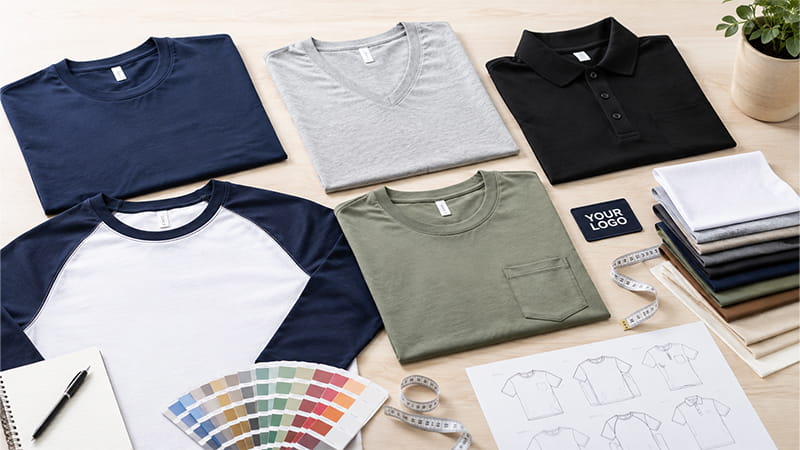
T-shirts may look simple, but neckline, fit, sleeves, fabric, weight, and construction can create very different garments. A regular event tee, oversized merchandise shirt, polo, and performance tee solve different needs. This guide compares the main types of T-shirts and shows how to choose the right style for casual wear, branding, events, and custom orders.
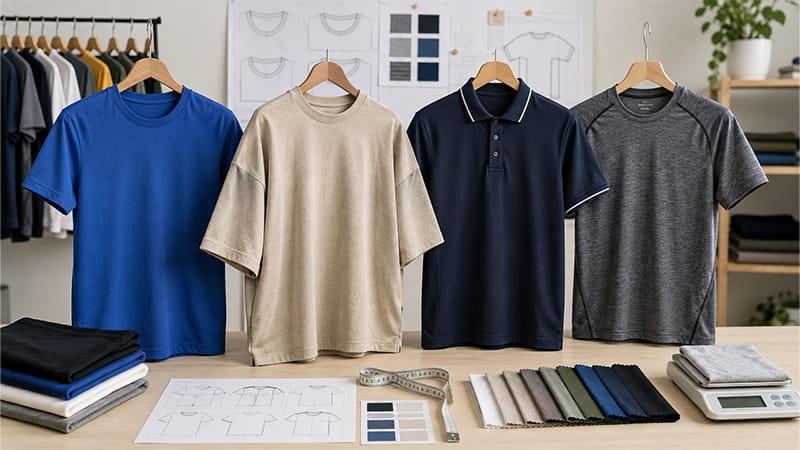
What Are the Main Types of T-Shirts?
There is no single way to classify every T-shirt. Some names describe the neckline. Others refer to the fit, sleeves, construction, fabric, or intended use.
Here are 20 common types of T-shirts:
| T-Shirt Type | Main Difference | Common Use |
|---|---|---|
| Crew neck | Classic round neckline | Events, staff, merchandise |
| V-neck | V-shaped neckline | Casual and lifestyle apparel |
| Henley | Button placket without a collar | Lifestyle merchandise |
| Polo | Collar and button placket | Corporate and hospitality |
| Scoop/U-neck | Wider rounded neckline | Fashion and casual wear |
| Regular fit | Balanced standard silhouette | General bulk orders |
| Slim/fitted | Closer body fit | Retail and fashion |
| Relaxed fit | More ease than regular | Casual wear and merchandise |
| Oversized | Deliberately enlarged proportions | Streetwear and merchandise |
| Boxy | Wider, straighter silhouette | Fashion merchandise |
| Cropped | Shorter body length | Fashion and fitness |
| Longline | Extended body length | Fashion and streetwear |
| Babydoll | More shaped silhouette | Fashion-focused collections |
| Short sleeve | Standard short sleeves | Everyday and promotional use |
| Long sleeve | Full-length sleeves | Cooler-weather programs |
| Raglan/baseball | Diagonal sleeve construction | Sports and casual events |
| Sleeveless/tank | No conventional sleeves | Fitness and summer events |
| Ringer | Contrast collar and sleeve rib | Retro merchandise |
| Pocket tee | Chest pocket | Casual and lifestyle programs |
| Performance tee | Designed for active use | Sports and outdoor events |
A Better Way to Classify T-Shirts
Lists of different types of T-shirts can become confusing because these categories often overlap.
One garment, for example, could be:
Oversized + Heavyweight + Crew Neck + Graphic
Each term describes a different characteristic:
| Dimension | Example |
|---|---|
| Neckline | Crew neck |
| Fit | Oversized |
| Sleeve / construction | Short sleeve |
| Fabric / weight | Heavyweight cotton |
| Decoration / use | Graphic merchandise |
A clearer way to compare T-shirt varieties is:
Neckline + Fit + Sleeve/Construction + Fabric/Function + Decoration
This framework also makes custom sourcing easier. Asking for an “oversized T-shirt” still leaves the fabric, weight, color, construction, and decoration undefined.
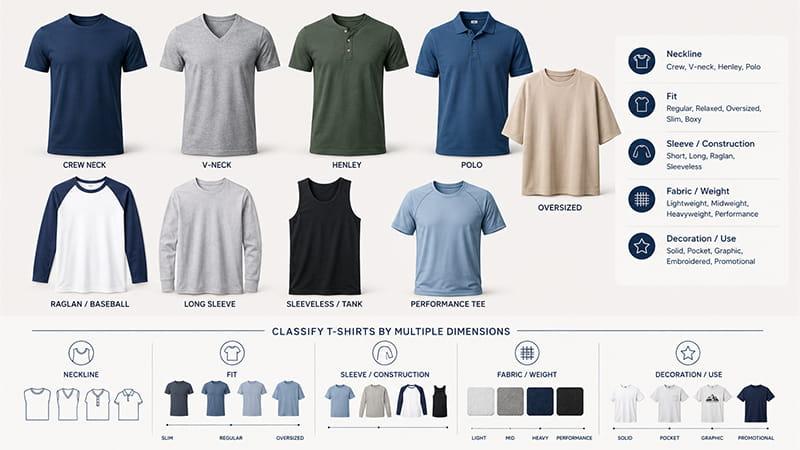
Types of T-Shirts by Neckline
Crew Neck T-Shirt
The crew neck T-shirt has a close, round neckline and remains one of the most familiar T-shirt styles.
Its simple shape works across everyday wear, employee apparel, promotional events, branded merchandise, and other broad-use programs. The uninterrupted front also leaves useful space for larger graphics.
“Crew neck” describes the neckline. It does not tell you whether the shirt is lightweight or heavyweight, regular or oversized, basic or premium.
For a buyer comparing several crew neck T-shirts, fabric, fit, measurements, and construction matter just as much as the round neckline itself.
V-Neck T-Shirt
A V-neck T-shirt replaces the round opening with a V-shaped neckline.
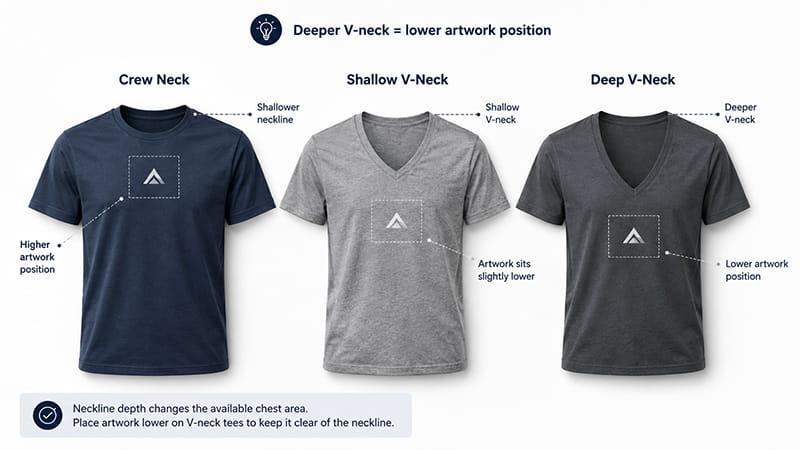
The V can be shallow or much deeper, so different V-neck T-shirts can look quite different even when the rest of the garment is similar.
For custom apparel, neckline depth also affects artwork placement. A deep V leaves less space at the upper chest, so artwork positioned for a crew neck should not automatically be copied onto a V-neck T-shirt.
Henley T-Shirt
A Henley T-shirt normally combines a collarless neckline with a short button placket.
That small construction detail gives it more character than a basic crew neck and makes Henley T-shirts useful for lifestyle merchandise and premium casual collections.
The placket also takes up center-chest space. Large front graphics may need to sit lower, move off-center, or shift to the back.
Polo Shirt
Polo T-shirts use a collar and button placket, creating a more structured appearance than a basic tee.
They are common for:
- corporate staff;
- trade shows;
- hospitality teams;
- sales staff;
- customer-facing events.
Smaller chest logos and embroidery often work naturally with the cleaner shape of polo shirts.
For projects where polo construction matters, the TOMAS guide to types of polo shirts compares options for uniforms, teams, events, and golf.
Scoop or U-Neck T-Shirt
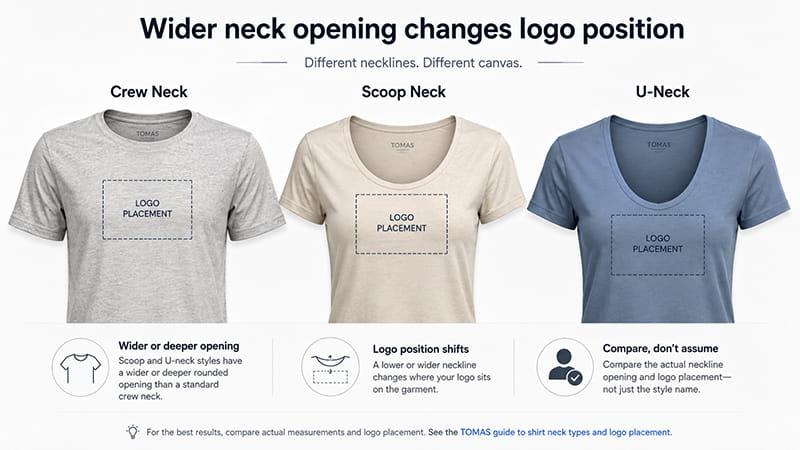
A scoop or U-neck T-shirt has a wider or deeper rounded opening than a standard crew neck T-shirt.
These styles appear more often in fashion, lifestyle, and audience-specific collections than in broad promotional programs.
If the neckline is an important design decision, compare the actual opening and logo position instead of relying on the style name alone. The TOMAS guide to shirt neck types and logo placement provides a more detailed neckline comparison.
Types of T-Shirts by Fit and Silhouette
Fit can change a T-shirt as much as its fabric or neckline. Two crew neck T-shirts made from similar cotton can still look completely different because their patterns use different proportions.
Regular or Classic-Fit T-Shirt
A regular T-shirt uses balanced proportions through the chest, body, shoulders, and sleeves.
That familiar shape makes it a practical starting point for staff uniforms, event shirts, giveaways, university programs, and projects where one style has to work across a broad group.
For mixed-size orders, a regular fit can also be easier to manage than a highly shaped style. The size chart still matters, but the silhouette is less specialized.
Slim or Fitted T-Shirt
A slim or fitted T-shirt follows the body more closely and normally provides less ease through areas such as the chest, waist, and sleeves.
This can work well for retail and fashion-focused collections, but sizing needs more attention when the garments will be distributed across a mixed group.
A medium fitted tee will not necessarily fit like a medium regular tee. Check the actual measurements before approving the style.
Relaxed-Fit T-Shirt
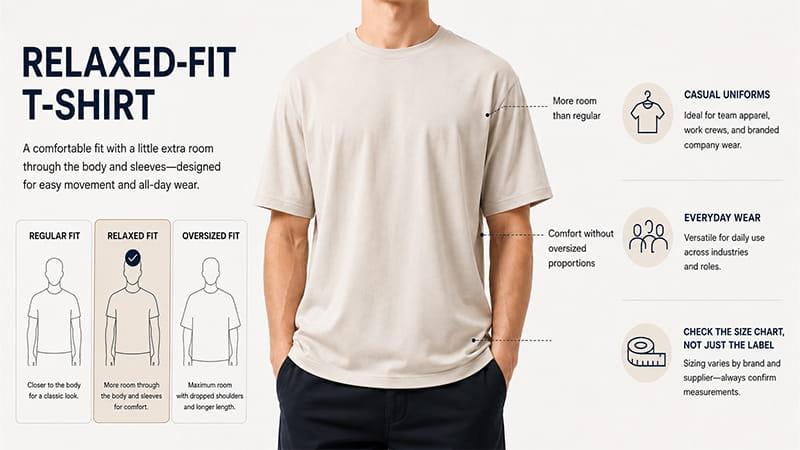
A relaxed-fit T-shirt gives the wearer more room than a regular fit without creating the deliberately enlarged proportions of an oversized tee.
It suits casual uniforms, everyday wear, and lifestyle merchandise where comfort matters but a full streetwear silhouette is unnecessary.
Supplier terminology is not always consistent. When “relaxed” and “oversized” appear in a catalog, the size chart is more useful than the label alone.
Oversized T-Shirt
An oversized T-shirt is not simply a regular T-shirt ordered one or two sizes larger.
A true oversized pattern may change several proportions together:
- shoulder position;
- body width;
- sleeve width and length;
- armhole shape;
- garment length;
- overall pattern balance.
Those changes create the intended silhouette instead of simply enlarging every measurement.
Oversized T-shirts are common in streetwear, music merchandise, youth-oriented campaigns, fashion brands, and branded retail collections. The broader front and back can also support larger graphics.
Boxy T-Shirt
A boxy T-shirt generally emphasizes a wider, straighter body and may use shorter proportions.
An oversized tee usually creates more overall volume through the shoulders, body, or sleeves. A boxy tee focuses more on the squared silhouette.
Photos do not always show this difference clearly. If the silhouette is central to the project, compare actual measurements and a physical sample.
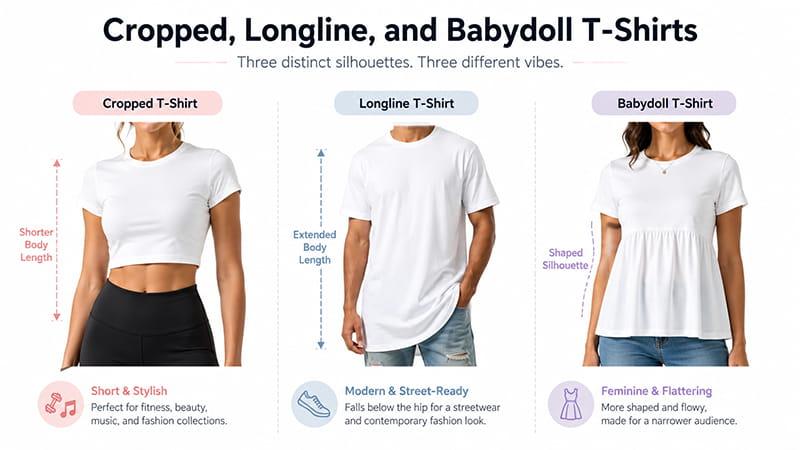
Cropped, Longline, and Babydoll T-Shirts
These styles serve more specific fashion audiences.
A cropped T-shirt uses a shorter body and often appears in fitness, beauty, music, and fashion collections.
A longline T-shirt extends below conventional tee proportions and is more closely associated with fashion and streetwear.
A babydoll T-shirt uses a more shaped silhouette and usually targets a narrower audience.
They can work well when the silhouette is part of the product concept, but regular and relaxed fits are generally easier to manage for broad staff or event programs.
T-Shirt Types by Sleeves and Construction Details
Short-Sleeve T-Shirt
The short-sleeve T-shirt is the standard form most people associate with a basic tee.
It works across casual wear, company events, promotional campaigns, staff apparel, and merchandise. The straightforward shape also offers flexible front, back, chest, and sometimes sleeve branding areas.
Long-Sleeve T-Shirt
Long-sleeve T-shirts provide more coverage and suit cooler conditions or programs where short sleeves are less practical.
The sleeves also create another branding area for logos, sponsor names, event details, or secondary graphics.
Usable space depends on sleeve width, taper, cuff construction, and the decoration method.
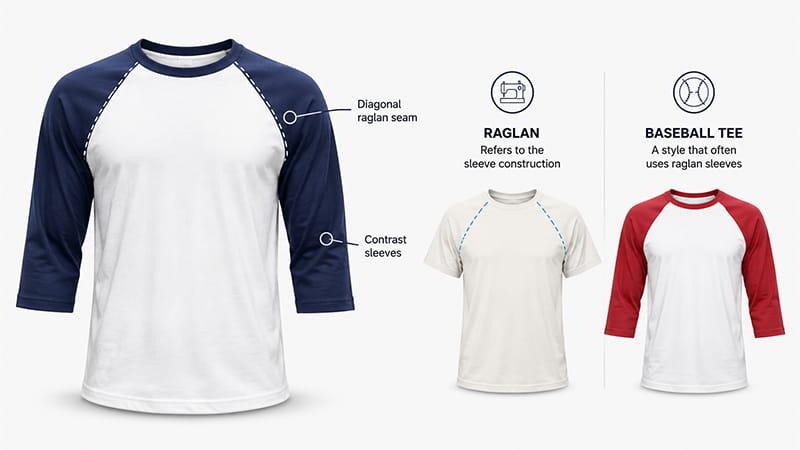
Raglan / Baseball T-Shirt
Raglan sleeve T-shirts use a diagonal seam running from the neckline toward the underarm instead of a conventional shoulder seam.
This construction creates a recognizable athletic appearance and is common in sports-inspired and casual wear. Contrast sleeves are also popular.
Baseball tees frequently use raglan sleeves, but the terms are not identical. Raglan describes the sleeve construction, while baseball tee describes a style that often uses it.
Sleeveless T-Shirt / Tank Top
Sleeveless T-shirts and tank tops are common for fitness, running, summer promotions, beach programs, and other warm-weather activities.
Removing the sleeves gives the arms more freedom but also removes a possible sleeve branding area.
Armhole shape matters as well. A deep athletic cut can fit very differently from a more conventional sleeveless shirt.
Ringer T-Shirt
A ringer T-shirt normally combines a contrasting collar rib with matching contrast sleeve openings.
The result has a recognizable retro, collegiate, or team-inspired appearance.
If the rib and body use different fabrics or colors, confirm the final combination on a physical sample. Small material and dye differences can change how the parts look together.
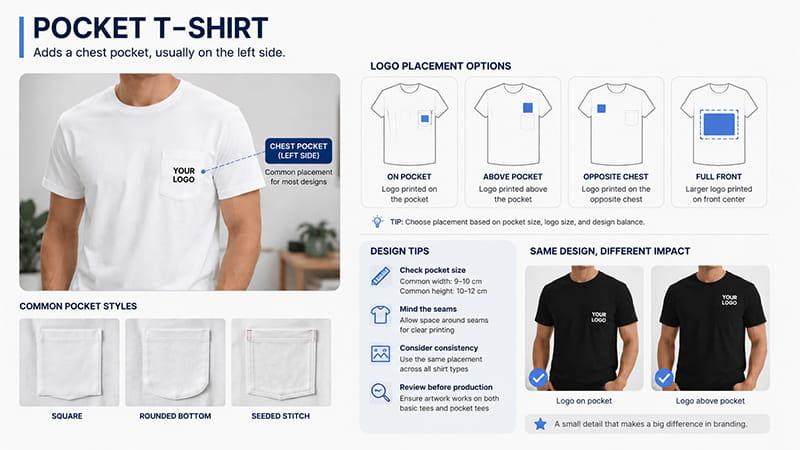
Pocket T-Shirt
A pocket T-shirt adds a chest pocket, usually on the left side.
The pocket sounds like a small detail until a logo needs to go in the normal left-chest position. Artwork may need to sit on the pocket, above it, on the opposite chest, or somewhere else entirely.
Check the pocket dimensions and seams before approving the artwork. This matters even more when the same design will be used across both basic tees and pocket T-shirts.
For more detailed positioning decisions, the TOMAS T-shirt logo placement guide covers front, back, chest, sleeve, and polo applications.
T-Shirt Types by Fabric, Weight, and Function
Fabric affects hand feel, drape, opacity, structure, comfort, decoration, and cost. No single fiber or fabric weight defines the overall quality of a finished T-shirt.
Cotton T-Shirts
Cotton tees are widely used for casual wear, merchandise, employee apparel, events, and promotional programs.
Depending on yarn, knitting, finishing, and garment construction, cotton T-shirts can range from light and soft to dense and structured.
“100% cotton” is a fiber specification, not a quality grade. Two cotton shirts can feel and perform very differently.
Polyester and Performance T-Shirts
Polyester is common in performance tees, marathon shirts, sports apparel, gym wear, and outdoor programs.
Performance fabrics may be designed around quicker drying, airflow, stretch, or moisture management. Those properties depend on the complete textile construction and finishing, not simply the fiber name.
A useful distinction is:
Polyester describes a fiber. Performance describes what the garment is expected to do.
A polyester T-shirt is not automatically a performance shirt.
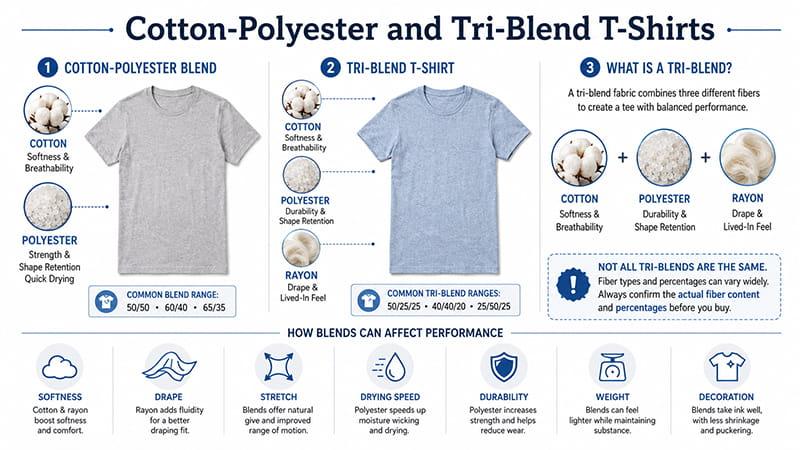
Cotton-Polyester and Tri-Blend T-Shirts
Blended fabrics combine fibers to change how a garment feels or behaves.
Depending on the composition, a blend may affect:
- softness;
- drape;
- stretch;
- drying speed;
- durability;
- weight;
- decoration behavior.
A tri-blend T-shirt contains three fiber types, but there is no single universal tri-blend formula. Buyers should confirm the actual percentages instead of assuming them from the name.
Lightweight, Midweight, and Heavyweight T-Shirts
Fabric weight is commonly expressed in GSM, or grams per square meter.
A heavier fabric may feel more structured and opaque. A lighter fabric may feel cooler and drape more easily.
But:
GSM measures fabric weight. It does not measure overall T-shirt quality.
Quality also depends on factors such as:
- yarn;
- knitting;
- finishing;
- stitching;
- pattern consistency;
- shrinkage control;
- intended use.
A lightweight event tee and a heavyweight streetwear shirt solve different problems. More GSM is not automatically better.
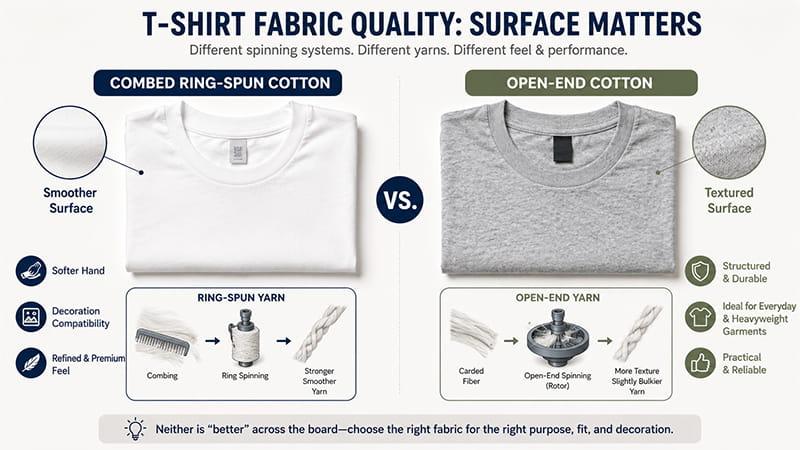
Combed Ring-Spun vs. Open-End Cotton: Why Surface Matters
Yarn processing changes the final fabric surface.
The textile education platform CottonWorks, developed by Cotton Incorporated, explains how different spinning systems create different yarn structures and characteristics.
Combed and ring-spun cotton is commonly associated with a smoother surface and softer hand. Open-end cotton can have a more textured or structured character and is used in many practical and heavyweight garments.
Neither term should be treated as a complete quality verdict. The finished shirt still needs to be judged for hand feel, structure, fit, and decoration compatibility.
Quick Comparison: Which T-Shirt Type Should You Choose?
There is no single best T-shirt style for every project. These are useful starting points:
| Project | Recommended Starting Type | Why | Branding Note |
|---|---|---|---|
| Event giveaway | Regular crew neck | Familiar fit for broad groups | Large front/back print area |
| Company staff | Crew neck or polo | Can match different formality levels | Polo suits smaller chest branding |
| Trade show / hospitality | Polo | More structured presentation | Keep branding clear and visible |
| Marathon / sports | Performance tee | Better suited to active use | Test decoration on actual fabric |
| Fashion merchandise | Oversized or heavyweight tee | Stronger retail positioning | Larger graphics can suit the silhouette |
| Music festival | Oversized / graphic tee | Strong visual presence | Front and back graphics work well |
| Employee gift | Heavyweight tee or polo | More substantial feel | Subtle branding can feel more premium |
| Summer promotion | Lightweight crew or sleeveless tee | Better suited to warm conditions | Balance comfort with logo visibility |
These are starting recommendations rather than fixed rules. Audience, climate, budget, artwork, fit, and distribution can all change the final choice.
How T-Shirt Style Affects Custom Printing and Branding
Garment Shape Changes the Available Decoration Area
Logo placement depends partly on the garment itself.
A crew neck T-shirt provides a relatively clear chest panel, while other styles create different boundaries:
- a deep V-neck reduces upper-chest space;
- a Henley or polo has a center placket;
- a pocket occupies common left-chest logo space;
- raglan seams can cross shoulder or sleeve graphics;
- cropped tees reduce vertical front space;
- long sleeves create extra branding areas.
The useful rule is simple:
Choose the garment and decoration area together rather than treating them as separate decisions.
This matters even more when the same artwork needs to work across several types of T-shirts.
Fabric Affects Decoration Behavior
Once the garment is selected, make sure the decoration method suits the exact fabric and finish.
Common options include:
- screen printing;
- DTG;
- DTF;
- dye sublimation;
- embroidery.
A smooth cotton surface, polyester performance fabric, and cotton-poly blend can behave differently during decoration.
Brother’s DTG guidance explains that cotton type and surface characteristics can affect the final printed result. This is one reason decoration should be checked on the chosen garment when print quality matters.
For a broader comparison of screen printing, DTG, DTF, sublimation, and related processes, see the TOMAS guide to T-shirt printing methods.
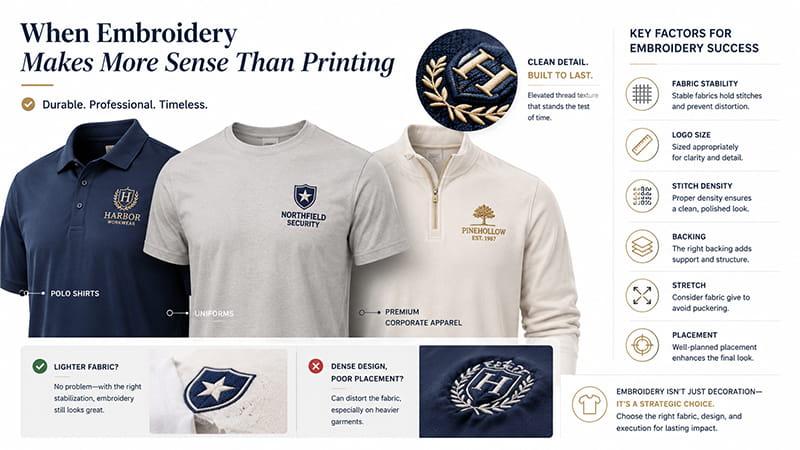
When Embroidery Makes More Sense Than Printing
Embroidery is often considered for polo T-shirts, uniforms, smaller chest logos, and premium corporate apparel.
Fabric weight alone does not determine whether embroidery will work well.
Also check:
- fabric stability;
- logo size;
- stitch density;
- backing;
- stretch;
- placement.
A lighter shirt may still accept embroidery with suitable artwork and stabilization. A dense design can also distort a poorly planned area on a heavier garment.
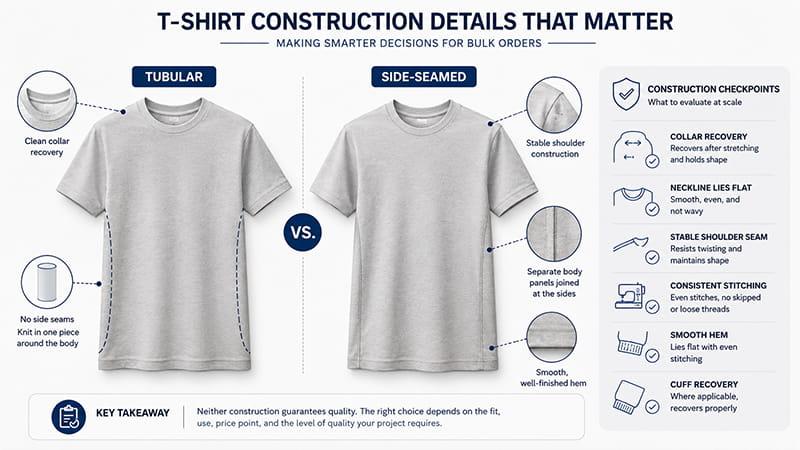
Construction Details That Matter in Bulk T-Shirt Orders
Tubular vs. Side-Seamed T-Shirts
Tubular and side-seamed construction are sometimes used as quick quality labels. That is too simple.
Tubular T-shirts can be produced without conventional side seams around the body and are common among many basic and blank tees.
Side-seamed T-shirts use separate body panels joined at the sides. This can give pattern makers more control when a design requires a particular fitted or engineered silhouette.
Neither construction automatically determines quality.
Tubular construction does not automatically mean poor quality, and side seams do not automatically guarantee better dimensional stability.
Final results also depend on knitting, fabric preparation, cutting, sewing, finishing, shrinkage control, and laundering.
For a buyer, the more useful question is whether the chosen construction produces the fit, shape, consistency, and branding area required for the project.
Collar, Shoulder, and Hem Construction
Small construction details become more noticeable when hundreds or thousands of shirts use the same specification.
Check whether:
- the collar recovers after stretching;
- the neckline lies flat;
- shoulder construction feels stable;
- stitching is consistent;
- hems lie smoothly;
- cuffs recover properly where applicable.
There is no single collar or seam formula that works for every T-shirt. The construction should match the intended fit, use, price level, and quality requirement.
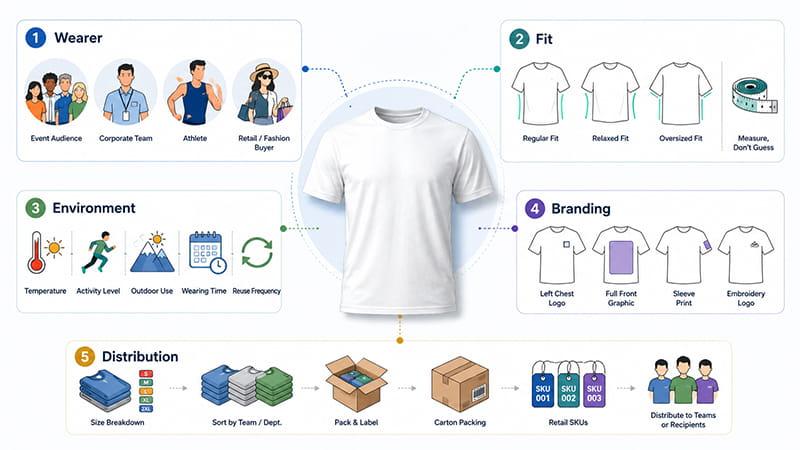
How to Choose the Right T-Shirt for Your Project
Start With the Wearer
Start with the person who will actually receive or buy the shirt.
A broad event audience, corporate team, athlete, retail customer, and fashion merchandise buyer do not necessarily need the same fit or fabric.
Getting this decision right can eliminate unsuitable options before smaller specifications become a distraction.
Match the Fit to the Audience
Regular and relaxed fits are often easier to manage across broad groups.
For fashion merchandise, the silhouette itself may be part of the product. An oversized, fitted, or boxy cut can therefore carry much more design value.
Do not rely only on S, M, L, and XL labels. Compare actual garment measurements because the same size name can fit differently between patterns.
Consider the Wearing Environment
Think about how the garment will really be used:
- temperature;
- activity level;
- expected wearing time;
- required appearance;
- frequency of reuse.
A T-shirt that photographs well is not automatically the right choice for an eight-hour outdoor event or a uniform worn every week.
Decide the Branding Area Before Finalizing the Shirt
Large graphics, small chest logos, sleeve prints, and embroidery all need different amounts and shapes of space.
Garment selection and artwork planning should therefore happen together.
If the artwork already exists, place it on the actual garment template or sample before the T-shirt style is locked.
Consider How the Shirts Will Be Distributed
Distribution is often considered too late.
A bulk order may need to be:
- sorted by employee or department;
- distributed according to event registration sizes;
- packed as retail SKUs;
- separated by team;
- prepared for open giveaways.
Those decisions can affect size breakdown, labeling, sorting, individual packaging, and carton packing before production is finished.
What Buyers Should Confirm Before Ordering Custom T-Shirts in Bulk
“I need 1,000 custom T-shirts” sounds specific, but it still leaves many production variables unanswered.
A useful specification should include:
| Specification | What to Confirm |
|---|---|
| Style | Crew, polo, oversized, performance, etc. |
| Fit | Regular, fitted, relaxed, oversized |
| Fabric | Fiber composition |
| Fabric weight | GSM or oz if required |
| Construction | Tubular / side-seamed if relevant |
| Color | Final garment colors |
| Size range | Required sizes |
| Total quantity | Overall order quantity |
| Size breakdown | Quantity per size |
| Color breakdown | Quantity per color |
| Artwork | Final logo or graphic |
| Placement | Front, back, chest, sleeve, etc. |
| Decoration | Printing, embroidery, etc. |
| Sample | Required approval sample |
| Packing | Standard or custom sorting |
| Destination | Country or warehouse |
| Required date | Delivery target |
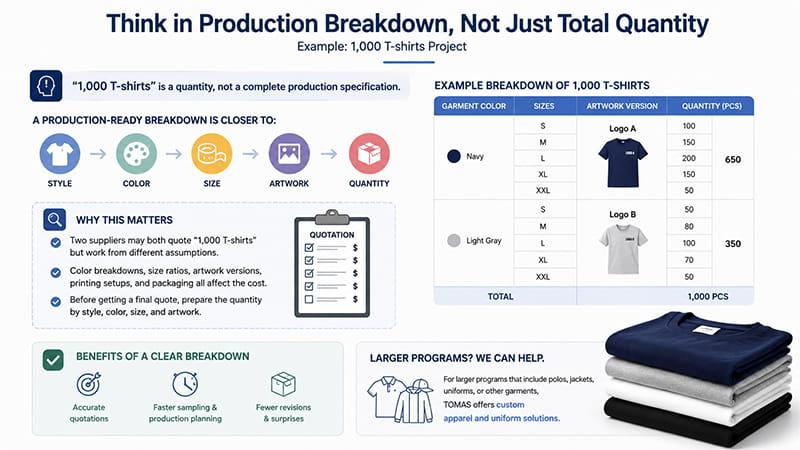
One common sourcing mistake is treating total quantity as if it were already a production breakdown.
“1,000 T-shirts” is a quantity, not a complete production specification.
A production-ready breakdown is closer to:
Style → Color → Size → Artwork → Quantity
Consider a 1,000-piece project divided between two garment colors, five sizes, and two artwork versions. The total remains 1,000 pieces, but the factory is no longer producing one identical item. Each combination needs to be identified correctly for production and packing.
This matters when buyers compare quotations. Two suppliers may appear to quote the same “1,000 T-shirts” while working from different assumptions about color breakdowns, sizes, artwork versions, printing setups, or packing.
Before requesting a final quotation, it is better to prepare the quantity by style, color, size, and artwork. That gives both sides the same reference and reduces revisions once sampling or production planning begins.
For larger programs that include polos, jackets, uniforms, or other garments, TOMAS also offers custom apparel and uniform solutions.
What to Test Before Approving Bulk Production
Check Fit, Measurements, and Garment Shape
Compare the physical sample with the approved requirements.
Check:
- key measurements;
- intended fit;
- shoulder position;
- sleeve proportion;
- neckline shape;
- seams;
- hems;
- cuffs where applicable.
A size chart gives numbers. It does not fully show how an oversized tee drapes or how a fitted shirt feels when worn.
For an order with several sizes, do not assume that approving one size proves the entire size range is correct. Review the supplier’s grading and identify any sizes that deserve an additional measurement check before bulk production.
Check Shrinkage and Fabric Behavior
Shrinkage should be handled as a project specification rather than a percentage copied from another garment.
Confirm:
- the required tolerance;
- how testing will be carried out;
- relevant washing and drying conditions;
- whether measurements remain acceptable afterward.
For formal testing, AATCC TM150 provides a standardized method for evaluating dimensional changes in garments after home laundering.
That is a better basis for quality control than assuming one shrinkage number should apply to every type of T-shirt.
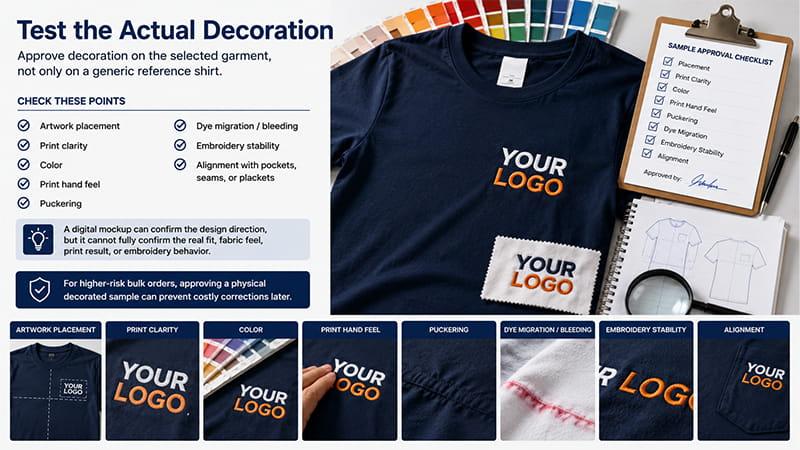
Test the Actual Decoration
Approve decoration on the selected garment, not only on a generic reference shirt.
Check:
- artwork placement;
- print clarity;
- color;
- print hand feel;
- puckering;
- dye migration or bleeding where relevant;
- embroidery stability;
- alignment with pockets, seams, or plackets.
A digital mockup can confirm the design direction, but it cannot fully confirm the real fit, fabric feel, print result, or embroidery behavior.
For higher-risk bulk orders, approving a physical decorated sample can prevent a much more expensive correction after production.
Common Mistakes When Choosing T-Shirt Types for Custom Orders
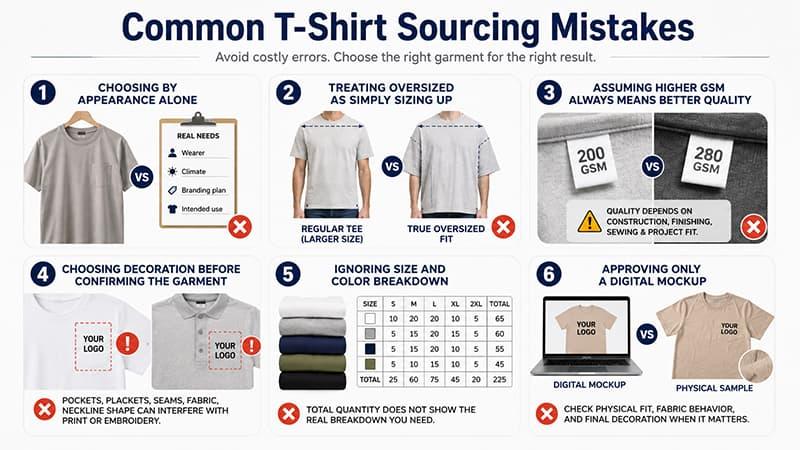
Choosing by appearance alone. A good product photo does not prove that the T-shirt will suit the wearer, climate, branding plan, or intended use.
Treating oversized as simply sizing up. An oversized pattern can change shoulder, body, sleeve, and length proportions. Buying a larger regular T-shirt does not necessarily create the same silhouette.
Assuming higher GSM always means better quality. GSM describes fabric weight. Overall quality still depends on textile construction, finishing, sewing, and whether the garment suits the project.
Choosing decoration before confirming the garment. Pockets, plackets, seams, fabric, and neckline shape can all interfere with the intended print or embroidery area.
Ignoring size and color breakdown. The total quantity does not tell the supplier how many pieces are required for each size, color, and artwork version.
Approving only a digital mockup. A mockup is useful for artwork direction. Physical fit, fabric behavior, and final decoration still need to be checked when those details matter to the order.
Conclusion
The different types of T-shirts become easier to compare when the decision is separated into style, fit, fabric, construction, use, and decoration.
A regular crew neck T-shirt may work well for a broad event audience, while polo T-shirts, performance shirts, or oversized heavyweight tees solve very different needs.
The most popular T-shirt is not automatically the right T-shirt for every project. The better choice matches the wearer, environment, branding plan, quantity, budget, and distribution requirements.
Need Help Choosing T-Shirts for a Custom Project?
If you are preparing custom T-shirts for a company, event, sports program, merchandise collection, or promotional campaign, contact TOMAS Crafts with your intended use, preferred style, quantity, size range, artwork, destination, and required date.
TOMAS can help compare practical T-shirt styles, fabrics, decoration options, samples, packing, and bulk-production requirements before the order is finalized. For projects that extend beyond apparel, explore more TOMAS Crafts promotional product solutions.
FAQs
How Do I Choose the Right T-Shirt Type for My Event, Staff, or Merchandise?
Start with the wearer and the real use environment. Then compare fit, fabric, branding requirements, and budget.
A regular crew neck T-shirt can be a practical starting point for broad event groups. Polo T-shirts suit many structured corporate or hospitality programs. Performance tees are common for active projects, while oversized or heavyweight shirts often work better for fashion-focused merchandise.
These are starting points rather than universal rules. The right T-shirt should fit the people who will actually wear it.
What Fabric and GSM Should I Choose for Custom T-Shirts?
Choose fabric weight according to climate, opacity, drape, comfort, intended use, decoration, and budget.
A lighter fabric can make sense for a warm-weather event. A heavier fabric can provide more structure for premium merchandise.
GSM tells you how much the fabric weighs, not how good the finished T-shirt is. Yarn, knitting, finishing, sewing, shrinkage behavior, and the physical sample still matter.
How Can I Avoid Sizing, Shrinkage, and Print Problems in a Bulk T-Shirt Order?
Confirm the actual size chart, quantity breakdown, physical garment sample, relevant tolerances, and final decoration before bulk production.
If shrinkage, print appearance, or embroidery performance matters, test the selected garment rather than relying on a generic reference.
A digital mockup is useful for artwork approval, but production approval should also cover the physical details that the mockup cannot show.
What Information Should I Send a Supplier to Get an Accurate Custom T-Shirt Quote?
Provide the T-shirt style, fit, fabric, fabric weight if required, colors, size range, quantity by size and color, artwork, logo placement, decoration method, packing requirements, destination, and required delivery date.
“1,000 T-shirts” alone is not enough for an accurate production quotation.
The clearer the specifications are, the easier it becomes to compare quotations, prepare the right sample, and avoid changes after production planning has started.