
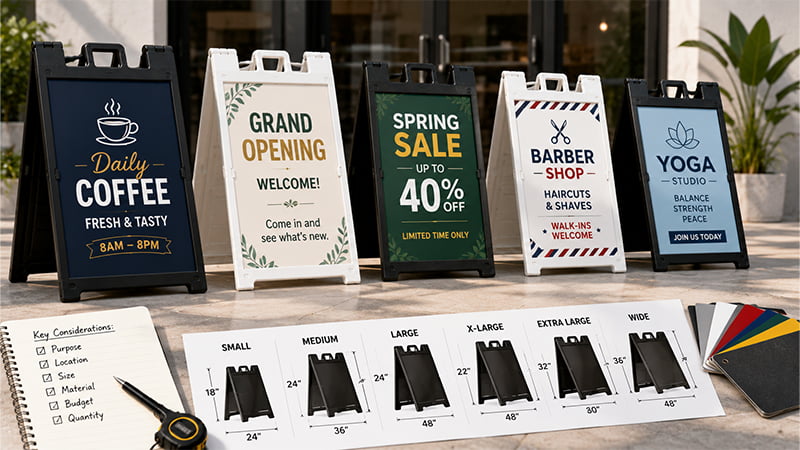
A-frame signs are used outside stores, restaurants, hotels, exhibitions, and event entrances. However, a listed A-frame size may describe only the printed insert, not the complete frame. This can cause covered artwork, insufficient space, or oversized cartons. This guide explains the dimensions, structures, artwork checks, and sourcing details buyers should confirm before ordering.
Quick Answer: What Is the Standard A-Frame Sign Size?
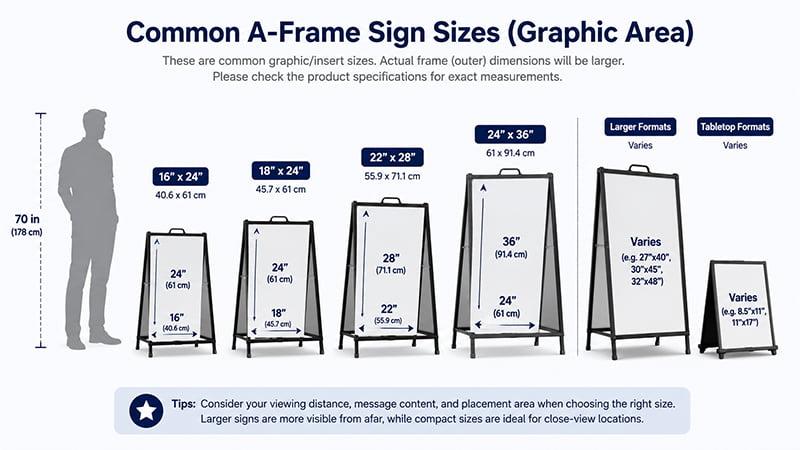
Common A-frame sign sizes include 16 × 24, 18 × 24, 22 × 28, and 24 × 36 inches. The 24 × 36-inch format is a common commercial choice for storefronts, restaurants, sidewalks, exhibitions, and event entrances.
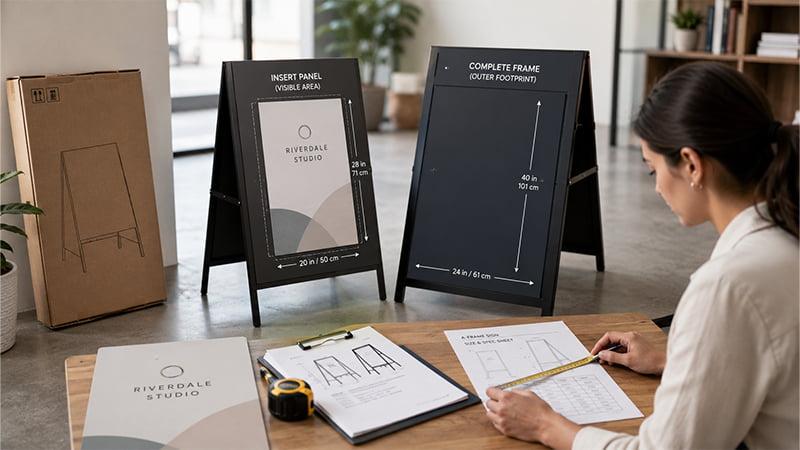
There is no universal standard for the complete A-frame size. A listed measurement may describe only the printed insert. Before ordering, confirm the visible area, outer dimensions, open depth, folded size, and compatible insert thickness.
Standard A-Frame Sign Size Chart
| Graphic or Nominal Size | Approx. Metric Size | Common Applications | Main Purchasing Check |
|---|---|---|---|
| 16 × 24 in | 40.6 × 61 cm | Indoor entrances, real estate signs, and narrow spaces | Outer dimensions and open depth |
| 18 × 24 in | 45.7 × 61 cm | Cafés, salons, reception areas, and small stores | Visible area and insert method |
| 22 × 28 in | 55.9 × 71.1 cm | Retail promotions, restaurants, and event directions | Frame-edge coverage |
| 24 × 36 in | 61 × 91.4 cm | Sidewalks, storefronts, exhibitions, and hotels | Complete footprint and packing size |
| Larger formats | Varies | Venue entrances, forecourts, and high-traffic areas | Stability, storage, and placement |
| Tabletop formats | Varies | Counters, hostess desks, and registration tables | Usable display area |
These figures may describe the printed graphic, insert, nominal product category, or complete frame. External dimensions, visible openings, panel thicknesses, and open footprints vary by model.
Two frames that accept the same insert size may still have different hardware dimensions, visible areas, opening angles, weights, and packing cartons. Never approve a placement plan or artwork file from the nominal size alone.
What Do A-Frame Dimensions Mean?
“A-frame dimensions” can refer to several separate measurements. Buyers, designers, and suppliers should identify each one before approving artwork or production.
Graphic Size, Insert Size, and Visible Area
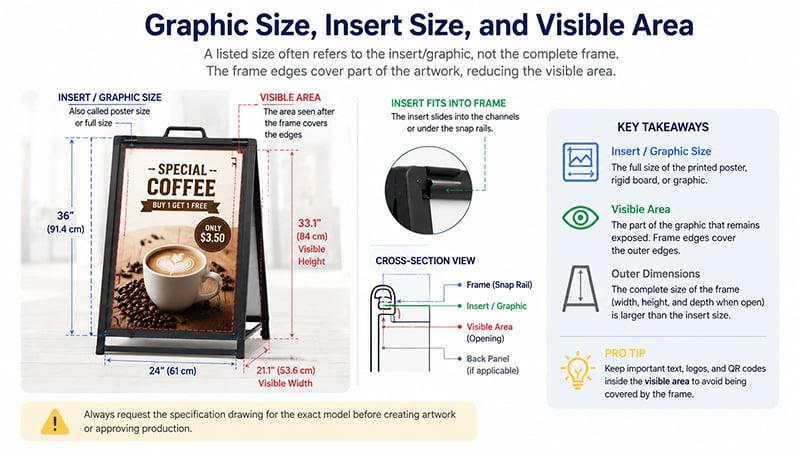
The graphic size is the full width and height of the printed poster, rigid board, adhesive graphic, or replacement panel.
The insert size describes the material that fits inside the frame’s channel, recessed opening, retaining clips, or snap rails. On some products, the graphic and insert have the same dimensions. This should still be verified against the selected model.
The visible graphic area is the part that remains exposed after installation. Several frame components can cover the outer edges of the artwork:
- Snap-open rails
- Frame lips
- Retaining tabs
- Insert channels
- Rounded corners
- Protective covers
A file may match the insert dimensions and still lose important content beneath the frame border. Keep headlines, prices, logos, arrows, contact details, and QR codes inside the confirmed safe area.
A 24 × 36-inch specification often describes the printed insert rather than the complete hardware. The full unit will usually be wider, taller, and deeper when opened. Always request the specification drawing for the exact model under review.
Outer Dimensions and Open Footprint
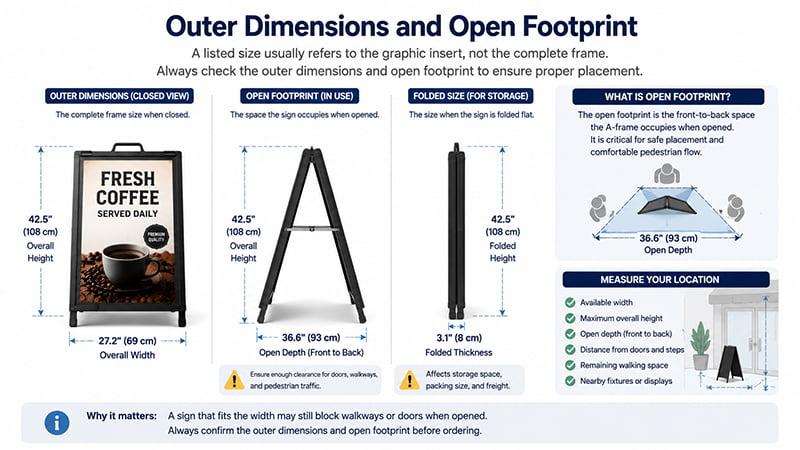
Suppliers may call the complete product measurements its overall, external, or outer dimensions. These figures include the frame borders, handle, feet, hinges, base, and support arms.
The outer dimensions show whether the sign fits its planned location. Check doorways, exhibition booths, restaurant entrances, reception areas, vehicles, and storage spaces before ordering.
The open footprint is equally important. An A-frame forms a triangular structure when opened, so it occupies front-to-back space as well as width. A model may fit the available storefront width but still extend too far into an aisle or pedestrian route.
Measure:
- Available width
- Maximum overall height
- Maximum open depth
- Distance from doors and steps
- Remaining walking space
- Nearby fixtures or displays
The open footprint matters most in areas with regular foot traffic, including retail stores, restaurants, hotels, exhibition halls, and event entrances.
Folded Size, Packing Dimensions, and Panel Compatibility
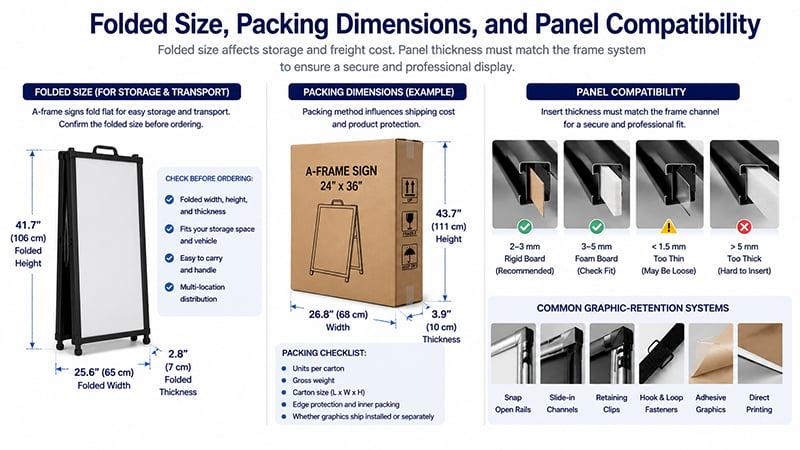
Folded dimensions affect daily storage, carton design, freight volume, and multi-location distribution. A low unit price may become less attractive when the folded structure requires a large export carton.
For bulk orders, confirm:
- Folded width, height, and thickness
- Units per carton
- Gross carton weight
- Whether frames can be nested
- Whether graphics ship installed or separately
- Whether cartons need location-specific labels
The insert thickness must also match the frame system. A thick panel may bind inside a channel. A thin panel may move, rattle, or fall out.
Common graphic-retention systems include slide-in channels, snap-open rails, retaining clips, hook-and-loop fasteners, adhesive graphics, direct printing, and posters beneath a protective cover.
The insert size, substrate, and thickness should be approved together. Matching the width and height alone does not guarantee that the graphic will fit correctly.
TOMAS Supplier Insight
A nominal frame size is not enough for artwork approval or bulk purchasing. When a buyer requests a “24 × 36-inch A-frame,” TOMAS Crafts first confirms whether the measurement refers to the insert or complete hardware. The frame, graphic, and packing specifications are then reviewed as one system.
| TOMAS Check | Why It Matters |
|---|---|
| Graphic size | Confirms the required printing and cutting dimensions |
| Visible opening | Prevents logos, arrows, and QR codes from being covered |
| Outer dimensions | Confirms the product fits the planned location |
| Open depth | Prevents the frame from extending too far into a walkway |
| Insert thickness | Prevents loose or incompatible printed panels |
| Replacement method | Shows whether staff can change campaigns easily |
| Folded carton size | Supports storage, freight, and distribution planning |
Two models may accept the same nominal graphic size but use different frame edges, hinge angles, footprints, and cartons. TOMAS Crafts therefore treats the hardware, printed graphic, and packing method as one complete display system.
Common A-Frame Sizes and Their Best Uses
The right size depends on the placement area, viewing conditions, message, and daily operating requirements.
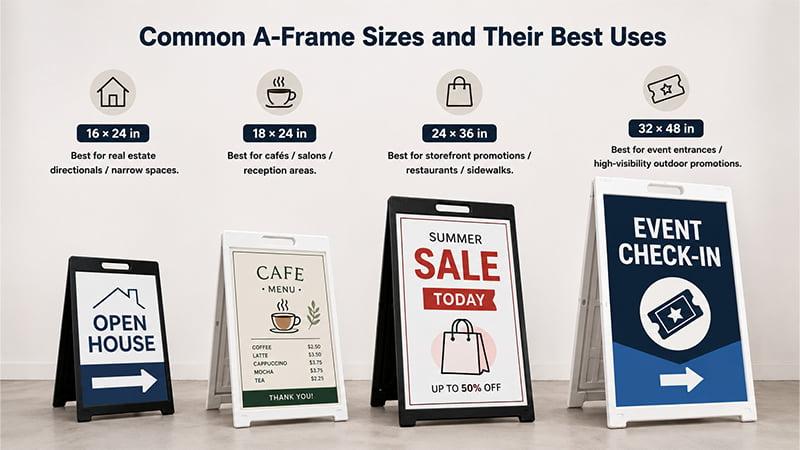
Compact A-Frames: 16 × 24 and 18 × 24 Inches
Compact A-frames suit close-view locations and narrow entrances. They work best with one short headline, one supporting message, and a simple price, offer, or direction.
These signs are easy to carry and store. They also fit well in reception areas, small retail entrances, cafés, salons, and indoor directional points.
Their main limitation is graphic space. A compact format is easier to overlook from a distance and should not carry a long menu, several offers, or detailed instructions.
Medium A-Frames: 22 × 28 Inches
A 22 × 28-inch A-frame offers more graphic space without the larger footprint of a 24 × 36-inch model.
It can hold a headline, short supporting message, logo, and CTA while remaining manageable for daily movement and storage. This balance makes it suitable for retail promotions, restaurant entrances, hotel directions, event registration, and pop-up activities.
Commercial A-Frames: 24 × 36 Inches
A 24 × 36-inch A-frame works well for storefront promotions, restaurant advertising, hotel entrances, exhibitions, event directions, grand openings, and seasonal campaigns.
This format supports larger typography and a clearer visual hierarchy. It can also provide space for a short supporting message or QR code without making the layout feel crowded.
The trade-offs are a larger open footprint, more storage space, higher shipping volume, and greater handling effort. These factors should be considered before choosing it for every location in a multi-store campaign.
Larger A-Frames and Tabletop Formats
Larger A-frames may suit venue entrances, forecourts, sports events, and locations with longer approach distances. However, increasing the graphic area also increases the surface exposed to wind.
Outdoor performance depends on the frame design, support system, ballast method, ground condition, and actual site exposure—not size alone.
Tabletop A-frames serve a different purpose. They are used at point-of-sale counters, hostess desks, registration tables, product displays, and QR-code stations. Confirm the usable display area because borders and holders can reduce the visible space.
TOMAS Crafts also explains other types of custom signs used for exhibitions, retail locations, events, and promotional campaigns.
How to Choose the Right A-Frame Size
An A-frame size chart provides a useful starting point. The final choice should reflect the location, message, and daily handling requirements.
Measure the Placement Area
Measure the exact location where the sign will stand instead of estimating from a product photograph.
Record the available width, maximum height, open depth, door clearance, nearby fixtures, pedestrian space, and ground condition.
Send the supplier a photograph with the measurements marked. It helps identify doors, steps, railings, counters, planters, and other obstacles that may affect placement.
Compare the supplier’s specification drawing with the marked placement measurements before selecting a model.
Match the Viewing Distance, Purpose, and Message
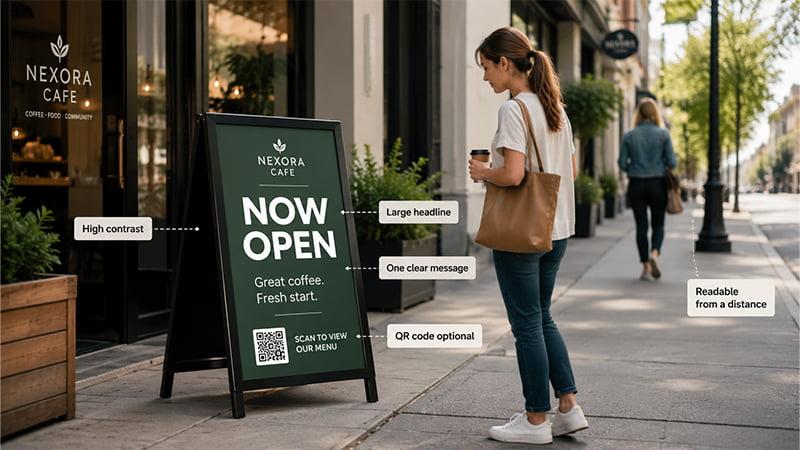
As viewing distance increases, the design needs larger text, fewer words, stronger contrast, and a simpler hierarchy.
There is no universal reading distance for one frame size. Readability also depends on the typeface, lighting, viewing angle, pedestrian speed, and surrounding visual clutter.
Give each A-frame sign one primary task. It may:
- Promote an offer
- Display a menu
- Direct visitors
- Show opening hours
- Identify a registration point
- Advertise an event
- Encourage QR-code scans
A directional sign should prioritize the destination and arrow. A promotional sign should lead with the offer. Several competing messages usually produce a crowded design.
A practical message hierarchy is:
- Main headline
- One supporting message
- Price, offer, or direction
- Optional CTA or QR code
A larger frame should improve readability, not provide an excuse to add more body copy.
Consider Handling, Storage, and Reorders
The selected A-frame sign must also work for the staff who move, store, and update it.
Confirm whether the sign will be moved indoors each evening, transported in a vehicle, folded after use, or stored in a limited space. Also check how often the message will change and whether several locations need identical hardware.
For frequently updated campaigns, a smaller frame with easy-change inserts may be more practical than a large unit that staff find difficult to operate.
A-Frame Types, Materials, and Graphic Systems
Two A-frames with similar listed dimensions can perform differently because of their materials and graphic-retention systems.
Plastic Sandwich Board A-Frames
Plastic sandwich boards often feature a molded handle, wide base, and rigid-insert or adhesive-graphic options. Some models accept water, sand, or separate weights.
They are commonly used by restaurants, retailers, service businesses, and event operators. Plastic does not rust, but outdoor suitability still depends on the complete frame and graphic system.
Their main purchasing disadvantage is often packing volume, especially for bulk international orders.
Metal Snap-Frame Signs
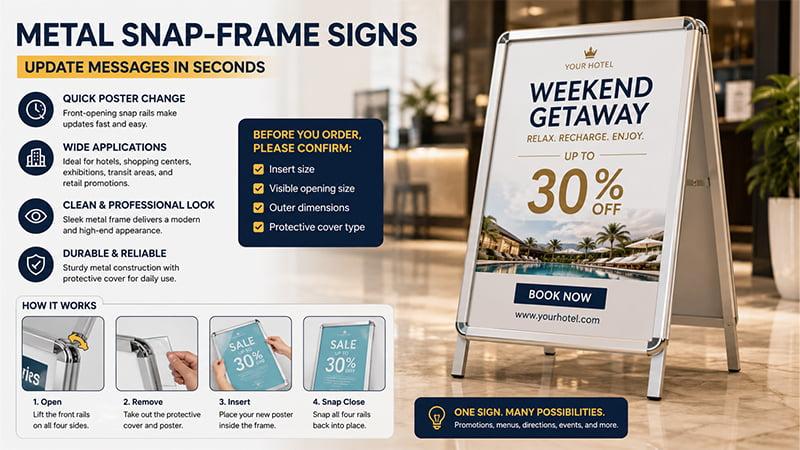
Metal snap frames use front-opening rails that allow posters to be replaced quickly. They suit hotels, shopping centers, exhibitions, transit areas, and retail campaigns that update messages regularly.
Their clean appearance works well in close-view environments. However, the metal edges may cover part of the poster. Buyers should confirm the insert size, visible opening, outer dimensions, and protective cover before ordering.
Folding and Writing-Surface A-Frames
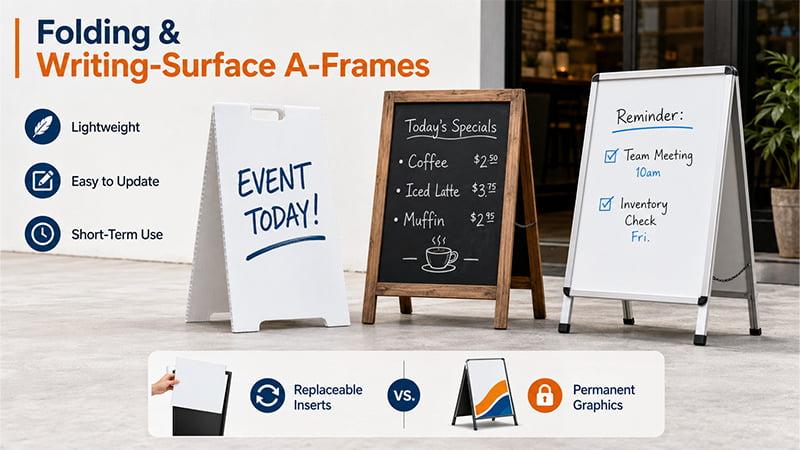
Corrugated plastic A-frames are lightweight and can pack relatively flat. They suit temporary events, registration areas, school activities, and short-term directional campaigns.
Their low weight can simplify handling and freight. Lightweight folding structures may need additional support when used outdoors.
Chalkboard and whiteboard A-frames work well for cafés, restaurants, hotels, and stores that update messages frequently. Confirm the usable writing area separately from the complete frame size.
Replaceable Inserts vs. Permanent Graphics
| Factor | Replaceable Insert | Permanent Graphic |
|---|---|---|
| Message changes | Easy to update | Requires reprinting or replacement |
| Repeat campaigns | More practical | Better for fixed messages |
| Installation | Insert system must be confirmed | Usually simpler |
| Critical specification | Size and thickness | Surface and adhesive compatibility |
| Future reorder | Graphics can be reordered separately | Full panels may need replacing |
For seasonal promotions, daily specials, and multi-stage campaigns, replaceable inserts are usually more practical. Permanent graphics suit long-term branding, fixed directions, and opening hours.
Artwork Setup and Production Approval
The hardware and printed graphic should be approved as one complete display system.
Use the Exact Supplier Template
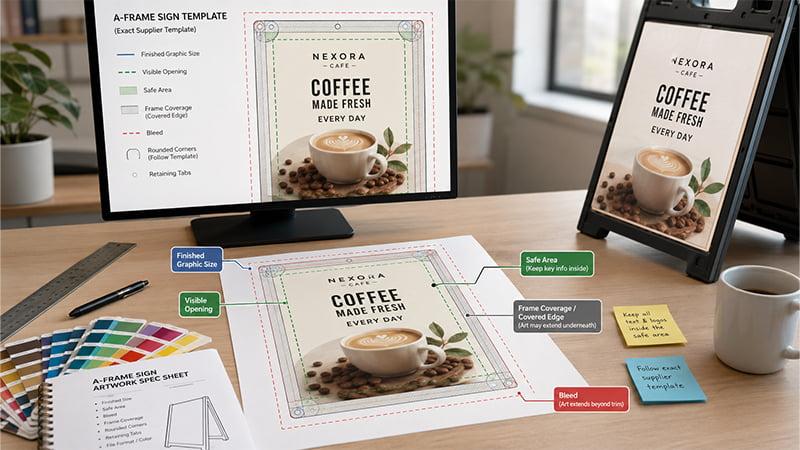
The production template should identify:
- Finished graphic size
- Visible opening
- Safe area
- Frame coverage
- Rounded corners
- Retaining tabs
- Bleed, where required
Do not prepare a generic 24 × 36-inch file before confirming the selected model. The exact supplier template should control the final artwork setup.
Confirm Safe Areas and Bleed
Keep logos, headlines, prices, arrows, contact details, and QR codes away from covered edges. The background may extend beneath the frame border, but essential information should stay inside the safe area.
Bleed requirements depend on the production method. Rigid inserts, adhesive vinyl, direct UV printing, covered posters, and full-surface panels may require different file setups.
As explained in Adobe’s official bleed guidance, bleed extends artwork beyond the final trim edge to help prevent unwanted white gaps after cutting. The exact bleed value should still follow the printer’s template.
Check Resolution, QR Codes, and Both Sides
Artwork created for social media, a website banner, or a small flyer may not remain clear when enlarged.
Check the resolution, small text, fine lines, contrast, image sharpness, QR-code position, and reflections from protective covers. Test the QR code from the expected viewing position instead of scanning it only on a computer screen.
Approve both sides separately when the sign uses directional arrows, different promotions, multiple languages, or location-specific artwork.
Review a Fully Assembled Sample
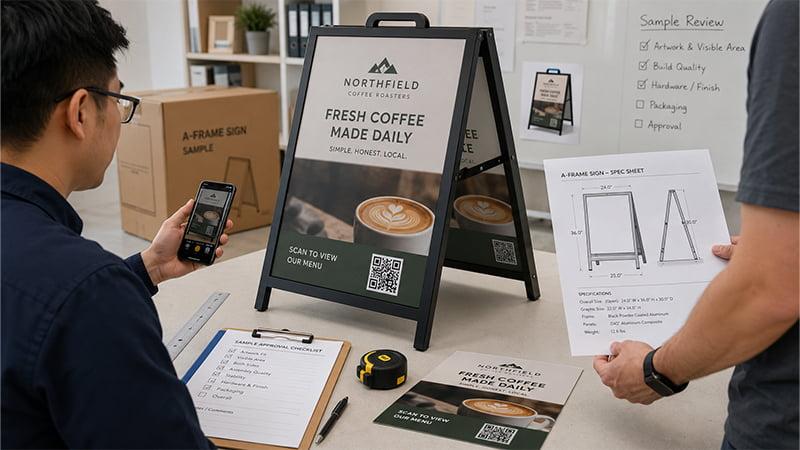
Before bulk production, TOMAS Crafts recommends checking one fully assembled sample. This is especially useful for replaceable inserts, double-sided artwork, and location-specific packing.
The sample review should cover:
- Insert fit
- Panel thickness
- Visible area
- Front and back orientation
- Opening and closing mechanism
- Graphic replacement process
- Frame workmanship
- Final packing method
A digital proof or printed panel alone cannot confirm whether the complete display functions correctly.
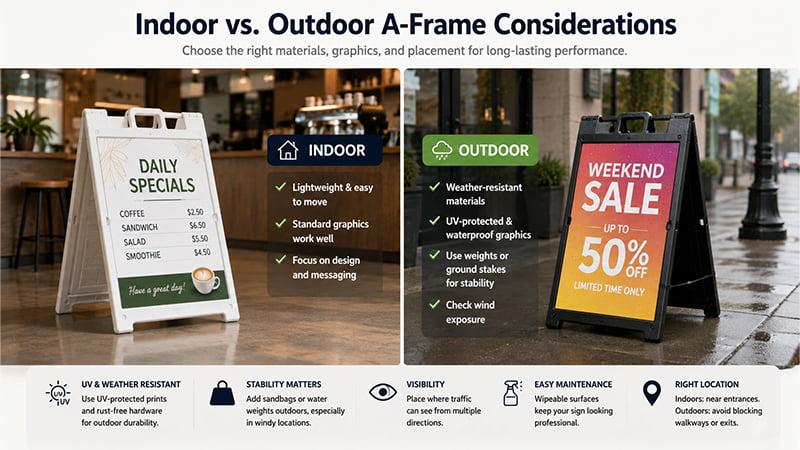
Indoor and Outdoor A-Frame Considerations
Stability, Footprint, and Ballast
Outdoor suitability depends on the base width, open depth, hinge system, support arms, frame weight, graphic surface, ground condition, and site exposure.
A heavier or larger sign is not automatically more stable. A larger graphic area may also receive more wind pressure.
Possible support methods include water or sand filling, separate weight bags, heavy bases, side stays, and support rods. Follow the instructions for the selected model rather than applying one product’s capacity to another.
Portable A-frames should be moved indoors during unsafe weather instead of being treated as permanent outdoor structures.
Weather Resistance and Double-Sided Use
A weather-resistant frame does not automatically make its printed insert suitable for prolonged outdoor exposure.
Confirm:
- Graphic substrate
- Ink system
- Water resistance
- UV exposure
- Edge sealing
- Protective cover
- Expected display period
Also confirm whether the quotation includes one printed face, two identical graphics, two different graphics, or two separate insert panels.
This is especially important for wayfinding signs because arrows may need to point in different directions on opposite sides.
Sidewalk, Property, and Venue Requirements
Before placement, buyers should review local permits, property rules, venue requirements, entrance clearance, emergency routes, and accessible pedestrian paths.
In the United States, the U.S. Access Board’s accessible-route guidance explains that an accessible route generally requires a minimum continuous clear width of 36 inches. Limited reductions and additional passing or turning requirements may apply.
This does not create one universal sidewalk-sign rule. Cities, properties, and venues may impose separate restrictions.
TOMAS Crafts can review the product footprint, but the buyer or venue operator should verify legal and site-specific placement requirements.
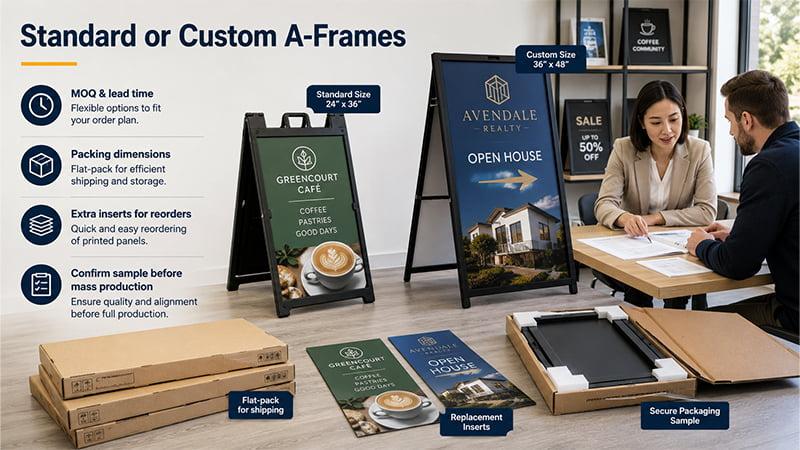
Standard or Custom A-Frames: MOQ, Packing, and Reorders
When to Choose a Standard or Custom Frame
A standard A-frame is normally more practical when the quantity is limited, faster production is required, the budget is controlled, or replacement inserts will be reordered.
Standard models also work well when several campaigns will reuse the same hardware. For lower-volume projects, existing hardware with custom graphics normally avoids the tooling, development time, and higher MOQ associated with fully custom structures.
A custom frame may make sense when:
- A special proportion is required
- Standard hardware cannot fit the location
- The structure must match a branded retail fixture
- A distinctive shape is central to the campaign
- Special accessories are required
- A recurring program supports development costs
Custom development can increase the MOQ, tooling cost, and sampling time. It may also affect carton size, freight, replacement parts, and future reorders.
A custom frame size should be approved only after the placement space, expected quantity, packing method, and reorder plan have been reviewed.
Packing and Multi-Location Distribution
Graphics may ship installed or separately.
Installed graphics reduce setup work and allow the complete unit to be inspected before shipment. They may require additional surface protection.
Separately packed graphics may reduce scratching and allow several campaigns to share the same hardware. They require clear installation instructions, accurate labels, and careful version control.
For multi-store or multi-event projects, confirm:
- Graphic versions
- Frame quantities
- Location labels
- Installation hardware
- Packing lists
- Delivery sequence
- Spare inserts
A-frame signs can also be coordinated with standard banner sizes, different banner styles, table covers, directional boards, lanyards, staff apparel, and event giveaways.
For campaigns involving booths, displays, branded merchandise, and visitor giveaways, review TOMAS Crafts’ trade show promotional solutions.
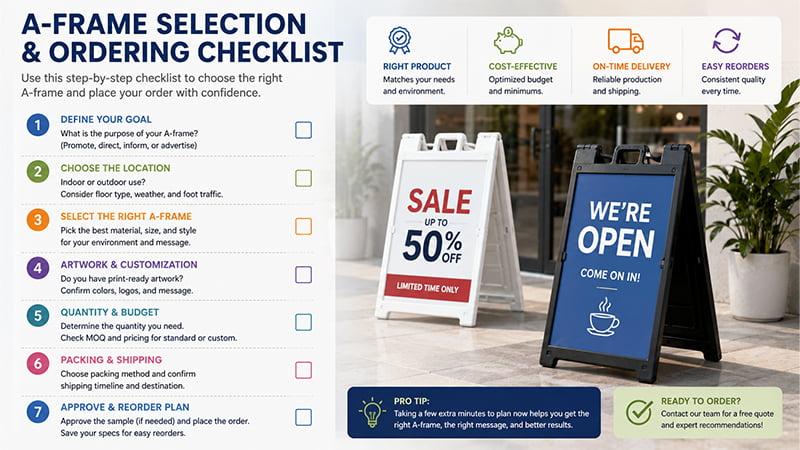
A-Frame Selection and Ordering Checklist
Quick Selection Flow
- Measure the placement area.
- Confirm the maximum open depth.
- Estimate the viewing distance.
- Define the sign’s main purpose.
- Select the frame structure.
- Check indoor or outdoor conditions.
- Confirm the graphic size, visible area, and outer dimensions.
- Request the exact artwork template.
- Review an assembled sample or proof.
- Confirm packing and delivery requirements.
Information Needed for a Quotation
Placement and Size
- Intended application
- Indoor or outdoor use
- Preferred A-frame size
- Maximum outer dimensions
- Maximum open depth
Frame and Artwork
- Preferred frame material or structure
- Replaceable insert or permanent graphic
- One- or two-sided printing
- Graphic material and thickness
- Artwork files
Order and Delivery
- Quantity
- Stability or ballast requirements
- Packing and labeling requirements
- Delivery deadline
- Shipping destination
- Related display or promotional products
Conclusion
Choosing the correct A-frame requires confirming the graphic size, visible area, outer dimensions, open footprint, and folded size as separate specifications. Buyers should also review panel compatibility, graphic replacement, placement conditions, and packing requirements before approving production.
For lower-volume or frequently updated campaigns, a standard frame with replaceable inserts is usually more practical. Custom hardware makes more sense when the available space, brand design, special accessories, or recurring order volume justifies additional development.
Need Help Confirming Your A-Frame Sign Specifications?
Share your placement area, preferred A-frame size, quantity, frame type, artwork, deadline, and shipping destination.
TOMAS Crafts can help confirm the complete specifications, compare standard and custom structures, and coordinate custom graphics, packing, banners, table covers, directional signs, bags, lanyards, and related event merchandise.
FAQs
What Is the Standard A-Frame Sign Size?
Common graphic sizes include 18 × 24, 22 × 28, and 24 × 36 inches. There is no universal complete frame size, so buyers should also confirm the visible area, outer dimensions, and open depth.
Is 24 × 36 Inches the Graphic Size or Complete Frame Size?
It usually refers to the printed insert. The complete hardware will normally be wider, taller, and deeper when opened.
How Do I Choose the Right A-Frame Size for a Sidewalk or Storefront?
Measure the available width and open depth first. Then consider viewing distance, message length, pedestrian space, daily handling, storage, and local placement rules.
What A-Frame Specifications Should I Confirm Before Ordering?
Confirm the graphic size, visible opening, outer dimensions, open depth, folded size, frame material, insert thickness, replacement method, printing sides, quantity, packaging, deadline, and shipping destination.