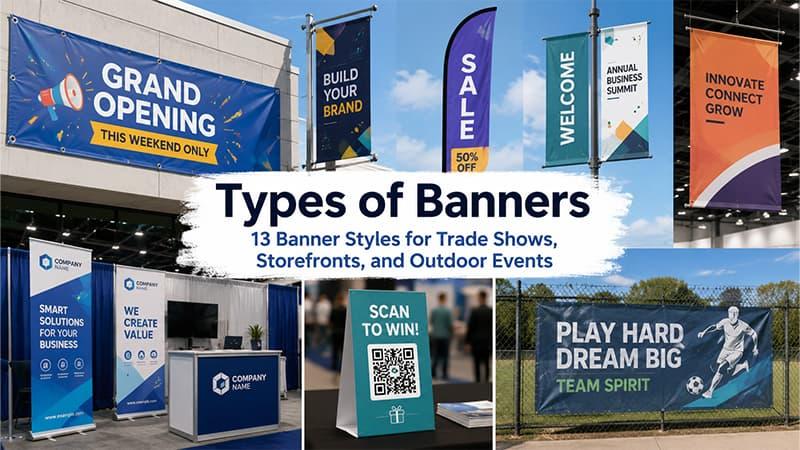
Banners are one of the most common display tools for trade shows, storefronts, schools, restaurants, hotels, sports venues, and promotional campaigns. But not every banner style works for every location. This guide explains the main types of banners, where each one works best, and how to choose the right option before ordering.
Quick Answer: What Are the Main Types of Banners?
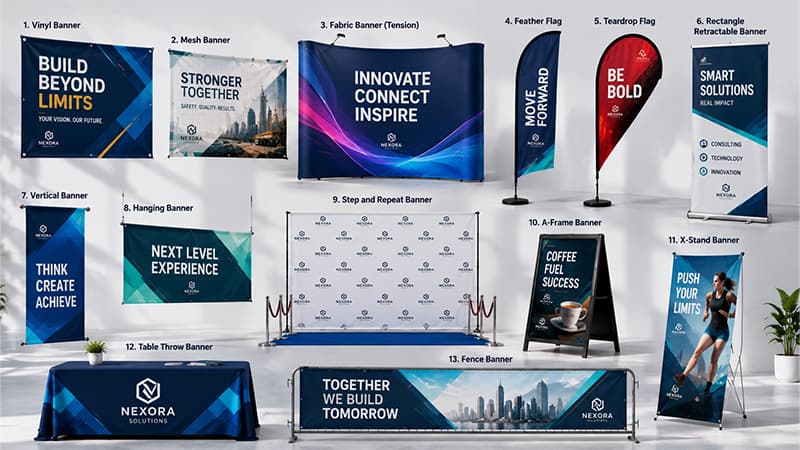
The main types of banners include vinyl banners, fabric banners, mesh banners, retractable banners, pull up banners, X-stand banners, hanging banners, pole banners, step and repeat banners, table banners, fence banners, backdrop banners, feather flags, and teardrop flags.
The right banner type depends on display location, viewing distance, installation method, weather exposure, and transport needs. Vinyl banners work well for storefronts and outdoor promotions. Fabric banners are better for indoor events and premium backdrops. Mesh banners are useful for windy fences, while portable roll-up displays are popular for trade shows.
What Makes One Banner Style Different From Another?
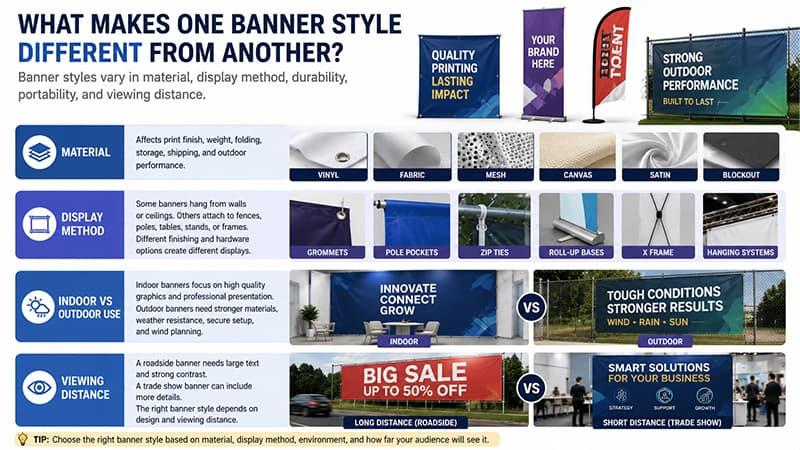
Different banner styles are not only different in shape. They also differ in material, display method, durability, portability, and viewing distance.
Material: Banner material affects print finish, weight, folding, storage, shipping, and outdoor performance. Common choices include vinyl, polyvinyl chloride, polyester fabric, mesh, canvas, satin display fabric, and blockout material.
Vinyl banners are versatile and durable. Fabric banners look softer and more premium. Perforated mesh material lets wind pass through. Blockout materials are useful when a banner needs double-sided printing or stronger opacity.
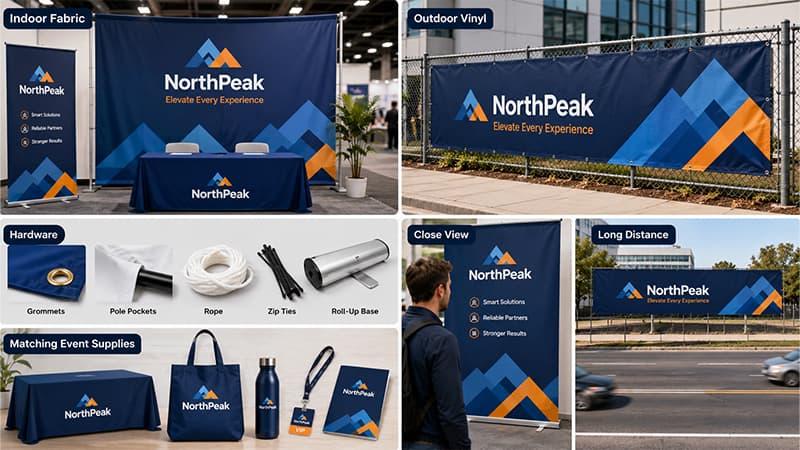
Display method: Some banners hang from walls or ceilings. Others attach to fences, poles, tables, stands, or lightweight frames. Common finishing and hardware options include grommets, ropes, pole pockets, zip ties, stands, roll-up bases, hanging systems, and X frame structures.
Indoor vs outdoor use: Indoor banners usually focus on high quality graphics, smooth appearance, glare control, and professional presentation. Outdoor banners need stronger materials, weather resistance, secure setup, and wind planning. For outdoor events, buyers should consider wind, rain, sunlight, base mechanism, and how the banner will be attached.
Viewing distance: A roadside advertising banner needs large text, strong contrast, and a simple message. A trade show booth banner can include more details because customers stand closer. This is why the right banner style depends not only on the design, but also on how people will see it.
Common Types of Banners and When to Use Them
The following types of banners are commonly used for events, retail spaces, outdoor promotions, and B2B display projects.
Vinyl Banners
Vinyl banners are one of the most common and versatile banner types. They are often used for storefronts, fences, school events, sports fields, construction sites, outdoor promotions, and temporary sales.
A vinyl advertising banner is a good choice when you need strong color coverage and a cost-effective display. For outdoor use, confirm material weight, edge finishing, grommets, and installation points before production.
Fabric Banners
Fabric banners are a better fit when the display needs to look clean, soft, and more polished than a standard vinyl sign. They are commonly used for indoor events, trade shows, conferences, photo backdrops, stage displays, retail walls, and corporate presentations.
Fabric banners fold more easily than vinyl banners, which helps with transport and storage. The final look depends on fabric type, printing method, wrinkle control, and how the display is used under lighting.
Mesh Banners
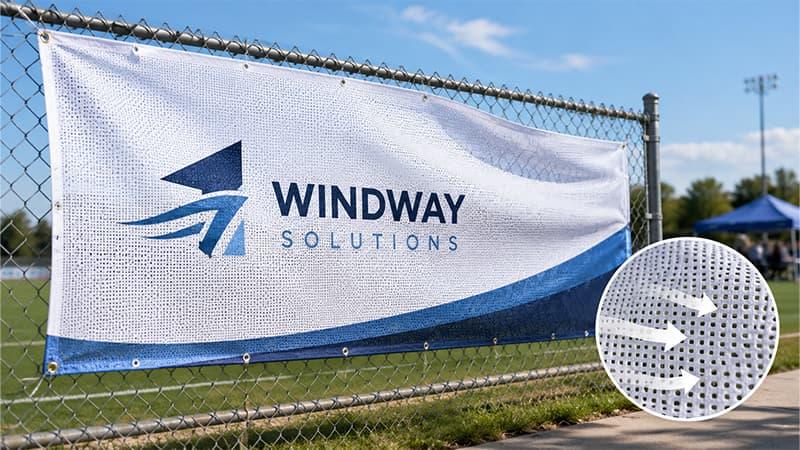
Mesh banners have tiny holes that allow wind to pass through the material. They are useful for fences, sports fields, construction sites, outdoor festivals, large perimeter displays, and windy outdoor events.
Perforated mesh displays reduce wind pressure, but the printed image may look slightly less solid than standard vinyl. Choose this material when wind exposure matters more than full color density.
Retractable Banners and Pull Up Banners
Retractable banners pull up from a base and are also called roll-up banners or pull up banners in many buying situations. These displays are popular for trade shows, conferences, reception areas, product launches, showrooms, pop up booths, and indoor promotions.
These portable roll-up displays are easy to transport and quick to set up. If the banner will be reused often, check the base mechanism, graphic material, carrying bag, and replacement options.
Pull Up Banners vs Roll-Up Displays
In many markets, pull up banners and roll-up displays refer to very similar portable products. “Retractable” usually describes the base mechanism, while “pull up” describes how the printed graphic is lifted into position.
For most B2B buyers, the more important questions are base quality, banner width, graphic replacement, and transport case quality.
X-Stand Banners
X-stand banners use a lightweight frame to hold the printed graphic in tension. They are often used for indoor promotions, retail displays, school fairs, temporary booths, and low-cost event signage.
An X frame display is lightweight and affordable, but it is usually less stable and less premium than a roll-up stand. It works best for short-term indoor use.
Feather Banners and Feather Flags
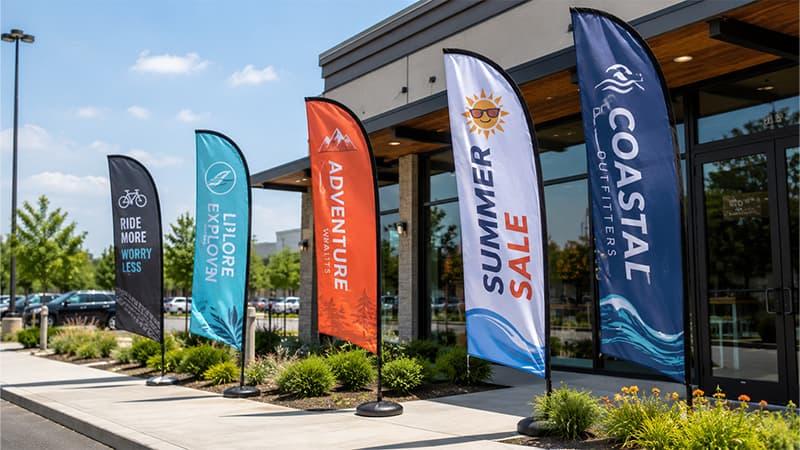
Feather banners, also called feather flags, are tall vertical fabric displays with a curved or feather-like shape. They are commonly used for roadside promotions, storefront entrances, car dealerships, outdoor events, sporting events, and real estate promotions.
Feather banners create height, movement, and maximum visibility from different angles. They are different from flat banners because they use a pole and fabric shape to attract attention.
Teardrop Flags
Teardrop flags have a rounded shape and usually stay more stretched than feather banners. They are often used for outdoor events, sports fields, beach events, entry points, brand activations, and tourism events.
This banner style is useful when you want a cleaner shape with less flutter. Artwork should stay simple because the printed area is curved.
Pole Banners
Pole banners attach to light poles, street posts, campus poles, or boulevard hardware. They are common for city events, school campuses, seasonal promotions, tourism districts, festivals, and public campaigns.
For streets, campuses, and tourism districts, double-sided pole banners are often easier to read from both traffic directions. Buyers should confirm pole size, post hardware, material strength, and local installation requirements before production.
Hanging Banners and Suspended Banners
Hanging banners and suspended banners are displayed from ceilings, walls, truss systems, or overhead structures. They are useful in trade show halls, shopping malls, school gyms, large venues, event entrances, and directional signage.
Overhead displays can improve visibility in busy spaces because they are shown above eye level. Before ordering, confirm banner weight, hanging points, venue rules, and installation hardware.
Step and Repeat Banners
Step and repeat banners, sometimes called repeat banners, feature repeated logos across a backdrop. They are often used for press events, award ceremonies, red carpet events, sponsorship walls, photo booths, and brand launches.
Logo spacing and contrast matter because these banners are usually photographed. The design should still look clear when people stand in front of it.
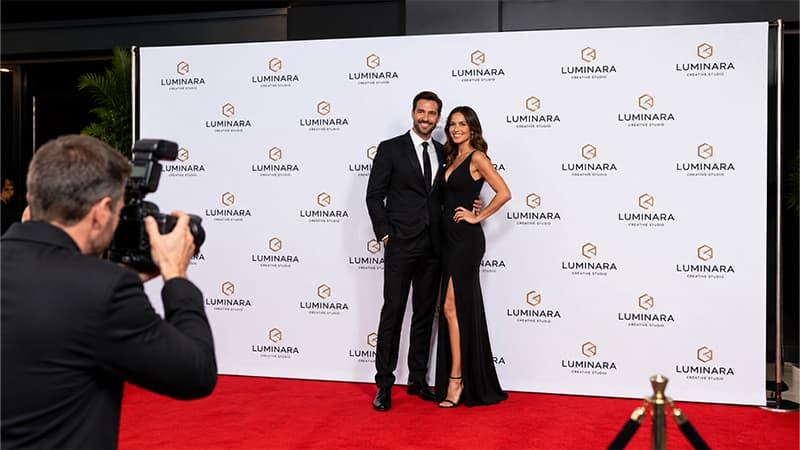
Table Banners and Table Throws
A table banner usually attaches to the front of a table. A table throw or table cover covers the full table. Both are useful for trade shows, registration desks, school fairs, nonprofit booths, product sampling, and pop-up retail events.
For a professional booth, match the table cover with the main backdrop, roll-up display, feather flag, or booth graphics.
Fence Banners
Fence banners attach to fences for visibility, privacy, or sponsor exposure. They are commonly used at sports fields, construction sites, schools, outdoor festivals, property promotions, and sporting events.
Choose wind-friendly mesh material for exposed fences and vinyl banners for stronger color coverage in calmer areas. Zip ties and reinforced edges are often important for outdoor installation.
Backdrop Banners
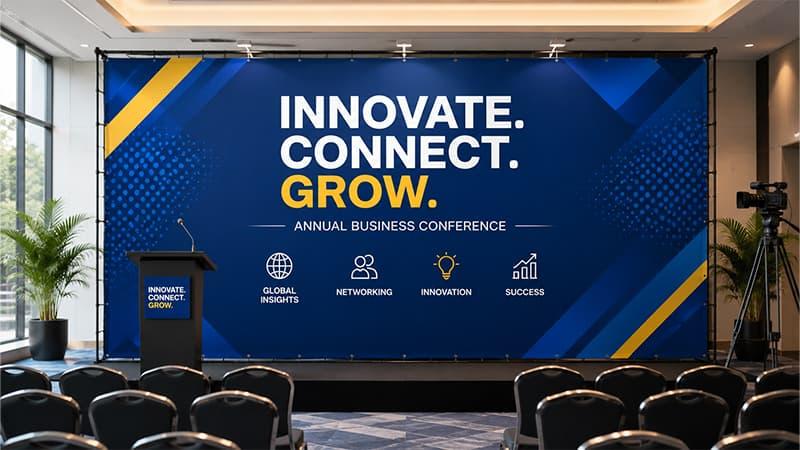
Backdrop banners create a large visual background for stage events, product launches, conferences, photo walls, press areas, and corporate meetings.
A backdrop banner needs the correct size, readable design, stable support hardware, and good lighting. If people will take photos in front of it, logo placement should be planned around where people stand.
Banner vs Flag vs Standard: What Is the Difference?
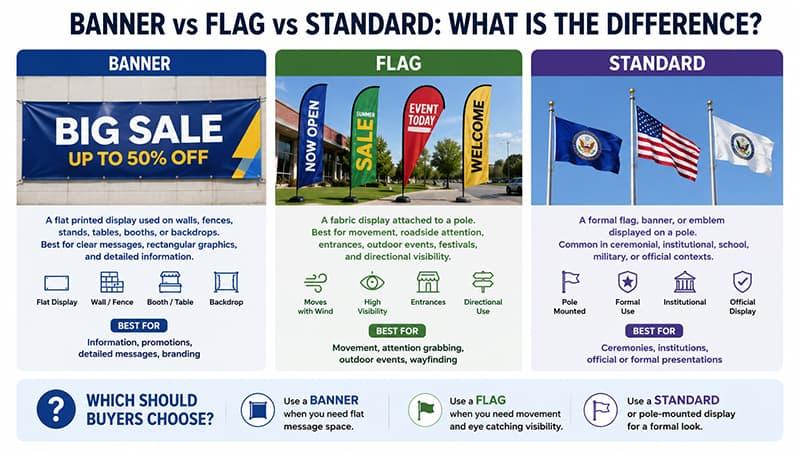
The phrase banner vs flag vs standard can be confusing because these terms overlap in events, advertising, and institutional displays.
What is a banner? A banner is usually a flat printed display used on walls, fences, stands, tables, booths, or backdrops. It is the better choice when you need clear message space, rectangular graphics, or detailed information.
What is a flag? A flag is usually a fabric display attached to a pole. It is often used for movement, roadside attention, entrances, outdoor events, festivals, and directional visibility. Feather flags and teardrop flags are flag-style displays, even though some buyers may call them feather banners.
What is a standard? A standard usually refers to a formal flag, banner, or emblem displayed on a pole. It is more common in ceremonial, institutional, school, military, or official contexts. In modern event buying, “standard” is less common than banner or flag, but some customers may use it to describe a formal pole-mounted display.
Which should buyers choose? Use a banner when you need flat message space. Use a flag when you need movement and eye catching visibility. Use a standard or pole-mounted display when the presentation needs a formal or vertical display style.
Best Banner Styles by Use Case
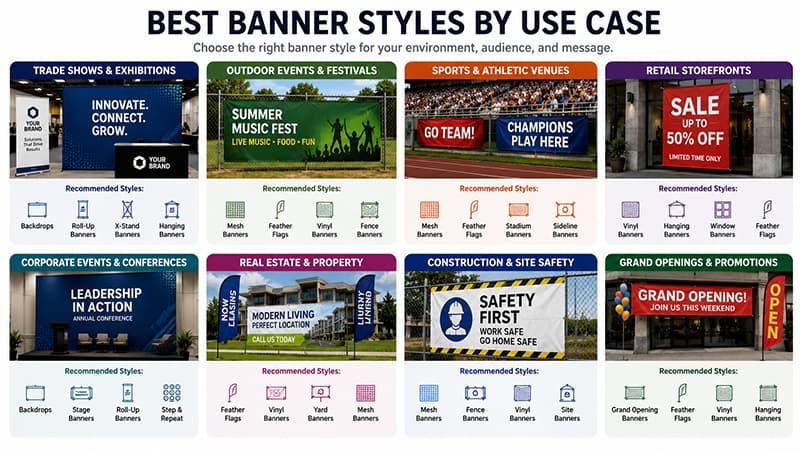
The same banner style can perform differently depending on location, viewing distance, and event setup.
Trade shows and exhibitions: Strong choices include roll-up displays, fabric backdrops, table throws, hanging banners, and step and repeat backdrops. These displays should be portable, quick to set up, reusable, and consistent with booth graphics. For larger booths, a mix of table covers, overhead displays, and giveaways can create a complete display. You can also pair your setup with useful trade show giveaways to support booth traffic and lead collection.
Storefronts and retail promotions: Storefront promotions often use vinyl banners, overhead signs, feather banners, window banners, and table banners. The message should be short and easy to read from a distance. Strong contrast, bold graphics, and clear offers are more important than adding many details.
Outdoor events: For outdoor events, common choices include wind-friendly mesh displays, vinyl signs, feather banners, teardrop flags, fence banners, and pole banners. Outdoor banners need weather-resistant materials, secure hardware, and careful setup. Wind conditions should be considered before choosing solid vinyl or mesh.
Conferences and corporate events: Corporate events often use fabric banners, portable roll-up stands, stage backdrops, step and repeat backdrops, and directional banners. The goal is usually a clean, professional appearance. Fabric and backdrop displays often work well because they photograph better and look softer under indoor lighting.
Sports and school events: Sports banners and school banners often include fence banners, vinyl banners, wind-friendly mesh material, feather banners, and overhead displays. These banners need durability, clear sponsor or team visibility, and easy installation. For outdoor fields, perforated material can be safer in windy areas.
Hotels, restaurants, and pop-ups: Hotels, restaurants, and pop-up spaces often use table banners, fabric banners, suspended displays, roll-up stands, and feather flags. These displays should be easy to set up, visually clean, and consistent with the brand environment. A banner used in a hotel lobby should feel more refined than a roadside sale banner.
How to Choose the Right Banner Type
Start with the display location. Ask whether the banner will be used indoors, outdoors, on a table, on a fence, on a wall, on a stand, above a booth, or at an entrance.
Next, check viewing distance. Long-distance banners need fewer words, larger text, and stronger contrast. Close-view banners can include more details, QR codes, product information, or schedules. For size planning, this standard banner sizes guide can help buyers compare common display dimensions.
Then match material to weather and use time. Vinyl works for many indoor and outdoor uses. Mesh is better for windy outdoor areas. Fabric is better for premium indoor displays. Polyester is common for flags. Blockout material is useful for double-sided prints.
Also confirm installation hardware. Depending on the display format, you may need grommets, pole pockets, ropes, frames, bases, stands, fence ties, hanging systems, or a roll-up base mechanism.
Finally, think about transport and storage. Portable stands and fabric banners are easier to transport. Large vinyl banners may need rolling, folding control, or careful packing to avoid damage.
Common Mistakes When Ordering Custom Banners
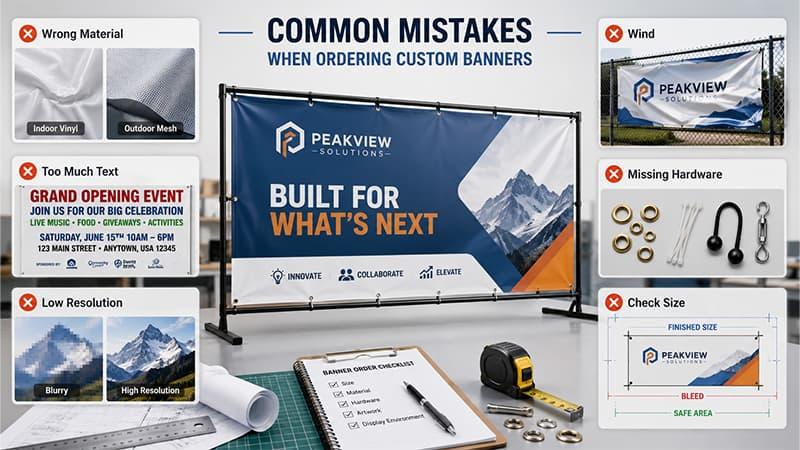
Choosing the wrong material: Indoor material may fail outdoors, while heavy outdoor material may look less refined indoors. Match material to weather, use time, and display environment.
Adding too much text: A banner should communicate quickly. Too many words make the message hard to read, especially from a distance.
Ignoring wind conditions: Outdoor banners need wind planning. Wind-friendly mesh material may be safer for fences, scaffolding, and exposed outdoor spaces.
Forgetting installation hardware: A banner is not only the printed material. Hardware affects whether it can be displayed safely and neatly.
Using low-resolution artwork: Large banners need high quality graphics and vector logos when possible. Low-resolution artwork can look blurry when enlarged. Adobe’s guide to raster vs vector files explains why vector artwork is usually safer for scaling logos and graphics for large-format printing.
Ordering without checking finished size: Buyers should confirm finished size, bleed, safe area, pole pockets, grommet placement, and mounting method before production.
TOMAS Supplier Insights: What TOMAS Crafts Checks Before Banner Production
For B2B orders, banner production should start with the use environment, not only the artwork.
Banner Material Should Match the Event Environment
In TOMAS Crafts projects, banner selection usually starts with where the banner will be displayed. A vinyl banner for a storefront, a wind-friendly fence display, and a fabric backdrop for an indoor conference do not solve the same problem.
The Finishing Method Affects Installation
Grommets, pole pockets, ropes, frames, roll-up bases, zip ties, and hanging systems all affect how the banner is installed. Buyers should confirm these details before artwork approval, not after printing.
The Artwork Should Match the Viewing Distance
A booth banner can include more detail because people stand close. A roadside banner needs larger text, fewer words, and stronger contrast. This is one of the most common design problems in banner orders.
Color should also be reviewed with the final material in mind. Pantone explains that the same color can look different on coated and uncoated surfaces because of ink absorption and finish. This is a useful reminder when buyers need banners, table covers, flags, and packaging to look visually consistent. See Pantone’s guide to coated and uncoated color systems.
Banner Kits Should Match Other Event Supplies
For trade shows and events, banners often need to match table covers, flags, lanyards, staff uniforms, tote bags, and promotional giveaways. Reviewing colors, logos, and layout together helps the full event setup look more professional.
Quick Comparison: Which Banner Type Should You Choose?
Use this quick table to compare common banner types by display location, indoor or outdoor use, and buyer notes before ordering.
| Banner Type | Best For | Indoor / Outdoor | Buyer Note |
|---|---|---|---|
| Vinyl banner | Storefronts, fences, promotions | Indoor / outdoor | Versatile and cost-effective |
| Fabric banner | Trade shows, conferences, backdrops | Indoor | Premium look and easy folding |
| Mesh banner | Fences, windy outdoor spaces | Outdoor | Lets wind pass through |
| Roll-up display | Booths, lobbies, events | Indoor | Portable and reusable |
| X-stand banner | Low-cost indoor displays | Indoor | Lightweight and affordable |
| Step and repeat backdrop | Photo walls, press events | Indoor | Good for repeated logos |
| Feather flag | Roadside and storefront visibility | Outdoor | Adds height and movement |
| Table banner | Booth tables and registration desks | Indoor | Good for small booth spaces |
Ordering Checklist Before Custom Banner Production
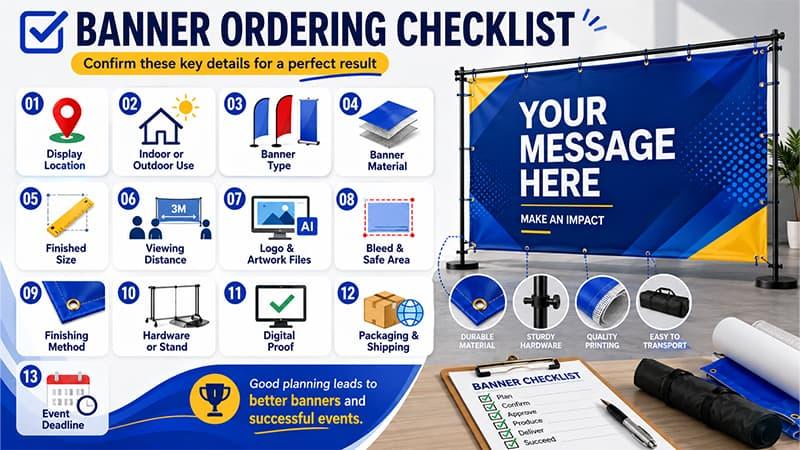
Before placing a custom banner order, confirm these details:
- Display location
- Indoor or outdoor use
- Banner type
- Banner material
- Finished size
- Viewing distance
- Logo and artwork files
- Bleed and safe area
- Finishing method
- Hardware or stand
- Digital proof
- Packaging and shipping method
- Event deadline
This checklist helps reduce artwork mistakes, installation problems, and last-minute event risks.
Conclusion
The right banner type depends on where it will be displayed, how far away people will view it, and how it will be installed. Vinyl banners, fabric banners, mesh displays, roll-up displays, feather flags, table banners, fence banners, and backdrops all serve different purposes.
Instead of choosing only by price, buyers should compare material, banner style, visibility, installation, hardware, shipping, and event needs before ordering. Comparing different types of banners by material, installation, and viewing distance helps buyers avoid the wrong display choice.
Need Help Choosing Custom Banners for Your Event?
TOMAS Crafts can help compare banner types, materials, sizes, printing methods, finishing options, and matching event supplies before production starts.
TOMAS Crafts can also help match custom banners with feather flags, table covers, lanyards, tote bags, staff uniforms, and promotional giveaways for a more consistent event setup.
Share your event type, display location, size, quantity, logo file, budget, and deadline with the TOMAS Crafts team. The team can help build a practical custom banner and event display solution for trade shows, storefronts, conferences, sports events, hotels, restaurants, and promotional campaigns.
Contact TOMAS Crafts to discuss your custom banner project.
FAQs
What are the main types of banners?
The main types of banners include vinyl banners, fabric banners, mesh banners, retractable banners, pull up banners, X-stand banners, hanging banners, table banners, fence banners, backdrop banners, feather flags, and teardrop flags.
Which banner style is best for outdoor use?
Vinyl banners, mesh banners, feather flags, teardrop flags, and fence banners are common outdoor choices. Mesh banners are better for windy areas, while vinyl banners offer stronger solid color coverage.
What is the difference between a banner and a flag?
A banner is usually a flat printed display used on walls, fences, tables, or stands. A flag is usually fabric-based and displayed on a pole, often with movement for outdoor visibility.
What banner type is best for trade shows?
Retractable banners, fabric backdrops, table throws, hanging banners, and step and repeat banners are good for trade shows because they are portable, visible, and easy to match with booth graphics.