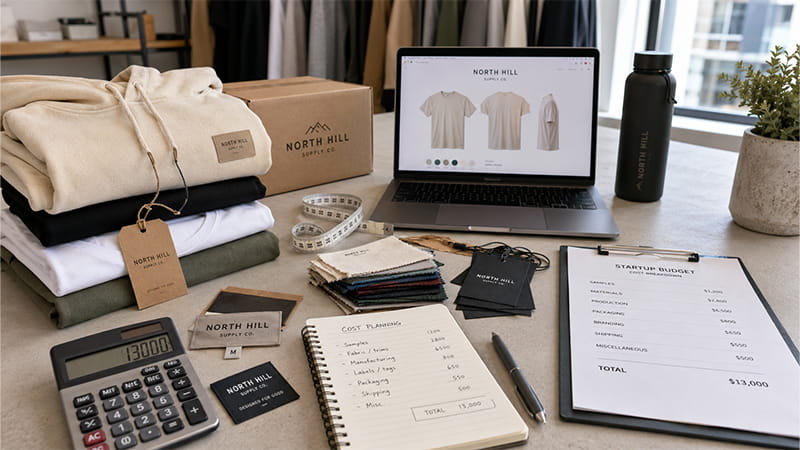
Starting a clothing brand can require anything from a small test budget to a much larger investment in product development and inventory. The answer to how much does it cost to start a clothing brand depends mainly on the business model, production method, customization, SKU count, inventory, and marketing. This guide breaks down those startup costs and shows where new brands can save.
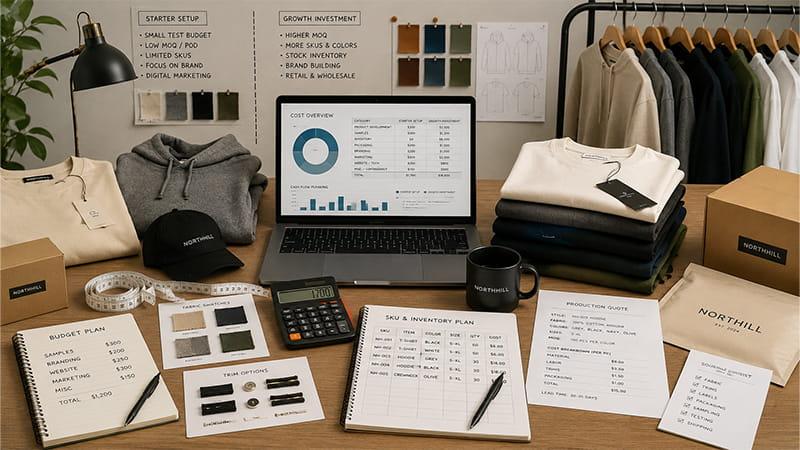
How Much Does It Cost to Start a Clothing Brand?
Quick answer: Starting a clothing brand can range from a few hundred dollars for a lean print-on-demand test to several thousand or tens of thousands for inventory-based or fully custom production. The biggest cost drivers are product development, SKU count, customization, inventory, marketing, and shipping.
There is no single startup budget that fits every clothing business. A founder testing graphic T-shirts through print-on-demand has a very different cost structure from a fashion brand developing original patterns, sourcing fabric, approving prototypes, and ordering bulk inventory.
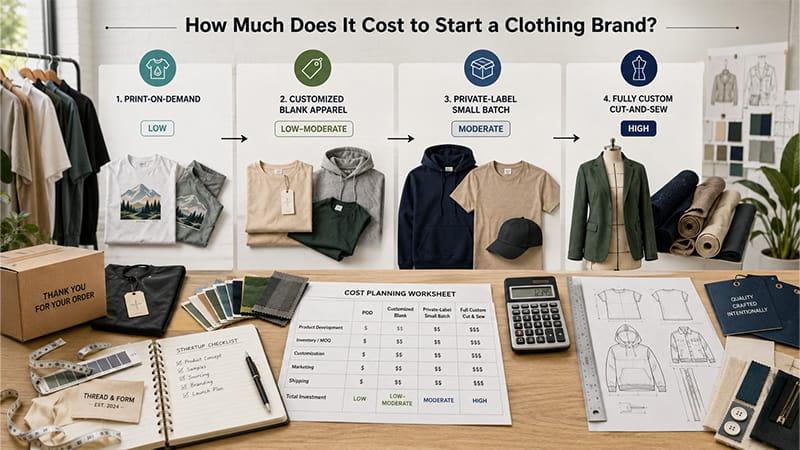
For planning purposes, the startup levels generally look like this:
| Launch Model | Illustrative Startup Level | Upfront Inventory | Product Development | Customization | Best Fit |
|---|---|---|---|---|---|
| Print-on-Demand | Hundreds to low thousands | Very low | Low | Limited–moderate | Testing demand |
| Customized Blank Apparel | Low thousands and up | Low–moderate | Low | Moderate | T-shirt and merchandise startups |
| Private-Label Small Batch | Several thousand and up | Moderate | Moderate | Moderate–high | Emerging apparel brands |
| Fully Custom Cut-and-Sew | Several thousand to tens of thousands+ | High | High | Highest | Original garment collections |
These are planning ranges, not universal supplier quotations. Actual startup costs vary with the garment, quantity, target market, sales channel, and what each supplier includes in the quotation.
A smaller budget does not automatically mean a weaker brand. It usually means the first launch needs to be more focused.
What Determines Your Clothing Brand Startup Cost?
Before calculating production costs, identify the decisions that change the budget most.
| Cost Driver | Why It Changes the Budget |
|---|---|
| Production model | Changes development, manufacturing, and inventory requirements |
| Styles and SKUs | More combinations increase inventory complexity |
| Customization level | More custom elements require additional development and sampling |
| Production quantity | Changes unit cost and cash tied up in stock |
| Sales channel | An online store, wholesale program, and physical clothing store have different overhead |
| Marketing plan | Determines how much working capital needs to remain after production |
The product itself also matters. A printed stock T-shirt involves far less development than a jacket with custom fabric, lining, hardware, and an original pattern.
Why SKU Complexity Matters
SKU count is one of the easiest costs to underestimate when you start a clothing brand.
Suppose the first clothing line includes:
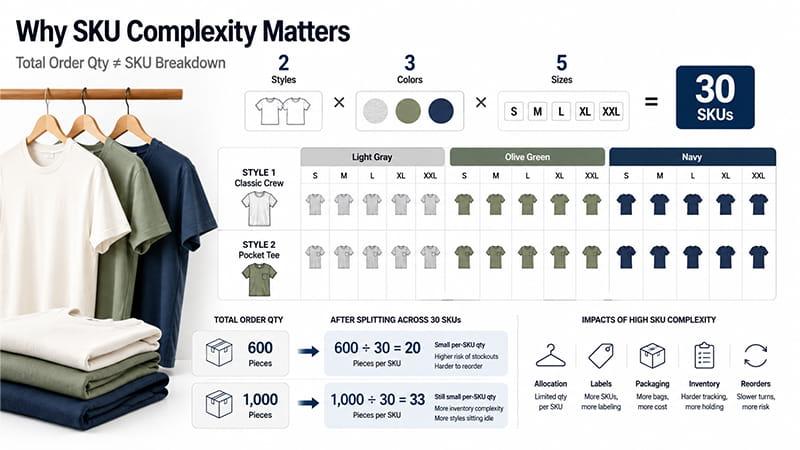
2 styles × 3 colors × 5 sizes = 30 SKU combinations
That is before adding different artwork versions.
An order of 600 pieces may still sound small, but divided evenly across 30 combinations it averages only 20 pieces per SKU before actual demand differences are considered.
The issue is not simply warehouse organization. SKU complexity affects:
- quantity allocation
- labels and size marking
- individual packaging
- photography
- inventory tracking
- reorder planning
- slow-moving colors and sizes
- how production quantity is divided at the factory
This creates an important sourcing distinction:
Total order quantity tells a supplier how many garments you want. SKU breakdown tells the supplier what actually needs to be produced.
A 1,000-piece order in one color with five sizes is a different production plan from 1,000 pieces divided across several colors, several sizes, and multiple artwork versions.
Total quantity and SKU complexity are not the same thing.
For a new brand with limited capital, reducing unnecessary colors or styles can sometimes release more working capital than negotiating a small reduction in garment price.
Four Clothing Production Models and How They Affect Startup Cost
The production method usually affects startup capital more than the logo, website theme, or brand story.
Print-on-Demand
Print-on-demand is one of the lowest-inventory ways to start a clothing brand because products are generally produced after a customer places an order.
For someone researching how to start a T-shirt business, early expenses may mainly involve product samples, graphic design, ecommerce setup, product content, and marketing rather than bulk inventory. There is also no need to purchase printing equipment.
The advantage is lower inventory exposure and easier testing. The trade-off is less control over garment specifications, labeling, packaging, decoration, and sometimes consistency. Per-unit costs may also be higher than larger production runs.
POD works best when the immediate objective is to test demand rather than create a proprietary garment.
Customized Blank Apparel
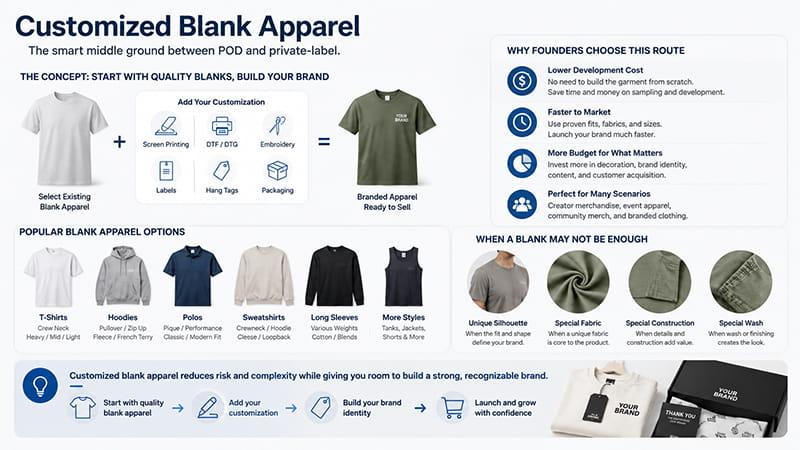
Customized blank apparel fills the gap between POD and private-label production.
Instead of developing the garment itself, the brand selects an existing T-shirt, hoodie, polo, sweatshirt, or similar product and adds screen printing, DTF, DTG, embroidery, labels, hang tags, or packaging.
A suitable blank can reduce development work because the basic fabric, fit, sizing, and construction already exist. The startup can put more of its budget into decoration, brand identity, content, and customer acquisition.
This route works particularly well for founders researching how to start a tee shirt company without investing in printing equipment. It is also practical for creator merchandise, event apparel, community merchandise, and branded clothing.
If you are still deciding which garment type fits the project, our guide to different types of T-shirts compares common styles, fits, fabrics, and uses.
An existing blank becomes less suitable when the silhouette, fabric, wash, or construction itself is central to the value of the product.
Private-Label Small-Batch Apparel
Private-label production gives a clothing brand more control without necessarily requiring every garment component to be developed from scratch.
Depending on the supplier and product, the project may use existing or adapted garment structures with private labels, selected colors or materials, custom decoration, hang tags, and branded packaging.
The financial trade-off moves toward sampling, minimum order quantities, initial inventory, and SKU allocation.
Smaller production runs may carry a higher cost per unit than mass production, but that does not automatically make them worse for a startup. Paying slightly more per garment can be reasonable when it prevents the business from holding substantially more stock than it can sell.
This is an important distinction when comparing quotations:
Lower unit cost and lower startup risk are not always the same objective.
Fully Custom Cut-and-Sew Clothing
A custom clothing line requires more development before bulk production begins.
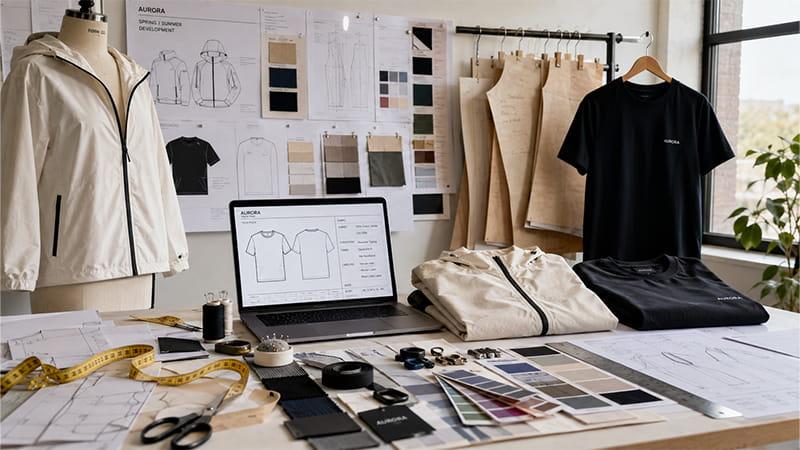
Depending on garment complexity, the process may involve technical drawings, measurement specifications, tech packs, patterns, fabric sourcing, trims, grading, prototypes, fittings, revisions, and pre-production approval.
This is closer to what many founders mean when they search how to make clothing for their own brand.
A custom jersey T-shirt and a technical jacket are both apparel, but their material costs, labor, sampling requirements, and production processes are very different.
Fully custom manufacturing can create stronger differentiation, but more capital is committed before the first sellable unit exists.
Clothing Brand Startup Cost Breakdown
Once the business model and product direction are clear, startup costs become easier to organize.
The U.S. Small Business Administration recommends identifying both one-time and ongoing expenses when calculating startup costs, rather than budgeting only for the first product purchase.
Business registration, licenses, trademark work, insurance, and other administrative expenses should also be included in the overall startup budget. These vary by country, jurisdiction, and business structure, so local official requirements should be checked rather than using one universal estimate.
Product Design and Technical Development
Development costs depend on what is actually being made.
A graphic-based clothing line using existing garments may only require:
- artwork
- garment selection
- garment color
- decoration specifications
- decoration dimensions
- placement instructions
A fully custom product may require:
- technical drawings
- measurement specifications
- construction details
- fabric requirements
- trims
- tech packs
- pattern development
Not every clothing startup needs the same technical package.
A standard T-shirt with a front print does not require the same development as an oversized garment with a specified shoulder drop, finished garment length, fabric weight, rib construction, and private labeling.
The technical information should match the complexity of the product.
This also affects supplier comparisons. A simple inquiry may receive a low preliminary price because the supplier has assumed a standard garment. Once fabric weight, fit, labels, print dimensions, packing, and size breakdown are confirmed, the quotation may change because the specification has changed—not necessarily because the supplier has arbitrarily increased the price.
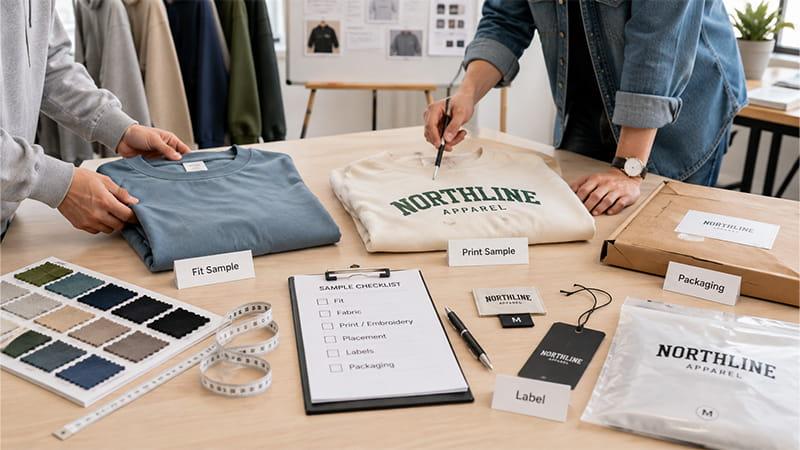
Samples and Prototypes
A project may use a stock garment sample, decoration sample, fit sample, custom prototype, or pre-production sample. Not every order needs every sample type.
The purpose is to confirm details that would be expensive to correct after bulk production begins. A physical sample can expose problems with fit, fabric feel, garment proportions, logo placement, print quality, embroidery stability, labels, or packaging.
Sampling is a risk-control cost, not automatically wasted money.
The key is to make each sample answer a specific question.
For example:
- Is the fit correct?
- Is the fabric appropriate?
- Is the decoration positioned correctly?
- Does embroidery distort the garment?
- Are the labels correct?
- Does the packaging protect the product?
Repeated sampling becomes expensive when specifications continue changing. Clearer requirements before sampling usually make product development more efficient.
Production and Inventory
Production costs depend on more than total quantity.
A manufacturer may need to account for:
- fabric composition
- fabric weight
- garment construction
- labor
- trims
- decoration
- colors
- sizes
- packaging
- production volume
A larger production quantity can reduce the base price per piece, but that does not automatically make the order financially safer.
If a supplier offers a lower price at 2,000 pieces than at 500 pieces, the saving only creates value if the additional inventory sells.
Otherwise, the brand has exchanged a lower production cost per unit for more cash tied up in stock, slower inventory turnover, and greater markdown risk.
MOQ therefore needs to be considered alongside demand, reorder lead time, available cash, and SKU breakdown.
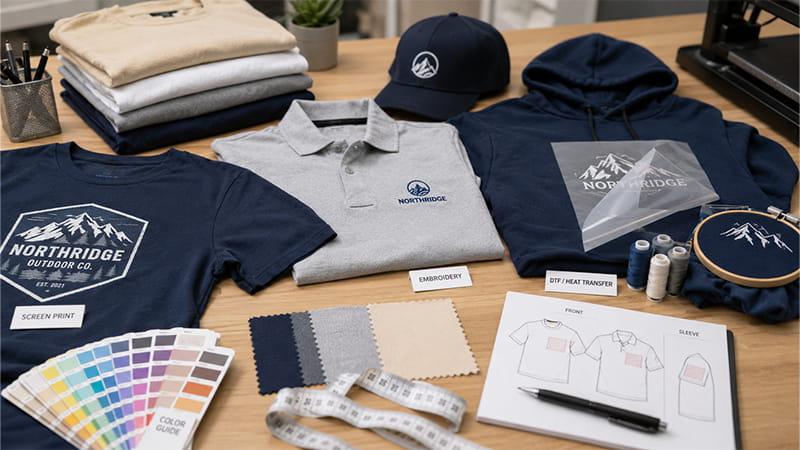
Printing, Embroidery, and Decoration
Common decoration methods include screen printing, DTF, DTG, embroidery, and sublimation for suitable products.
There is no reliable universal rule saying one method is always cheaper. Cost can change with:
- artwork complexity
- color count
- decoration dimensions
- garment material
- production volume
- setup requirements
- required hand feel or finish
For a meaningful comparison, ask suppliers to quote suitable methods using the same garment, artwork, decoration size, and quantity.
For a deeper comparison, see our guide to T-shirt printing methods.
Artwork placement should also be considered before the garment is finalized because pockets, plackets, seams, necklines, and garment proportions can affect the usable branding area. Our T-shirt logo placement guide covers those decisions in more detail.
Labels and Packaging
A new clothing business may consider main labels, size labels, care labels, hang tags, individual bags, mailers, printed inserts, tissue paper, stickers, or retail boxes.
Every additional component can introduce another:
- MOQ
- setup charge
- printing requirement
- sample requirement
- packing step
- lead-time dependency
Custom packaging can strengthen brand identity, but it should have a clear purpose.
A first clothing line may benefit more from a suitable garment, reliable decoration, and consistent branding than from several packaging formats.
A common sourcing problem is treating packaging as an afterthought during the original quotation and then adding several custom components after the garment price has already been confirmed. That can change the total project cost because labels, boxes, inserts, assembly, and carton configuration all affect production.
For clothing sold in the United States, the FTC provides guidance on apparel and textile labeling, including fiber content, country of origin, responsible-business identification, and care-label requirements.
Requirements differ by market, so labels should be checked against the rules where the products will actually be sold.
Ecommerce, Photography, and Marketing
Production is only part of the cost to start a clothing brand.
An online store may also require:
- a domain
- ecommerce platform
- payment processing
- software
- product photography
- lifestyle content
- product copy
- organic social media marketing
- creator partnerships
- paid advertising
- launch promotions
This is why committing nearly all available capital to bulk inventory can create problems. Products still need to be presented, marketed, sold, shipped, and supported.
A founder with an established audience may rely more heavily on organic reach. An emerging fashion brand with little audience data may need more cash available for advertising, creator seeding, or other customer-acquisition tests.
There is no useful marketing percentage that applies to every fashion business. The budget should reflect the actual acquisition strategy.
Shipping, Import Costs, and Fulfillment
Shipping costs are easy to underestimate because early supplier discussions often focus on the factory price.
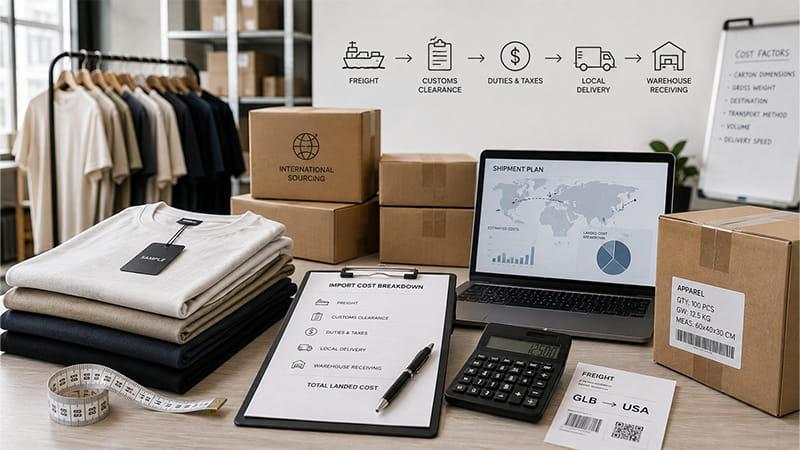
International sourcing may add:
- freight
- customs clearance
- applicable duties and taxes
- local delivery
- warehouse receiving
Shipping costs can change with carton dimensions, gross weight, destination, transport method, total production volume, and delivery speed.
For U.S. imports, duty rates depend on tariff classification rather than one standard percentage for all clothing. U.S. Customs and Border Protection provides guidance on determining duty rates.
This is one reason a sourcing decision should not be based on the garment price alone.
How to Build a Realistic Clothing Brand Startup Budget
Once you understand how much it costs to start a clothing brand, separate the cost of creating the products from the money needed to launch and operate the business.
| Product Launch Budget | Business Launch Budget |
|---|---|
| Product development | Business registration |
| Samples | Ecommerce |
| Manufacturing | Photography |
| Decoration | Marketing |
| Labels | Software |
| Packaging | Customer fulfillment |
| International freight | Operating cash |
| Import costs where applicable | Contingency |
A factory production quote is not the total cost of starting a clothing brand.
A manufacturing quotation may tell you what a supplier charges to produce and pack the goods. It does not automatically include every cost required to bring that inventory into your market, acquire customers, and complete sales.
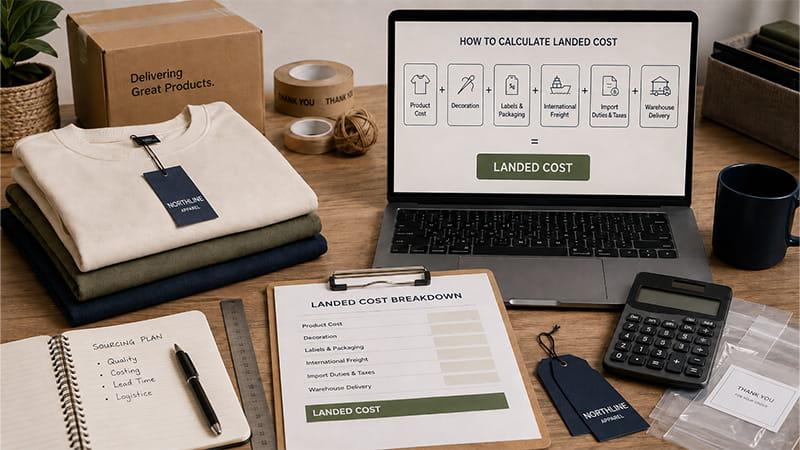
How to Calculate Landed Cost
For imported apparel, a practical sourcing framework is:
Production Cost + Decoration + Labels & Packaging + International Freight + Applicable Import Duties and Taxes + Delivery to the Warehouse = Landed Cost
Customer fulfillment, payment fees, returns, discounts, and customer acquisition sit beyond landed cost, but they still affect final profitability.
For example, imagine the factory portion of a garment is $8 per piece. After decoration, labels, packaging, freight, applicable import charges, and delivery to the warehouse are allocated, its landed cost might become $11 or $12.
That is an illustrative example, not a standard clothing-industry markup.
Unit price is not landed cost.
This distinction also matters when comparing manufacturers. One quotation may already include decoration, private labels, and individual packing while another includes only the base garment.
A lower number is not necessarily a lower-cost offer if the commercial assumptions are different.
Example Clothing Brand Startup Budgets
Different production models require startup capital to be allocated differently.
| Launch Type | Budget Usually Needs to Cover | Main Financial Risk |
|---|---|---|
| Lean POD Test | Samples, graphics, ecommerce, content, marketing | Higher unit cost and limited product control |
| Customized Blank Launch | Garments, decoration, labels, packaging, freight, marketing | Inventory and SKU allocation |
| Private-Label Clothing Line | Samples, labels, garment customization, inventory, packaging, marketing | More cash committed before demand is proven |
| Fully Custom Clothing Line | Technical development, patterns, fabrics, prototypes, grading, production, freight | Development costs plus inventory exposure |
A lean POD test mainly validates the product concept without substantial inventory. Customized blanks require more working capital because garments are purchased and decorated before sale. Private-label production adds more branding and product-development costs, while a fully custom clothing line can incur pattern, fabric, prototype, and fitting expenses before mass production begins.
The useful question is not only:
Which business model costs the least?
It is also:
Which level of product development is necessary for the product customers are actually buying?
Hidden Costs and Budget Mistakes That Increase Startup Costs
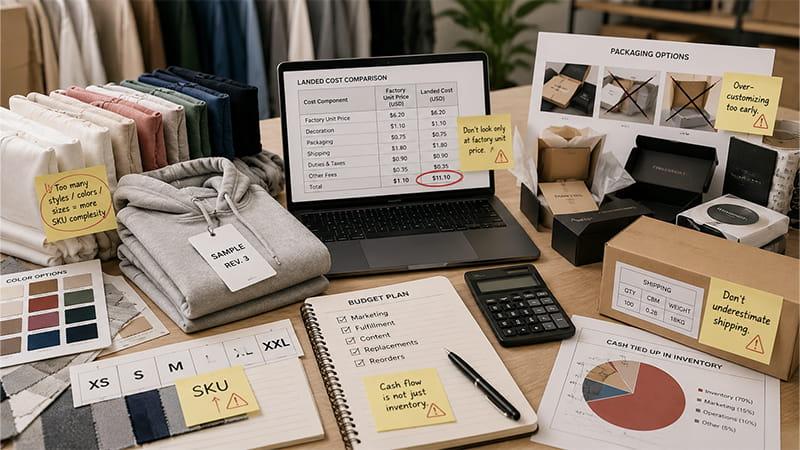
Launching too many styles, colors, and sizes. A broad first clothing line spreads inventory across more SKUs before there is enough sales data to know what deserves deeper stock.
Changing specifications after sampling starts. Fabric, fit, artwork, decoration, labels, or packaging changes can affect production costs, require another sample, and delay manufacturing.
Looking only at the factory unit price. The lowest base price is not necessarily the lowest landed cost after decoration, packaging, freight, and import expenses are included.
Over-customizing packaging too early. Multiple box sizes, inserts, tissue paper, stickers, and separate packaging formats can each create additional MOQ, setup, and packing requirements.
Underestimating shipping costs. Apparel freight depends on carton volume and weight as well as quantity, destination, and delivery method.
Putting too much available cash into inventory. The clothing business still needs capital for customer acquisition, fulfillment, content, replacements, and successful reorders.
How to Start a Clothing Brand With a Smaller Budget
Lower startup costs do not have to mean lower product quality.
Start With One Hero Product
A new fashion brand does not need a large collection simply to look established.
One T-shirt, hoodie, sweatshirt, or other core garment can be enough to test customer response, price acceptance, sizing, colors, artwork, and marketing messages.
Products that perform well can support later expansion.
Reduce SKUs Before Reducing Product Quality
If the budget feels too high, simplify the clothing line before automatically downgrading the garment.
For example:
5 garment colors → 2 strong colors
may create a healthier first order than:
suitable fabric → cheapest available fabric
Style count, artwork versions, packaging formats, and accessory options can also be reduced.
A lean launch reduces unnecessary complexity, not necessary product quality.
Use Existing Garments When Full Custom Development Is Unnecessary
A custom pattern makes sense when fit, fabric, or construction is central to the product.
It may be unnecessary when customers are mainly buying artwork, event merchandise, community identity, branded uniforms, or promotional apparel.
In those cases, a suitable existing garment can reduce pattern development, fabric sourcing, and sampling requirements.
TOMAS provides custom apparel and uniform solutions for projects that need to compare existing garments, decoration options, and more customized production routes.
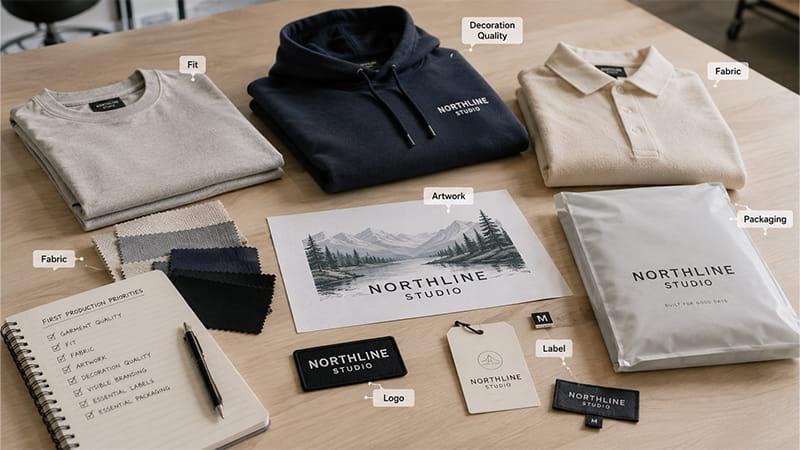
Customize What Customers Actually Notice
Not every component needs to be custom in the first production run.
Prioritize:
- garment quality
- fit
- fabric
- artwork
- decoration quality
- visible branding
- essential labels
- essential packaging
Then evaluate additional customization individually.
Does another custom detail improve the product enough to justify another MOQ, setup charge, sample, or packing step?
If not, it may be better saved for a later clothing line.
Approve the Right Samples
Use samples to answer the highest-risk production questions: fit, fabric, decoration, labels, and packaging.
Not every project needs every sample type. The objective is enough confirmation to prevent expensive corrections after bulk production.
Keep Working Capital Available
A clothing business continues spending after manufacturing begins.
Cash may still be needed for marketing, creator samples, fulfillment, customer service, replacements, content, successful reorders, or unexpected shipping expenses.
A small reduction in unit price has limited value if the business runs out of cash before it can sell the inventory.
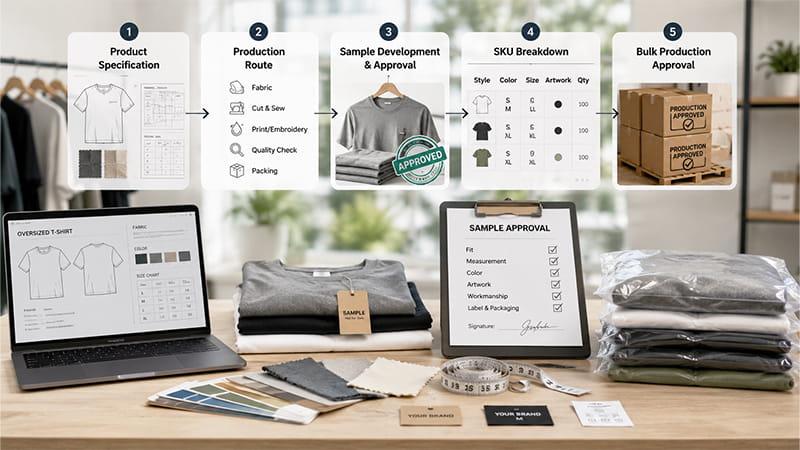
From Clothing Idea to Production
For founders wondering how to make clothing for their own brand, the production path can be simplified into:
Define the Product Specification → Choose the Production Route → Develop and Approve the Sample → Confirm the SKU Breakdown → Approve Bulk Production
The production quantity eventually needs to become:
Style → Color → Size → Artwork → Quantity
That is much more useful to a manufacturer than simply saying:
“I need 1,000 T-shirts.”
TOMAS Sourcing Rule: For apparel quotations, TOMAS treats style, color, size, artwork, quantity, decoration, and packaging as separate production inputs. A total quantity is useful, but it is not enough to create a production-ready quotation.
This is also why a quotation can change after the original inquiry. If the first request says only “1,000 custom T-shirts,” the supplier still does not know whether that means:
- one garment color or several
- one artwork or multiple versions
- a standard or heavyweight garment
- basic packing or custom packaging
- one decoration method or another
The quotation becomes more accurate as those assumptions are replaced by confirmed specifications.
What to Send a Clothing Manufacturer for an Accurate Quote
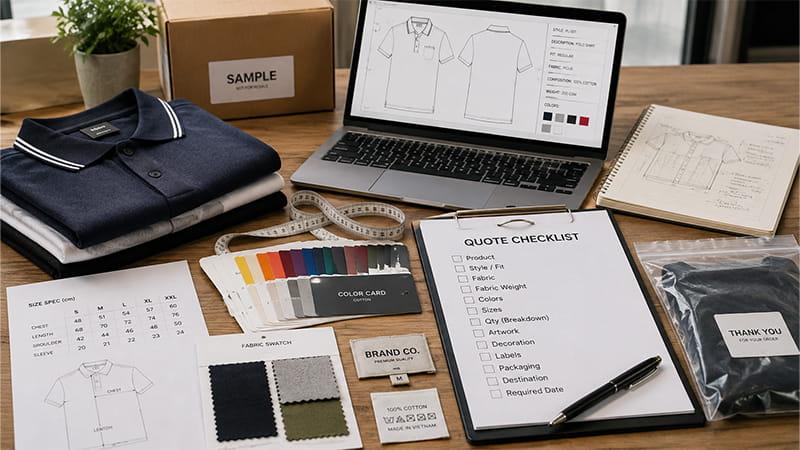
An accurate quote starts with an accurate specification.
| Specification | What to Provide |
|---|---|
| Product | T-shirt, hoodie, polo, jacket, etc. |
| Style / Fit | Regular, relaxed, oversized, etc. |
| Fabric | Required composition |
| Fabric Weight | GSM if relevant |
| Colors | Required garment colors |
| Sizes | Required size range |
| Quantity | Breakdown by color and size |
| Artwork | Vector or print-ready artwork |
| Decoration | Printing, embroidery, etc. |
| Labels | Main, size, and care labels |
| Packaging | Standard or custom |
| Destination | Country or warehouse |
| Required Date | Target delivery date |
“I want to start a clothing brand” is not enough information for an accurate production quote.
Without detailed specifications, manufacturers may make different assumptions.
One supplier might quote a lightweight stock T-shirt with one-color printing and standard packing. Another may assume heavyweight cotton, multi-color decoration, private labels, and individual custom packaging.
The prices differ because the products being priced are different.
This leads to a practical sourcing rule:
Compare suppliers only after you have made the quotations comparable.
Send the same garment specification, artwork, quantity breakdown, decoration requirements, packaging, destination, and requested commercial terms to each supplier.
That gives the clothing brand a much more useful basis for comparing production costs.
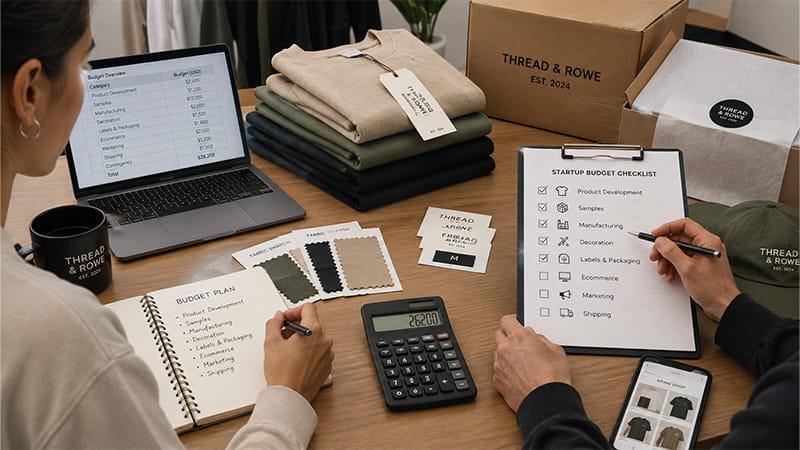
Clothing Brand Startup Budget Checklist
Before committing the full startup budget, confirm that you have considered:
- Product development
- Samples
- Manufacturing
- Decoration
- Labels and packaging
- Ecommerce and photography
- Marketing
- International and domestic shipping
- Business registration and administration
- Customer fulfillment
- Contingency
Confirm the product specification, sample requirements, production quantity, and shipping assumptions before committing all available capital.
Conclusion
There is no universal answer to how much does it cost to start a clothing brand. The right startup budget depends on the production model, SKU complexity, customization, inventory strategy, sales channel, and launch plan.
The strongest clothing startup budgets do more than add up factory prices. They account for development, inventory, landed cost, customer acquisition, and the cash the business still needs after production begins.
For a new clothing brand, launching lean usually means reducing unnecessary complexity before reducing the quality of the product itself.
Need Help Planning Your First Apparel Order?
Planning your first apparel order? Share your garment type, colors, sizes, quantity, artwork, customization requirements, destination, and required date with TOMAS Crafts. TOMAS can help compare garment options, decoration methods, samples, packaging, and bulk-production requirements before you commit to production.
You can also explore TOMAS Crafts for custom promotional apparel and broader branded product solutions.
FAQs
1. Can You Start a Clothing Brand With $1,000?
A $1,000 budget may be enough to test some clothing business models, particularly POD, preorders, or a very lean T-shirt concept.
It should not be treated as a universal budget for private-label inventory or fully custom manufacturing.
If the objective is demand validation, a low-inventory business model may be enough. If the goal is a proprietary garment involving custom fabric, patterns, packaging, and bulk stock, substantially more capital may be required.
2. What Is the Cheapest Way to Start a Clothing Brand Without Sacrificing Quality?
Reduce complexity first.
Start with fewer styles, colors, SKUs, artwork versions, and packaging formats. Use suitable existing garments when full custom development is not central to the product.
Avoid saving money by choosing an unsuitable fabric or skipping a sample needed to confirm the garment.
The lowest-cost launch is not necessarily the one with the cheapest unit price. It is the one that tests demand without creating unnecessary product-development and inventory exposure.
3. How Much Inventory Should a New Clothing Brand Order?
There is no universal starting quantity.
The right amount depends on MOQ, SKU count, expected demand, preorder information, audience size, sales channel, reorder lead time, and available working capital.
A clothing line with several colors and sizes should plan inventory at SKU level rather than looking only at total pieces.
A smaller production run may cost more per unit but still create a healthier launch if it prevents excessive slow-moving inventory.
4. What Information Does a Clothing Manufacturer Need for an Accurate Quote?
Provide the garment type, style and fit, fabric composition, fabric weight where relevant, colors, size range, quantity by size and color, artwork, decoration method, labels, packaging, destination, and required date.
If you are comparing manufacturers, send the same specification to each one. Otherwise, one supplier may be pricing a different garment, decoration process, or packaging method from another.
Clear specifications make production costs easier to compare and reduce avoidable revisions later.