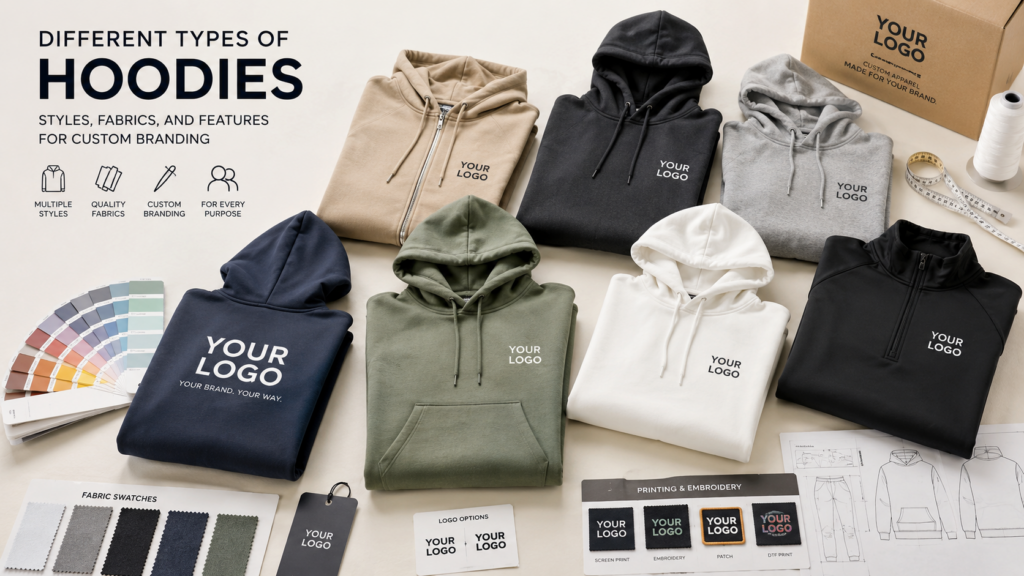
Hoodies are easy to wear, easy to brand, and practical for many business projects. But not every hoodie fits the same purpose.
A heavyweight fleece hoodie may feel right for employee gifts. A lightweight pullover may be easier to pack for event giveaways. A polyester hoodie may work better for sports teams or fitness campaigns.
For custom apparel buyers, the wrong style can affect logo placement, packaging size, production time, and final cost. This guide compares different types of hoodies by style, fabric, feature, and branding use, so you can choose a hoodie that looks good and works well for the project.
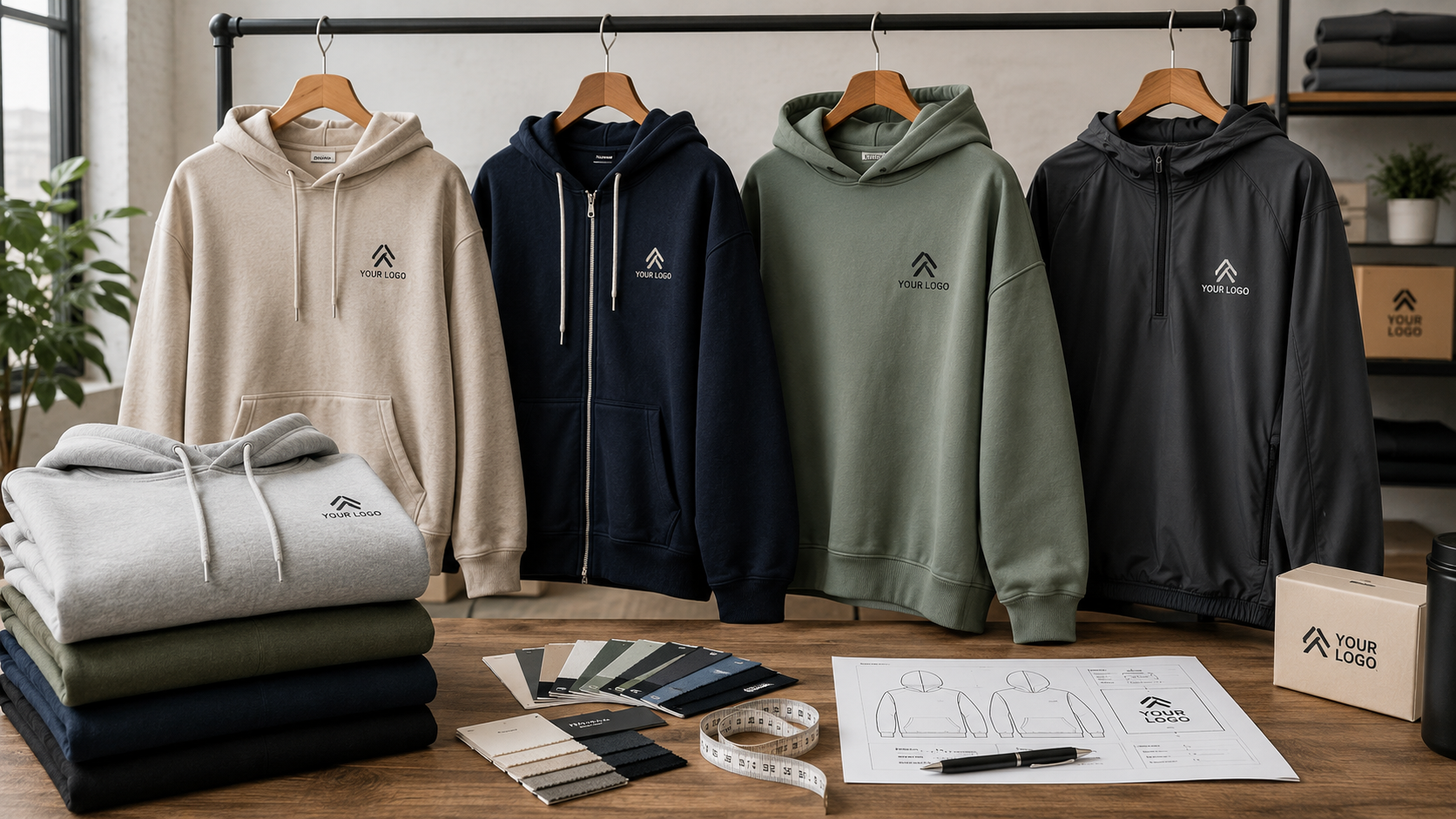
How to Choose the Right Hoodie Type for Your Audience
Before comparing hoodie styles, start with the people who will wear them.
A hoodie for a trade show giveaway does not need the same fabric weight as a hoodie for premium employee gifts. A gym hoodie should feel breathable and easy to move in. A corporate hoodie may need a cleaner look with subtle embroidery.
For business buyers, the right hoodie usually comes down to four things: use case, season, logo placement, and budget. Hoodies can work as part of a broader custom apparel solution for employees, school teams, events, and branded merchandise.
If the hoodie will be worn often, comfort matters most. If it will be used for branding, logo visibility matters more. If the event date is fixed, production time and shipping volume also become part of the decision.
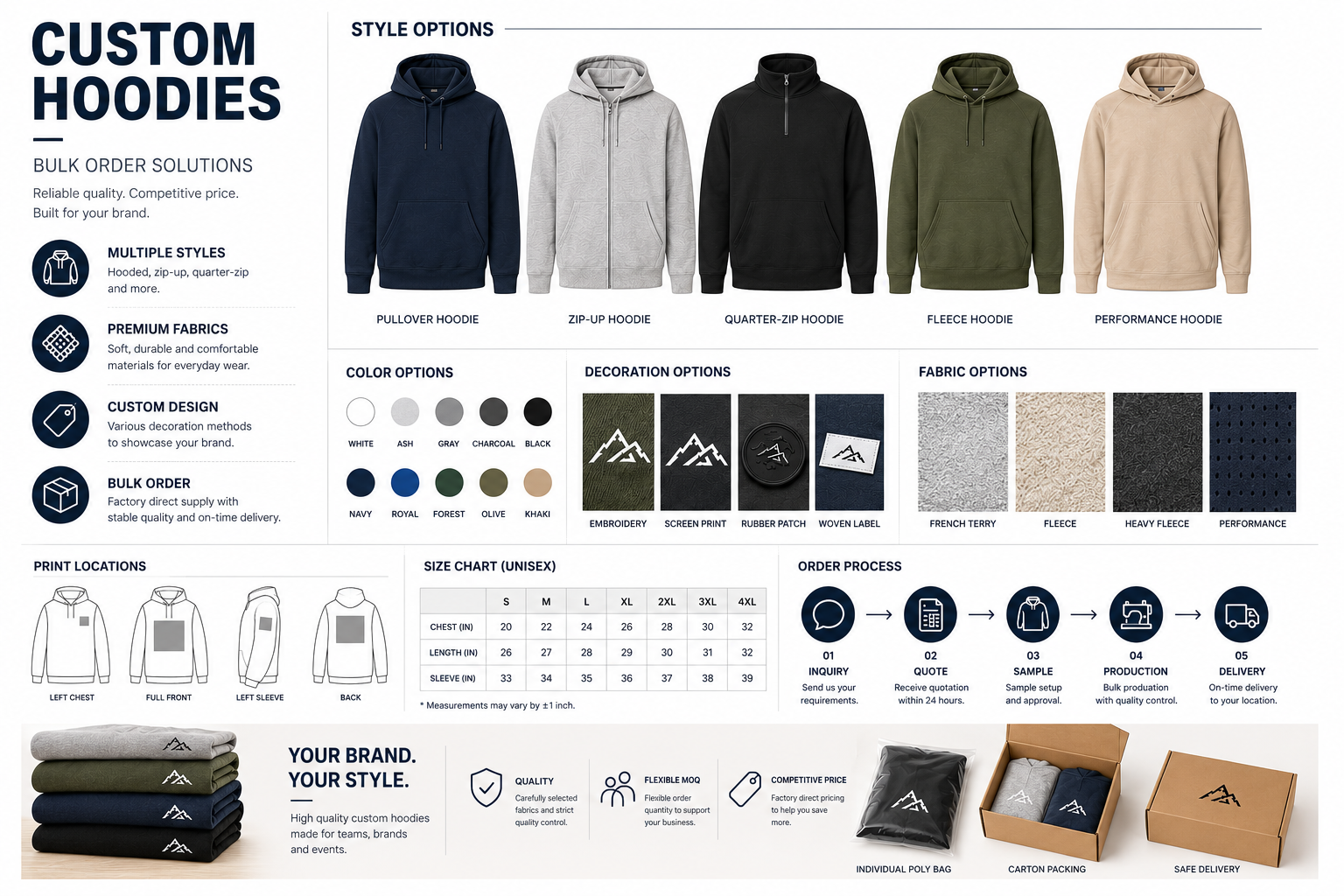
Hoodie vs Sweatshirt: What’s the Difference?
- Hoodie is usually a sweatshirt with a hood. It may include drawstrings, a kangaroo pocket, a zipper, or performance features.
- Sweatshirt is the broader category. It can include crewneck styles, quarter-zips, or pullovers without a hood.
For branding, hoodies feel more casual and relaxed. They are a strong fit for team apparel, event giveaways, school activities, sports programs, and branded merchandise. Sweatshirts usually look simpler. They may feel more suitable for low-key office apparel or minimal corporate gifts.
The easier way to choose is this: pick a hoodie when you want a casual item with strong logo visibility. Pick a sweatshirt when you want something cleaner and more understated.
Different Hoodie Styles
Different hoodie styles are not just about fashion. The shape affects how the hoodie is worn, where the logo can go, how easy it is to produce, and how suitable it is for bulk orders.
- Pullover Hoodie
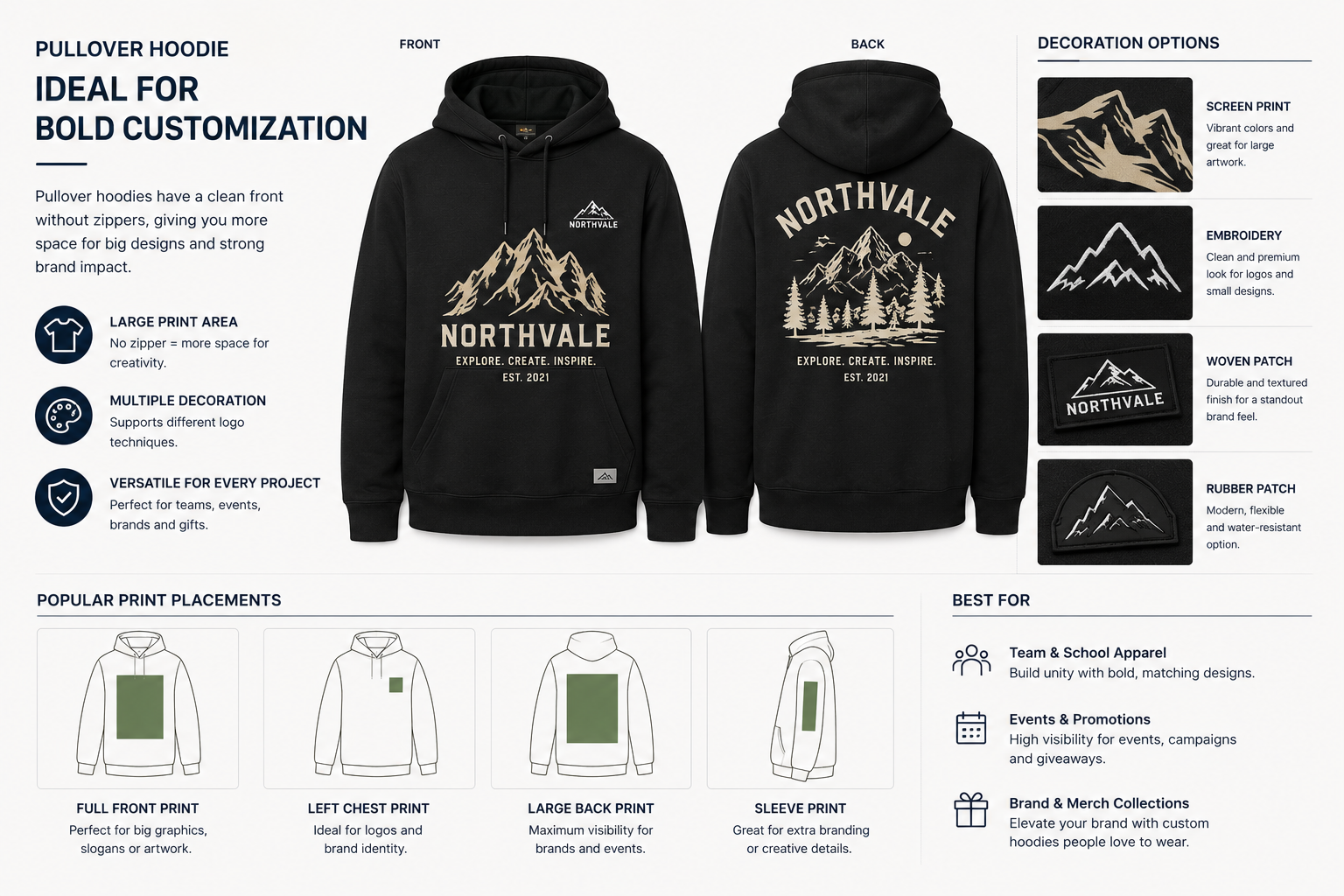
A pullover hoodie is the classic no-zip style. It usually has a hood, drawstrings, ribbed cuffs, and either a kangaroo pocket or no pocket.
For custom branding, this is one of the safest hoodie types. There is no zipper cutting through the front, so the clean front panel gives you more room for a chest print, full-front artwork, or large back design.
Choose pullover hoodies for school apparel, employee gifts, event merchandise, and promotional campaigns. They work well with screen printing, embroidery, heat transfer, or patches.
- Zip-Up Hoodie
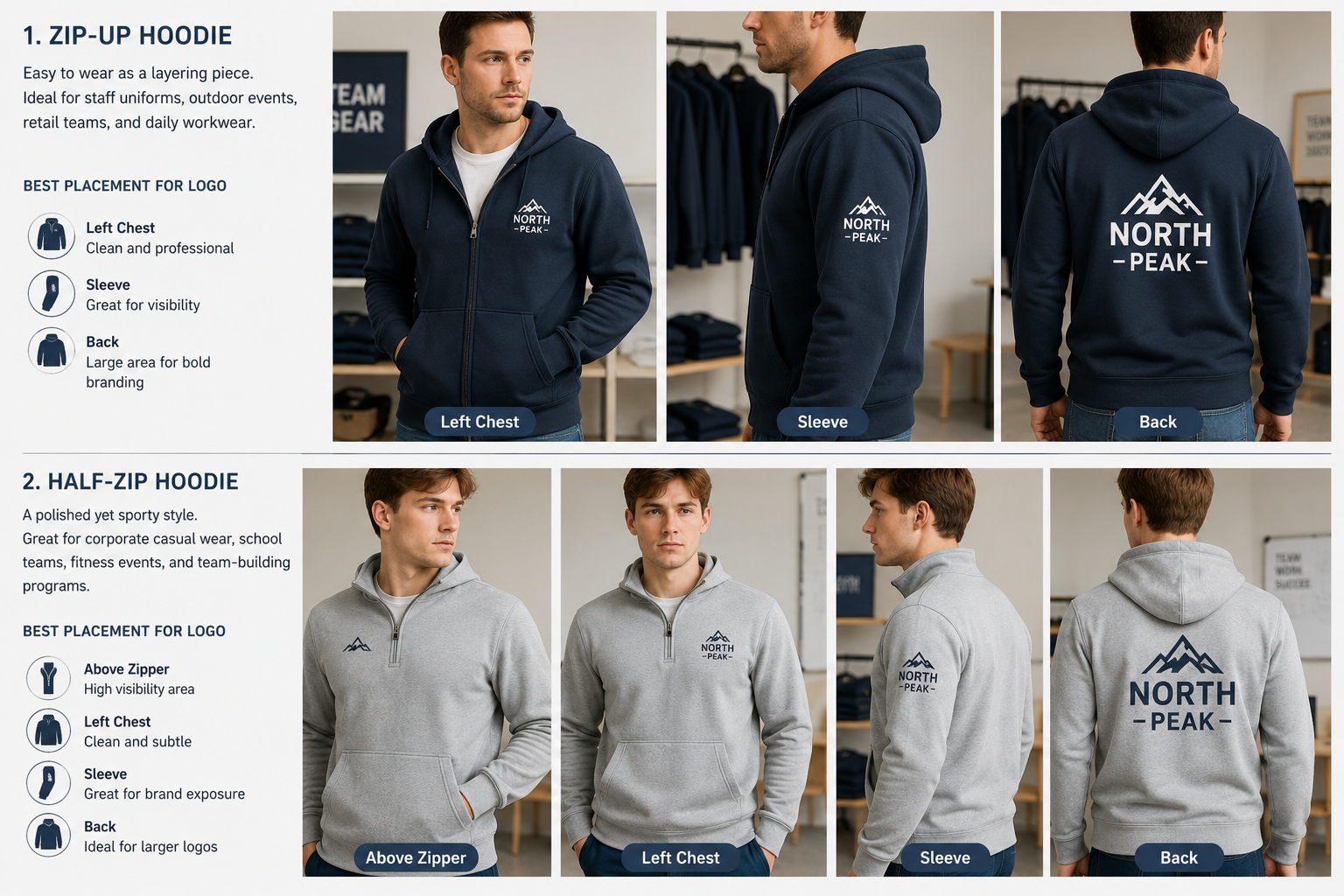
A zip-up hoodie, also called a full-zip hoodie or zip hoodie, is easier to wear as a layering piece. It is one type of hoodie people choose when they need convenience for staff uniforms, outdoor events, retail teams, and daily workwear.
The main branding detail is the zipper. A large front graphic may be interrupted, so it is usually better to place the logo on the left chest, sleeve, or back.
If the project needs a large front logo, choose a pullover. If the wearer needs easy layering or temperature control, choose a zip-up hoodie.
- Half-Zip Hoodie
A half-zip hoodie sits between a pullover and a full-zip hoodie. It looks a little more polished than a basic pullover, but it still keeps a sporty and casual feel.
You’ll often see this style in corporate casual wear, school teams, fitness events, and team-building programs because it looks cleaner than a standard hoodie without feeling too formal.
For branding, the safest areas are above the zipper, the left chest, the sleeve, or the back. Among popular hoodie styles, this one often fits programs that want a cleaner finish without losing comfort. If the fabric is thick enough, embroidery can create a clean corporate finish.
- Sleeveless Hoodie
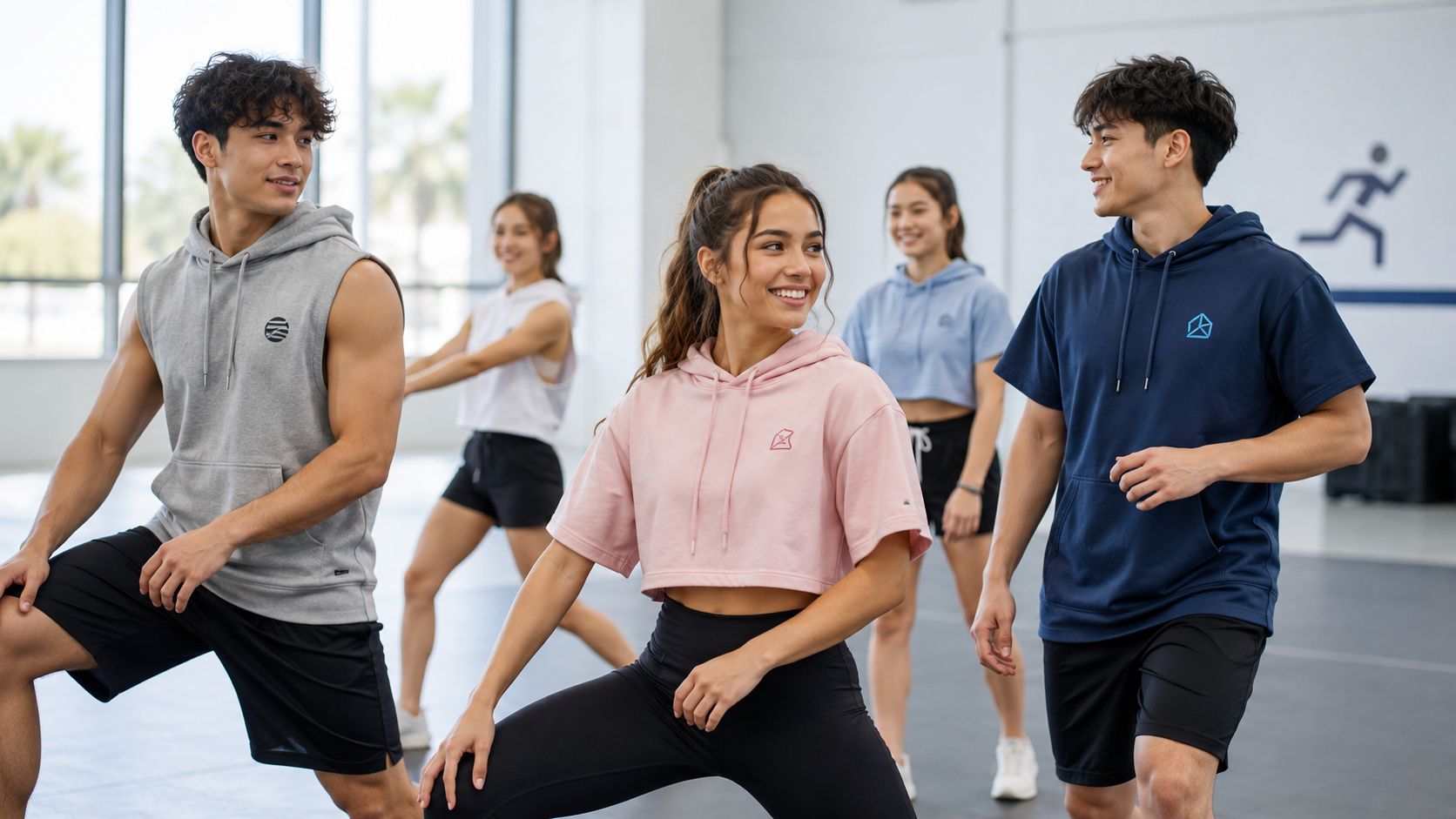
Sleeveless hoodies are built for movement. They keep the hooded look but remove the sleeves, making them suitable for gyms, training events, dance teams, and warm-weather sports activities.
This is not the first choice for general corporate gifting. It works better when the audience already expects activewear or fitness apparel.
For customization, chest logos and back prints are usually easier to read than small detailed artwork. If the fabric stretches, confirm the print method before bulk production.
- Short-Sleeve Hoodie
A short-sleeve hoodie gives the casual look of a hoodie without the warmth of a full-sleeve fleece style. It can work for warmer climates, spring events, summer campaigns, outdoor promotions, or fitness programs.
This style feels relaxed and youthful. It is not usually a premium corporate gift item, but it can be practical for casual event merchandise or warm-weather campaigns.
Simple chest prints, sleeve graphics, and back logos can work well, depending on the fabric.
- Cropped Hoodie
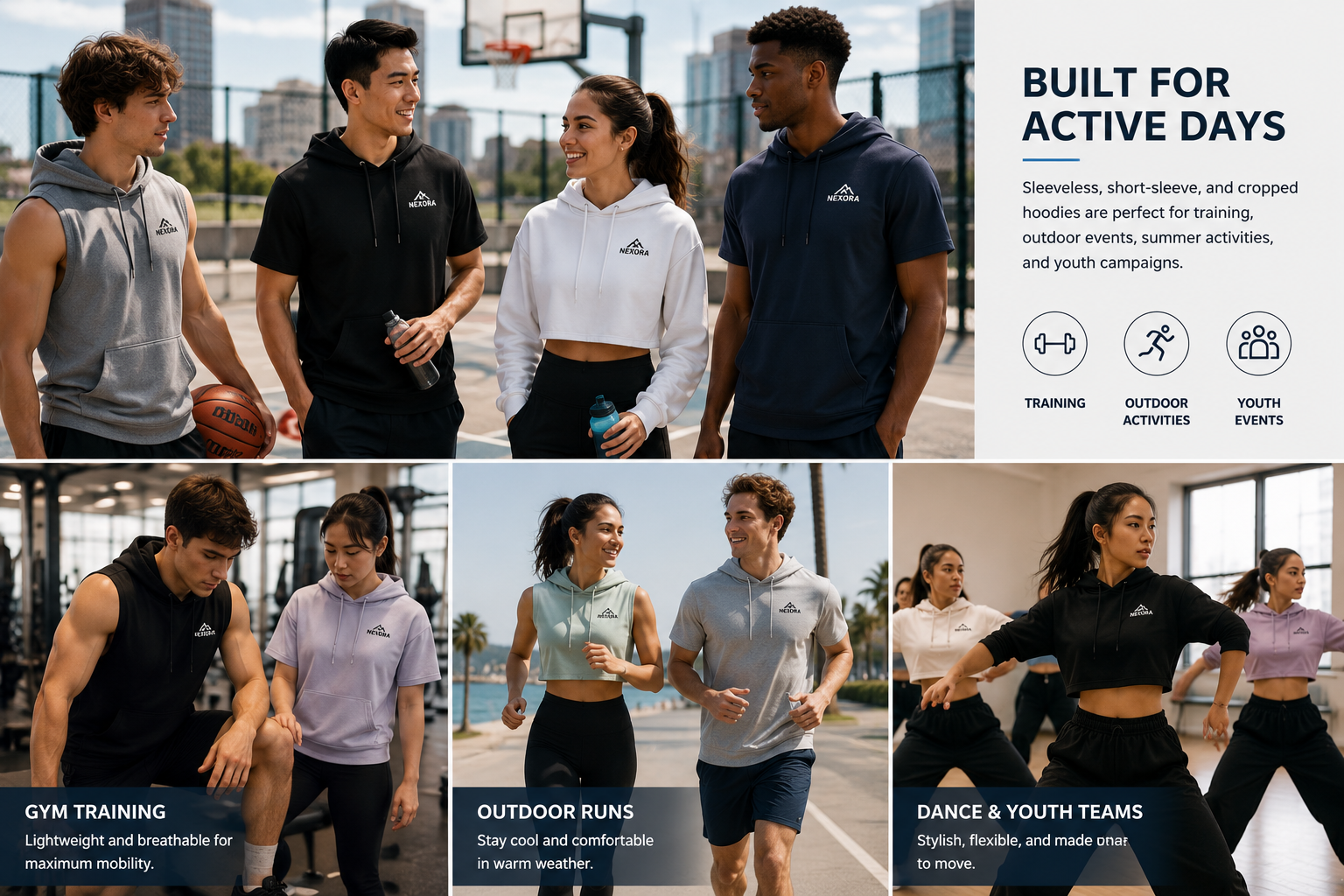
Cropped hoodies are more fashion-driven. They have a shorter body length and are often used for lifestyle brands, dance teams, gyms, youth campaigns, and summer merch drops.
This style can create a strong visual identity, especially when paired with matching bottoms or branded activewear.
Choose cropped hoodies only when the audience already expects fashion-led apparel. They are less universal for broad employee programs or conservative corporate gifts.
- Oversized Hoodie
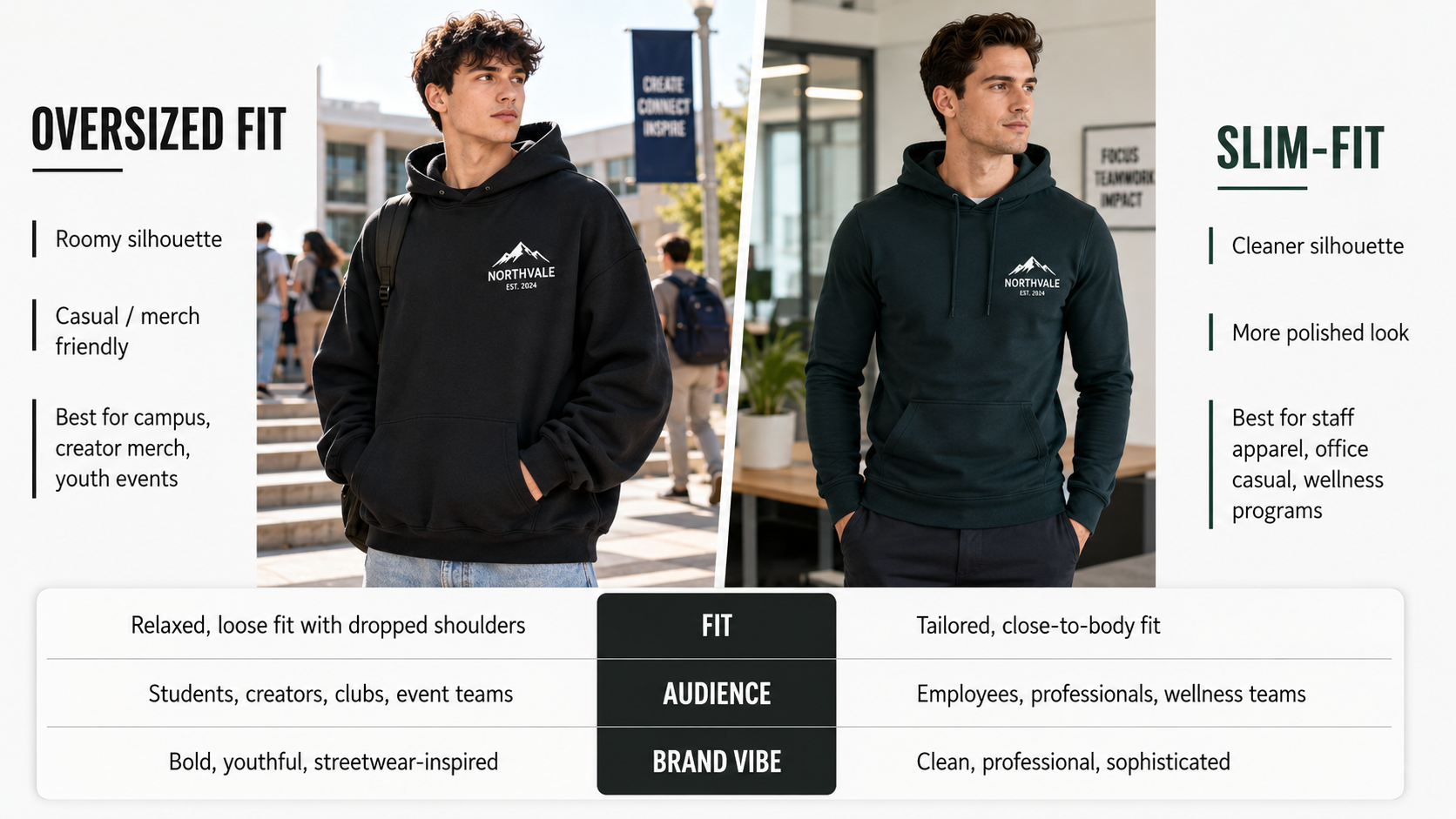
Oversized hoodies have a relaxed, streetwear-inspired fit. They are popular for campus events, creator merch, music festivals, fashion drops, and youth-focused campaigns.
The larger silhouette gives more room for bold artwork, oversized back prints, puff prints, sleeve graphics, or woven patches.
For bulk orders, size planning matters. Oversized fits do not follow the same expectations as standard apparel sizing, so buyers should confirm measurements before production.
- Slim-Fit or Fitted Hoodie
Slim-fit hoodies offer a cleaner and more tailored look. They are suitable for retail teams, office casual uniforms, premium staff apparel, wellness programs, and athleisure-style branding.
This style usually looks better with subtle decoration. A small chest logo, clean embroidery, tone-on-tone branding, or simple sleeve mark can look more professional than a large front graphic.
For corporate buyers, fitted hoodies can feel more polished than oversized or graphic styles, especially when comparing different styles for a more refined look.
Types of Hoodie Materials
Match the fabric to the season, wearer, logo method, and budget. Material decides how the hoodie feels, how warm it is, how well it prints, and how practical it is for bulk orders.
| Hoodie Material | Best For | Branding Note | Buying Concern |
| Cotton | Daily wear, casual merch | Good for simple prints and soft hand feel | May shrink depending on fabric treatment |
| Cotton-poly blend | Bulk custom orders | Works with many logo methods | Check fabric weight and hand feel |
| Fleece | Winter gifts, outdoor use | Embroidery or patches work well | Bulkier carton volume |
| French terry | Year-round casual wear | Good for light embroidery and printing | Not as warm as fleece |
| Polyester | Sports and fitness | DTF or heat transfer works well | Test logo durability on stretch fabric |
| Recycled polyester | Eco campaigns | Supports sustainability messaging | Verify material claims and documentation |
French Terry Hoodie
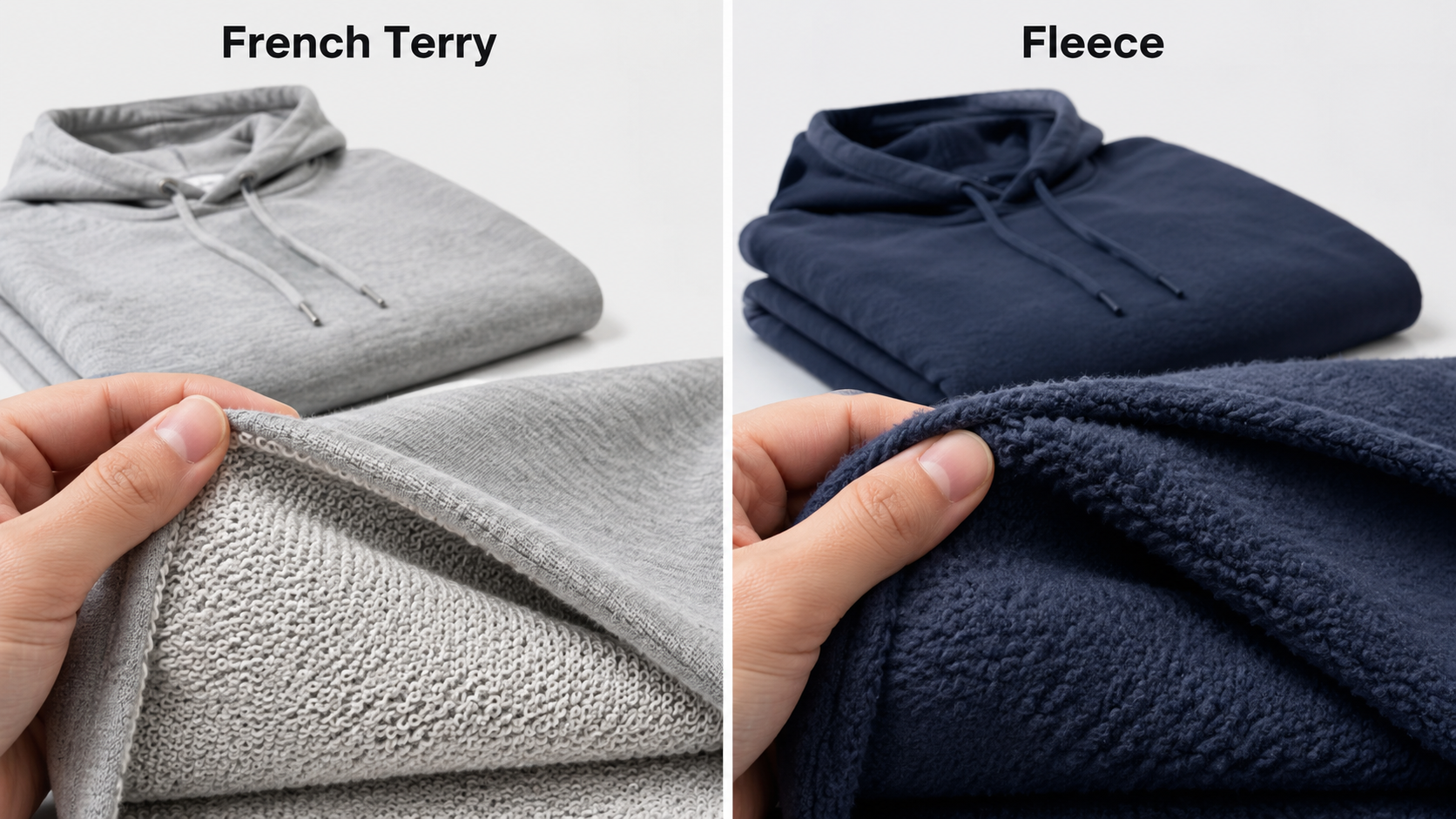
French terry is usually lighter than fleece. It is a knit fabric with soft loops on the inside and a smooth surface on the outside, which makes it comfortable for casual wear and athleisure styles. Cotton Incorporated also describes French terry as a versatile knit with soft loops inside and a smooth outside surface.
French terry hoodies are a good middle option when buyers want something more substantial than a thin lightweight hoodie but less bulky than winter fleece. The classic pullover hoodie keeps the simple no-zip structure, so it works well for spring, autumn, travel programs, casual uniforms, and lifestyle merchandise.
For branding, French terry usually supports printing and light embroidery well, depending on fabric weight and surface texture.
Fleece and Polar Fleece Hoodies
Fleece hoodies are warm, soft, and popular for winter gifts, outdoor staff apparel, school programs, and cold weather events. They often feel more substantial than lightweight hoodies, which can make them suitable for employee gifts or premium giveaways. A sherpa lined hoodie adds extra insulation for colder conditions, while faux fur lining on the inside can make the garment feel even cozier.
For chilly weather or colder climates, polar fleece is usually a better fit when warmth matters more than a smooth fashion look.
Supplier tip: In large winter orders, this is easy to miss. Fleece hoodies may look simple on the product page, but they can take much more carton volume than lightweight pullovers. That can affect packing, storage, and shipping cost.
Polyester Hoodie
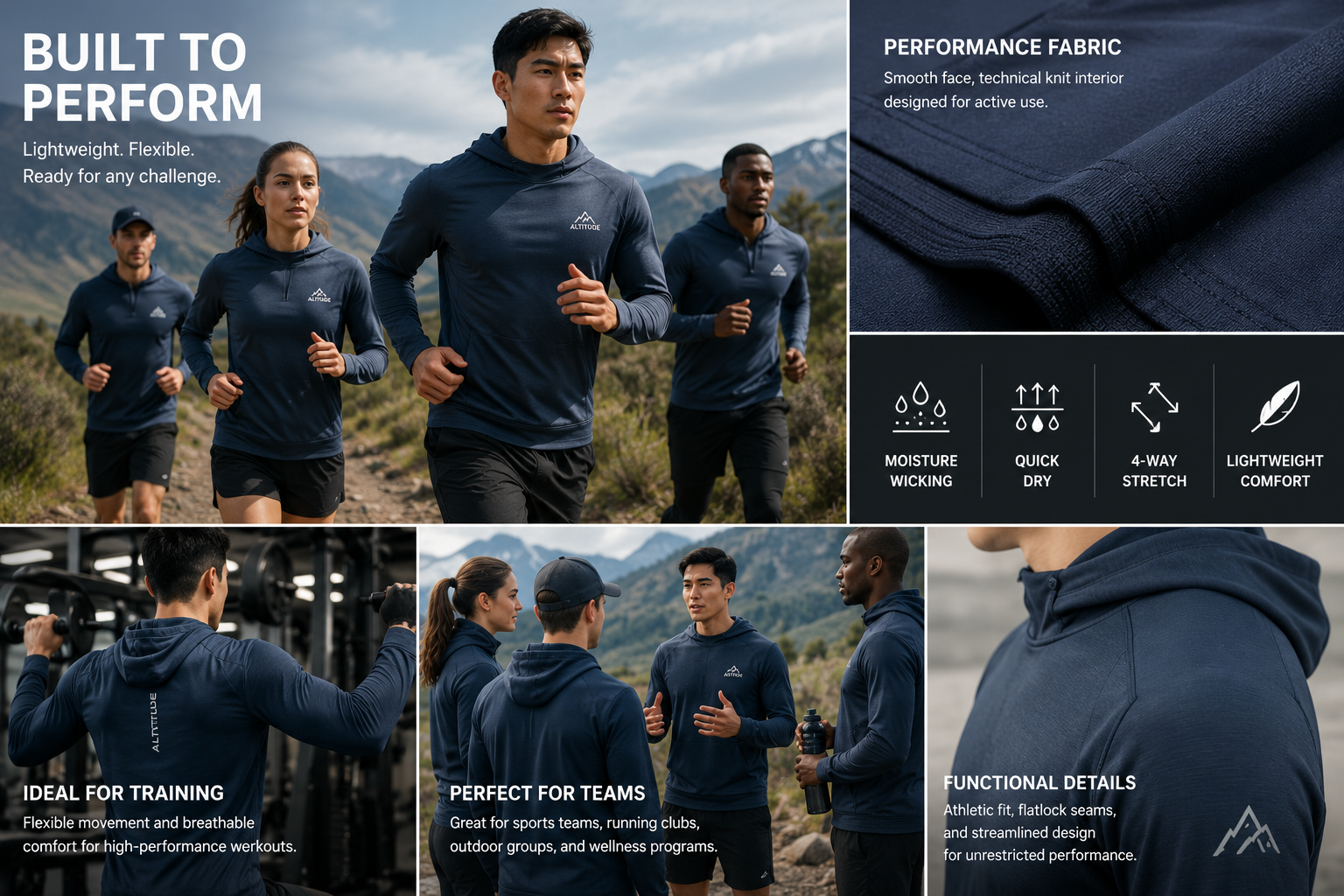
Polyester is commonly used in sports and performance wear. Polyester hoodies may offer moisture-wicking, quick-dry, or stretch properties, depending on the fabric construction.
This material works well for fitness brands, sports teams, outdoor activities, wellness programs, and active event campaigns.
For logo customization, the printing method matters. DTF printing, heat transfer, or other lightweight decoration methods may work better than heavy ink layers, especially if the fabric stretches.
Polyester is also important in the wider textile market. Textile Exchange’s 2025 Materials Market Report states that polyester accounted for 59% of global fiber production in 2024, making it the most widely produced fiber globally.
Cotton and Cotton-Blend Hoodies
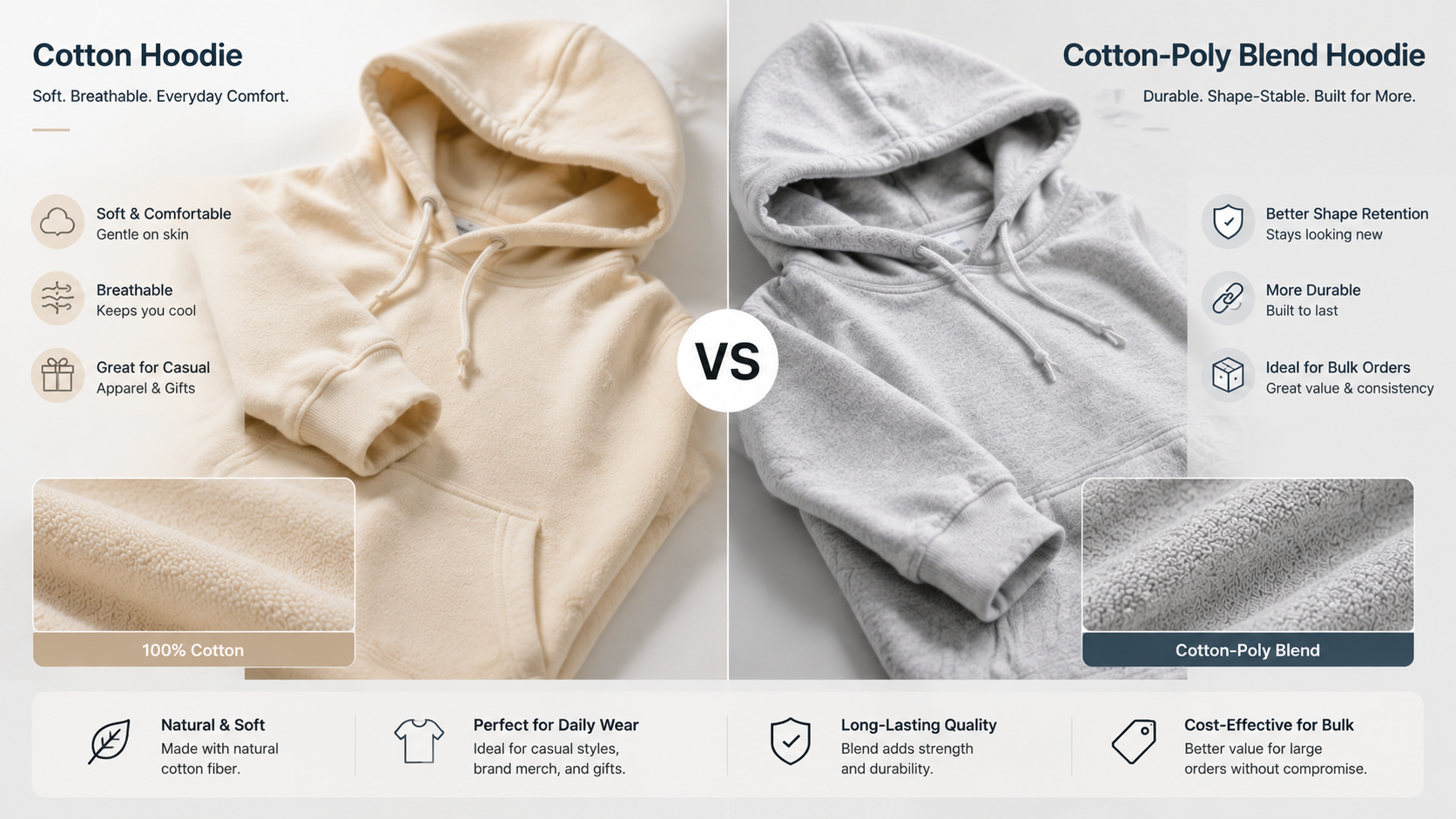
Cotton is a natural fiber, so it often feels softer and more breathable than many synthetic options. Cotton hoodies are often used for casual apparel, brand merchandise, and employee gifts.
Cotton-poly blends are especially common for bulk hoodie orders because they balance comfort, durability, shape stability, and cost.
For promotional use, cotton-blend hoodies are easier to manage than very delicate or specialty fabrics.
Some hoodie projects may use niche fabrics such as jersey, modal, wool blends, neoprene, or terry cloth. These are useful when the design concept, retail price point, or brand positioning needs a special feel.
For most bulk B2B orders, however, organic cotton hoodies, cotton-poly, fleece, French terry, recycled polyester, and polyester are usually easier to source, decorate, and manage.
Graphic, Embroidered, and Printed Hoodie Styles
Some hoodie types are defined less by silhouette and more by decoration. For branded apparel, decoration can completely change the final impression.
Graphic Hoodies for Merch and Event Campaigns
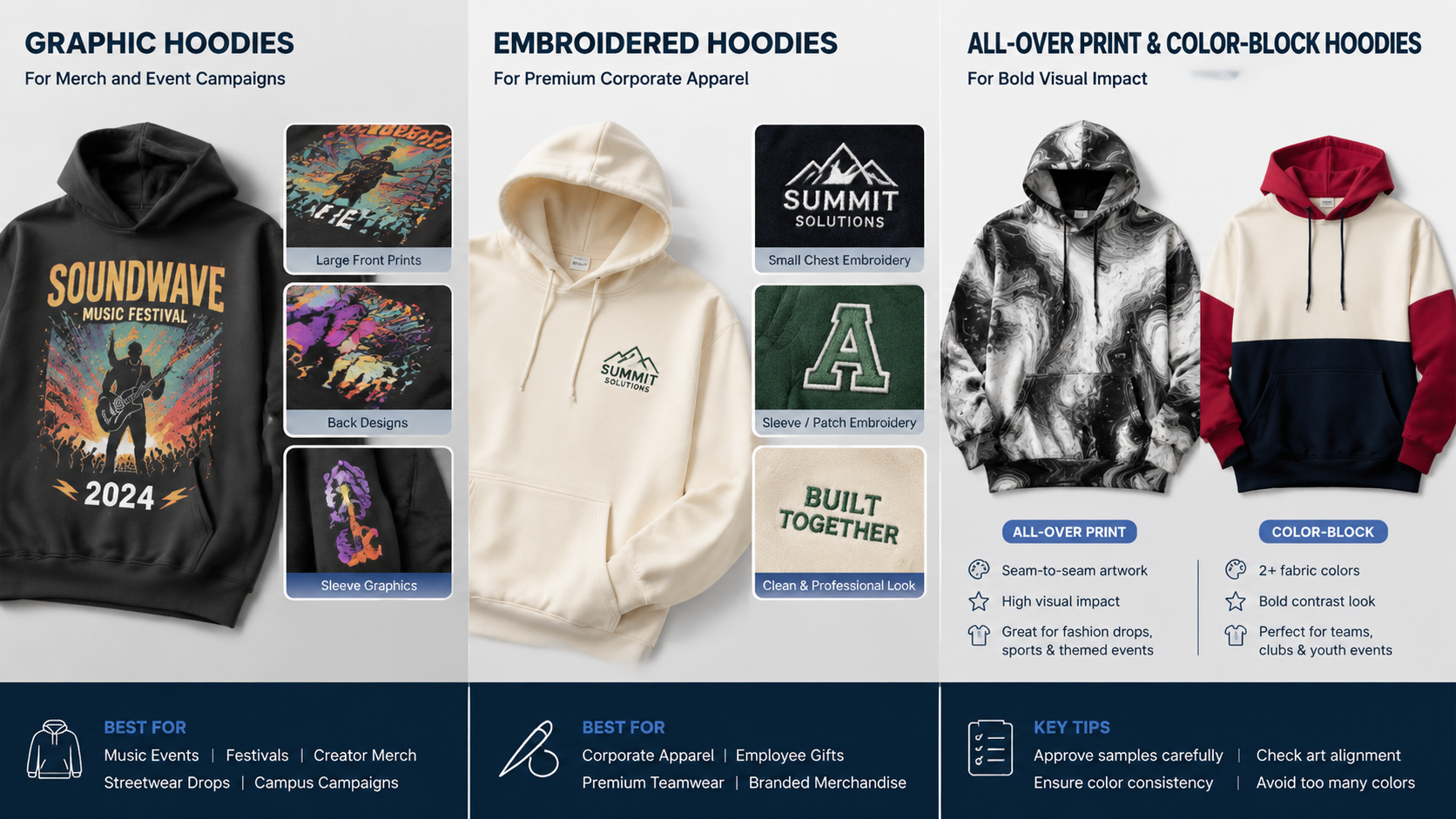
Graphic hoodies are built around artwork. They may use large front prints, oversized back designs, sleeve graphics, or full-color illustrations.
This style fits music events, festivals, creator merch, streetwear drops, campus campaigns, and youth-focused promotions. A graphic hoodie can feel more like a retail product than a simple promotional item.
Before sampling, check the artwork file, print size, color contrast, and fabric color. A strong graphic can lose impact if the colors do not stand out clearly on the hoodie.
Embroidered Hoodies for Premium Corporate Apparel
Embroidered hoodies feel more refined, and even graphic hoodies often rely on bold graphics as a key part of the hoodie design. They are often used for corporate apparel, employee gifts, premium teamwear, and subtle branded merchandise.
Small chest embroidery is one of the most common choices. Graphic hoodies commonly feature illustrations, slogans, or trend-driven visuals to express personal style. It looks clean, durable, and professional. Sleeve embroidery or small patch-style embroidery can also work well, especially when the placement supports the overall brand message.
Thread colors should match the brand palette, but contrast still matters. A dark logo on a dark hoodie may look elegant up close but disappear in photos or event settings.
All-Over-Print and Color-Block Hoodies
All-over-print hoodies use artwork across larger areas of the garment, often from seam to seam. They can create a strong visual effect for fashion merchandise, brand drops, sports campaigns, or themed events.
Color-block hoodies use two or more fabric colors to create contrast. They work well for school teams, sports clubs, youth events, and campaigns that want to match brand colors.
Both options need careful sample approval. For all-over print, check artwork alignment, seam placement, color consistency, and sizing before bulk production. For color-block hoodies, avoid using too many colors once a logo is added.
Hoodie Features That Affect Comfort, Function, and Cost
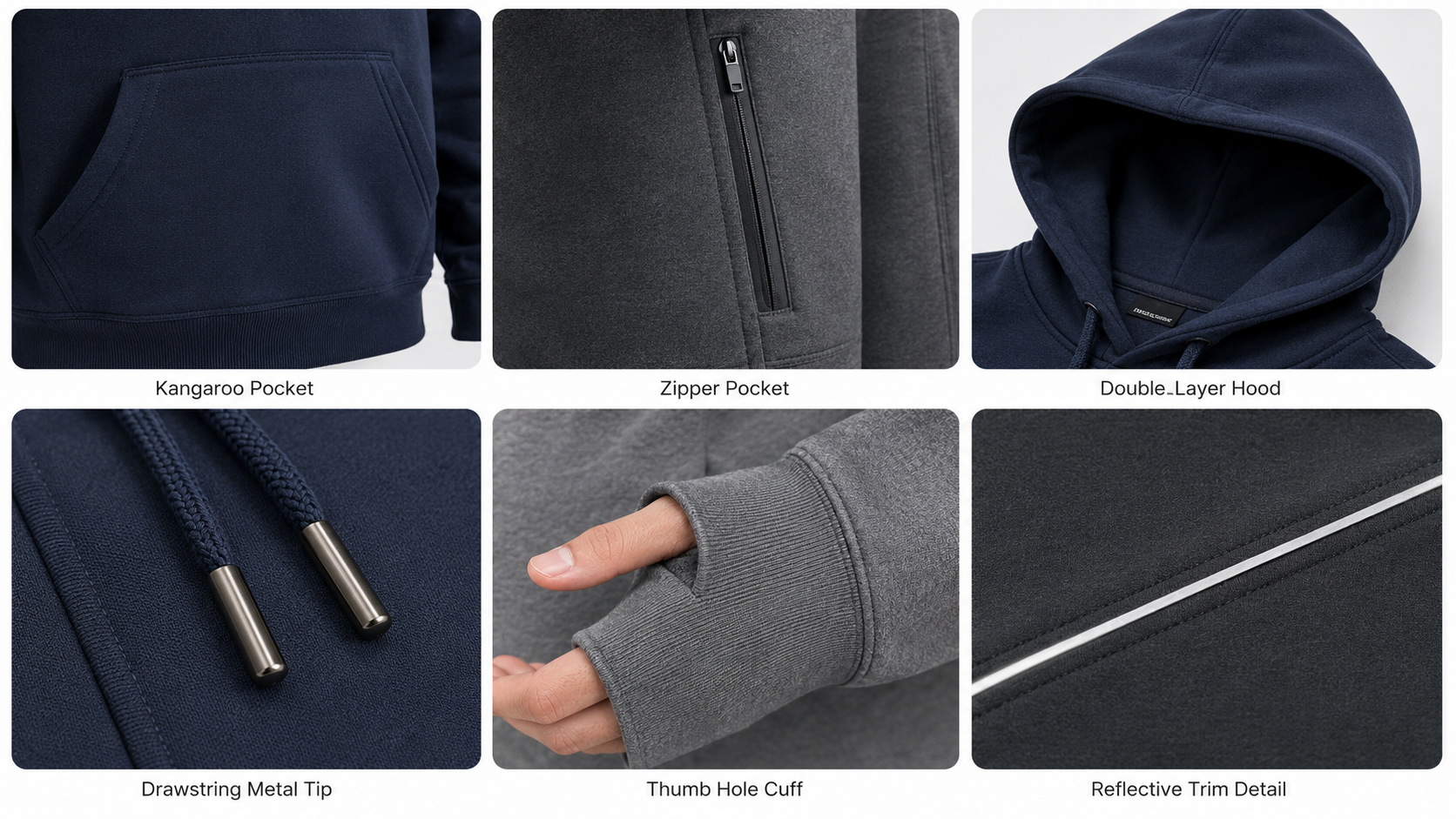
Small hoodie features can change how the garment feels, how it is used, and how much it costs to produce.
Pockets. Kangaroo pockets give a classic casual look. Zip pockets are more secure for travel teams, outdoor staff, and event workers. Hidden pockets can be useful for phones, wallets, badges, or keys.
Hood construction. A single-layer hood is lighter and may be more cost-effective. A double-layer hood gives better shape, warmth, and perceived quality.
Drawstrings. Flat cords, round cords, metal tips, plastic tips, or color-matched drawstrings each create a different impression. For branded apparel, matching the drawstring with the hoodie color or logo color can make the design feel more intentional.
Technical features. Windproof fabric, breathable panels, reflective trim, thumb holes, or water-resistant finishes can help outdoor teams, sports events, nighttime activities, running clubs, logistics staff, or activewear campaigns.
Do not add features just to make the hoodie sound better. Each feature should match the use case. Reflective trim is useful for outdoor night activity, but unnecessary for a basic office gift hoodie.
Which Hoodie Type Works Best for Your Project?
After comparing styles, materials, and features, the easiest way to choose is to match the hoodie type with the project goal.
| Project Goal | Better Hoodie Choice | Why It Works | Budget Note |
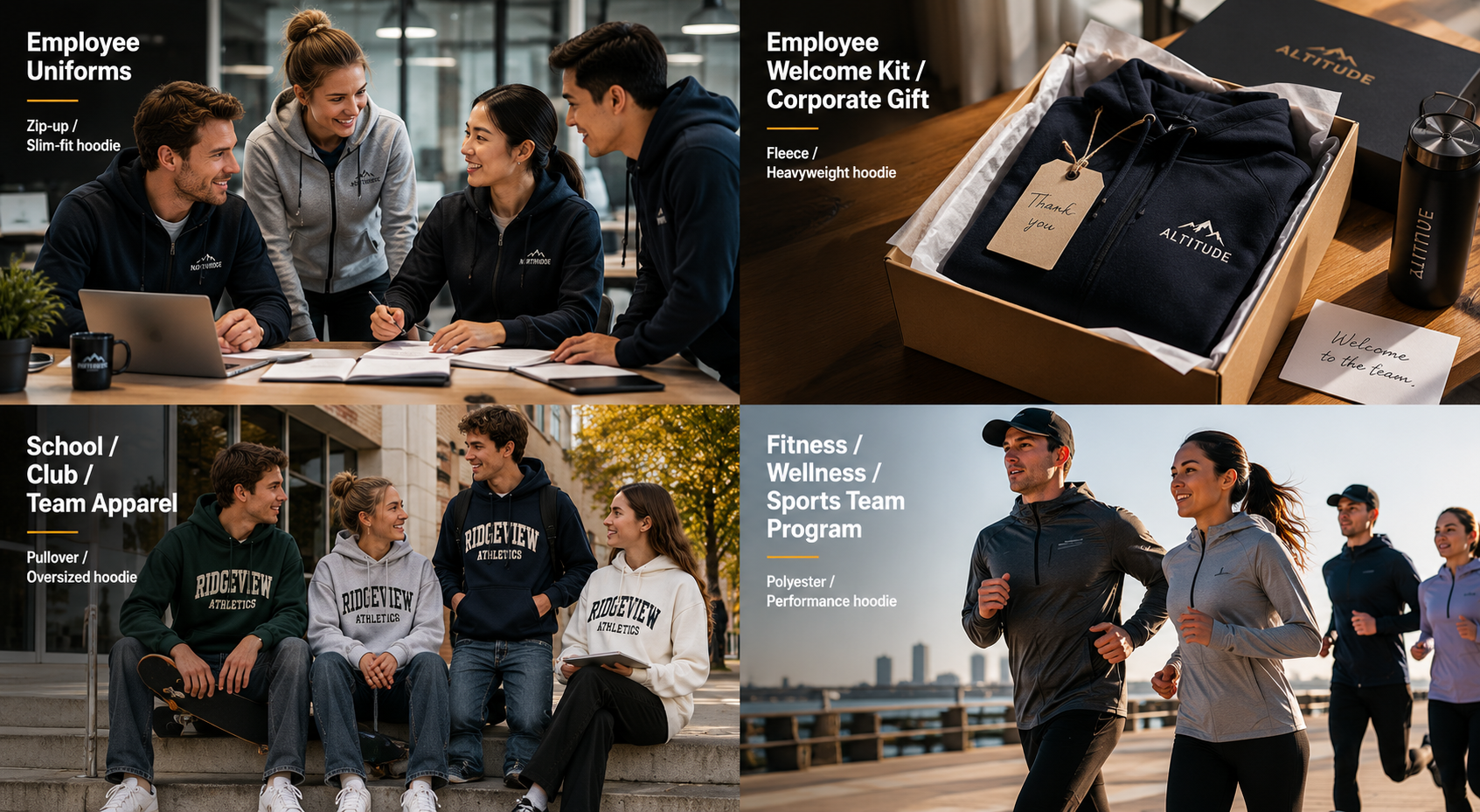
| Employee uniforms | Zip-up or slim-fit hoodie | Easy to layer and looks cleaner | Mid-range option |
| Trade show giveaways | Lightweight pullover | Easier to print, pack, and distribute | Helps control shipping volume |
| Corporate gifts | Fleece or heavyweight hoodie | Warmer and higher perceived value | Higher unit and freight cost |
| Branded merch | Oversized or graphic hoodie | Stronger fashion appeal | Better for retail-style projects |
| Fitness events | Sleeveless or polyester hoodie | Better breathability and movement | Test print durability |
| Winter campaigns | Fleece or polar fleece hoodie | Better warmth | Check carton volume early |
| Eco campaigns | Organic cotton or recycled polyester hoodie | Matches sustainability messaging | Verify material claims |
| Outdoor teams | Workwear or technical hoodie | More durable and functional | Higher feature cost |
This table can help narrow the choice quickly, but the final decision should still consider budget, order quantity, logo method, sample timing, and delivery date.
For corporate apparel programs, hoodies can also be combined with notebooks, drinkware, bags, or packaging as part of a wider corporate gift solution.
Custom Hoodie Logo Placement and Branding Tips
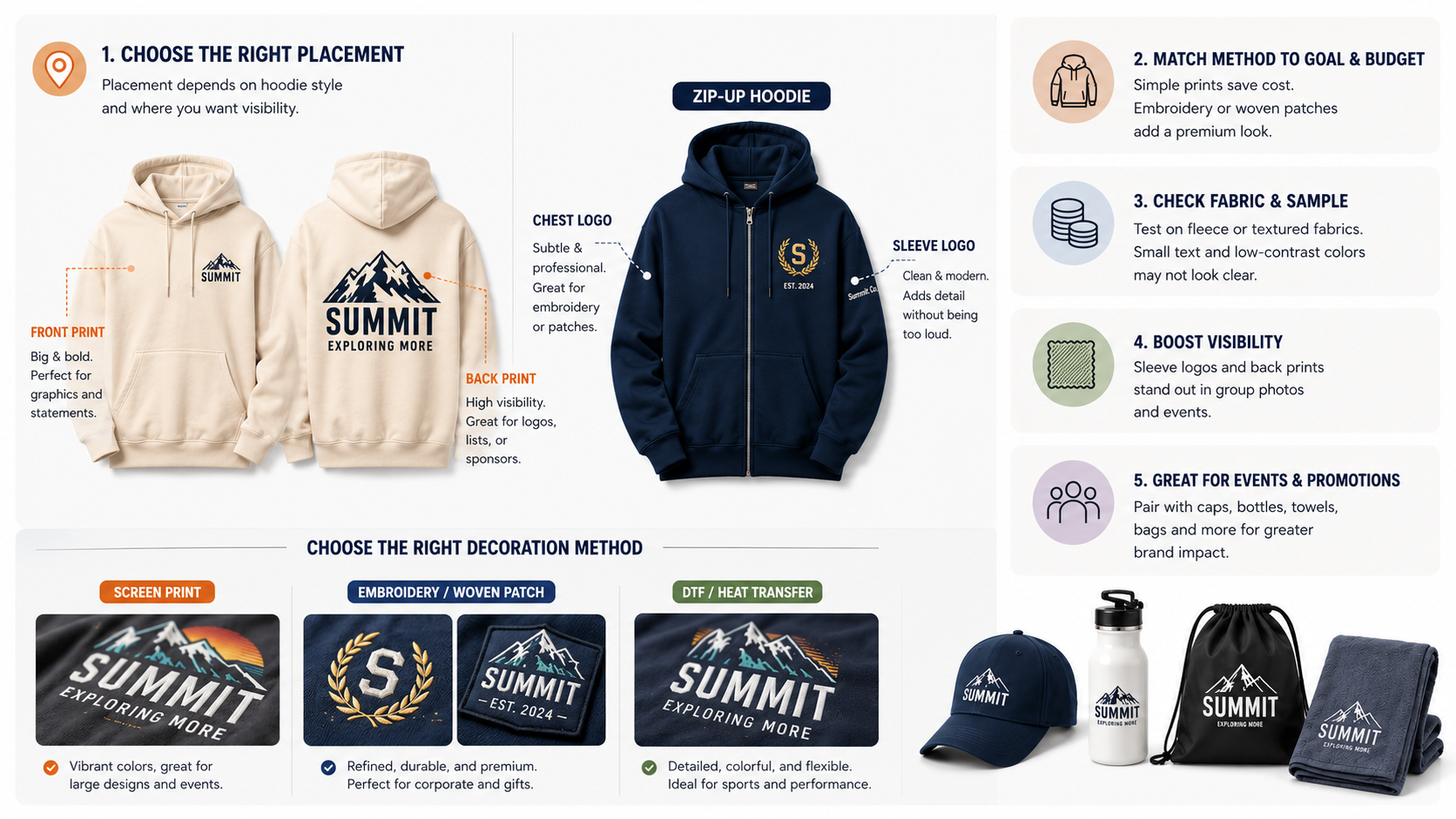
The hoodie style affects where the logo can go. A pullover gives you a clean front print area, while a zip-up hoodie usually works better with chest, sleeve, or back branding.
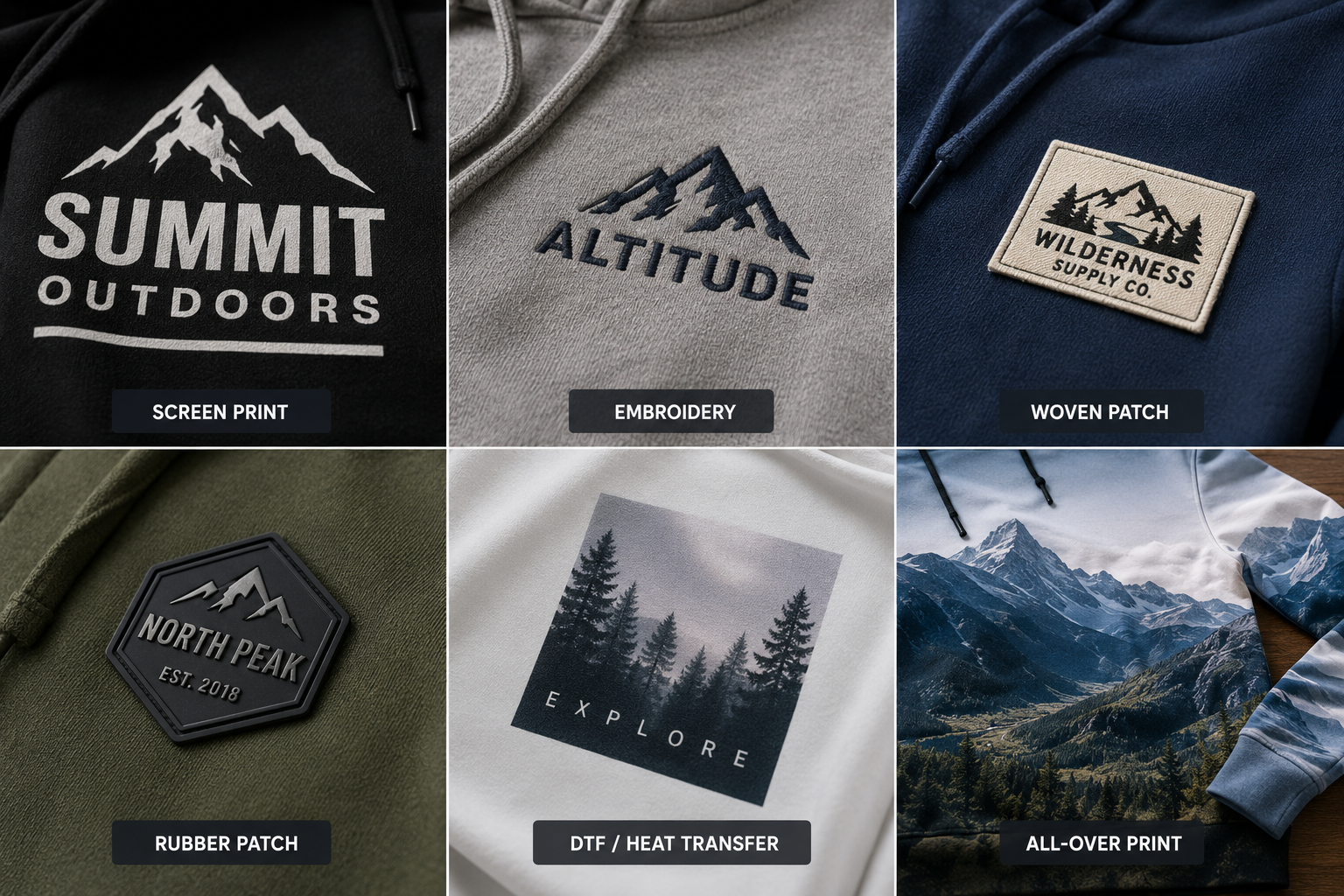
For simple bulk orders, a one-color front or back print can help control cost. For premium corporate apparel, embroidery or woven patches can create a more refined look. For sports and performance fabrics, heat transfer or DTF printing may be more suitable than heavy screen printing.
Supplier tip: If the hoodie uses fleece, French terry, or another textured fabric, check a physical logo sample before bulk production. Small text, fine lines, and low-contrast colors may not look clear on thick or textured hoodie fabrics.
For event staff, school teams, or sports activities, sleeve logos and back prints can improve visibility in group photos and on-site activities. These hoodie projects can also fit into broader promotional gifts for events when combined with caps, bottles, towels, drawstring bags, or fan items.
Before You Order Custom Hoodies
Choosing the hoodie style is only the first step. For custom hoodie orders, the small details decide comfort, branding quality, cost, and delivery timing.
Before placing a bulk order, group your checks into four areas:
| Check Area | What to Confirm | Why It Matters |
| Product details | Fabric swatches, fabric weight, size range, size ratio | Helps avoid wrong fabric feel, poor fit, or missing sizes |
| Branding details | Logo proof, print position, label design, care tags | Keeps the final hoodie aligned with your brand |
| Quality checks | Sample size and fit, wash stability, pilling resistance | Reduces the risk of rework after bulk production |
| Packing and delivery | MOQ, individual packaging, carton marks, delivery date | Helps control packing cost, shipping volume, and event timing |
Bulk order tip: Do not only confirm the size range. Confirm the size ratio and the actual wearer group. Employee orders usually need more accurate size collection, while giveaway orders often use a simpler size ratio. If the hoodies are for resale, sizing should match the target market more carefully.
For event orders, keep the design practical. A simple pullover with one logo is usually easier to manage than a hoodie with all-over print, multiple logo positions, custom labels, sleeve prints, and gift packaging. Complex details need more proofing time before bulk production, which can be risky when the event date is fixed.
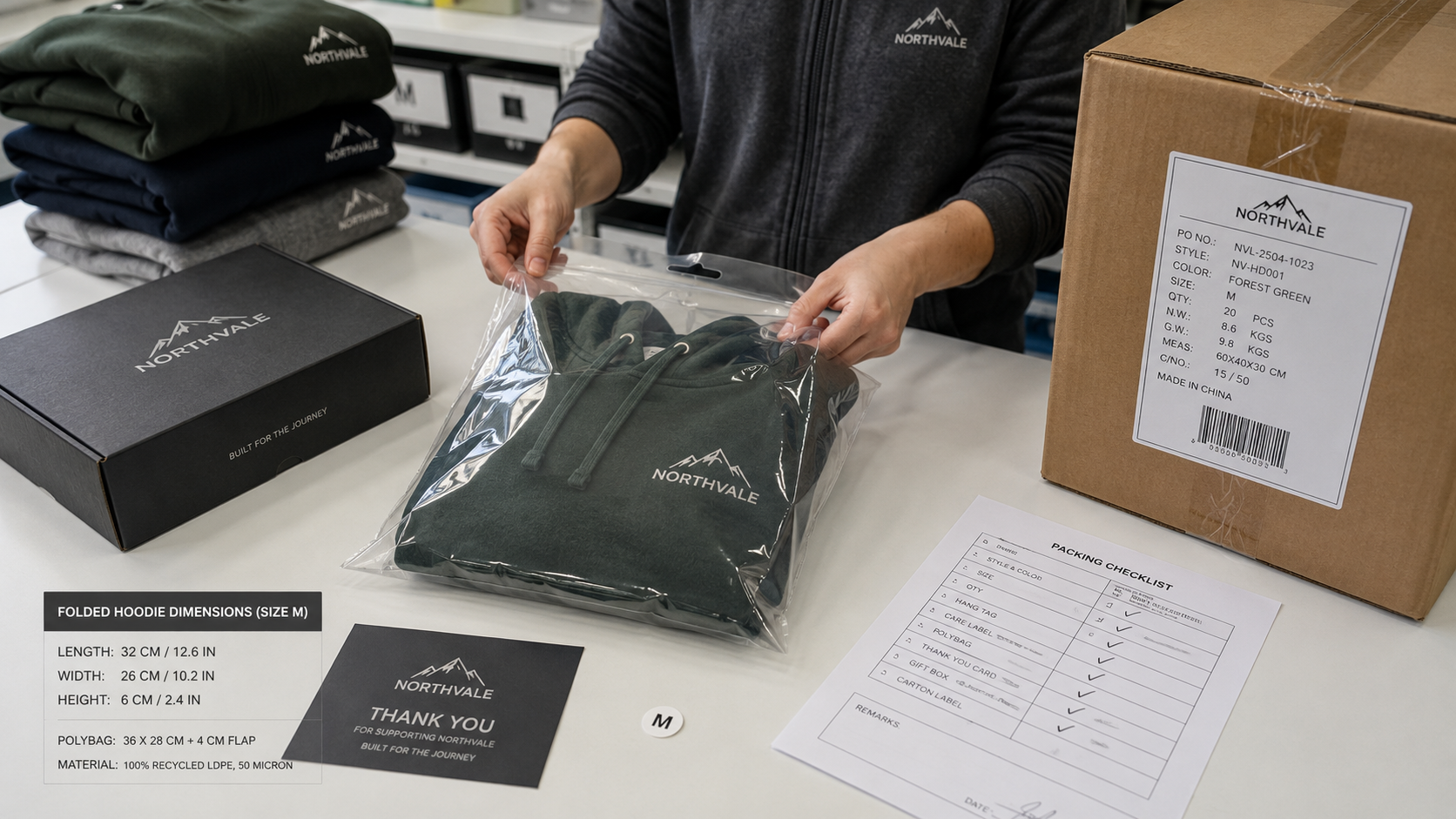
Packaging also affects more than presentation. A hoodie for employee onboarding may need individual polybags, size stickers, thank-you cards, or branded gift boxes. A hoodie for a trade show may only need simple packing that supports fast distribution.
Packaging tip: Gift packaging can make a hoodie feel more premium, but it also changes folded size, carton volume, and shipping cost. For employee welcome kits or corporate gifts, confirm the folded hoodie size before designing the gift box. If the box is confirmed too early, the hoodie may not fit neatly after folding.
FAQs
What are the main types of hoodies?
The most popular hoodies include pullover hoodies, zip-up hoodies, oversized hoodies, fleece hoodies, French terry hoodies, graphic hoodies, and embroidered hoodies. Other hoodie types include cropped, sleeveless, short-sleeve, half-zip, polyester, all-over-print, and color-block hoodies.
What hoodie style is best for custom branding?
Pullover hoodies are usually the safest choice for large front or back prints because they have a clean, uninterrupted surface. Zip-up and half-zip hoodies are better for chest embroidery, sleeve logos, or back designs. A slim fit style can also limit print area, and slim fit style offers a more body-contoured shape, so fit and panel layout can affect branding results.
What hoodie material is best for bulk orders?
Cotton-poly blends are often practical for bulk hoodie orders because they balance comfort, cost, and durability. Fleece works better for winter gifts, while polyester is better for sports, fitness, and activewear projects.
What is the difference between a hoodie and a sweatshirt?
A hoodie is usually a sweatshirt with a hood. A sweatshirt may also be a crewneck, quarter-zip, or pullover style without a hood. Hoodies usually feel more casual, while sweatshirts can look simpler and more understated.
What should businesses check before ordering custom hoodies?
Businesses should check hoodie style, fabric weight, logo method, print position, size ratio, sample approval, packaging, MOQ, production time, and shipping deadline. These details help avoid rework, delays, and mismatched expectations.
Choose the Hoodie Type That Fits the Project
The best hoodie type depends on the people who will wear it and the purpose of the project. A pullover hoodie is a safe choice for many bulk orders, while fleece and heavyweight hoodies feel better for gifts. Performance hoodies work better for sports, and oversized or graphic hoodies are stronger for merch.
Once the style is clear, check the material, logo method, size ratio, packaging, and delivery timeline before production. That is the difference between choosing a hoodie that simply looks good and choosing one that works well for a real business project.
Need Custom Hoodies for Your Business Project?
Not sure which hoodie style fits your event, team, employee program, or branded merch project? TOMAS can help you compare fabric options, logo methods, packaging, and delivery timing before you confirm the final style.
Send us your quantity, logo file, target use, budget range, and delivery date, and our team will help you build a practical custom apparel solution. You can also request a product catalog or sample suggestion before confirming the final style.