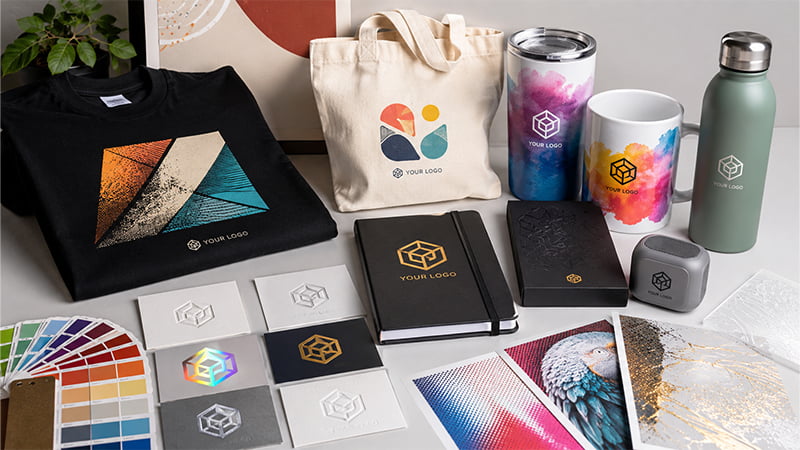
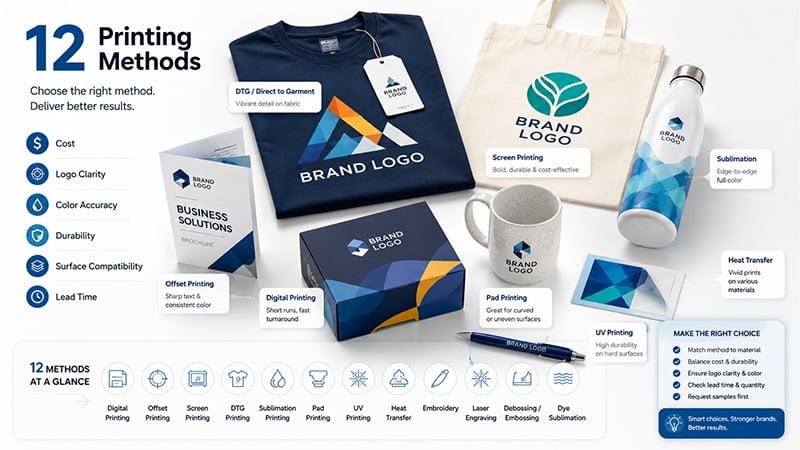
Choosing the right types of printing affects cost, logo clarity, color accuracy, durability, surface compatibility, lead time, and brand presentation. When the method does not match the material or artwork, bulk orders can face color shifts, poor adhesion, or rework. This guide explains 12 printing methods and how buyers can choose the right option before production starts.
What Are Printing Methods?
Printing methods are processes used to transfer ink, pigment, toner, dye, foil, or decoration onto a surface. That surface may be paper, cardboard, fabric, plastic, metal, glass, ceramic, wood, leather, or packaging material.
Different types of printing exist because products are not made from the same materials. A catalog does not need the same process as a T-shirt. A flexible pouch does not behave like a stainless steel bottle. A full-color image needs different treatment from a one-color logo.
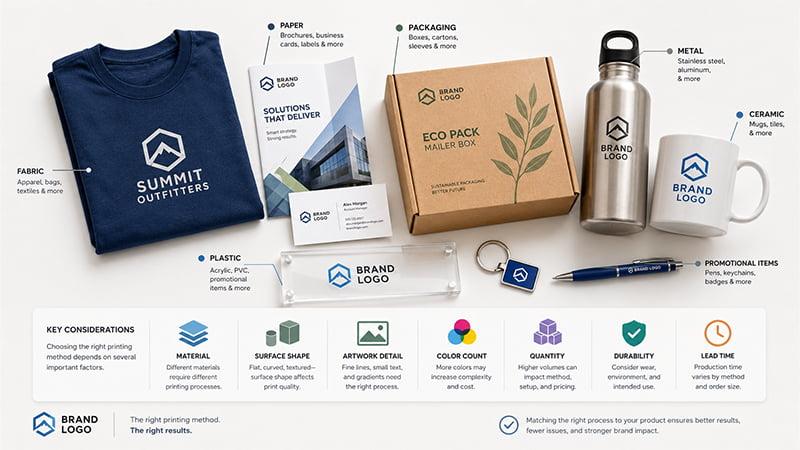
The right printing process depends on several key factors: product material, surface shape, artwork complexity, color count, order quantity, budget, durability requirements, and production deadline.
For B2B buyers, this matters because the wrong method can lead to blurry logos, color shifts, poor ink adhesion, high setup costs, or delayed bulk orders.
Quick Comparison Table: 12 Types of Printing Methods
| Printing Method | Best For | Common Products | Watch Out For |
|---|---|---|---|
| Digital Printing | Short runs, fast turnaround, full color | Flyers, cards, labels, stickers, small packaging | Unit cost may be higher for large runs |
| Offset Printing | High-volume paper printing | Catalogs, brochures, boxes, inserts | Setup cost and longer prep time |
| Screen Printing | Bold logos and solid colors | T-shirts, tote bags, signs, bottles | Not ideal for tiny details or many colors |
| Pad Printing | Small and curved products | Pens, USB drives, keychains, small gadgets | Limited print area |
| Flexographic Printing | Flexible packaging and labels | Bags, films, labels, cartons | Best for repeated high-volume work |
| Gravure Printing | Very large-volume packaging | Magazines, packaging, decorative film | High setup cost |
| Letterpress Printing | Premium tactile paper goods | Cards, invitations, luxury packaging | Limited for full-color detail |
| Sublimation Printing | Polyester and coated products | Sportswear, mugs, lanyards | Not suitable for cotton or all materials |
| Heat Transfer Printing | Names, numbers, event apparel | T-shirts, jerseys, uniforms | Hand feel and durability need testing |
| DTF Printing | Full-color apparel graphics | T-shirts, hoodies, bags | Finish and stretch should be checked |
| DTG Printing | Detailed cotton apparel prints | Cotton T-shirts, small apparel runs | Fabric and pretreatment matter |
| UV Printing | Full-color hard surface printing | Acrylic, metal, plastic, glass, gifts | Surface adhesion should be tested |
1. Digital Printing
Digital printing prints directly from a digital file without traditional printing plates. It is useful for short runs, quick turnaround, variable data, personalized designs, and small-batch printed materials.
Common uses include cards, flyers, labels, stickers, sample packaging, paper inserts, small packaging runs, and marketing materials. It also works well when each printed image needs to change, such as custom names, QR codes, serial numbers, or regional versions.
Digital printing is often a cost-effective choice for small batch projects because it avoids plate setup. For large-scale production, however, the unit cost may be higher than offset printing or flexographic printing.
Use digital printing when speed, flexibility, and full-color artwork matter more than the lowest unit cost for bulk orders. Print-on-demand can help small brands test designs, but bulk buyers still need to compare material quality, sample proofing, unit cost, and production consistency before scaling.
2. Offset Printing / Offset Lithography
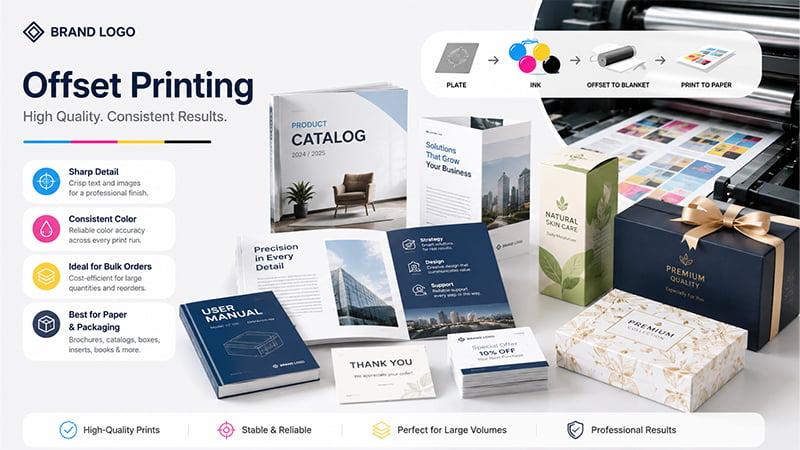
Offset printing, also called offset lithography, transfers an inked image from a printing plate to a rubber blanket and then onto the final printing surface. Britannica explains offset printing as a commercial printing technique that transfers the inked image from a plate to a rubber cylinder before printing onto paper or another material.
This method is common for catalogs, brochures, books, manuals, paper inserts, folding cartons, gift boxes, and high-volume marketing materials. It produces high-quality prints with sharp detail and consistent color across large production runs.
Offset printing usually has higher setup cost because it needs plates, press setup, and more preparation time. Once the job is running, though, it can become efficient for bulk orders.
Use offset printing when you need stable color, fine detail, and large-volume paper or packaging production. It is especially useful for brands that need consistent printed materials across many individual sheets or repeated packaging orders.
3. Screen Printing
Screen printing pushes ink through a mesh screen onto the product surface. Each color usually needs its own screen, so simple shapes, bold logos, and solid color designs work best.
This is one of the most common printing methods for T-shirts, tote bags, banners, signs, bottles, notebooks, uniforms, custom apparel, and promotional items. It can create strong color opacity and a durable finish, especially on fabric and flat surfaces.
For bulk promotional orders, screen printing is often practical because the setup cost can be spread across many pieces. It is widely used for corporate branding, event merchandise, team shirts, custom jerseys, and reusable shopping bags.
Avoid screen printing when the artwork has too many colors, tiny text, fine detail, complex gradients, or photo-style images. For detailed prints or full-color apparel graphics, DTF printing, DTG printing, or heat transfer printing may be better.
4. Pad Printing
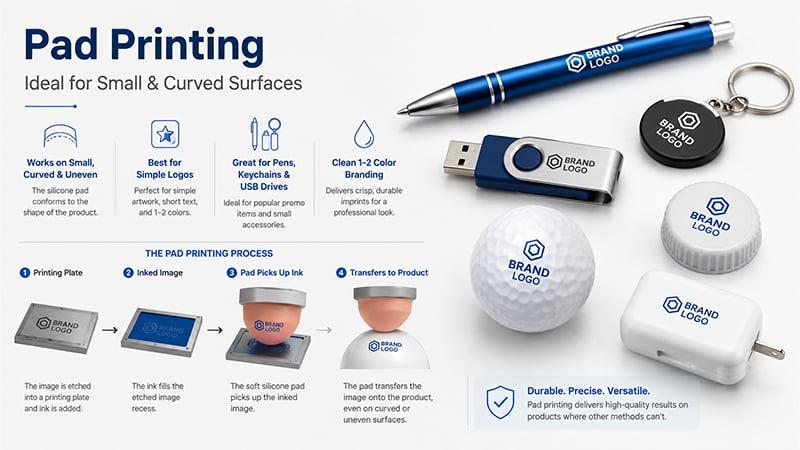
Pad printing uses a soft silicone pad to pick up an inked image from a printing plate and transfer it onto a product. This method is useful because the pad can flex around small, curved, or uneven surfaces.
It is widely used for pens, keychains, USB drives, golf balls, bottle caps, toys, small tools, electronic accessories, and other small promotional items. When a product has a limited image area or non-flat surface, pad printing is often a practical choice.
Pad printing works best for simple logos, short text, and one-color or limited-color designs. It is not ideal when the artwork needs large coverage, fine detail, or full-color gradients.
Use pad printing when the product surface is small, curved, or slightly uneven. Always check the print area before approval, because the desired image may need to be simplified to fit the available space.
5. Flexographic Printing
Flexographic printing uses flexible relief plates to transfer ink onto a surface. It is a high-speed process often used for packaging and labels.
For packaging buyers, flexographic printing is most useful when the same design needs to run repeatedly on labels, films, paper bags, plastic packaging, corrugated cartons, or food packaging.
This method can handle many materials, including paper, cardboard, plastic film, and other flexible substrates. It is often chosen for large-scale production because it supports high-speed printing.
The main tradeoff is setup. Plates and press preparation may not make sense for very small orders or frequent design changes. Use flexographic printing when the same design will be printed repeatedly at volume.
6. Gravure / Rotogravure Printing
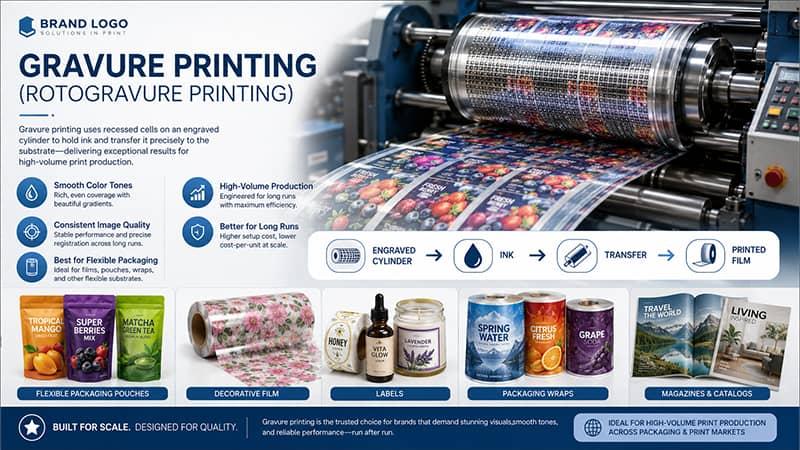
Gravure printing, also called rotogravure printing, uses recessed cells on a cylinder to hold and transfer ink. Britannica describes rotogravure printing as an intaglio process based on transferring fluid ink from depressions in a printing plate to paper or another surface.
This method is used for very high-volume magazines, decorative films, labels, flexible packaging, and packaging that needs smooth color tones or consistent image quality over long runs.
Gravure can deliver high-quality results, but it has high setup cost because the cylinders require preparation. That makes it more suitable for large-scale production, not small batch promotional orders.
Use gravure printing only when the production scale is large enough to justify the upfront cost. For smaller packaging tests, digital printing or offset printing may be more flexible.
7. Letterpress Printing
Letterpress printing uses raised surfaces to press ink into paper. It is one of the older printing techniques, but it remains popular for premium paper goods because it creates a tactile impression.
This method is often used for business cards, invitations, certificates, hang tags, luxury packaging inserts, greeting cards, and premium stationery. It gives the printed surface a physical texture that digital printing cannot easily copy.
Letterpress works best when touch, texture, and premium finish matter more than full-color detail. It is especially suitable for simple typography, logos, borders, and elegant designs.
Avoid letterpress if the project needs photographic images, detailed color transitions, or low-cost large-volume printing. For full-color paper products, offset printing or digital printing may be more practical.
8. Sublimation Printing
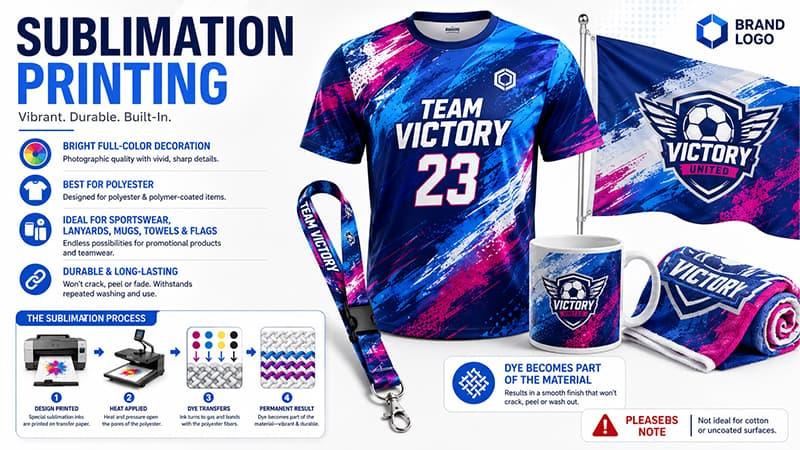
Sublimation printing uses heat to transfer dye into polyester fibers or specially coated surfaces. Instead of sitting as a thin layer on top of the surface, the dye becomes part of the material.
For sportswear, event lanyards, mugs, towels, flags, and coated promotional products, sublimation is often chosen when buyers need bright full-color decoration.
Sublimation works especially well for all-over prints and performance apparel. It is a strong option for sports teams, events, marathons, and branded textile products made from polyester.
The main limitation is material compatibility. Sublimation does not work well on cotton, uncoated metal, uncoated ceramic, or many natural fabrics. Use it when the product material is suitable and the design needs bright, full-color coverage.
9. Heat Transfer Printing
Heat transfer printing uses heat and pressure to apply a printed design, transfer ink, or vinyl layer onto a product. It is common in apparel decoration because it works well for names, numbers, logos, and small-to-medium orders.
This method is often used for T-shirts, jerseys, uniforms, event shirts, tote bags, staff apparel, sportswear, and custom names. It can be useful when the design changes from piece to piece.
Heat transfer is flexible, but buyers should check hand feel, stretch, washing performance, and edge durability. Some transfers feel thicker than ink, which may or may not suit the final product.
Use heat transfer printing when you need customization, small runs, full-color designs, or individual names and numbers. For large-volume simple logos, screen printing may still be more cost-effective.
10. DTF Printing
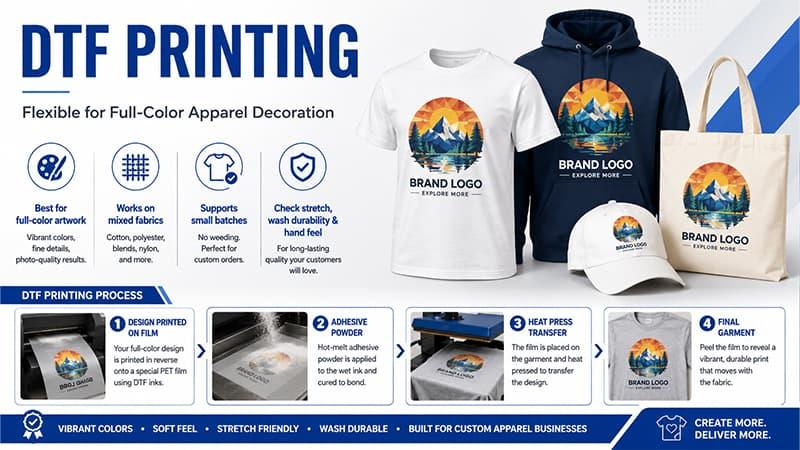
DTF printing means direct-to-film printing. The design is printed onto a special film, coated with adhesive powder, and then transferred to fabric using heat.
DTF is a modern apparel printing method that works well for full-color designs, detailed logos, T-shirts, hoodies, tote bags, uniforms, and mixed-fabric products. It is often more flexible than DTG because it can work on more fabric types.
This method is helpful when the design has many colors, gradients, or fine detail. It can also support small batch orders and custom apparel projects.
Before bulk production, check the stretch, hand feel, wash durability, and finish. DTF can be a strong option, but the final result depends on film quality, powder, heat press settings, fabric type, and production control.
11. DTG Printing
DTG printing, or direct-to-garment printing, applies ink directly onto fabric using a digital printer. It is often used for detailed prints, photo-style artwork, and small apparel runs.
DTG works best on cotton T-shirts and similar fabrics. It can produce detailed prints with many colors without creating separate screens for each color.
This method is useful for small batch custom apparel, sample shirts, personalized designs, and print-on-demand workflows. It can handle complex designs that would be difficult or expensive with traditional screen printing.
The buyer should check fabric composition, pretreatment, color vibrancy, wash durability, and print feel. DTG is not always the best choice for polyester or very large orders, where DTF, sublimation, or screen printing may be better.
12. UV Printing
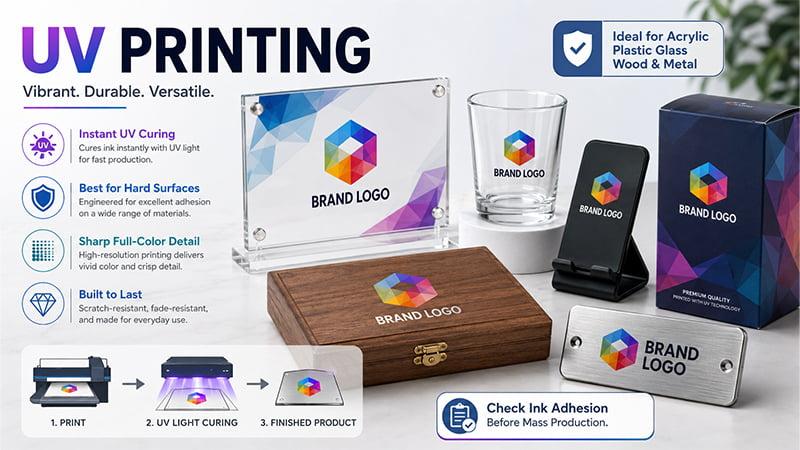
UV printing uses ultraviolet light to cure ink quickly on the printing surface. Because the ink dries almost instantly, UV printing can work on many hard surfaces.
It is often used for acrylic, plastic, glass, wood, metal, phone stands, drinkware, signs, packaging samples, nameplates, and hard promotional gifts. It is useful for full-color logos, detailed images, and short-run customization.
UV printing can produce sharp images on flat surfaces and certain treated materials. It is a good option when the product needs full-color branding but does not suit paper or fabric printing methods.
The key risk is ink adhesion. Smooth, glossy, coated, or uneven surfaces may need testing before mass production. Use UV printing for hard goods, but always approve a sample if durability matters.
Common Branding Methods Often Compared With Printing
Some logo decoration methods are not strictly printing, but B2B buyers often compare them when selecting branding options for custom promotional products, apparel, packaging, and corporate gifts.
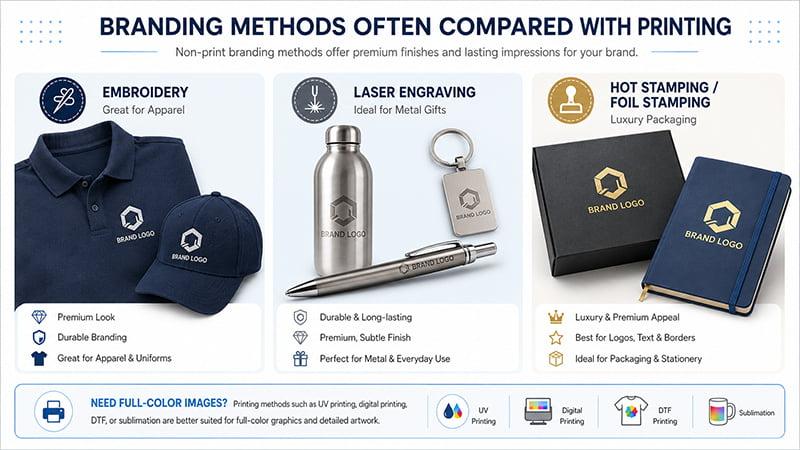
Embroidery is commonly used on polos, jackets, caps, uniforms, bags, and patches. It creates a textured, premium appearance but is less suitable for tiny text, gradients, or highly detailed artwork.
Laser engraving is popular for metal pens, stainless steel bottles, keychains, plaques, and premium corporate gifts. It offers excellent durability but does not support full-color graphics.
Hot stamping, also called foil stamping, is often used on gift boxes, notebooks, certificates, leatherette products, cards, and luxury packaging. It works best for logos, text, borders, and metallic decorative effects.
When buyers need full-color images, printing methods such as UV printing, digital printing, DTF, or sublimation are usually more suitable. When they need a premium or long-lasting logo treatment, embroidery, laser engraving, or foil stamping may be the better choice.
How to Choose the Right Printing Method
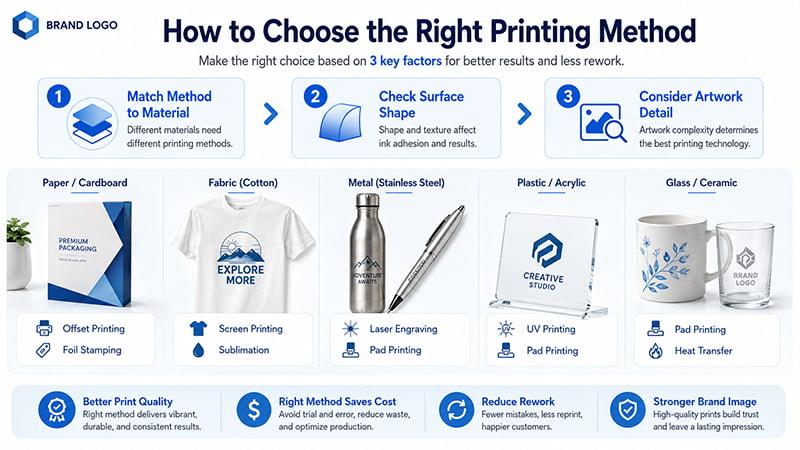
Choosing the correct printing method starts with the product, not the artwork alone. A method that works beautifully on paper may fail on plastic, metal, fabric, or coated surfaces.
Start with the product material
Product material comes first. Paper, cardboard, cotton, polyester, plastic, metal, glass, ceramic, wood, leather, and coated surfaces all respond differently to ink, heat, pressure, and surface treatment.
For example, cotton can absorb water-based inks. Metal may reflect light and resist ink adhesion. Polyester may work better with sublimation, DTF, or heat transfer. Paperboard packaging may need offset printing, flexographic printing, or foil stamping.
Before choosing a printing method, confirm the material first.
Check the surface shape and texture
The surface shape affects the final print. Flat, curved, small, flexible, rough, glossy, matte, metallic, transparent, coated, and textured surfaces may need different methods.
Pens and small gadgets often need pad printing. Flat acrylic or plastic items may work with UV printing. Metal bottles may look cleaner with laser engraving. Fabric products may need screen printing, heat transfer, DTF, DTG, or sublimation. Gift boxes may need offset printing, hot stamping, or foil stamping.
A design that looks good on a flat mockup may not print well on a curved or uneven surface.
Match the method to the artwork
Simple one-color logos may work well with screen printing or pad printing. Full-color artwork may need digital printing, UV printing, DTF printing, DTG printing, or sublimation printing.
Premium metal gifts may look better with laser engraving. Small curved items may need pad printing. Packaging may need offset, flexographic, gravure, or foil stamping depending on volume and finish.
Artwork details matter. Small text, thin lines, gradients, complex designs, and non-image areas can all affect the correct printing method.
Match the method to the quantity
Some methods are better for small batches. Others become more cost-effective when quantity increases.
Digital printing, UV printing, DTF, and DTG are often flexible for small batch projects or quick turnaround. Offset printing, flexographic printing, gravure printing, and screen printing often become more efficient for bulk orders and mass production.
For large-scale production, setup cost can be worth it. For short runs, methods with lower setup requirements may be safer.
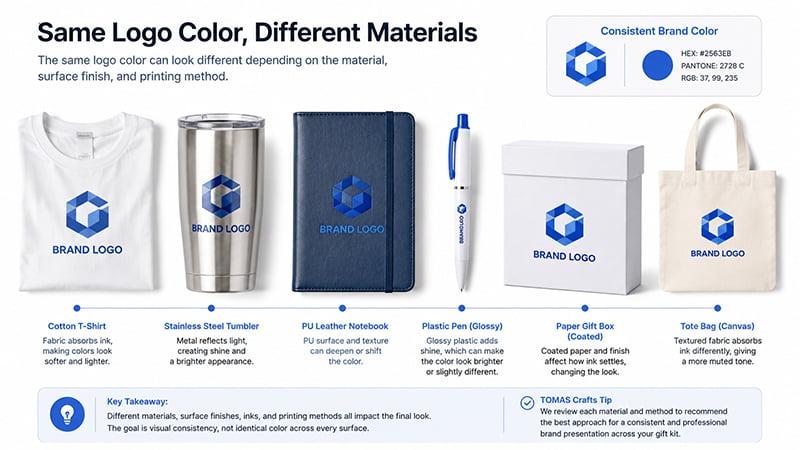
TOMAS Crafts information gain: the same logo color can look different across materials
In real B2B gift projects, buyers often expect one corporate color to look identical across a T-shirt, metal tumbler, PU notebook, plastic pen, and paper gift box. In production, that rarely happens without adjustment.
Fabric absorbs ink. Metal reflects light. PU leather may change how a color appears. Matte plastic, glossy plastic, coated paper, and stainless steel can all make the same logo color look slightly different.
The Pantone color system helps brands and manufacturers communicate color more consistently, but the final visual effect still depends on the material, surface finish, ink, and production method.
TOMAS Crafts can review the product material, surface finish, logo color, and printing method before recommending a branding plan. For a mixed gift kit, the goal is not to force one printing method across every item. The better approach is to keep the brand visually consistent while choosing the right method for each surface.
For example, a tote bag may use screen printing, a metal bottle may use laser engraving or UV printing, a pen may use pad printing, and a gift box may use offset printing or hot stamping. This helps the full kit look coordinated without sacrificing print clarity or durability.
Common Printing Method Mistakes to Avoid
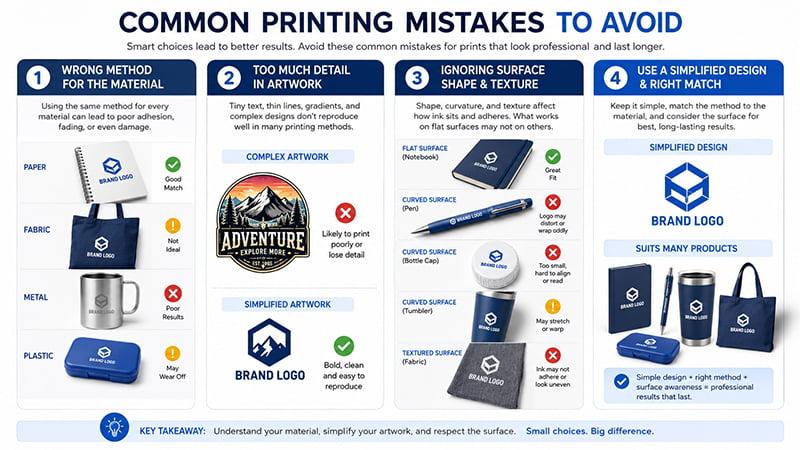
Even when a design looks clean on screen, production can fail if the printing method does not match the product. These are the most common mistakes buyers should avoid.
Choosing the method before checking the material
A printing method that works on paper may fail on plastic, metal, fabric, or coated surfaces. Always confirm the material before choosing the method.
For example, sublimation works well on polyester and coated products, but not on cotton. Pad printing may work on small plastic items, but not every coating accepts ink well. Laser engraving may be better than ink printing on some metal gifts.
Using artwork with too much detail
Tiny text, thin lines, gradients, and complex full-color artwork may not work well with every method.
Screen printing is strong for simple logos and bold color blocks, but too many colors can increase setup complexity. Pad printing may not hold very small details on curved items. Embroidery may require a simplified version of the original artwork.
Before production, ask whether the artwork needs to be simplified.
Ignoring surface shape
Curved products, small products, textured surfaces, and flexible materials may limit print size and detail.
A logo that fits a flat notebook may not fit a pen. A detailed design that looks clear on a digital mockup may blur on a bottle cap or rubberized surface. A curved printing surface often needs a smaller, cleaner design.
Skipping sample approval
A digital proof is not the same as a physical sample. It cannot always show ink adhesion, color shift, hand feel, stretch, texture, or durability.
For bulk orders, a physical sample helps confirm the real print effect. It can show whether the color looks right, whether small text is readable, and whether the print feels suitable for the product.
Skipping this step can create expensive rework during mass production.
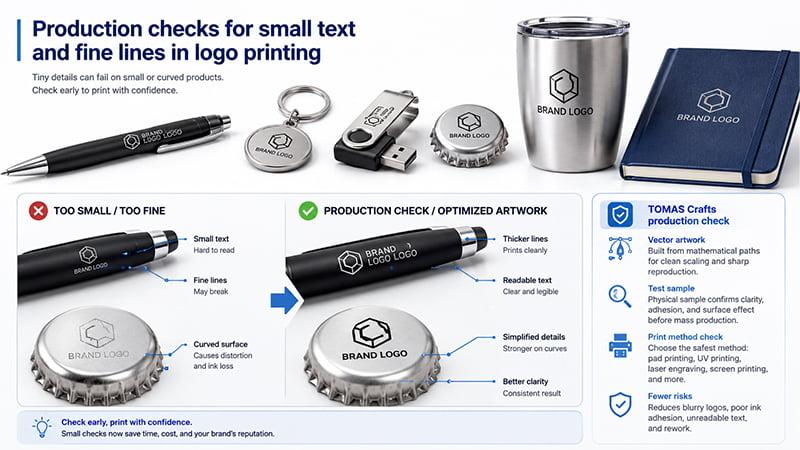
TOMAS Crafts information gain: small text and fine lines need production checks
A logo that looks sharp on screen may not stay sharp on a small or curved product. This is common with pens, keychains, USB drives, bottle caps, small tools, and coated drinkware.
Before bulk production, TOMAS Crafts can check the logo size, line thickness, small text, negative space, color count, material, surface shape, and print position. These details help decide whether pad printing, UV printing, laser engraving, screen printing, or another method is safer.
Adobe explains that raster images are pixel-based, while vector artwork is built from mathematical formulas, which makes vector files more suitable for clean scaling and sharp logo reproduction.
For example, very small text may blur on a pen. Thin lines may break on a textured surface. A full-color logo may look better with UV printing on a flat hard surface, while a metal bottle may look cleaner with laser engraving. For curved or coated products, a physical sample is often more useful than a digital mockup because it shows the real print clarity, adhesion, and surface effect.
This production check helps reduce blurry logos, poor ink adhesion, unreadable small text, and rework during mass production.
Sustainability and Waste Reduction in Printing
Sustainability in printing is not only about ink choice. It also depends on ordering the right quantity, selecting the correct printing method, testing samples, and reducing avoidable waste.
Over-ordering creates excess inventory. Choosing the wrong process can lead to misprints and unnecessary rework.
Buyers can reduce waste by matching the printing method to the order size, using recyclable packaging when possible, and approving samples before mass production.
A small sample proof often prevents costly production mistakes and reduces material waste.
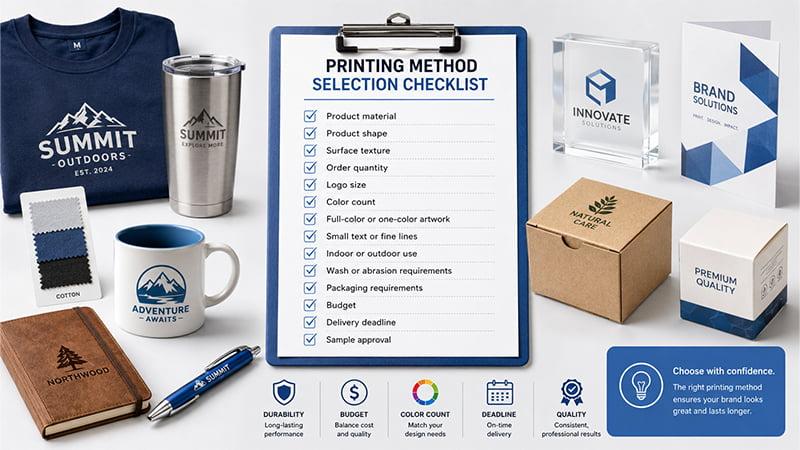
Printing Method Selection Checklist
Before approving a printing method, check:
- product material
- product shape
- surface texture
- order quantity
- logo size
- color count
- full-color or one-color artwork
- small text or fine lines
- indoor or outdoor use
- wash or abrasion requirements
- packaging requirements
- budget
- delivery deadline
- sample approval
This simple checklist helps buyers compare different printing methods before production starts.
Conclusion
Choosing the right printing method is not only about print quality. It affects cost, durability, lead time, material compatibility, and brand presentation.
The best method depends on the product material, artwork complexity, quantity, budget, surface shape, and final use. A simple logo on a pen, a full-color image on a T-shirt, a premium logo on a metal bottle, and a printed gift box may all need different methods.
Get Help Choosing the Right Printing Method
Not sure which printing method fits your product? The right choice depends on the material, surface shape, logo details, quantity, budget, and deadline.
TOMAS Crafts can help B2B buyers review artwork, compare suitable printing and branding methods, prepare samples, and manage bulk production for promotional products, apparel, packaging, and corporate gifts.
Share your product list, logo file, quantity, and delivery timeline with the TOMAS Crafts team. Contact TOMAS Crafts to get a practical printing recommendation before production starts.
FAQs
What are the main types of printing?
The main types of printing include digital printing, offset printing, screen printing, pad printing, flexographic printing, gravure printing, letterpress, sublimation, heat transfer, DTF, DTG, and UV printing.
What is the best printing method for promotional products?
It depends on the product material and logo design. Pad printing works well for small curved items, screen printing works well for simple logos on flat surfaces, UV printing works well for full-color hard goods, and laser engraving works well for metal gifts.
Why can the same logo color look different on different products?
The same logo color can look different because each material reflects or absorbs color differently. Fabric absorbs ink, metal reflects light, PU leather has surface texture, and glossy plastic changes how color appears. A sample proof helps confirm the final effect before bulk production.
How do I choose the right printing method?
Start with the product material, surface shape, artwork complexity, color count, order quantity, budget, and deadline. Then ask for a sample proof before bulk production to check color, detail, adhesion, and durability.