
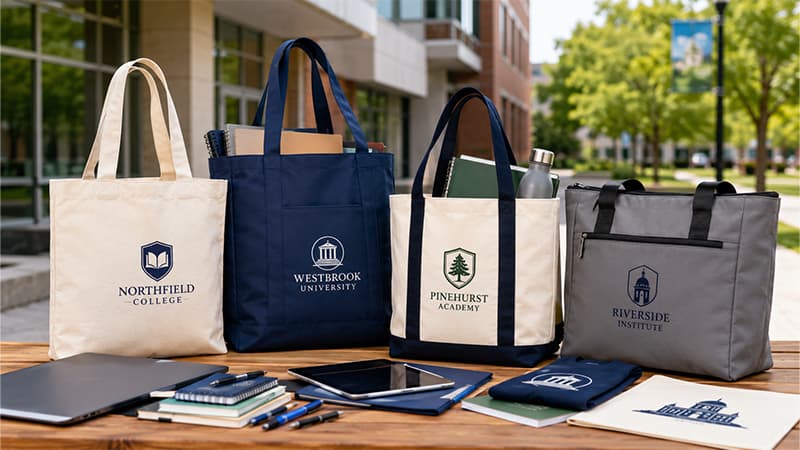
Tote bags can work well for schools, colleges, campus events, and student welcome kits, but only when the size, material, handle length, and structure match the real carrying need. A tote that looks nice may still be too small, weak, bulky, or difficult to customize.
This guide explains how to choose better school tote bags before buying or placing a bulk custom order.
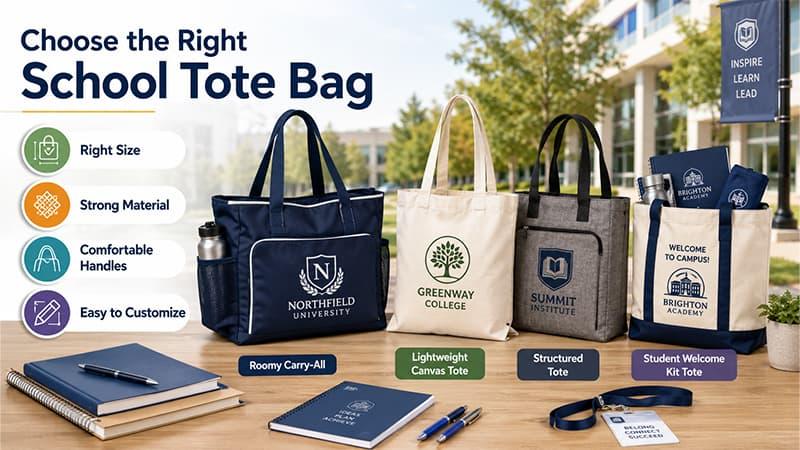
Quick Answer: What Size Tote Bag Is Best for School?
A medium to large tote bag is usually best for school. For college students, a tote around 14–16 inches wide and 15–17 inches tall often works for notebooks, folders, tablets, light books, and day to day items.
If the tote needs to carry a laptop, textbooks, a water bottle, lunch box, hoodie, or welcome kit products, choose a larger tote with stronger fabric, longer shoulder straps, and a bottom gusset. Small tote bags work better for flyers, light giveaways, and one-day school events.
For reuse and higher perceived value, a canvas tote is usually a stronger choice than very thin event bags.
Matching Tote Bags to School Needs
The right tote depends on who will use it and what they need to carry. A bag for a college orientation kit should not be chosen the same way as a simple event giveaway.
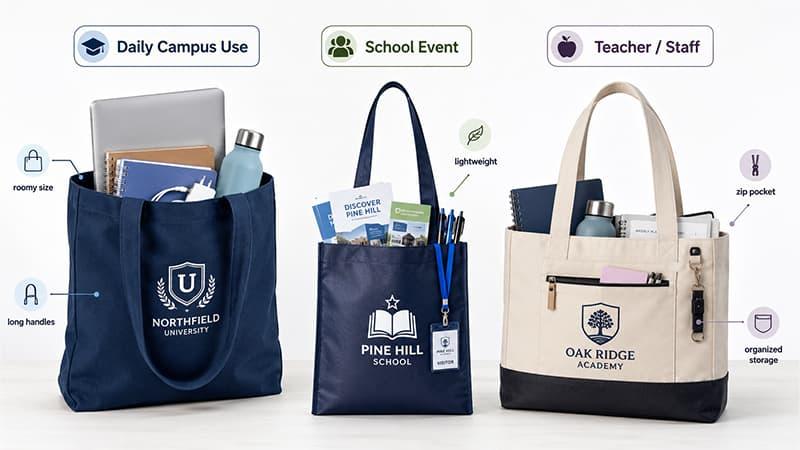
Daily classes and campus commuting: Students may carry notebooks, folders, tablets, chargers, snacks, a phone, a water bottle, and small personal items such as lip balm. A daily school tote should be roomy enough for essentials without feeling bulky on the shoulder.
College orientation and welcome kits: Orientation bags often need to hold printed guides, notebooks, pens, bottles, lanyards, ID holders, and welcome cards. A gusseted tote usually works better than a flat tote because it gives more space for mixed items.
School events and education fairs: For one-day events, the tote may only need to carry brochures, flyers, small gifts, or light supplies. A lightweight cotton or non-woven tote can be enough if long-term everyday use is not the goal.
Teacher gifts and bookstore merchandise: Teacher gifts and campus bookstore totes usually need higher perceived value. Canvas tote bags, zippered totes, heavier fabric totes, or structured large totes can feel more gift-worthy and more suitable for year round use.
How Tote Bag Measurements Work
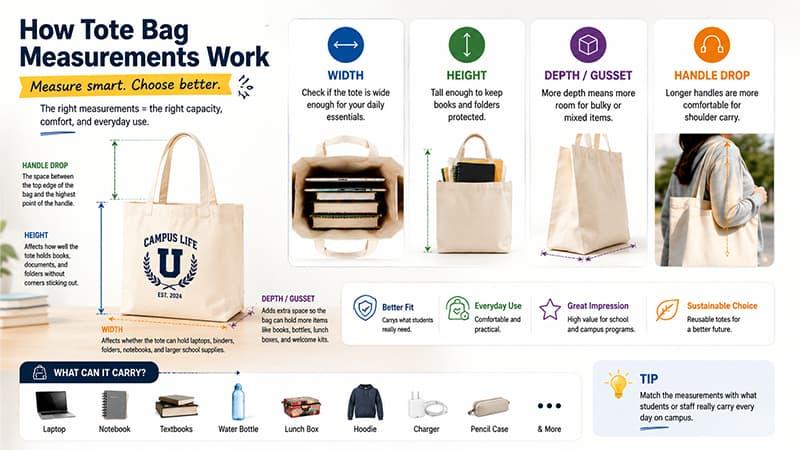
Before choosing the right tote bag, buyers should understand how tote measurements affect real storage space. Online dimensions can look generous, but the actual capacity can vary based on shape, material, gusset, lining, and handle design.
Width: Width affects whether the tote can hold laptops, binders, folders, notebooks, and larger school supplies. A tote may look wide when laid flat, but if it has no depth, thick items can push against the side seams and reduce usable space. For school and college programs, compare the tote width with the real items that need to go inside.
Height: Height affects how well the tote holds books, documents, planners, and folders without corners sticking out. A taller tote can protect papers better, especially when students walk across campus or carry the bag on public transport. But if the tote is too deep, small items such as keys, cards, pens, and headphones may fall to the bottom unless the bag includes pockets or an interior organizer.
Depth or gusset: Depth is often created by a bottom gusset or side gusset. A flat tote works for papers, flyers, and light items. A gusseted tote works better for books, bottles, lunch boxes, folded clothes, and welcome kits because it gives the bag more usable room.
This is why large tote bags for campus use often need a gusset. The extra depth helps the bag carry more stuff without putting too much pressure on the side seams.
Handle drop: Handle drop is the space between the top edge of the bag and the highest point of the handle. Longer handles usually work better for shoulder carry, especially for college students who walk across campus or wear hoodies, jackets, or coats. Short handles may work for hand carry, but they can feel uncomfortable during a full school day.
Common Tote Bag Sizes and What They Fit
Use this table as a practical size guide before choosing a school tote.
| Tote Size | Approx. Dimensions | Best For | Buyer Note |
|---|---|---|---|
| Small tote | 10″ x 12″ | Flyers, small books, light giveaways | Good for events, not heavy daily use |
| Medium tote | 13″ x 15″ | Notebooks, folders, light books | Good general school option |
| Large tote | 15″ x 16″ or larger | College books, laptop, bottle | Better for campus and daily use |
| Gusseted tote | Any size with 3″–5″ gusset | More volume and stability | Better for books, kits, and supplies |
| Oversized tote | 18″ x 20″ or larger | Bulk items, sports, art supplies | May feel too large for daily school use |
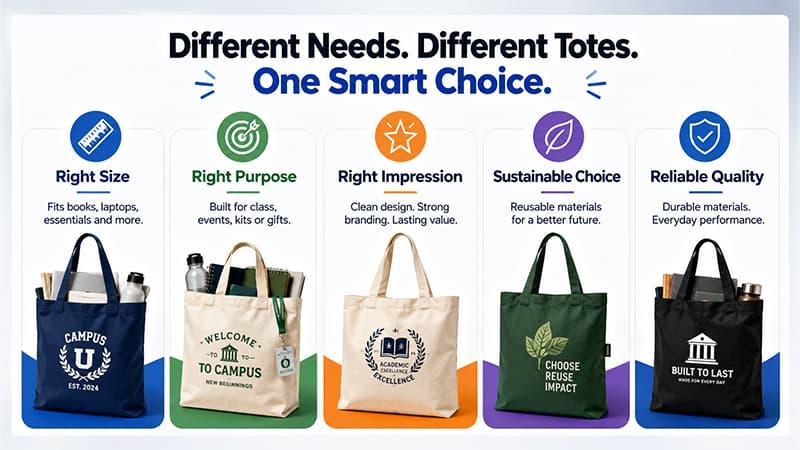
The right size tote bag depends on what needs to go inside. A flat medium tote may be enough for folders and papers, but a gusseted tote is usually better when the bag needs to hold books, bottles, snacks, or welcome kit items.
Large totes can be useful for college programs, bookstore merchandise, sports items, or art supplies. For younger students or light school events, oversized bags may feel too bulky.
Canvas Tote Bags for School: When Are They a Good Choice?
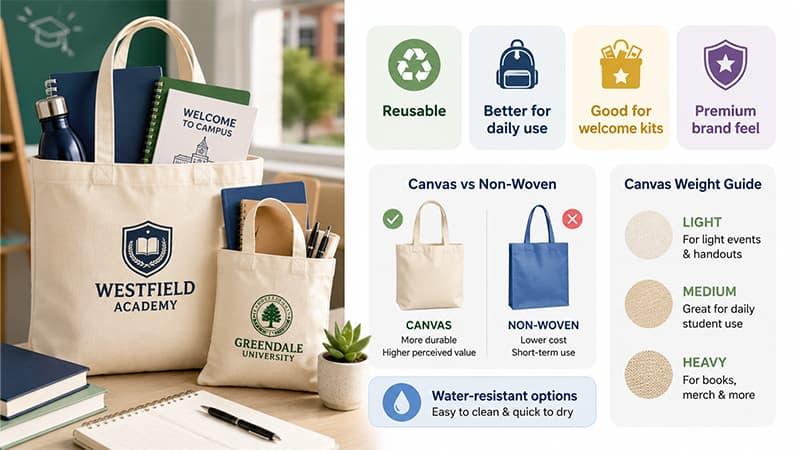
A canvas tote is often a strong option for school programs because it feels reusable and more gift-worthy than many thin giveaway bags. It also gives schools, clubs, and education brands a clean surface for custom printing.
Why canvas works well for school: For school programs that need a more reusable bag, canvas is often a safer direction than thin event material. It can work well for notebooks, folders, light books, student welcome kits, bookstore merchandise, and campus campaigns. For a deeper material overview, readers can review this guide to a canvas tote bag.
Canvas weight matters: Canvas fabric weight affects how the bag feels and how it performs in everyday use. Lighter cotton can work for one-day events, flyers, and simple handouts. Medium canvas is better for daily student use and campus programs. Heavier canvas can feel more premium for college totes, bookstore merchandise, teacher gifts, or bags that need to carry books.
Canvas tote vs non-woven tote: Non-woven tote bags can work for low-cost, short-term event giveaways. They are lightweight, easy to distribute, and useful for brochures or small items. Canvas totes are better when the buyer wants longer reuse, higher perceived value, and a more retail-like finish.
Polyester or recycled fabric: Polyester, recycled fabric, or laminated materials may work better for programs that need water resistance, faster drying, or easy cleaning. Some school bags may need to wipe clean after outdoor events, sports days, beach programs, or rainy campus use, where water resistance and easy cleaning matter. Recycled material tote bags can also support sustainability campaigns, eco clubs, and university programs with an environmental message.
School Tote Bag for College: What Should Buyers Check?
A school tote bag for college needs more than a simple open shape. College students often carry a mix of study items, technology, personal belongings, and daily essentials.
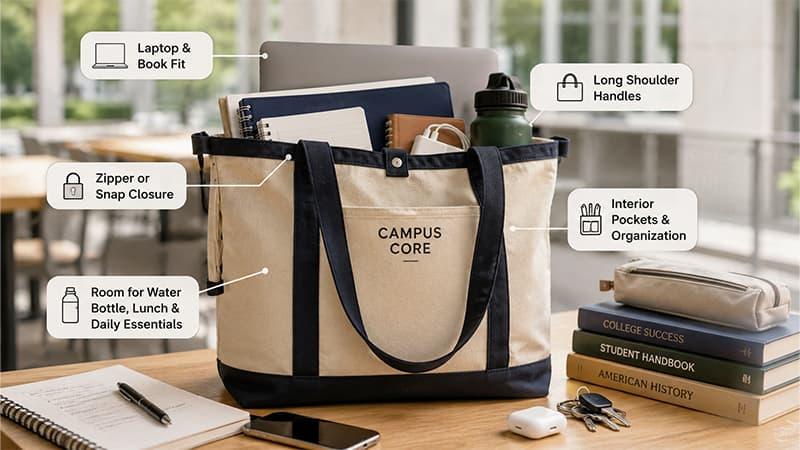
Laptop and book fit: College students may carry laptops, notebooks, folders, chargers, bottles, and personal items. The tote should have enough width, depth, and suitable fabric structure for the intended use. If the tote is too flat, a laptop and books may press against the front and back panels. A gusseted tote or structured large tote bag usually works better for heavier class loads.
Shoulder handle length: Longer handles are usually better for campus walking because students may carry the tote over hoodies, jackets, or coats. For everyday use, buyers should test how the bag feels on the shoulder, not only how it looks in a product photo.
Zipper, snap closure, or open top: Open-top totes are simple and easy for events, bookstores, and quick distribution. A snap closure can offer a small level of security without adding as much cost or complexity as a zipper. Zippered totes are better when students need more security for personal items, laptops, or commuting. For higher-value college programs, an interior zipper pocket can make the tote feel more practical.
Interior organization and pockets: Good interior organization helps students avoid digging through the bag for keys, cards, phones, chargers, or pens. Pockets can be simple, but they make a real difference for daily campus use. For tech-focused college kits, consider a padded laptop sleeve, inner pocket, or cable pouch.
Bottle, lunch, and extra items: A tote that only fits documents may not work for a full campus day. If the bag needs to hold a water bottle, lunch, charger, sweater, or small umbrella, a gusseted design is usually more useful. The goal is not always to choose the largest bag. The goal is to choose a tote that matches the student’s day to day routine.
Work Tote Bag vs School Tote Bag: What Is the Difference?
A work tote bag often needs a cleaner shape, neutral color, laptop-friendly structure, and a more polished finish. It may be used with office clothes, business travel, and daily commuting.
A school tote bag may need more flexibility. Students may use it for books, folders, snacks, bottles, sports items, beach days, shopping, running errands, or weekend activities. It needs to be practical, lightweight, and easy to carry.
Some tote bags can work for both school and work. A medium or large canvas tote with strong handles, a simple design, and enough room for a laptop can suit college, internships, commuting, and light office use.
How to Choose the Right Tote Bag for School Programs
Choosing the right tote bag starts with the user, not the product photo. A tote that works for a college orientation kit may not work for younger students, teacher gifts, or a high-volume school event.
Start with the user group: Ask whether the tote is for younger students, college students, teachers, parents, campus visitors, or event attendees. College students may need laptop space and shoulder comfort. Teachers may prefer a zippered tote with pockets. Event attendees may only need space for brochures and small gifts.
Define what the bag needs to carry: List the actual items before choosing the bag. Common school contents include notebooks, folders, textbooks, tablets, lunch boxes, bottles, sports items, event materials, pens, lanyards, ID cards, and welcome kit products. This step helps prevent a common mistake: choosing a tote based on appearance, then discovering it cannot hold the intended items.
Choose material and fabric weight: Match material to use time and carrying needs. A one-day event tote does not need the same standard as a daily campus bag. A canvas tote works well for reuse, while lightweight cotton or non-woven material may be better for high-volume, low-cost distribution.
Check handle type and stitching: Handles and stitching matter because school tote bags may carry heavier items. For heavier school use, buyers should ask about reinforced stitching, handle attachment, seam finishing, and bottom structure. A tote can look fine when empty but feel weak when packed with books, bottles, or boxed gifts.
Decide on open top, zipper, or pockets: Open-top totes are simple, affordable, and easy to pack. Zippers, snap closures, and pockets improve security and function but may increase cost and production time. Choose features based on the use case.
Match logo size to daily reuse: A subtle school logo, mascot, or event design may be reused more often than a very large promotional logo. Students may avoid carrying a bag that looks too much like an advertisement. For everyday use, design should balance brand visibility with real-life wearability.
Best Tote Bag Styles for School and Campus Events
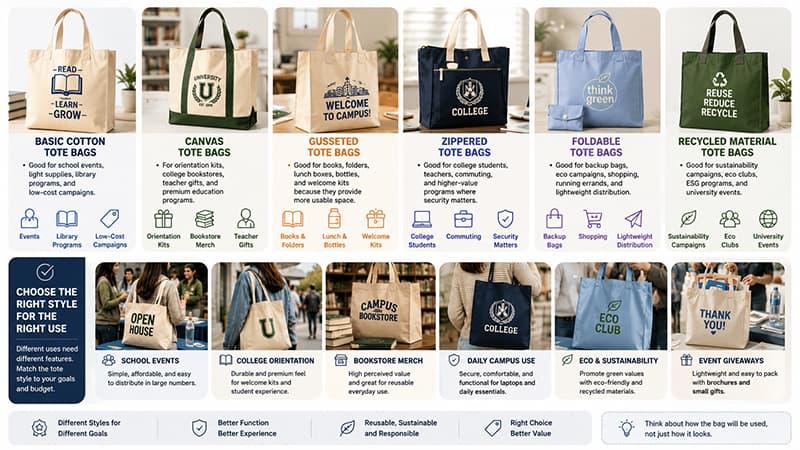
Different tote styles solve different school problems. Use the style based on how the bag will be used.
Basic cotton tote bags: Good for school events, light supplies, library programs, and low-cost campaigns.
Canvas tote bags: For orientation kits, college bookstores, teacher gifts, and premium education programs, canvas usually gives the bag a more reusable feel and better perceived value.
Gusseted tote bags: Good for books, folders, lunch boxes, bottles, and welcome kits because they provide more usable space.
Zippered tote bags: Good for college students, teachers, commuting, and higher-value programs where security matters.
Foldable tote bags: Good for backup bags, eco campaigns, shopping, running errands, and lightweight distribution.
Recycled material tote bags: Good for sustainability campaigns, eco clubs, ESG programs, and university events.
The right style depends on whether the bag is for everyday use, event distribution, retail merchandise, or a complete school welcome kit. For broader sourcing options, buyers can also review TOMAS Crafts’ custom backpacks and tote bags page.
Common Mistakes When Ordering Tote Bags for School
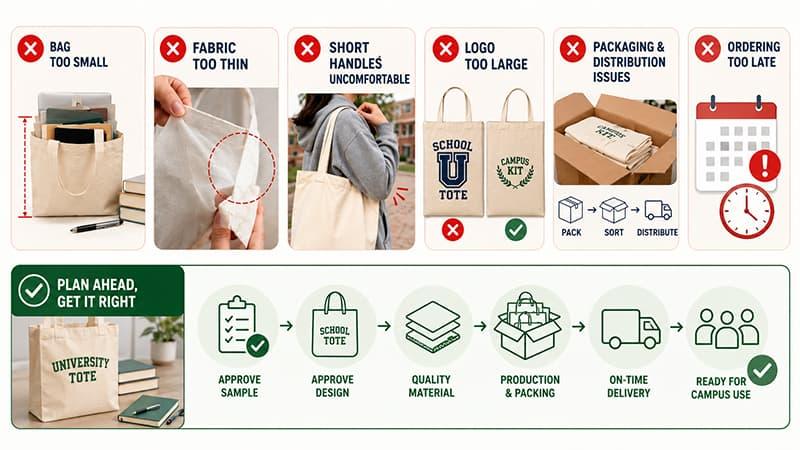
Choosing a bag that is too small: A small tote may look neat but fail to carry folders, books, or laptops. This is especially common when buyers only look at flat dimensions online.
Choosing fabric that is too thin: Thin bags may work for flyers and light items but may not suit daily school use.
Ignoring handle comfort: Short handles can be uncomfortable for college students who walk across campus or wear jackets.
Printing a logo too large: Oversized logos can make students less likely to reuse the bag outside the event. A cleaner design may create more long-term visibility.
Forgetting packaging and distribution: For orientation, bookstore programs, or school events, packaging and carton sorting may affect distribution speed.
Ordering too late: Tote bags need time for sample approval, logo printing, bulk production, packing, and shipping. Late orders often force buyers to simplify materials, logo methods, or packaging.
TOMAS Supplier Insights: What TOMAS Crafts Checks Before Bulk Tote Production
For B2B school programs, tote production should not start with a bag style only. It should start with the items, use time, logo method, packaging plan, and deadline.
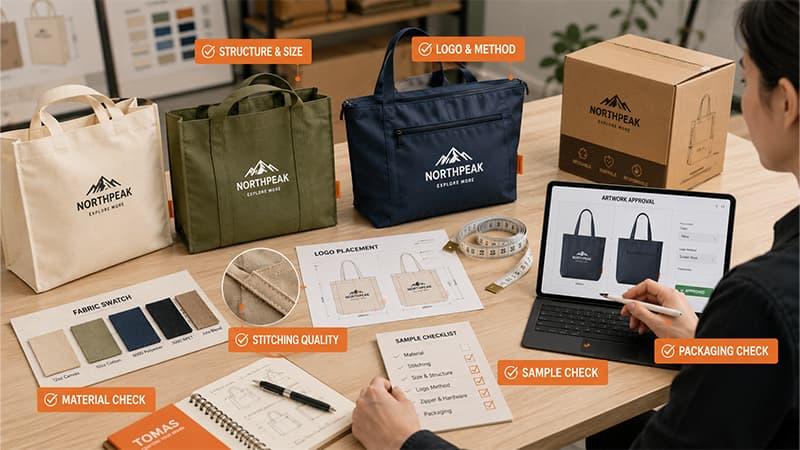
Size should match the actual items inside: TOMAS Crafts usually recommends checking tote size against real contents, such as A4 folders, notebooks, bottles, laptops, lanyards, or welcome kit items.
For school welcome kits, TOMAS Crafts may review whether the tote can hold the actual packed items before final size and packaging approval. A dimension that looks fine on paper may not work when notebooks, bottles, and boxed gifts are packed together.
TOMAS Crafts can also check one packed sample before bulk production. This helps confirm whether the tote size, logo position, item layout, and carton packing method work together.
Fabric weight should match the use time: One-day school event bags and daily campus totes should not use the same standard. For repeated school use, buyers should review fabric feel, thickness, structure, and sample performance before bulk production.
For a short event, lightweight material may control cost. For year round reuse, bookstore merchandise, or premium college programs, a stronger canvas tote may be the better fit.
Handle stitching and bottom gusset affect real use: Handles, seams, and bottom structure matter when the tote carries books or heavier items. For higher-use school bags, TOMAS Crafts checks whether reinforced stitching, box stitching, cross stitching, or a bottom gusset is needed. The goal is not to overbuild every bag. The goal is to match construction to the expected use.
Logo method should match the fabric: Screen printing, heat transfer, embroidery, and woven labels can all work, but not every logo method fits every fabric. Detailed school logos, mascots, or multicolor artwork should be checked before production.
For artwork files, vector logos usually produce cleaner results for custom printing. Adobe’s guide to raster vs vector files is a useful reference for understanding why file type matters for logo scaling.
For more decoration options, buyers can also review TOMAS Crafts’ guide to types of printing.
School kits need consistent packaging: For school welcome kits, tote bags may be packed with notebooks, pens, bottles, lanyards, ID holders, cards, or small accessories. Colors, logo placement, item size, and packaging should be reviewed together before final proof approval.
If the program uses recycled fabric or has sustainability requirements, buyers should also confirm whether any certification or material documentation is needed before production. For textile safety and material claims, references such as OEKO-TEX can help buyers understand why documentation matters for apparel, bags, and textile-based promotional products.
Quick Comparison: Which School Tote Bag Should You Choose?
Use this comparison to match the tote style to the program goal before requesting a quote.
| Use Case | Recommended Tote | Why It Works |
|---|---|---|
| School event giveaway | Basic cotton tote | Affordable and easy to distribute |
| College orientation | Medium canvas tote | Fits folders, books, and welcome kits |
| Daily campus use | Large gusseted tote | More room and better capacity |
| Teacher gift | Zippered canvas tote | More secure and practical |
| Eco campaign | Recycled material tote | Supports sustainability message |
| Bookstore merchandise | Heavy canvas tote | Higher perceived value and reuse |
Ordering Checklist Before Custom School Tote Production
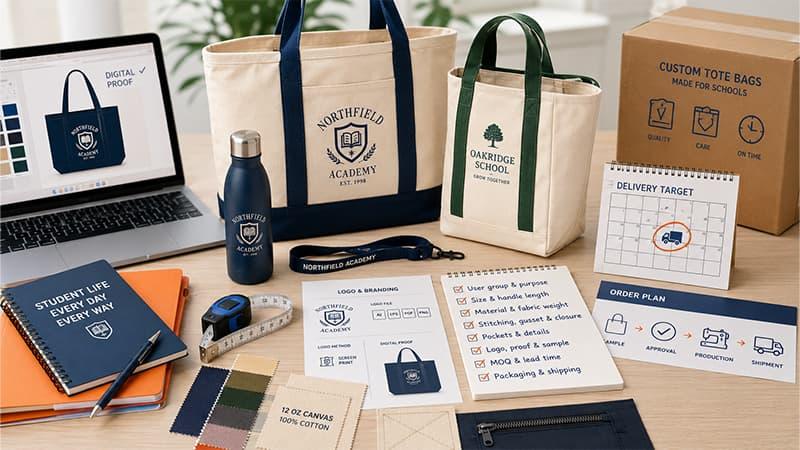
Before placing a custom tote order, confirm these details:
- User group
- Bag purpose
- Tote size
- Material
- Fabric weight
- Handle length
- Stitching and gusset
- Closure type or open top
- Pocket requirements
- Logo file
- Logo method
- Digital proof
- Sample if needed
- MOQ
- Production lead time
- Packaging
- Shipping deadline
This checklist helps reduce size mistakes, logo issues, packaging problems, and delivery delays before bulk production starts.
Conclusion
The right tote bag for school depends on more than appearance. Buyers should compare size, fabric, handle comfort, structure, and the actual items students need to carry.
A canvas tote may work well for daily school or college use, while basic cotton or non-woven totes may fit lighter event giveaways. For bulk school programs, the safest choice is the one that matches the user group, contents, logo method, packaging, and delivery schedule.
Need Help Choosing Custom School Tote Bags or College Event Kits?
TOMAS Crafts can help compare tote bag sizes, materials, fabric weights, handle options, logo methods, packaging, and delivery schedules before production starts.
TOMAS Crafts can also help match tote bags with notebooks, pens, bottles, lanyards, ID holders, and packaging for school welcome kits or other promotional gifts programs.
Share your school event type, user group, quantity, logo file, budget, and deadline with the TOMAS Crafts team. The team can help build practical tote bag solutions for school events, college orientation, education fairs, bookstore merchandise, and student welcome kits.
Contact TOMAS Crafts to discuss your custom school tote bag project.
FAQs
What size tote bag is best for school?
A medium or large tote bag is usually better because it can carry notebooks, folders, and daily items. For college students, choose a larger or gusseted tote if they need to carry books, laptops, chargers, or bottles.
Are canvas tote bags good for school?
Yes. Canvas tote bags are reusable, suitable for custom printing, and stronger than many thin event bags. They work better for daily use, bookstore merchandise, and higher-value school programs than short-term giveaway bags.
Can a tote bag replace a backpack for college?
A tote bag can work for light college use, especially for notebooks, tablets, folders, and personal items. For heavy textbooks or long walking days, a backpack may be more comfortable.
What is the best school tote bag for college?
A good school tote bag for college should have enough room for books, folders, a laptop, and daily items. Medium to large canvas totes, gusseted totes, and zippered totes are usually better than very small flat totes.
What should buyers check before ordering custom school tote bags?
Buyers should check tote size, material, fabric weight, handle length, stitching, gusset, closure type, pocket options, logo method, sample approval, MOQ, production time, packaging, and shipping deadline.