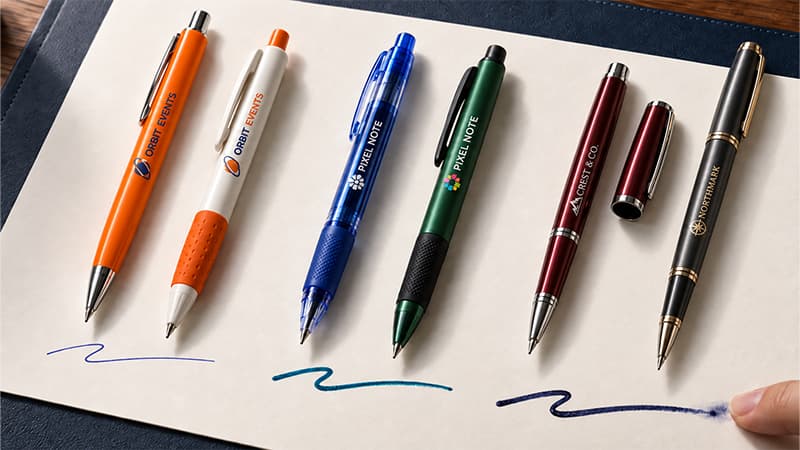
A gel pen feels smoother, a ballpoint usually dries faster, and a rollerball lays down a darker, wetter line. This gel pen vs ballpoint guide compares all three, supported by ISO document-use standards and an independent 40-model test of ballpoint and gel pens. It then matches each option to everyday notes, left-handed writing, professional documents, and custom promotional gifts.
Quick Answer: Gel Pen vs Ballpoint vs Rollerball
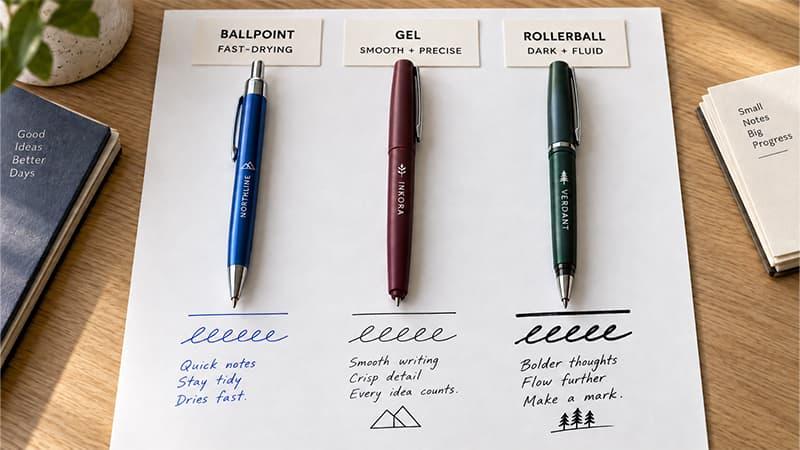
Choose ballpoint pens for fast drying, ordinary paper, and dependable everyday writing. Choose gel pens for smooth, precise writing and a wider range of vibrant colors. Choose a rollerball pen when you want a dark, fluid line with minimal pressure. The selected refill, tip, and paper can matter more than the category name.
| Feature | Ballpoint pens | Gel pens | Rollerball pens |
|---|---|---|---|
| Ink system | Usually oil-based ink | Water-based gel ink | Liquid water-based ink |
| Writing feel | Controlled and firmer | Smooth and precise | Fluid and low-pressure |
| Drying speed | Usually fastest | Varies by formula | Often slower |
| Smudge risk | Usually lower | Formula-specific | Usually higher |
| Thin-paper use | Generally practical | Depends on ink output | Greater bleed risk |
| Color selection | More limited | Usually widest | Usually moderate |
| Refill life | Often longer | Usually moderate | Often shorter |
| Best starting use | Daily writing and forms | Notes and color coding | Long writing and premium use |
These are category-level tendencies, not guarantees. Some gel pens resist smearing better than wet ballpoint pens, while a pressure-regulated rollerball pen may behave differently from a basic liquid-ink model.
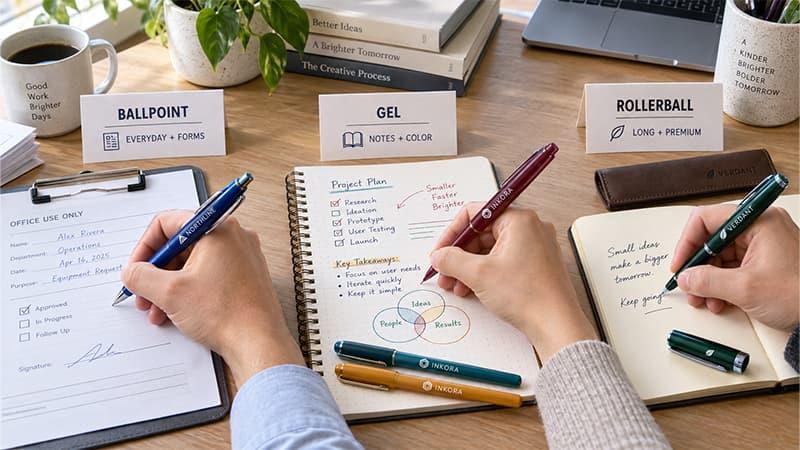
The Three Pen Types Explained
All three use a rotating ball to transfer ink from the refill to the page. Their practical differences begin with ink type and viscosity, or how easily the ink flows.
Ballpoint Pens
Ballpoint pens usually use thick oil-based ink delivered through a metal tip. The controlled flow helps the ink dry quickly on office paper, forms, receipts, and many surfaces.
This controlled flow gives many ballpoint pens consistent performance and helps their refills outlast wetter gel or rollerball refills.
Traditional ballpoint pen ink can require more pressure and create a lighter line. Ballpoint pens are not automatically permanent or waterproof; those properties depend on the chosen ink and supporting test standard.
For model-level options, the best ballpoint pens guide compares writing feel, tip size, refill access, and practical drawbacks.
Where Hybrid Ballpoint Pens Fit
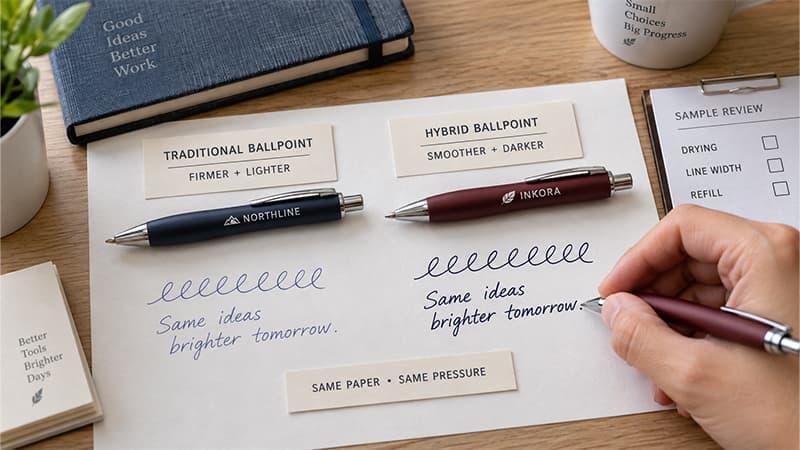
Hybrid or low-viscosity ballpoint ink reduces the drag of traditional ballpoint pen ink. It generally produces a darker, smoother line while retaining the controlled flow buyers expect from ballpoint pens.
That balance can suit employee stationery, conference notebooks, and frequently used promotional pens. However, hybrid performance remains refill-specific, so buyers should compare drying, line width, and replacement availability before approving a model.
Gel Pens
Gel pens suspend pigment or dye in water-based gel ink. They often write with less pressure than traditional ballpoint pens and produce dark, precise lines in vibrant colors.
That combination makes gel pens useful for note-taking, journaling, drawing details, and color-coded creative work.
Performance still varies by refill. Some gel ink dries fast and resists smearing; wetter formulas need more time, and very fine tips can catch on rough paper.
Gel pens often use ink faster than ballpoint pens, but independent testing shows wide differences within both groups. Product-level evidence is more useful than category assumptions.
Rollerball Pens
A rollerball pen uses liquid water-based rollerball ink. Because the ink flows freely, it can create a dark line with minimal pressure and a feel closer to a fountain pen.
Many rollerball pens use a cap to protect the tip and limit evaporation.
The wetter flow may take longer to dry, feather on absorbent paper, or bleed through thin sheets. A rollerball can also use a refill more quickly than a ballpoint. Travel performance is model-specific, so buyers should look for pressure or altitude documentation instead of assuming every rollerball pen is flight-safe.
Performance Comparison: What Actually Matters
Smoothness, Pressure, and Writing Comfort
Ink viscosity explains only part of the writing experience. A comfortable grip, balanced barrel, suitable diameter, and controlled tip can reduce hand fatigue. Gel and rollerball ink may need less pressure, while ballpoint feedback can improve control on quick forms. Smoothness is not a complete comfort rating.
Drying Time, Smudging, and Paper Compatibility
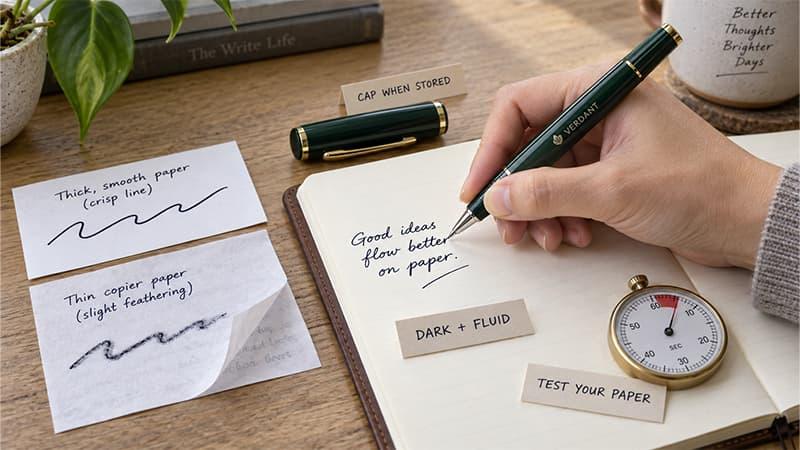
Ballpoint ink generally dries fast because it leaves a smaller amount of thick ink on the page. Gel performance varies, and rollerball ink is usually wetter. Glossy surfaces can slow all three because ink cannot absorb as it does on uncoated paper.
Paper choice can change the result as much as pen type, so compare the selected ballpoint, gel, or rollerball refill on the paper used most often.
Bleed-through means ink reaches the reverse side; feathering is sideways spread along fibers; ghosting is visibility through the page. The Hong Kong Consumer Council’s 40-model test shows why specific models can depart sharply from category averages.
| Test finding | Ballpoint results | Gel results |
|---|---|---|
| Models tested | 18 | 22 |
| Average writing distance | 1,052 m | 699.2 m |
| Overall writing-distance range | Shortest and longest models were ballpoints; all models ranged from 388.3 to 2,323.7 m | Results fell within the overall range |
| Blobbing and strike-through | Six models showed blobbing; strike-through was also observed among ballpoint samples | No model showed either problem |
| Variation among samples of one model | Eight models varied by more than 9% | Six varied by more than 9%; one exceeded 26%, or 240 m |
Across all 40 models, 15 dried in one to two seconds and 19 in about three to four seconds. One gel pen labelled quick-dry took at least 12 seconds. These results support a practical conclusion: verify the selected model instead of relying on the ink category or packaging claim alone.
Color, Line Width, and Refill Life
Gel pens typically offer the widest color range. Rollerballs often make saturated, continuous lines, while ballpoint pens tend to produce a lighter, controlled stroke. Hybrid ballpoint ink can narrow that difference.
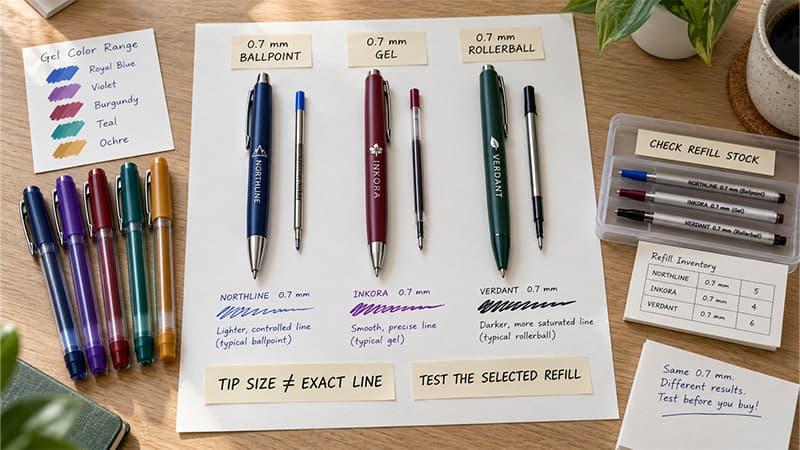
The number on a pen generally describes ball diameter, not exact line width. Ink flow, paper, pressure, angle, and tip construction all affect the mark. Refill life is also model-specific, so compare the selected refill, replacement price, and local availability instead of relying on a generic cost-per-page claim.
Which Pen Should You Choose?
Office Work, Forms, and Everyday Writing
For shared supplies, reception counters, forms, and quick notes, ballpoint pens are a practical default. Retractable ballpoint pens operate with one hand, and low-viscosity ink offers smoother writing.
Gel pens suit personal desks where richer lines matter, while rollerball pens suit correspondence on suitable paper. The ideal pen performs consistently on the paper used at work.
Students, Journaling, and Creative Work
Gel pens support color-coded notes, fine headings, journaling, and creative work. Rollerballs can reduce pressure during long sessions but may show through inexpensive notebooks. Ballpoints remain reliable for fast lecture notes and thin paper. Test the pen and page together before buying several refills.
Left-Handed Writers and Fast-Drying Needs
Left-handed writers should begin with drying behavior, not branding. Write a short paragraph, then pass the side of the hand over it at the normal pace. This simple check reflects hand position, writing speed, tip size, and paper without assuming all gel pens smudge or all ballpoint pens dry instantly.
Signatures and Professional Writing
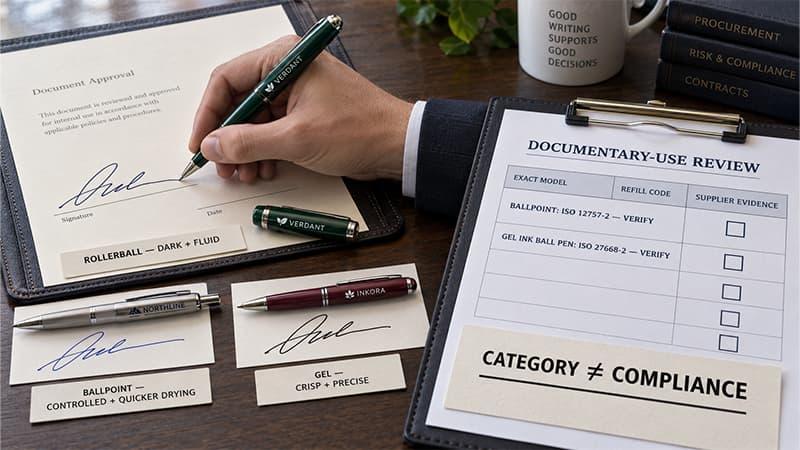
For signatures, a rollerball pen offers a dark, fluid line, while a metal ballpoint gives controlled writing with less drying risk. Gel pens can provide strong contrast and precision. Presentation matters, but the appearance of the pen should not replace verification of the refill.
For records that require documentary-use performance, check the chosen product’s documentation. ISO 12757-2 addresses ballpoint pens and refills for documentary use, while ISO 27668-2 covers gel ink ball pens and refills. A category name alone does not prove compliance.
Quick Decision Checklist
- Need fast drying and dependable everyday writing? Start with ballpoint pens.
- Want vivid colors and precise lines? Try gel pens.
- Prefer a dark, fluid line with less pressure? Try a rollerball pen.
- Write left-handed or use thin paper? Test the selected refill.
- Want smoother writing from a ballpoint? Consider hybrid ink.
- Need a pen for formal documents? Verify the exact specification.
- Still unsure? Write on the paper used most often.
Tip Sizes, Refills, and Pen Compatibility
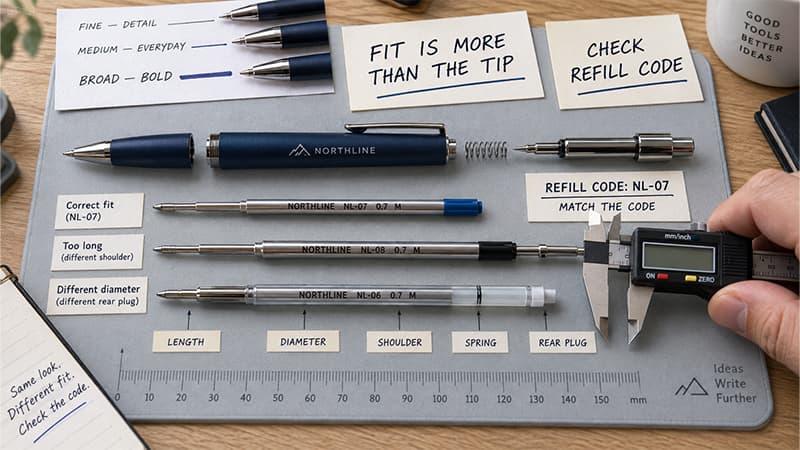
Fine tips suit compact handwriting and details. Medium tips balance control and smoothness for everyday writing. Broad tips create bold lines but place more ink on the page.
Refill compatibility goes beyond visible tip shape. Length, diameter, shoulder position, spring location, and rear plug design all matter. A gel refill, ballpoint refill, and rollerball refill may look similar but still fail to fit the same barrel.
Check the manufacturer’s refill code before buying. For a business gift, refill access affects the useful life of the entire item.
The TOMAS guide to the parts of a pen explains the tip, refill, grip, barrel, clip, cap, and retractable components. The broader types of pens guide compares other writing instruments and branding considerations.
Choosing Custom Pens for Business Use
Match the Pen Type to the Campaign
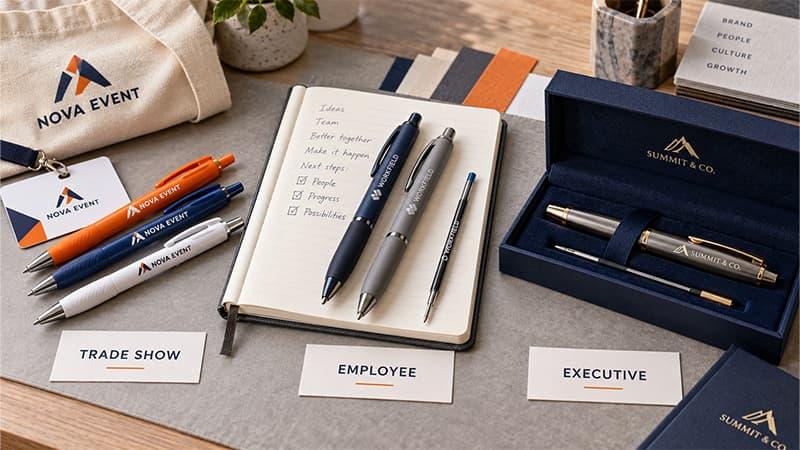
The recipient and task should guide selection before color or logo placement. A giveaway needs simple operation and reliable ink flows; employee stationery needs comfort and refill access; an executive gift needs suitable finish, mechanism, and presentation.
| Business application | Practical starting point | What to verify |
|---|---|---|
| Trade-show giveaway | Retractable ballpoint pens | Reliability, logo clarity, and budget |
| Employee stationery | Gel pens or hybrid ballpoint pens | Comfort, drying, and refill access |
| Shared office supplies | Ballpoint | Paper performance and durability |
| Client meeting set | Refillable metal ballpoint | Finish, refill access, and packaging |
| Executive gift | Metal ballpoint or capped rollerball | Weight, presentation, and refills |
| Travel gift | Model with documented pressure testing | Supplier or manufacturer evidence |
These are starting points rather than fixed rules. Buyers can explore custom pens and other branded office supplies before narrowing the specification.
How TOMAS Reviews Physical Pen Samples
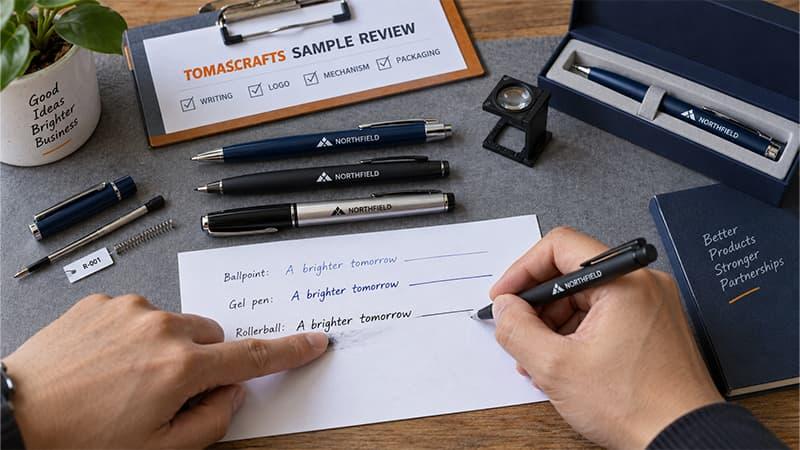
For a custom project, TOMAS can compare shortlisted ballpoint, gel, and rollerball samples as complete products. The purpose is purchasing approval, not laboratory certification, so each observation applies only to the reviewed model and setup.
| Review area | Consistent comparison method | Buyer decision |
|---|---|---|
| Refill and writing | Use the same sentence, paper, and normal writing pace | Compare line darkness, width, skipping, and visible smudging |
| Logo execution | Review the actual method on the curved barrel | Check small text, line clarity, contrast, and clip clearance |
| Mechanism | Operate each cap, clicker, or twist action repeatedly during review | Confirm ease of use and secure closure |
| Packaging | Place the completed pen in the intended sleeve or gift-box insert | Check clip pressure, movement, and presentation |
| Replacement | Record the refill code and format | Confirm future availability in the recipient’s market |
A digital mockup can show approximate logo size, position, and color, but it cannot confirm writing behavior, mechanism feel, barrel texture, logo sharpness, or packaging fit. The pen body, refill, decoration, and packaging should therefore be approved together through a physical sample and supporting documentation.
The TOMAS guide to printing methods explains why pad printing is often used on small curved products such as pens. Material, coating, artwork detail, and print area still require model-level review.
What to Confirm Before Bulk Production
- Exact pen and refill model
- Ink color and tip size
- Capped or retractable mechanism
- Barrel material and surface finish
- Logo method, size, color, and position
- Writing sample on the intended paper
- Body and trim colors
- Individual or set packaging
- Replacement-refill availability
- Order quantity and delivery destination
- Required arrival date
- Evidence for waterproof, archival, documentary-use, or pressure-safe claims
MOQ, unit price, and lead time are model-specific. Confirm them against the approved pen, refill, logo method, packaging, quantity, destination, and required date.
TOMAS can coordinate a physical sample so buyers can review the pen body, writing result, logo placement, mechanism, finish, and packaging together. Share the audience, budget, quantity, destination, and required date before selecting the final model.
Conclusion: Choose the Ink Before the Pen Body
Ballpoint pens are the practical starting point when quick drying, broad paper compatibility, and refill life matter most. Gel pens offer smoother writing, precision, and vibrant colors. A rollerball pen provides a fluid line with less pressure but may require better paper and more drying time.
No category wins every comparison. The exact refill, tip, paper, and intended task determine the better choice. For custom projects, approve the writing result alongside the barrel, logo, mechanism, and packaging instead of choosing from appearance alone.
Request a Custom Pen Shortlist
Planning branded pens for an event, employee kit, or client gift? Send TOMAS the intended audience, quantity, budget, delivery destination, required date, and available logo artwork. TOMAS can compare suitable ballpoint, gel, and rollerball options, then align the refill, logo method, and packaging before sample approval. Request a custom pen shortlist.
FAQs
Q1: Is a gel pen or ballpoint better for everyday writing?
Ballpoint pens are often better when fast drying, thin paper, and long refill life are priorities. Gel pens are preferable when smooth writing, dark lines, and vibrant colors matter more. For everyday writing, compare both on the paper used most often because individual refills vary.
Q2: What is the main difference between a rollerball and a ballpoint pen?
Both use a rotating ball, but a rollerball pen normally uses liquid water-based rollerball ink, while a ballpoint uses thicker oil-based ink. Rollerball ink flows with less pressure and creates a darker line. Ballpoint ink generally dries faster, resists smearing, and lasts longer in the refill.
Q3: Which pen type is best for left-handed writers?
Ballpoint pens are a practical starting point because their ink dries quickly. Some quick-drying gel pens are also suitable for left-handed writers. The best choice depends on hand position, writing speed, tip size, ink formula, and paper, so test the exact refill before buying in quantity.
Q4: Which pen type is best for custom promotional gifts?
Retractable ballpoint pens suit mass giveaways and shared office use. Gel pens or hybrid ballpoint pens fit employee stationery where smoother writing matters. Metal ballpoint pens and capped rollerball pens suit client or executive gifts. The final choice should reflect the recipient, budget, quantity, refill availability, branding, packaging, and delivery schedule.