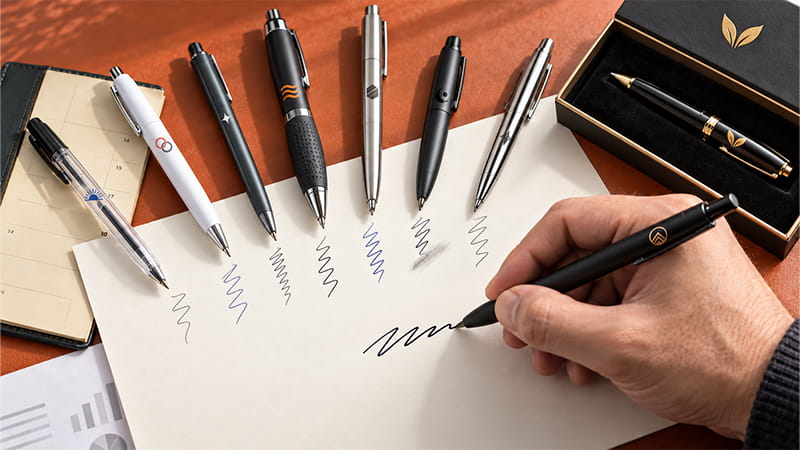
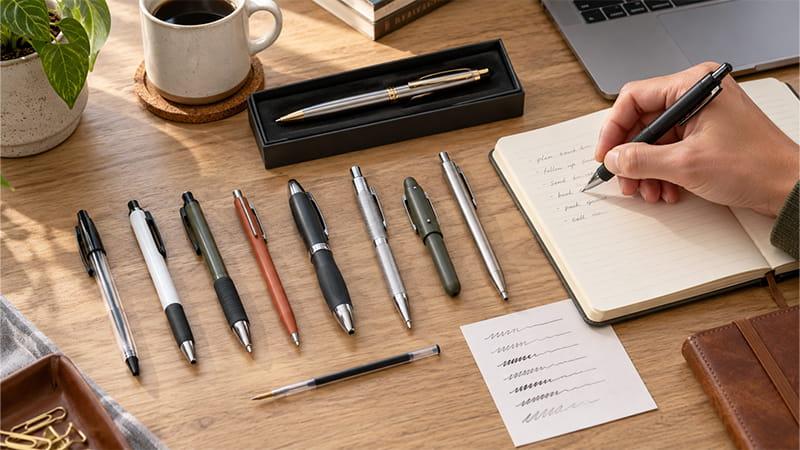
A ballpoint pen is easy to buy and surprisingly hard to choose well. The best ballpoint pens balance ink flow, tip size, comfort, refill access, and price. Using manufacturer specifications and independent research, this guide compares nine writing instruments for daily writing, travel, office work, and gifting, then explains what business buyers should verify before ordering custom pens in volume.
Quick Picks: The Best Ballpoint Pens at a Glance
Best overall: The Uni Jetstream RT offers the strongest balance of smooth writing, quick-drying ballpoint ink, refill access, and price. Choose the BIC Cristal Xtra Smooth for low-cost shared use, the Alpha Gel Grip for comfort, or the Cross Century II for a formal business gift.
| Pen | Best for | Ink and tip | Approximate US retail price* |
|---|---|---|---|
| Uni Jetstream RT | Best overall | Hybrid ballpoint, 0.7 mm | $3.09 |
| BIC Cristal Xtra Smooth | Budget and shared supplies | Oil-based ballpoint, 1.0 mm | About $0.15 each in a 500-count pack |
| Pilot Acroball PureWhite | Smooth, controlled writing | Advanced ballpoint, 0.7 mm | About 2−2−4 |
| Uni Jetstream Edge | Very small handwriting | Hybrid ballpoint, 0.28 or 0.38 mm | $16.09 |
| Uni Jetstream Alpha Gel Grip | Long writing sessions | Hybrid ballpoint, 0.7 mm | About 10−10−15 |
| Zebra F-701 | Durable everyday carry | Ballpoint, 0.8 mm | $10.50 |
| Fisher Bullet Space Pen | Travel and difficult conditions | Pressurized ballpoint, medium | $39 |
| Parker Jotter | Professional office use | Quinkflow ballpoint, medium | About 20−20−35 |
| Cross Century II | Premium business gift | Ballpoint, medium | $145 |
*Prices and availability were checked on September 14, 2026. They vary by region, finish, pack size, retailer, and limited-edition status. Confirm current specifications before buying.
How These Ballpoint Pens Were Selected
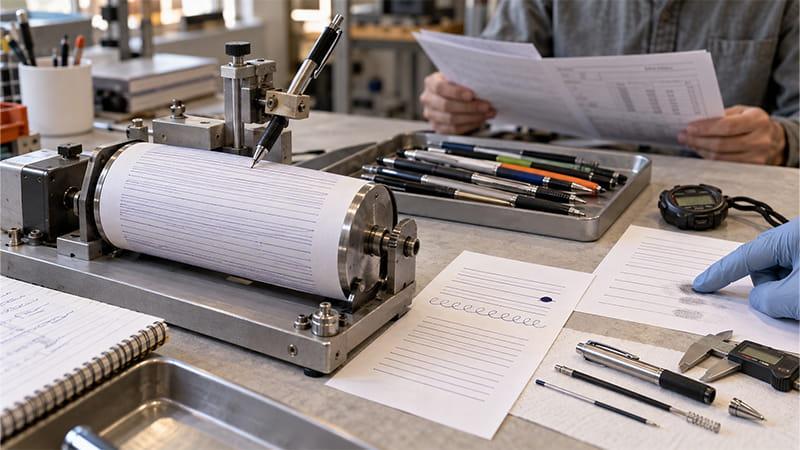
These recommendations consider consistent ink flow, line control, drying time, grip comfort, construction, and refill access. A good ballpoint pen must fit its task. A silky ink formula is less useful if it smears under a left-handed writer’s palm, while a heavy metal body may look impressive but become tiring during a long meeting.
Price was not treated as a performance score. In an independent test of 40 ballpoint and gel pens, the Hong Kong Consumer Council found nearly a fivefold difference in average writing distance. It also found no necessary relationship between price and overall quality.
The test examined writing distance, blobbing, drying time, resistance, and safety rather than appearance alone. See the Consumer Council ballpoint and gel pen test.
Research disclosure: TOMAS did not physically test every ballpoint pen in this guide. Selections use current manufacturer specifications, official product information, ink refill availability, independent testing where available, and suitability for each stated use. Subjective comments are framed as selection guidance rather than laboratory findings.
The Best Ballpoint Pens by Use Case
Uni Jetstream RT: Best Ballpoint Pen Overall
Best for: Everyday notes, office work, students, forms, and anyone moving from gel pens to ballpoint ink.
The Uni Jetstream RT is one of the most practical low viscosity ballpoint pens. Its hybrid ballpoint ink moves with less pressure than thick oil paste while retaining the quick-drying behavior expected from a ballpoint.
The current US 0.7 mm retractable model is listed at $3.09, comes in several colors, and accepts replacement refills. This ballpoint pen works across quick notes, forms, receipts, and longer pages without becoming a specialist tool.
Main drawback: The plastic body is practical rather than premium, and its 0.7 mm line may look finer than gel users expect.
BIC Cristal Xtra Smooth: Best Budget Ballpoint Pen
Best for: Shared supply cabinets, classrooms, reception desks, forms, and situations where pens disappear regularly.
Among classic ballpoint pens, the BIC Cristal Xtra Smooth keeps cost down with a capped design, transparent section, and comfortable round barrel. The US model uses a 1.0 mm medium point; BIC listed its 500-count black pack at 74.99,orabout74.99,orabout0.15 per ballpoint pen, when prices were checked.
Its simple, disposable construction makes it practical for shared supplies where writing instruments are frequently lost or taken.
Main drawback: Its hard, narrow body has no cushioned grip, and most versions are disposable. It suits short, shared tasks better than several pages of tight-grip writing.
Pilot Acroball PureWhite: Best for Smooth, Controlled Writing
Best for: Fast notes, left-handed writers, forms, and people who want smooth ink without losing paper feedback.
The Pilot Acroball PureWhite combines quick-drying ballpoint ink with a textured rubber grip. Pilot’s 2026 European catalog gives the 0.7 mm model an approximate 0.25 mm line, showing why ball diameter and written width are not interchangeable.
This ballpoint pen provides slight paper feedback, making fast handwriting easier to control than an extremely slippery writing instrument.
Main drawback: Available ink colors and refills depend on the market and version. Some promotional configurations use black ink regardless of grip color.
Uni Jetstream Edge: Best Fine-Tip Ballpoint Pen
Best for: Small handwriting, planners, annotations, technical notes, and narrow form fields.
The Uni Jetstream Edge offers 0.28 mm and 0.38 mm ballpoint tips, a hexagonal upper barrel, and a knurled metal grip. Its $16.09 official price buys precision rather than effortless speed. The 0.28 mm version fits tiny planner spaces and narrow forms, while low-viscosity ballpoint ink keeps such a fine tip usable.
Main drawback: The contact point feels sharper on rough paper and reacts more to writing angle. Heavy-handed writers may find the 0.28 mm tip too delicate.
Uni Jetstream Alpha Gel Grip: Best for Long Writing Sessions
Best for: Meeting notes, study sessions, journaling, and writers who grip a pen hard.
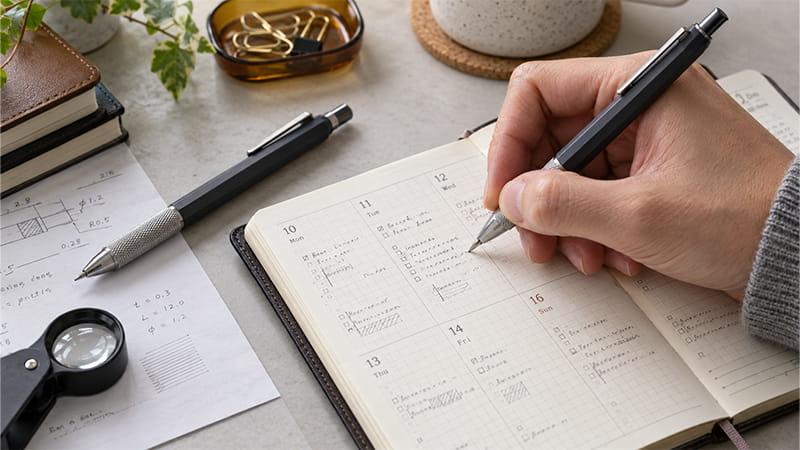
The Jetstream Alpha Gel Grip combines a soft silicone grip with low-viscosity ballpoint ink. The 0.7 mm model uses an SXR-7 ink refill; an authorized Japanese listing specifies a 13.3 mm diameter and 21 g weight. The larger, softer surface spreads finger pressure, while the ink needs less force than traditional paste. Those two traits make this ballpoint pen a sensible choice for long writing sessions.
Main drawback: A thick, soft grip can feel imprecise and may not fit a narrow pen loop.
Zebra F-701: Best Durable Everyday-Carry Pen
Best for: Workshops, warehouses, field notes, tool bags, and users who prefer an all-metal pen.
The Zebra F-701 has stainless-steel construction from tip to clip, a retractable mechanism, and a knurled grip. Zebra lists this ballpoint pen at $10.50 with a refillable 0.8 mm all-metal F-refill. Its firm texture and metal body suit workshops, warehouses, and field settings where a thin plastic writing instrument feels disposable.
Main drawback: Added weight and conventional ballpoint resistance make it less comfortable for long essays.
Fisher Bullet Space Pen: Best for Travel and Difficult Conditions
Best for: Travel kits, vehicles, fieldwork, compact everyday carry, and writing at unusual angles.
The Fisher Bullet Space Pen uses a sealed, pressurized PR4 refill. Among pressurized ballpoint pens, this ballpoint pen is a compact and well-documented choice. Fisher says it writes upside down, over grease, underwater, and across a wide temperature range.
The $39 matte black 400B has a brass body and measures 3.77 inches closed or 5.35 inches with the cap posted, so the writing instrument carries small but writes at full length.
Main drawback: Its pressurized ink requires more force than the smoothest hybrid formulas. The Fisher earns its price through portability and specialist performance rather than effortless desk writing.
Parker Jotter: Best Professional Ballpoint Pen
Best for: Office desks, client meetings, signatures, graduation gifts, and everyday professional carry.
The Parker Jotter ballpoint pen combines a stainless-steel cap and barrel, arrow clip, retractable click, and medium Quinkflow refill. The current stainless model comes in a Parker gift box and also accepts compatible Parker gel refills. This writing instrument is formal enough for a client signature but practical enough to live in a work bag.
Main drawback: Its slim polished body offers less support and grip than ergonomic models.
Cross Century II: Best Premium Ballpoint Pen for Business Gifts
Best for: Executive gifts, recognition awards, milestone presentations, and formal signing occasions.
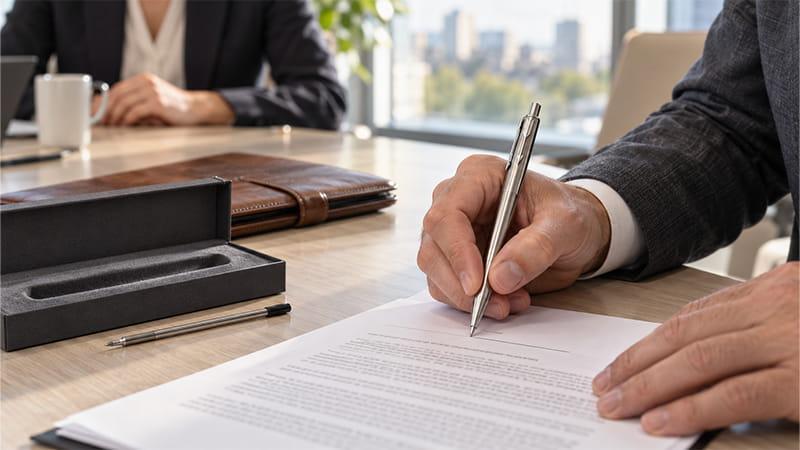
The Cross Century II ballpoint pen is wider than the slim Classic Century. The $145 black lacquer model uses a twist mechanism and Cross refill #8513, comes in a luxury gift box, and carries a lifetime mechanical guarantee. Its finish, balance, packaging, and refillable body fit promotions or milestones that call for a lasting writing instrument.
Main drawback: Its ink is not automatically smoother than a low-cost hybrid refill. Much of the price pays for construction and presentation.
What Is a Ball Pen?
A ball pen, more commonly called a ballpoint pen, uses a small rotating ball to transfer ballpoint ink from an internal refill onto paper. “Ball pen,” “ballpoint pen,” and “ball point pen” refer to the same writing instrument, although ballpoint pen is the standard modern spelling. Its controlled ink flow and relatively quick drying time make it practical on common paper.
Ballpoint pens remain popular because they combine long refill life, simple operation, and broad paper compatibility. These writing instruments work at a desk, in a classroom, at a reception counter, or inside a travel kit without the filling and cleaning routines associated with a fountain pen.
How a Ballpoint Pen Works
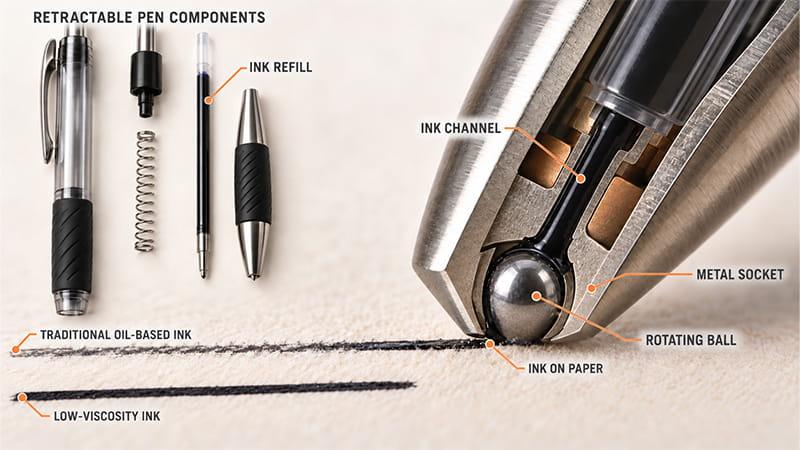
Ballpoint pens work by holding a tiny rotating ball in a socket. As it rolls across the writing surface, one side collects ink from the cartridge and the other deposits it on paper. The clearance around the ballpoint tip meters ink and helps seal the refill at rest. Components include the pen body, ink refill, grip, clip, and capped or retractable mechanism. See the TOMAS guide to the parts of a pen for the full anatomy.
Tungsten carbide balls resist wear, but material alone does not guarantee consistent ink flow on every writing surface. Ball finish, socket tolerance, ballpoint ink formulas, and assembly also matter.
Traditional Oil-Based Ink vs. Low-Viscosity Ink
Traditional ballpoint ink dries quickly and stores well in a compact refill, but its viscosity can require more pressure. Low viscosity ballpoint pens work with hybrid formulas that reduce that resistance, creating a smoother writing experience and darker line while retaining quick-drying behavior. Classic ballpoint pens may feel firmer, but some writers prefer that control. Tip size and paper still affect the result.
How to Choose a Good Ballpoint Pen
Choose the Right Tip Size
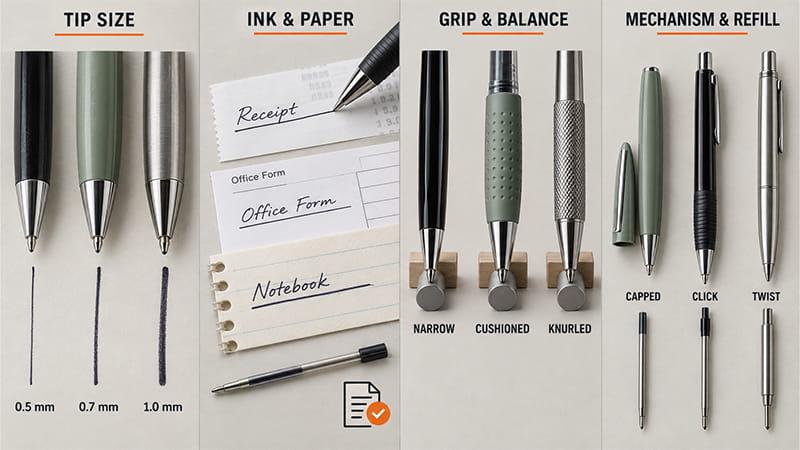
A 0.5 mm ballpoint tip suits small handwriting, forms, and planners. A 0.7 mm tip balances control and smoothness for daily use, while 1.0 mm favors larger, broader writing. The number describes ball diameter, not exact line width; ink, pressure, and angle change the result. Compare a writing sample, not only the package number.
Match the Ink to Your Writing and Paper
Fast and left-handed writers benefit from quick-drying ballpoint ink. Low-viscosity formulas reduce pressure, while traditional paste gives firmer control and often longer refill life. Fine tips can catch on rough fibers; broad or wet inks may show through thin sheets. Consistent ink flow matters most on receipts, forms, and absorbent office paper.
For signatures or records that must resist water, solvents, or fading, do not assume every blue or black refill is document safe. Ask for a suitable documented refill. ISO 12757-1 establishes minimum quality requirements for general-use ballpoint pens and refills, while ISO 12757-2 covers additional requirements for documentary use. See the current ISO 12757-1 standard summary.
Compare Grip, Weight, and Balance
A narrow hard barrel works for short notes and smaller hands. A thicker grip spreads pressure; rubber and silicone cushion, while knurling adds friction. Metal can feel controlled during a signature yet tire the hand across several pages. Balance matters as much as total weight, so write a paragraph before deciding.
Choose the Mechanism and Refill System
Capped ballpoint pens have few moving parts. Click mechanisms are fast for notes, while twist mechanisms look cleaner and are less likely to extend in a pocket. A refillable ballpoint pen is not universally compatible. Check the ink refill code, tip sizes, colors, and local supply. A beautiful body with an obscure cartridge may have a shorter useful life than a plain pen with common refills.
Ballpoint vs. Gel vs. Rollerball Pens
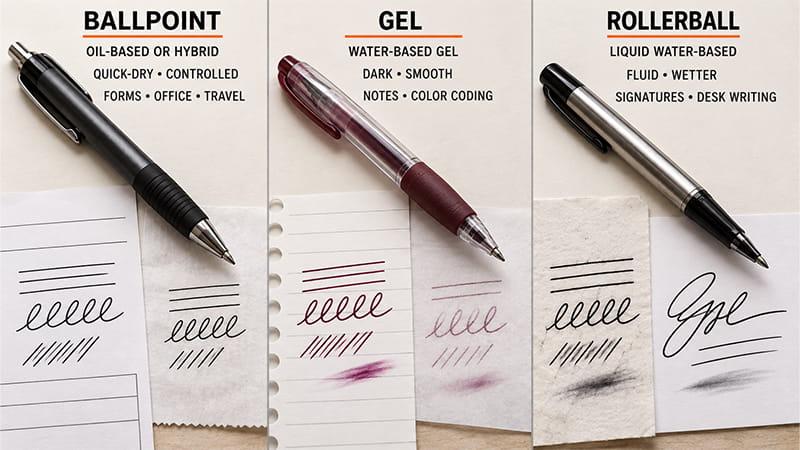
These writing instruments all use a rolling ball, but their ink formulas change how they write. Rollerball pens use more fluid ink and can feel closer to a fountain pen, while ballpoint ink places less liquid on the page.
| Pen type | Typical ink | Writing feel | Drying and smudging | Paper behavior | Best use |
|---|---|---|---|---|---|
| Ballpoint | Oil-based or low-viscosity hybrid | Controlled; ranges from firm to smooth | Usually quick drying | Reliable on common and absorbent paper | Forms, quick notes, office and travel |
| Gel | Water-based gel with suspended pigment | Smooth, dark, and available in many colors | Varies; some formulas smear | Can show through thin paper | Study notes, color coding, bold everyday writing |
| Rollerball | Liquid water-based ink | Fluid and close to a fountain pen | Usually wetter and slower to dry | May feather on low-quality paper | Signatures and smooth desk writing |
Choose a ballpoint when reliability, refill life, and broad paper compatibility come first. Choose a gel pen for saturated color or a rollerball pen for a fluid line. Compared with other writing instruments, a fountain pen needs more filling and cleaning care. The TOMAS guide to different types of pens covers these formats in more detail.
Ballpoint Pen Care and Refill Replacement
- Replace the refill: Identify the model and refill code, open the intended barrel joint, and note any spring. Insert the new cartridge without forcing the threads, then test it on scrap paper. Similar-looking refills can differ in length, tip diameter, and plug shape.
- Fix skipping: Wipe the tip with a clean, dry cloth, let a cold pen reach room temperature, and draw circles on uncoated paper. Replace a damaged or depleted refill. Do not use a flame or solvent.
- Store pens correctly: Retract or cap the tip and avoid prolonged heat, direct sunlight, and sharp temperature changes. Before an event, test stored stock early enough to replace questionable refills before packing.
Choosing Custom Ballpoint Pens for Business Use
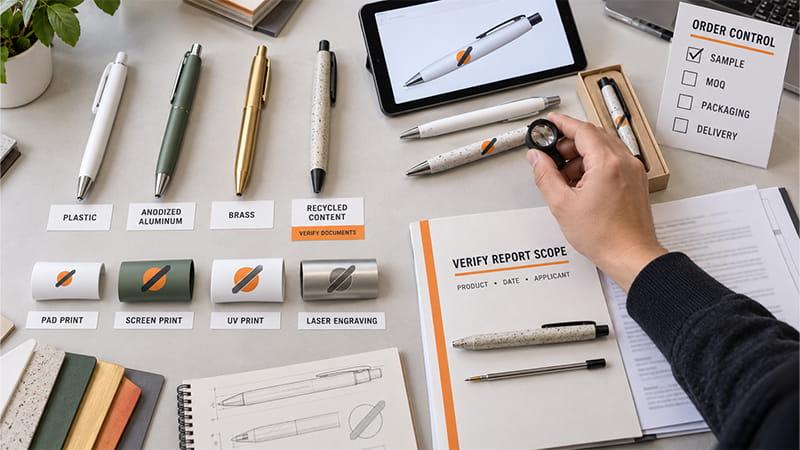
Businesses should select custom ballpoint pens by recipient, quantity, use, refill quality, material, branding, packaging, and delivery date. These promotional writing instruments need a suitable sample because a mockup cannot show how the finished ballpoint pen writes, operates, or carries the logo.
Match the Pen to the Audience and Campaign
| Use case | Better starting point | Main priority |
|---|---|---|
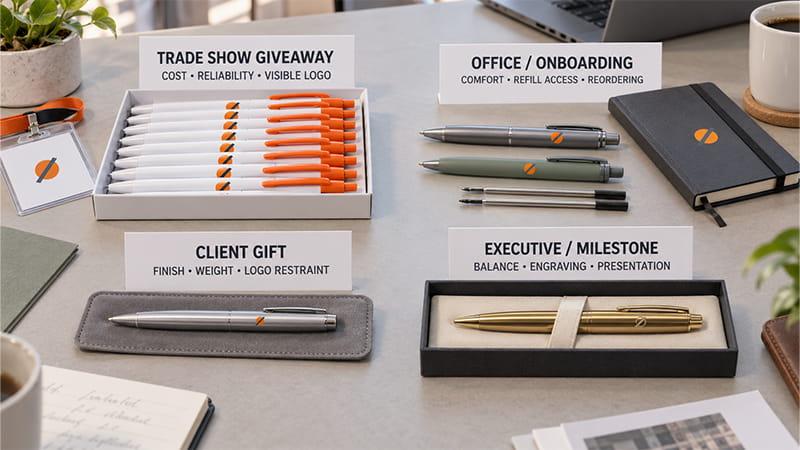
| Trade show giveaway | Lightweight plastic click pen | Cost, reliable writing, visible logo |
| Office or onboarding program | Refillable plastic or aluminum pen | Comfort, refill access, repeat ordering |
| Client gift | Metal ballpoint with individual packaging | Finish, weight, logo restraint |
| Executive or milestone gift | Brass or premium metal pen | Balance, mechanism, engraving, presentation box |
A cheap pen is not economical if the refill skips or the logo becomes unreadable. A premium metal pen is wasteful when recipients only need a giveaway. Start with the task, then choose materials and decoration within budget. Buyers can compare custom pens and other branded office supplies with TOMAS. Retail prices above are not bulk quotes.
Compare Plastic, Aluminum, Brass, and Recycled-Material Options
Plastic supports volume, color choice, molded grips, and several printing methods. Soft-touch coatings improve feel but can complicate color and adhesion. Aluminum makes lighter writing instruments suited to anodizing and engraving; brass feels denser and costs more. Classic ballpoint pens are not automatically sustainable, and the phrase “eco friendly ballpoint pens” requires supporting documentation for recycled content or another defined environmental attribute.
Choose the Right Logo Method
Pad printing handles small marks and curves; screen printing can create a larger opaque logo. UV printing supports full color, while laser engraving creates a restrained mark on compatible metal finishes. No method is universally permanent or scratch-proof. Choose by substrate, coating, detail, color, handling, and budget, then review a branded sample.
Confirm Samples, MOQ, Packaging, and Delivery
A digital mockup checks placement. An existing sample checks the body and refill; a logo sample shows decoration; a pre-production sample is closest to the intended order. MOQ and lead time vary by model. An in-stock barrel with one-color printing is usually simpler than a custom body with matched colors and gift packaging. Share the destination and required date at the start.
Review Quality and Market-Specific Compliance
ISO 12757-1 is relevant to general-use ballpoints; ISO 12757-2 adds documentary-use requirements. Other obligations depend on destination, materials, users, and buyer specifications. Confirm the product, report scope, date, and applicant because a certificate for one refill or barrel formulation may not cover another model.
TOMAS Sourcing Note: What to Check Before Ordering Thousands of Pens
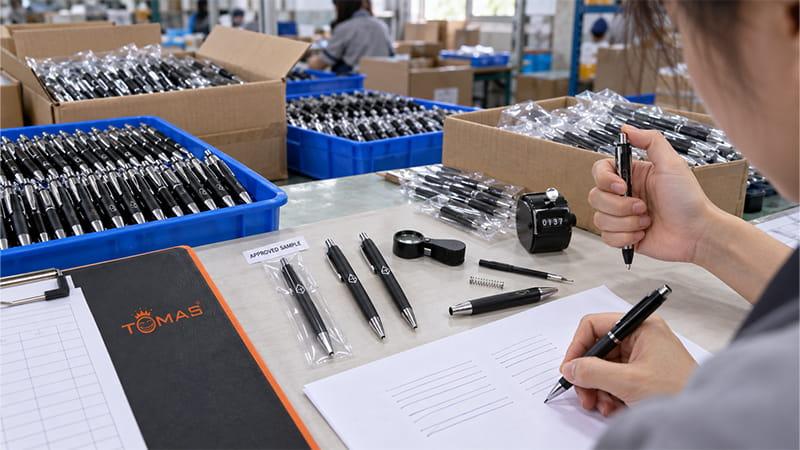
For a multi-thousand-piece order, TOMAS can lock the model, material, refill, logo method, packing, and arrival date so the quote, sample, and production use the same specification.
| Common risk | What TOMAS can check | Decision required before production |
|---|---|---|
| Small logo details become unclear | Imprint area, lettering, line thickness, and contrast | Approve artwork on the selected body |
| The pen looks good but writes poorly | Initial ink flow, line consistency, tip size, and refill | Approve the specified refill or a physical sample |
| The click or twist feels unreliable | Sample mechanism operation and component fit | Confirm the exact production mechanism |
| The logo method does not suit the barrel | Material, surface finish, colors, and handling | Select printing or engraving after sampling |
| Packing or delivery is overlooked | Individual packing, carton quantity, production time, and shipping | Work backward from the required arrival date |
A mockup cannot show ink flow, mechanism feel, texture, or print sharpness. TOMAS can coordinate a branded or pre-production sample when those details affect acceptance.
Selected production units can then be checked for writing start, mechanism, logo position, finish, packing, and carton quantity. These checks are not laboratory certification or a zero-defect promise.
Shelf-life, writing-distance, and mechanism-cycle claims should only be used when the selected pen has matching documentation or a recorded test.
Conclusion: Choose the Pen for the Writing Task
Ballpoint pens remain useful because they fit many writing tasks. For personal use, compare ballpoint ink, tip size, grip comfort, and refill access before paying for appearance. Everyday writing instruments should start reliably and remain comfortable, while premium models must justify their price through construction, presentation, or specialist performance.
For bulk promotion, brand recognition does not rescue a poor refill or unreadable imprint. Choose the writing experience first, then confirm the body, logo method, sample, packaging, and delivery plan. That sequence produces a pen people can use rather than another object left at the end of an event.
Request Custom Ballpoint Pen Options From TOMAS
Start with four essentials: quantity, target budget, destination, and required arrival date. TOMAS can then prepare a focused shortlist with suitable pen types, branding methods, sampling recommendations, and potential lead-time risks. Preferred materials, logo files, and packaging requirements can follow after the product direction is confirmed.
Contact TOMAS to request custom ballpoint pen options and a project-based quotation, or explore more promotional product solutions from TOMAS Crafts.
FAQs
1. What is the best ballpoint pen for everyday writing?
The Uni Jetstream RT is the best starting point for most people because its low-viscosity ballpoint ink writes smoothly, dries quickly, and works on common office paper. The standard body is affordable and refillable. Writers who grip hard or write for long periods should consider the Jetstream Alpha Gel Grip for its thicker cushioned section.
2. Is a 0.5 mm or 0.7 mm ballpoint pen better?
A 0.5 mm ballpoint suits small handwriting, planners, forms, and writers who value line control. A 0.7 mm tip generally feels smoother and is the safer size for everyday notes. Brand and ink formula affect the written width, so compare samples rather than assuming every 0.7 mm pen creates the same line.
3. Are ballpoint pens better than gel or rollerball pens?
Ballpoint pens are better for quick drying, long refill life, and broad paper compatibility. Gel pens usually create darker, more colorful lines, while rollerball pens offer a wetter and more fluid feel. These writing instruments serve different needs, so choose according to drying speed, writing surface, line appearance, and writing pressure.
4. What should businesses check before ordering custom ballpoint pens?
Confirm the model, barrel material, refill, tip size, ink color, logo method, imprint area, quantity, sample type, packaging, destination, and required arrival date. Review a suitable sample before bulk production, then check production units against the approved specification. Compliance documents should match the actual product and destination market.