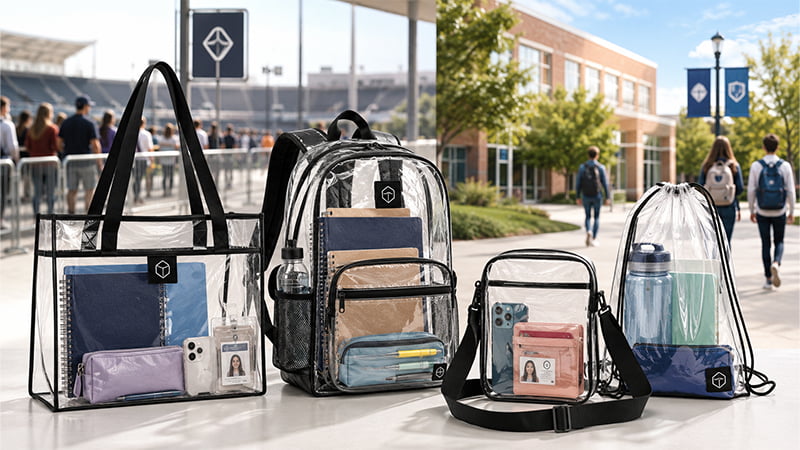
Clear bags are used at stadiums, schools, concerts, workplaces, festivals, and security programs because they make contents easier to inspect. But the wrong size, material, style, or logo placement can cause entry problems, user complaints, or bulk order waste. This guide explains how to choose clear bags for real rules, real use, comfort, branding, and delivery.
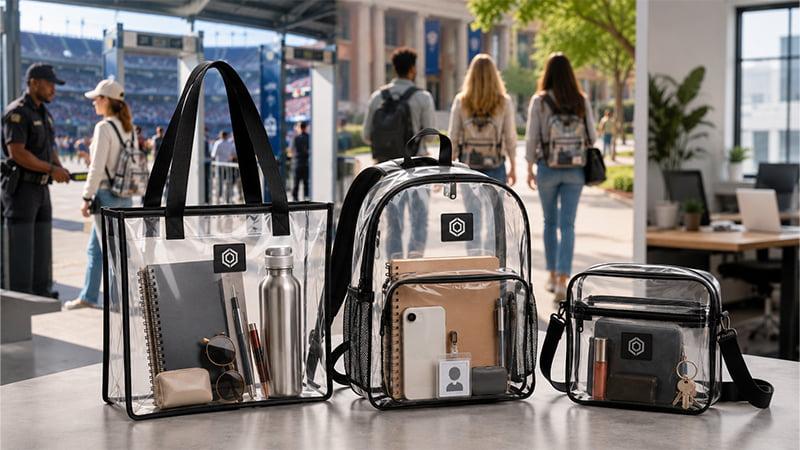
Quick Answer: What Are Clear Bags?
Clear bags are bags made from transparent materials such as PVC, TPU, vinyl, or other see through plastic material. They allow the items inside to be visible, which helps with security checks at stadium events, concerts, schools, workplaces, and large public events.
A clear tote bag works well for basic event entry. A see through purse is better for phones, wallets, tickets, keys, and small essentials. A transparent plastic backpack works better when users need more room for school, work, staff items, or everyday use. Rules vary by venue, school, and event, so buyers should check the specific policy before purchasing or placing a bulk custom order.
Why Clear Bags Are Used and What Rules Buyers Should Check
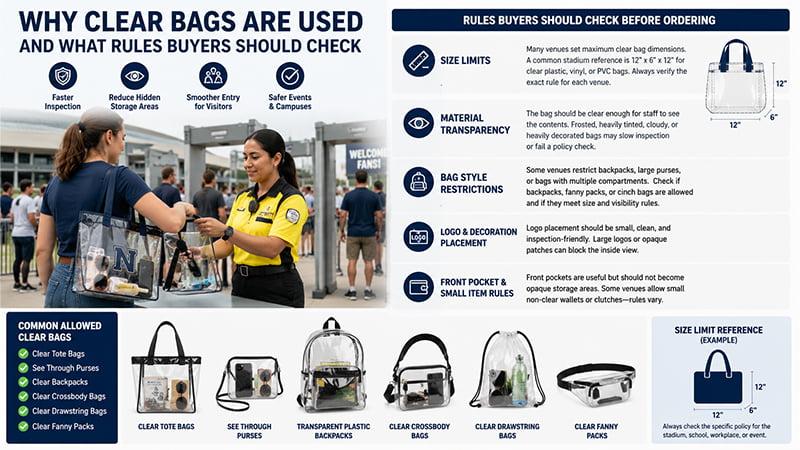
Clear bags are common because they support faster inspection and reduce hidden storage areas. For sporting events, concerts, festivals, and stadium events, a clear bag can help visitors move through security more smoothly.
Schools and workplaces may also use clear bags for campus security, workplace checks, warehouse control, kids’ programs, or staff identification. Event organizers may use clear tote bags or clear drawstring bags as practical giveaways for volunteers, visitors, or attendees.
Still, a clear bag is not automatically accepted everywhere. Buyers should check these points before choosing a product.
Size limits: Many venues set maximum clear bag dimensions. A common stadium reference is 12″ x 6″ x 12″ for clear plastic, vinyl, or PVC bags, but users should verify the exact rule for the stadium, school, workplace, or event. The official NFL Clear Bag Policy also encourages fans to check individual team or stadium websites for venue-specific guidance.
Material transparency: The bag should be clear enough for staff to see the contents. Frosted, heavily tinted, cloudy, or heavily decorated bags may slow inspection or fail a policy check.
Bag style restrictions: Some venues may allow clear tote bags but restrict backpacks, large purses, or bags with multiple compartments. Other locations may allow clear backpacks, fanny packs, or cinch bags if they fit the allowed size and visibility rules. For example, the Soldier Field bag policy lists clear backpacks, clear fanny packs, and clear cinch bags as acceptable only when they fit the stated clear bag dimensions.
Logo and decoration placement: Logo placement should stay small, clean, and inspection-friendly. Large logos, opaque patches, printed front panels, or heavy decorative trims can block the inside view.
Front pocket and small item rules: A front pocket can be useful for tickets, cards, or keys, but it should not become an opaque storage area. Some policies allow small non-clear wallets or clutches, but this varies by venue.
Avoid claims such as “approved everywhere,” “universal stadium approved,” or “guaranteed entry.” Clear bag rules are practical policies, not one global standard.
Main Types of Clear Bags and When to Use Them
Different clear bags solve different problems. The right choice depends on the rule, the user, the carrying need, and the event type.
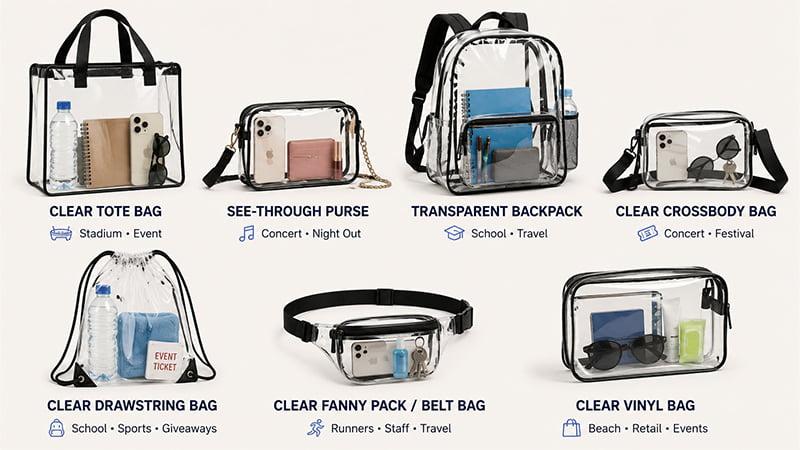
Clear tote bags: A clear tote bag is one of the most common choices for stadium events, concerts, school events, trade shows, and basic security entry. It offers more carry space than a small purse and is easier to inspect than a traditional bag. For B2B programs, clear tote bags are also useful for volunteer kits, sports team giveaways, and event merchandise.
See through purses: A see through purse is smaller and better for light essentials. It can hold a phone, wallet, keys, tickets, lip balm, cards, and small personal items. This type fits concerts, sporting events, festivals, ticketed venues, and evening occasions where people do not need to carry much.
Transparent plastic backpacks: A transparent plastic backpack works better when users need more capacity or shoulder comfort. It can suit school programs, campus security, workplace security, staff kits, sports team supplies, kids’ activities, and travel basics. Buyers should check if backpacks are allowed by the policy before ordering.
Clear crossbody bags: These bags are useful for hands-free carrying at concerts, festivals, city events, travel, and stadium visits. They are smaller than backpacks but often more secure than open tote bags.
Clear drawstring bags: Clear drawstring bags work well for schools, sporting events, kids’ programs, giveaways, and low-cost bulk promotions. They are lightweight, easy to pack, and simple to distribute.
Clear fanny packs or belt bags: These are useful for runners, event staff, stadium visitors, and customers who only need small essentials.
Clear vinyl bags: Clear vinyl bags are common for stadium totes, beach bags, retail promotions, and event use. They can offer water resistance and a clean transparent look, but buyers should test thickness, flexibility, smell, and clarity before bulk ordering.
For broader bag sourcing options, buyers can also review TOMAS Crafts’ custom backpacks and tote bags page.
Clear Plastic Bags, PVC, TPU, and Vinyl: Which Material Should Buyers Choose?
“Clear plastic bags” is a broad term. It can refer to different materials and structures, including PVC, vinyl, TPU, PET-related sheets, or other transparent plastic material. For B2B buyers, the material should match the use case, budget, event deadline, and required quality level.
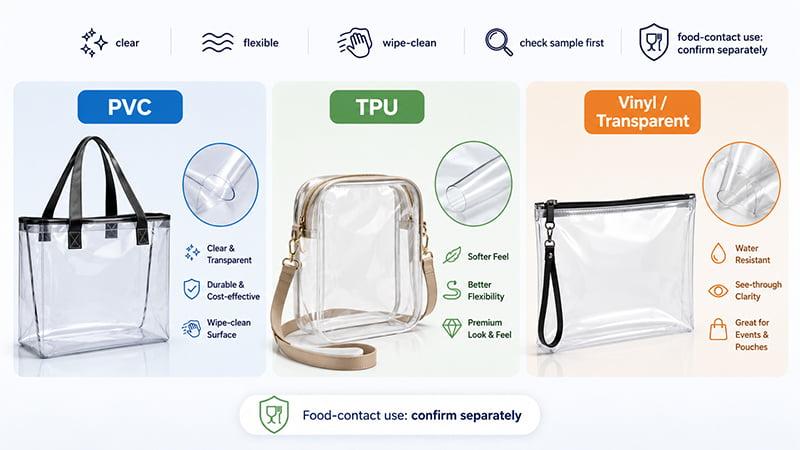
PVC clear bags: PVC is commonly used for clear tote bags, event bags, and promotional clear bags because it is transparent, flexible, and cost-effective for many bulk projects. Before approving bulk production, ask for a sample and review clarity, thickness, odor, flexibility, and wipe-clean surface together. For cold-weather sporting events or outdoor winter programs, ask the supplier to confirm material flexibility with samples.
TPU clear bags: TPU may be used for projects that need a softer feel, better flexibility, or a more premium material direction. It may suit higher-value clear bags, but cost, testing needs, and actual use should be reviewed before ordering.
Vinyl and other transparent materials: Vinyl is common for clear bags and can provide water resistance and a clean see through appearance. PET and other transparent materials may appear in pouches, packaging-related bags, or structured panels. Suitability depends on product design, printing method, and real use.
Food-contact note: If a clear plastic pouch or bag is intended to hold food directly, buyers should confirm food-contact requirements separately. A clear event bag and a food-contact bag are not the same sourcing project.
Avoid unsupported technical claims such as fixed cold-crack ratings, UV stability, or waterproof performance unless the exact product has test data.
Transparent Bag vs See Through Bag: Is There a Difference?
“Transparent bag” and “see through bag” are often used to describe the same basic idea: a bag that allows contents to be visible.
The phrase transparent bag sounds more material-focused. It may be used when buyers talk about clear plastic, PVC, TPU, vinyl, or product specifications. The phrase see through bags sounds more casual and user-focused. It is often used by shoppers looking for a bag that security staff can inspect quickly.
For security use, the wording is less important than the result. The bag must meet the policy, size, material, and visibility requirements. A transparent bag that is too large, too cloudy, or covered with opaque decoration may still be a poor choice.
Backpack See Through and See Through Purse: Which One Fits Your Use Case?
A backpack see through design and a smaller see through purse solve very different carrying needs.
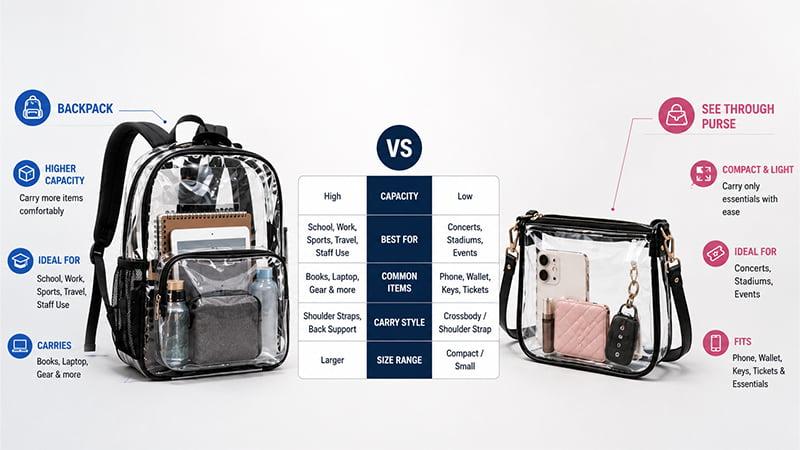
Backpack see through options: A backpack see through design makes sense when users need more capacity than a purse or tote. Good use cases include school supplies, campus security, workplace checks, warehouse control, sports team gear, event staff kits, volunteer programs, and travel packing.
Before ordering transparent plastic backpacks in bulk, buyers should check strap reinforcement, zipper quality, seam construction, and whether the bag remains easy to inspect after items are packed inside. Large opaque panels, thick trims, or hidden compartments can reduce visibility. A packed sample is useful when the backpack will carry books, uniforms, equipment, lunch, clothes, or staff tools.
See through purse options: A smaller see through purse works better when people only need essentials. It is useful for concerts, stadium games, festivals, evening events, ticketed venues, travel, event staff badges, and small tools.
Buyers should check phone fit, wallet space, key storage, zipper closure, strap comfort, front pocket visibility, and final dimensions. A clear handbag or see through purse may look compact, but it still needs to match the event policy.
Size Guide: What Clear Bag Dimensions Should Buyers Check?
Clear bag size is one of the most important buying points. A bag can look suitable online but still exceed policy limits once depth, piping, zipper structure, or front pocket design is measured.
12″ x 6″ x 12″ as a common stadium reference: Many stadium policies use 12″ x 6″ x 12″ as a common reference for clear plastic, vinyl, or PVC bags. Do not treat this as universal. Readers should check the exact stadium, school, venue, or event rule before buying. The NFL Clear Bag Policy can be used as one official reference point, but buyers should still confirm the policy for their specific venue.
Smaller clear purses and 9-inch compact bags: Smaller clear purses or 9-inch clear bags may work for phones, wallets, keys, tickets, cards, and small essentials. They are easier to carry but may not fit bottles, notebooks, lunch items, extra clothes, or staff tools.
Depth and front pocket visibility: Depth affects capacity. A bag that is too deep may exceed the allowed limit, while a flat bag may not hold enough. A front pocket can help organization, but it should not block the main inspection area.
Bulk sample check: For custom orders, finished sample size should be measured after production. Seam construction, piping, edging, zipper closure, or reinforced trim can slightly affect final dimensions. This matters when the bag must meet a strict policy.
How to Choose the Right Clear Bag for Your Use Case
The right clear bag starts with the rule, then the user, then the product details.
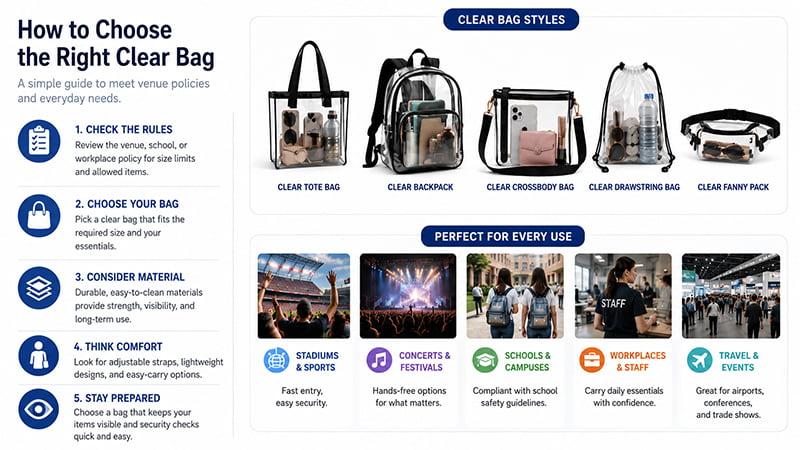
Start with the rule: Before choosing a style, check the venue, school, workplace, or event policy. Confirm allowed size, bag type, material, number of pockets, logo limits, and prohibited items.
Match the bag to what people carry: List actual contents before choosing the bag. Common items include phone, wallet, keys, tickets, ID card, water bottle if allowed, sunscreen, lip balm, charger, notebook, small umbrella, staff tools, school supplies, lunch, or clothes.
Choose material based on use time: Short-term giveaways may use lighter transparent material. Repeated-use clear bags need better material thickness, stronger seams, cleaner zipper construction, and better strap comfort.
Check comfort and carry method: Tote handles, crossbody straps, backpack straps, drawstring cords, and belt straps all affect comfort. A bag for everyday use or staff work needs stronger carry features than a one-day party or giveaway bag.
Keep visibility clear: Avoid large graphics, opaque pockets, thick trims, or decoration that blocks the inside view. This is especially important for stadium, school, and workplace security use.
Smart Buying Tips for Bulk Custom Clear Bags
Bulk clear bag orders need more checking than standard tote bags because the product often has to match a rule, not only a design preference.
Before placing a custom order, confirm the event or school policy. Then choose the bag size and style based on that policy. This helps avoid buying a clear handbag, clear tote bag, or transparent plastic backpack that looks useful but cannot be used at the actual venue.
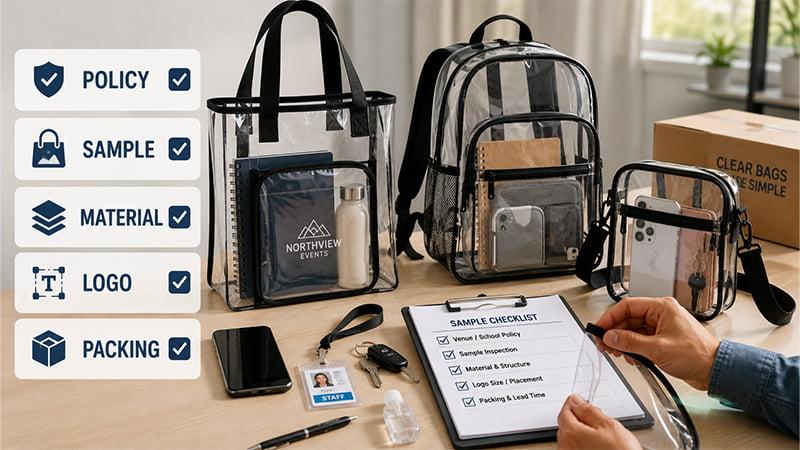
Request a sample if the order is for a strict venue, school program, or security checkpoint. Test real items inside the sample. Check whether the bag still closes properly, whether the zipper works smoothly, whether the straps feel strong, and whether the front pocket blocks the view.
Material checks are also important. Review clarity, smell, flexibility, thickness, and wipe-clean surface. A low-cost plastic material may work for a short giveaway, but repeated-use bags for schools, workplaces, or staff kits need better structure.
For custom branding, confirm logo size and placement before production. The logo should be visible enough for brand exposure but not so large that it blocks inspection. For decoration options and artwork setup, buyers can review TOMAS Crafts’ guide to types of printing.
Also confirm packing method, carton quantity, MOQ, production lead time, and shipping deadline. These details matter when clear bags are needed for a fixed event date.
Common Mistakes and TOMAS Supplier Insights
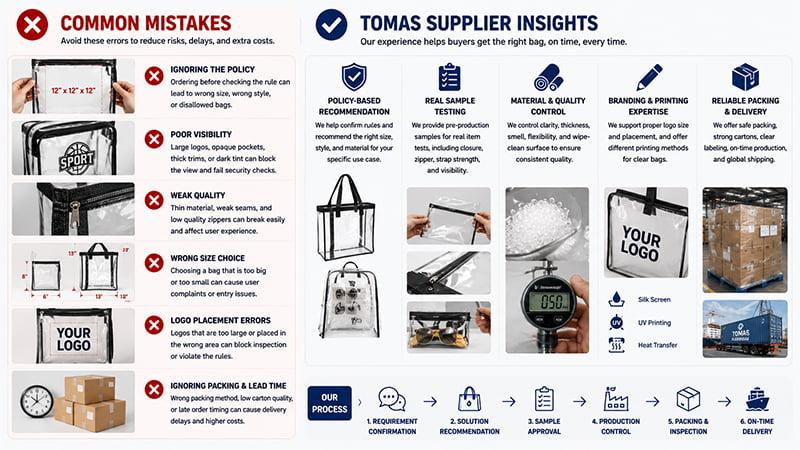
Many clear bag problems happen before production starts. They are usually caused by rushed decisions, unclear rules, or choosing a bag only by appearance.
Common mistakes when ordering clear bags:
- Choosing size before checking the policy
- Using too much logo coverage
- Choosing material that is too thin
- Ignoring zipper and strap quality
- Assuming all clear backpacks are accepted
- Forgetting front pocket visibility
- Ordering too late for the event date
For B2B buyers, these mistakes are easier to avoid when the supplier checks policy, material, logo placement, sample structure, and event timing before bulk production.
Policy comes before product style: TOMAS Crafts recommends confirming the event, school, workplace, or venue rule before selecting the final size and bag type. A clear tote, see through purse, or transparent plastic backpack may all be useful, but not every one fits every rule.
Transparency should stay clear after printing: Logo placement should not block the main viewing area. The goal is to keep the bag useful for inspection while still giving the buyer visible branding.
Material should match use time: A one-day giveaway bag and a repeated-use school, stadium, or workplace bag should not use the same material standard. Buyers should review thickness, flexibility, smell, surface clarity, and water resistance when needed.
Seams, zippers, and straps need real item testing: A packed sample can show whether the zipper, strap, and seams work with actual items inside. This is especially important for transparent plastic backpacks, staff kits, and workplace security bags.
For event staff kits or school programs, TOMAS Crafts can review one packed sample with the real items before bulk production, so the bag size, zipper, strap, logo position, and carton packing method are checked together.
Packing and delivery should match the event date: For sporting events, concerts, school orientations, trade shows, and promotional campaigns, delivery timing matters. Packaging, carton sorting, and shipping timeline should be confirmed before final approval.
Quick Comparison and Ordering Checklist
Use this comparison to match the clear bag style to the program goal before requesting a quote.
| Use Case | Recommended Clear Bag | Buyer Note |
|---|---|---|
| Stadium game | Clear tote bag | Check size and venue policy first |
| Concert or festival | Clear crossbody or see through purse | Good for small essentials |
| School or campus use | Transparent plastic backpack | Check school policy and strap quality |
| Sports team giveaway | Clear drawstring bag | Lightweight and easy to distribute |
| Event staff kit | Clear tote or clear backpack | Test with actual staff items |
| Workplace security | Clear tote or transparent backpack | Focus on visibility and repeated use |
| Beach or outdoor event | Clear vinyl bag | Check water resistance and wipe-clean surface |
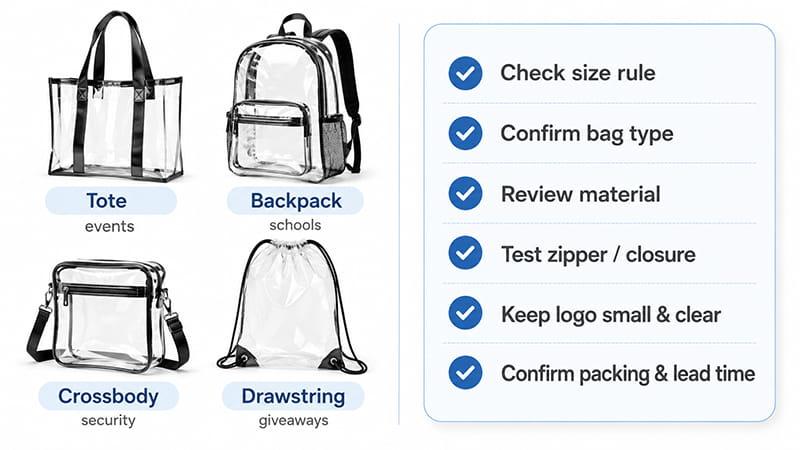
Before custom clear bag production, confirm these details:
- Event, school, or workplace policy
- Allowed size
- Allowed bag style
- Material type
- Material thickness
- Transparency level
- Zipper or closure type
- Strap or handle type
- Front pocket requirements
- Logo file
- Logo placement
- Sample approval
- MOQ
- Production lead time
- Packaging method
- Carton sorting
- Delivery deadline
This checklist helps buyers avoid size mistakes, visibility problems, weak construction, logo issues, and delivery delays.
Conclusion
Clear bags are useful for stadiums, schools, concerts, workplaces, sporting events, festivals, and promotional programs, but the right choice depends on more than transparency. Buyers need to check the rule, size, material, visibility, comfort, and real use before placing an order.
A clear tote bag may work well for stadium events. A see through purse may fit compact personal essentials. A transparent plastic backpack may be better for school, staff, or workplace use. For bulk custom orders, the safest approach is to confirm the policy first, then check the style, material, logo position, sample, packaging, and delivery schedule.
Need Custom Clear Bags for an Event or Security Program?
TOMAS Crafts can help compare clear tote bags, see through purses, transparent plastic backpacks, crossbody bags, drawstring bags, and event staff bags before production starts.
Share your event type, policy requirements, quantity, logo file, budget, packing needs, and delivery deadline with the TOMAS Crafts team. The team can help build a practical custom clear bag solution for stadium events, schools, concerts, festivals, workplaces, trade shows, and promotional gifts campaigns.
Contact TOMAS Crafts to discuss your custom clear bag project.
FAQs
What size clear bag is usually allowed at stadiums?
Many stadium policies use size limits for clear plastic, vinyl, or PVC bags. A common reference is 12″ x 6″ x 12″, but exact rules vary by venue. Always check the specific stadium, school, or event policy before buying or ordering custom clear bags.
Are clear backpacks allowed?
Clear backpacks may be allowed in some schools, workplaces, and events, but not all venues accept backpacks. Check the policy before buying a backpack see through design or transparent plastic backpack.
Can I print a logo on clear bags?
Yes, clear bags can usually be customized with a logo, but the logo should not block visibility. For event or stadium use, keep branding small, clean, and positioned where it does not interfere with inspection.
What should buyers check before ordering custom clear bags?
Buyers should confirm policy rules, size, material, transparency, zipper closure, straps, pockets, logo placement, sample approval, MOQ, production time, packaging, and shipping deadline.