
Apron can keep being useful long after a cooking event, campaign, or gift has been handed out. It may become something the recipient uses at home, part of a team’s everyday uniform, or a branded item that stays in regular use instead of being forgotten after the event.
Different types of aprons suit different ways of working, wearing, and using the product. Below are 12 common styles, how they differ, and what to look at when the aprons are being chosen for a team or customized with a company logo.
Apron Types at a Glance
If you already know how the apron will be used, this table gives you a quick starting point.
| Apron Type | What It Helps With | Typical Use |
|---|---|---|
| Bib Apron | Chest and front-body coverage | Cooking, baking, cafés |
| Full-Length Apron | Extra lower-body coverage | Messier kitchen prep |
| Cobbler Apron | Front and upper-back coverage | Cleaning, crafts, childcare |
| Cross-Back Apron | Shoulder-supported fit | Baristas, bakeries, cafés |
| Waist / Half Apron | Movement and quick pocket access | Servers, bars, catering |
| Bistro Apron | Longer lower-body coverage | Restaurants, hotels |
| Pinafore Apron | Easy on-and-off wear | Cafés, retail, light-duty work |
| Tuxedo Apron | Coordinates with formal service uniforms | Fine dining, banquets |
| 4-Way Apron | More than one usable working surface | Busy kitchens |
| Waterproof / Dishwasher Apron | Repeated water and splash exposure | Dishwashing, cleaning |
| Disposable Apron | Quick garment changes | Food handling, processing |
| Workshop Apron | Clothing protection plus tool storage | Workshops, crafts |
12 Common Types of Aprons
When staff are getting food, flour, dust, or other mess on their clothing, look at where it is happening before simply choosing the longest apron avai
Bib Aprons
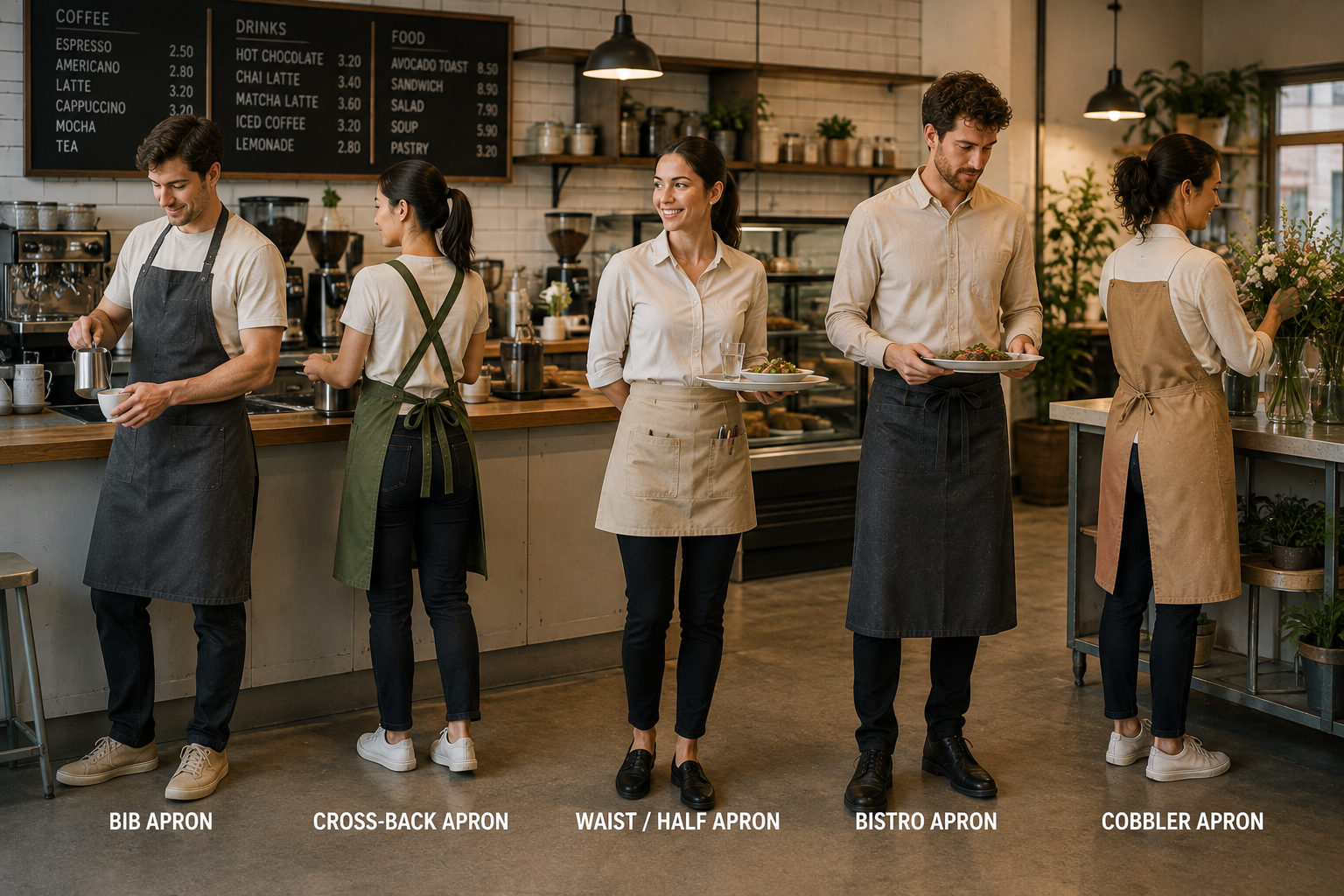
Bib aprons cover the chest and continue down the front of the body, making them a common kitchen apron, usually with a neck loop or adjustable neck strap and ties around the waist to help position the bib for a better fit.

For someone working at a prep counter, oven, coffee station, or bakery bench, most spills come from the front. The bib covers that area to help protect clothes from spills without wrapping fabric around the arms or back, so staff can still bend, reach, carry trays, and move around a counter normally.
Many designs also include front apron pockets, although whether those pockets help depends on what the wearer actually needs to carry.
The upper chest also gives cafés, bakeries, food brands, and event organizers a visible area for a logo when the apron is being used as part of a uniform or branded program.
Full-Length Aprons
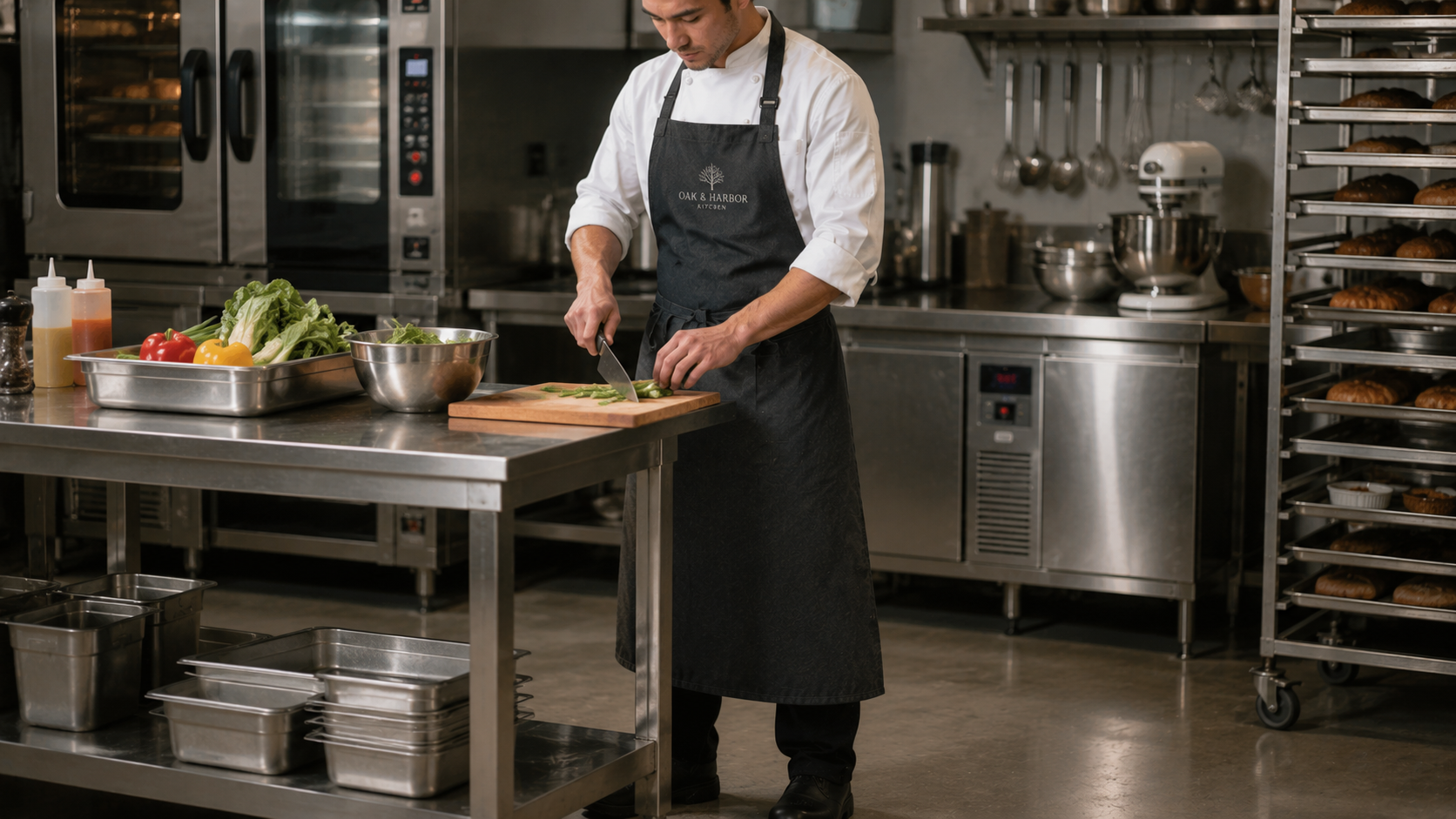
Full-length aprons extend farther down the legs than standard bib aprons. A full apron typically runs from the chest to just above the knee, so the apron length gives practical protection where spills and splashes actually land.
This type of apron coverage offers full coverage for commercial baking, butchery, sauce-heavy prep, and other messy work where spills often travel below the waist.
For light prep or counter service, however, the extra fabric may add heat and bulk without covering an area that gets dirty very often. In those settings, standard bib aprons can be easier to wear through a full shift.
Cobbler Aprons
Cobbler aprons cover both the front and upper back while leaving the arms free. The sides are usually open and held together with ties or fastenings.
That construction suits work where the wearer moves through the environment rather than facing one surface all day. Cleaners may brush against equipment from different directions, while childcare or craft staff may spend more time bending, carrying materials, and moving between work areas.
In those situations, protecting only the front of the torso can leave part of the clothing exposed even when the apron itself is long enough.
Cross-Back Aprons
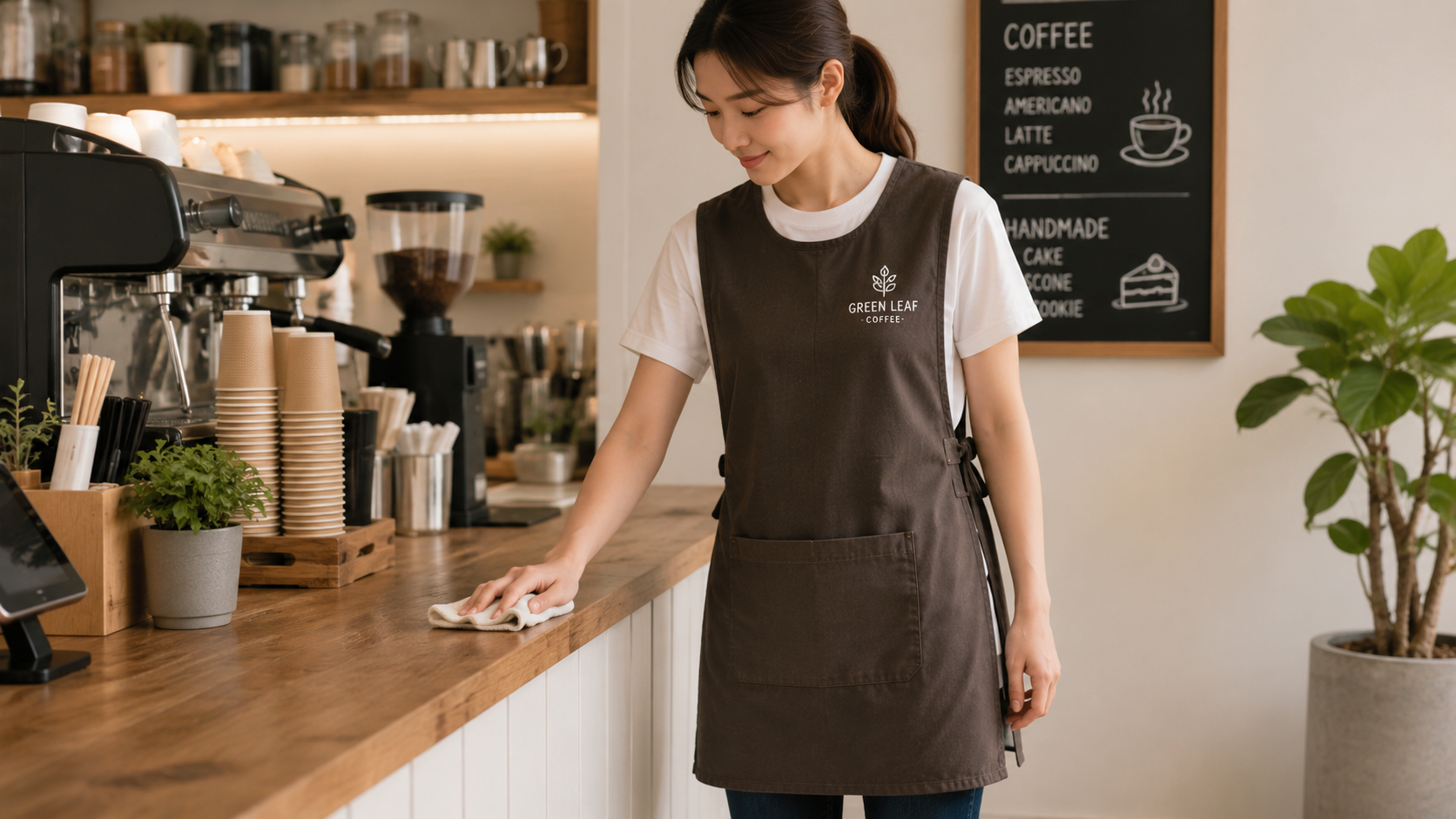
Conventional bib aprons place much of the garment support around the neck. Cross-back aprons move more of that support across the shoulders and back.
The difference may barely register during a short cooking task. It becomes easier to notice when a barista, baker, florist, or café employee keeps the same apron on for most of a shift, particularly if small items are also being carried in the pockets.
Cross-back straps do not guarantee that every wearer will prefer the fit. Some wearers prefer a more form fitting feel, though that still depends on strap adjustment and body shape. Strap width, fabric weight, adjustment range, and body shape still affect how the apron feels. For a team order, it is worth letting more than one person try the sample before approving the fit.
Waist Aprons
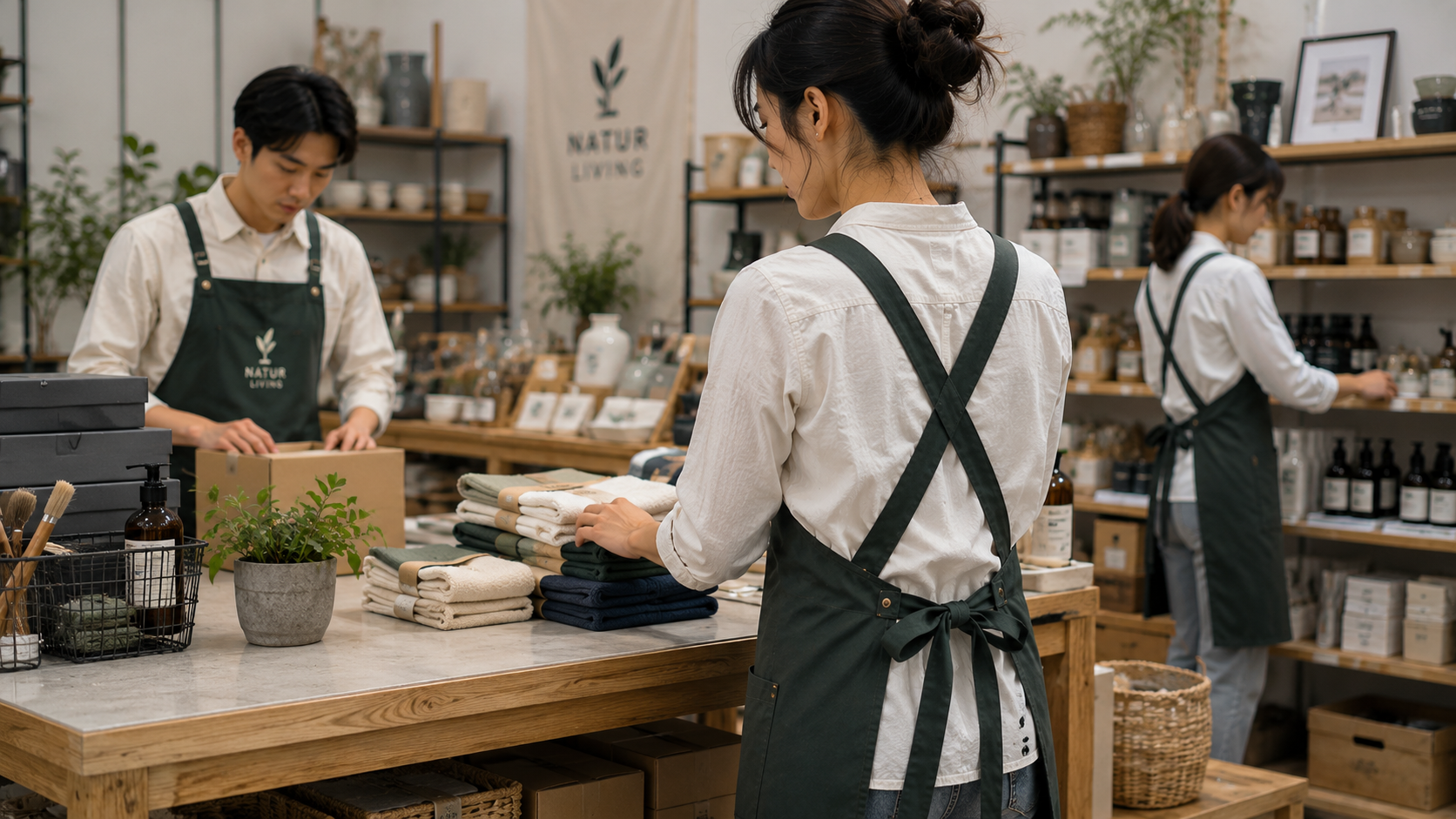
Waist aprons, also called half aprons, cover the lower front of the body while leaving the chest and arms free.
Servers and other service staff often need quick access to a few small items without adding fabric around the upper body. Pens, order pads, bottle openers, payment devices, or similar tools can stay within reach without requiring a full bib.
Pocket position becomes noticeable when those items are reached for repeatedly. Pockets that sit too low add an unnecessary reach, while those placed too far to the side can become awkward when carrying trays or moving through a busy service area.
Bistro Aprons
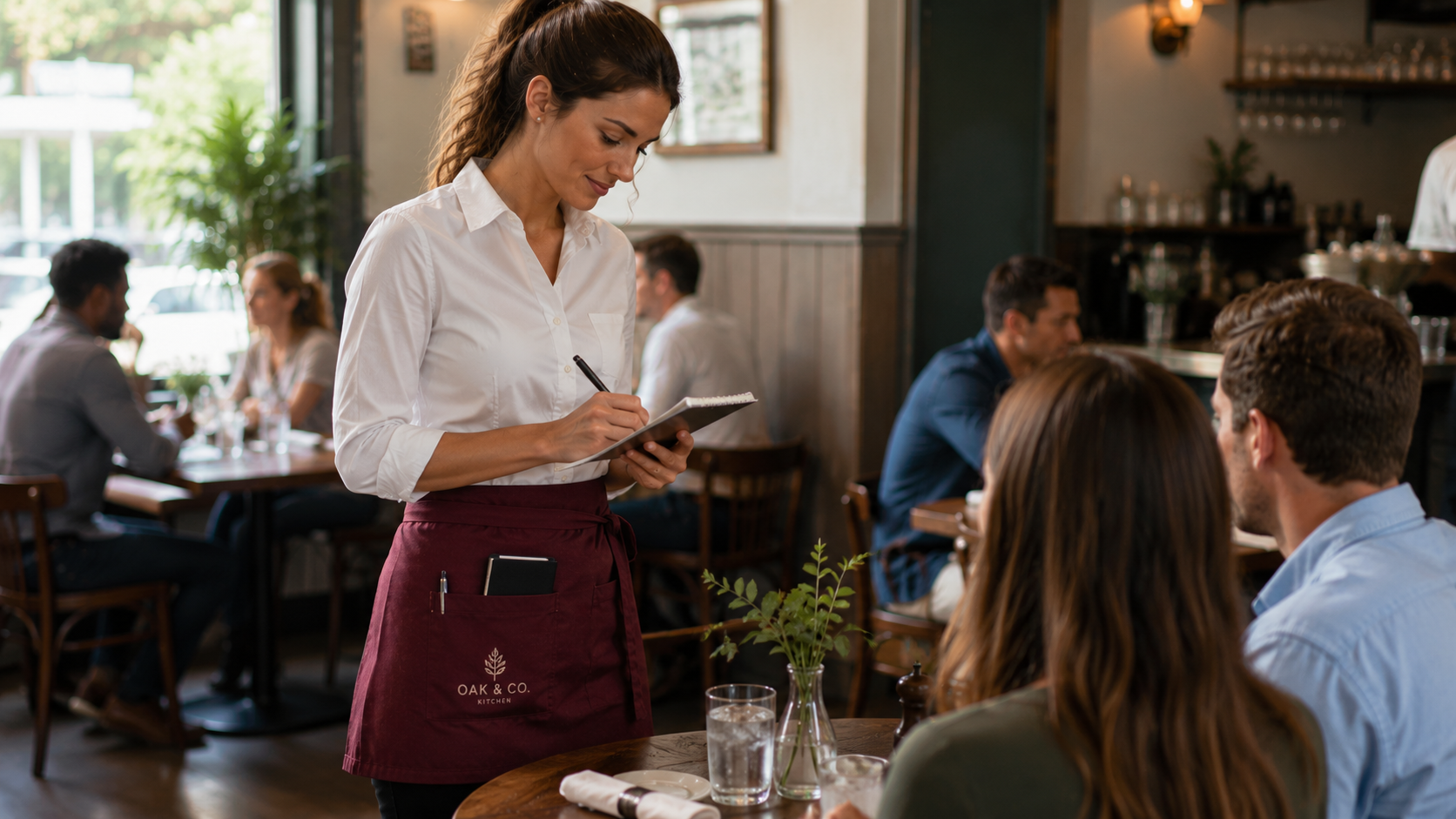
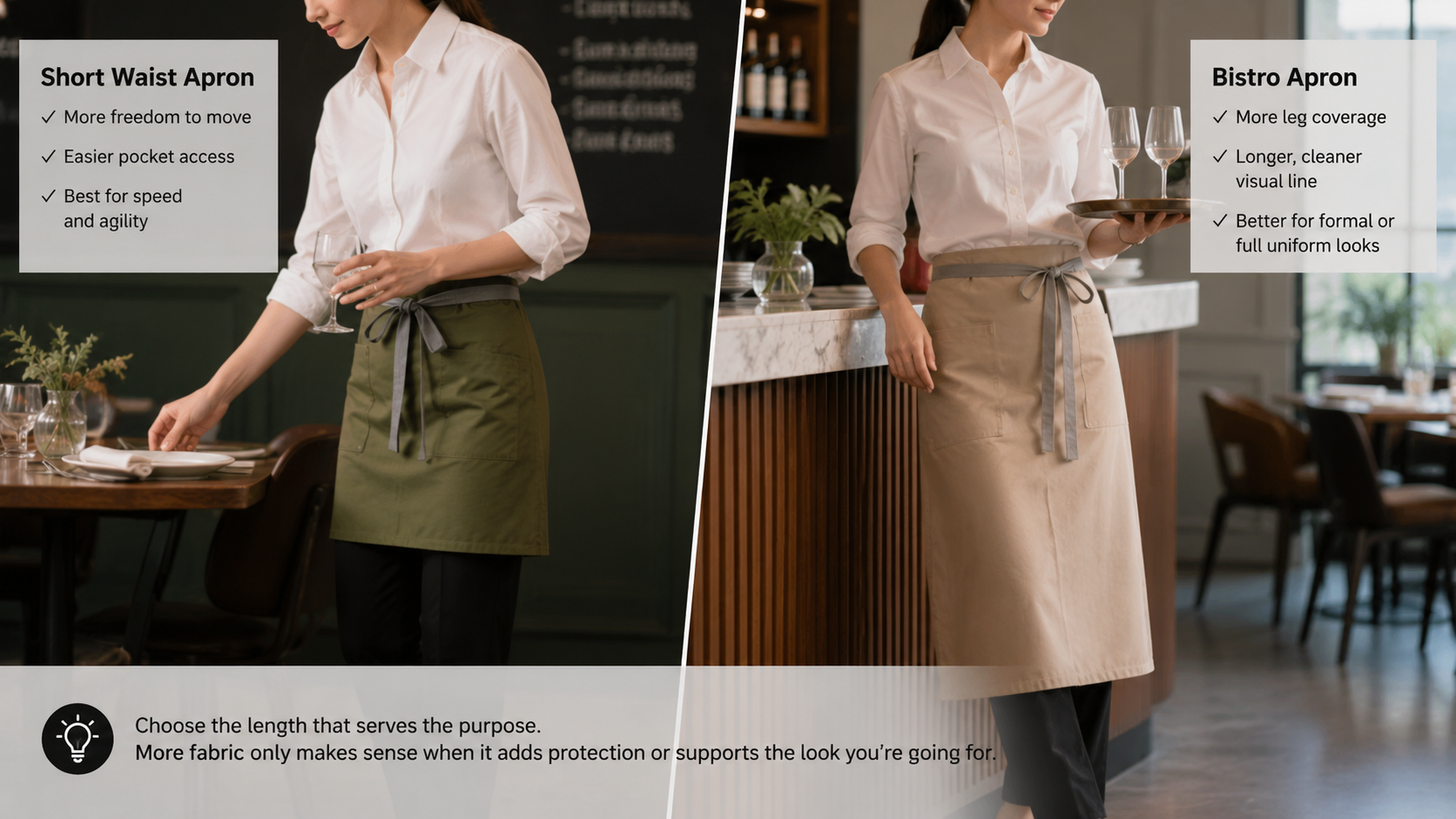
Bistro aprons keep the upper body free like waist aprons but extend farther down the legs; many aprons in this style fall below the knee for added trouser protection in service settings.
For front-of-house teams, the choice between the two usually comes down to what else the uniform needs to do. Short waist aprons work when movement and pocket access are the priority. Bistro aprons give more trouser coverage and create a longer visual line that can fit restaurant, hotel, wine-bar, or banquet uniforms more naturally.
Pinafore Aprons
Pinafore aprons are supported from the shoulders rather than hanging mainly from a neck loop. Many versions can be slipped on and off without dealing with long neck and waist ties.
That can suit café, retail, floral, or craft staff who remove and put the apron back on several times during the day. Smock aprons follow a similar easy-wear idea, although their exact construction varies.
The trade-off is the type of protection provided. Staff handling dishwater, sauces, or heavy food prep will usually need a more purpose-built bib or waterproof apron rather than choosing a loose, easy-on style simply because it is convenient to wear.

Tuxedo Aprons
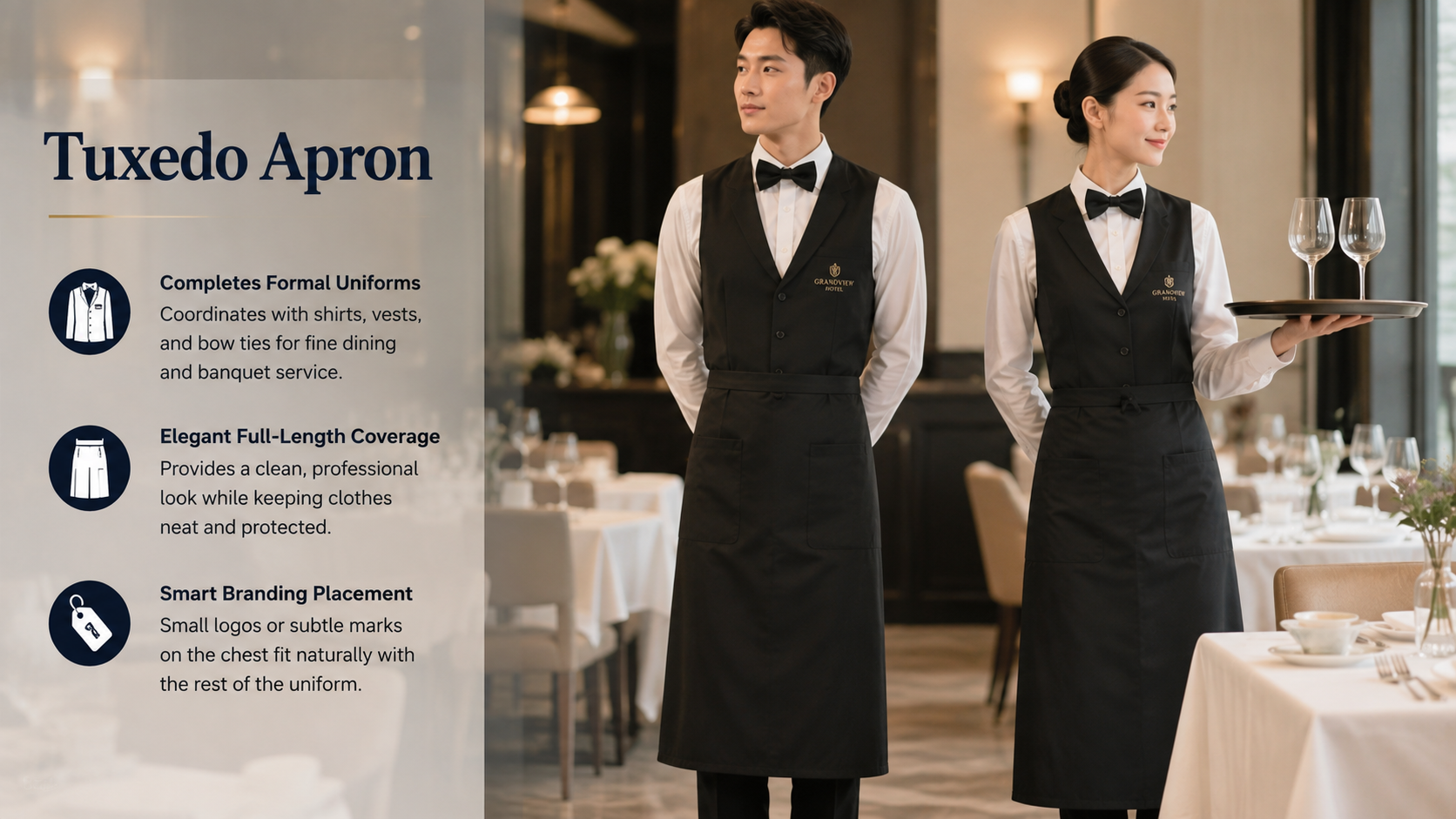
Tuxedo aprons become more relevant when the apron needs to coordinate with a shirt, vest, bow tie, or other formal service clothing.
If staff only need lower-body coverage and somewhere to keep service tools, bistro aprons may already do the job. In fine dining, banquet service, and some hotel environments, however, guests see the apron as part of the complete uniform rather than as a separate protective item.
That also affects branding. Large promotional prints can dominate a formal uniform, while smaller chest logos or restrained marks may sit more naturally with the rest of the clothing.
4-Way Aprons
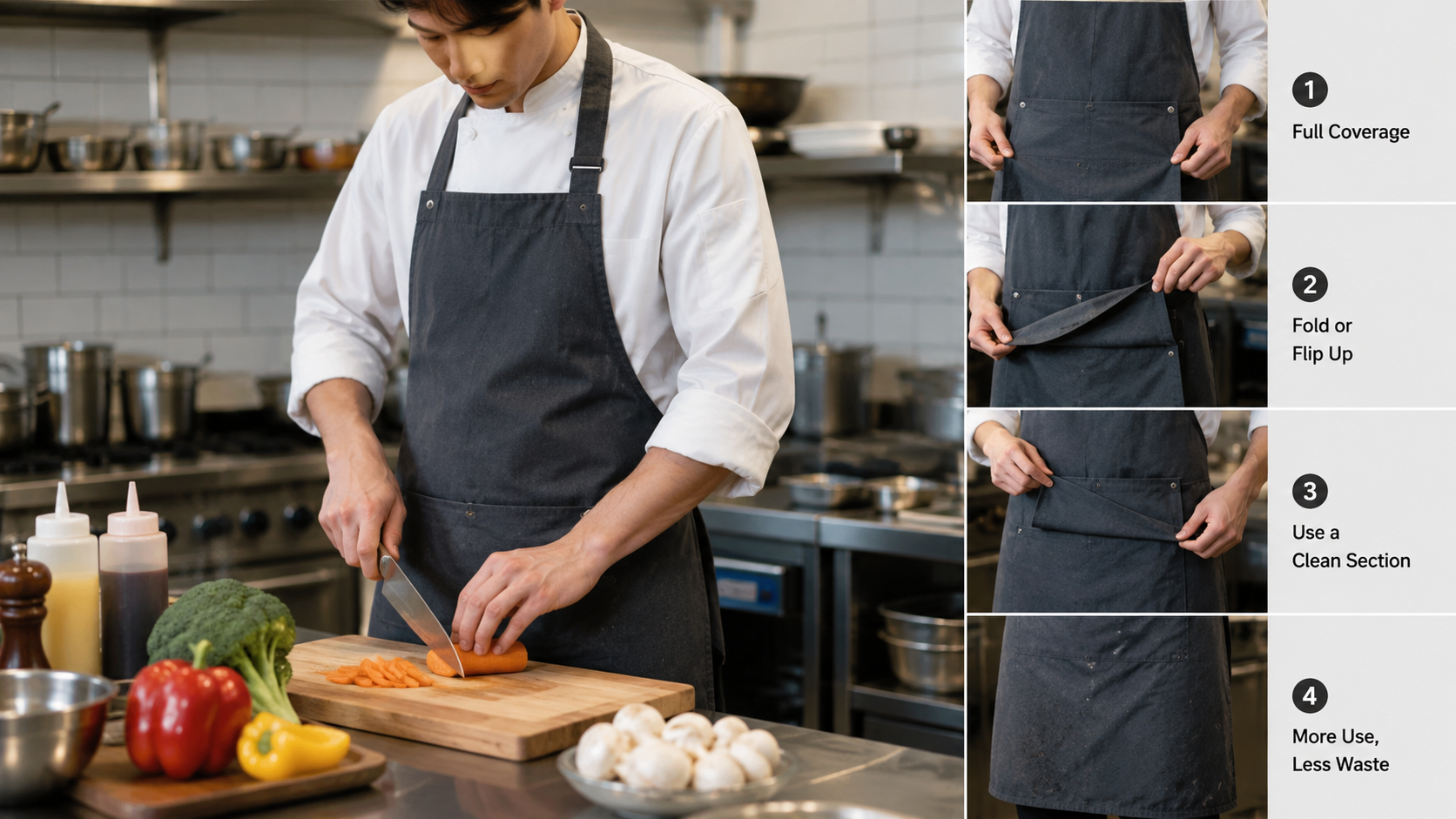
4-way aprons can be folded or turned to expose another usable section of fabric. If one surface picks up flour, sauce, or grease marks, the wearer can move to another clean section without immediately replacing the entire apron, and repeated turning can help manage light stains before it needs changing.
That feature offers less benefit in workplaces where visible contamination requires the apron to be changed completely. In those settings, keeping several reusable aprons available—or using an appropriate disposable option—may fit the workflow better.
Waterproof / Dishwasher Aprons
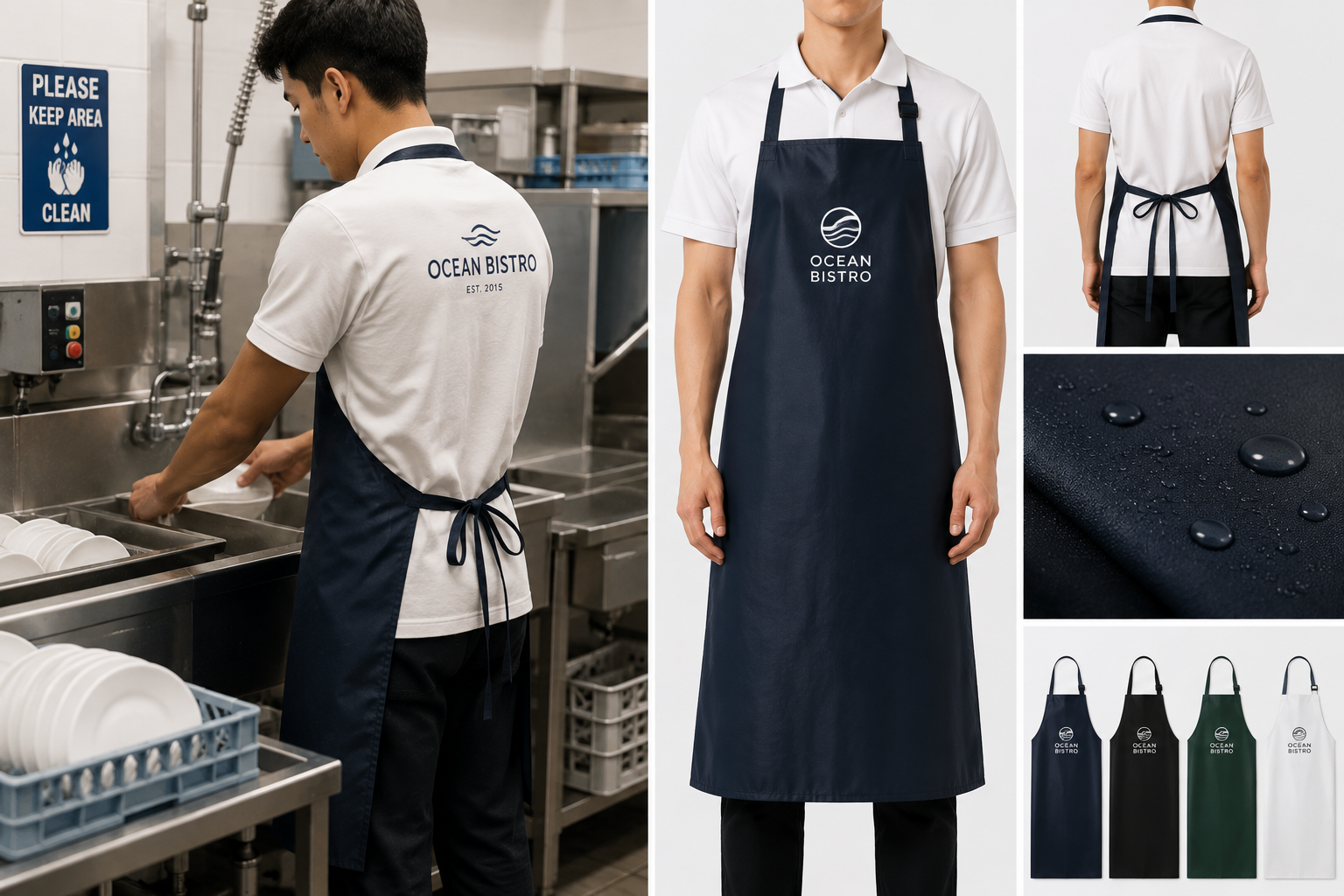
Waterproof and dishwasher aprons are designed for repeated water and splash exposure. Someone working beside a commercial sink may spend much of a shift around water, while ordinary cotton or poly-cotton can absorb moisture and remain wet, so dishwasher aprons are often made from rubber or vinyl for durable repeated wet use.
Coated fabrics, vinyl, and other water-resistant materials address that particular problem. They should not, however, be assumed to provide protection against chemicals, high heat, flames, or other workplace hazards.
For U.S. workplaces where aprons form part of protective equipment, OSHA requires employers to assess workplace hazards and select PPE appropriate to the hazards identified. See the OSHA General PPE Requirements.
If the task involves cleaning chemicals, heat, or another specific hazard, the product specification needs to address that hazard rather than relying only on the word “waterproof.”
Disposable Aprons
Disposable aprons are useful when workers need to change their outer protection frequently and laundering reusable garments between those changes would be impractical.
That can apply to food handling, food processing, cleaning, or other tasks where workers move between activities and need fresh outer clothing or protection.
The apron alone does not determine whether a workplace is hygienic. The FDA Food Code 2022 requires food employees to wear clean outer clothing to help prevent contamination of food and related items. Whether disposable aprons are required still depends on the task, workplace procedures, and applicable requirements.
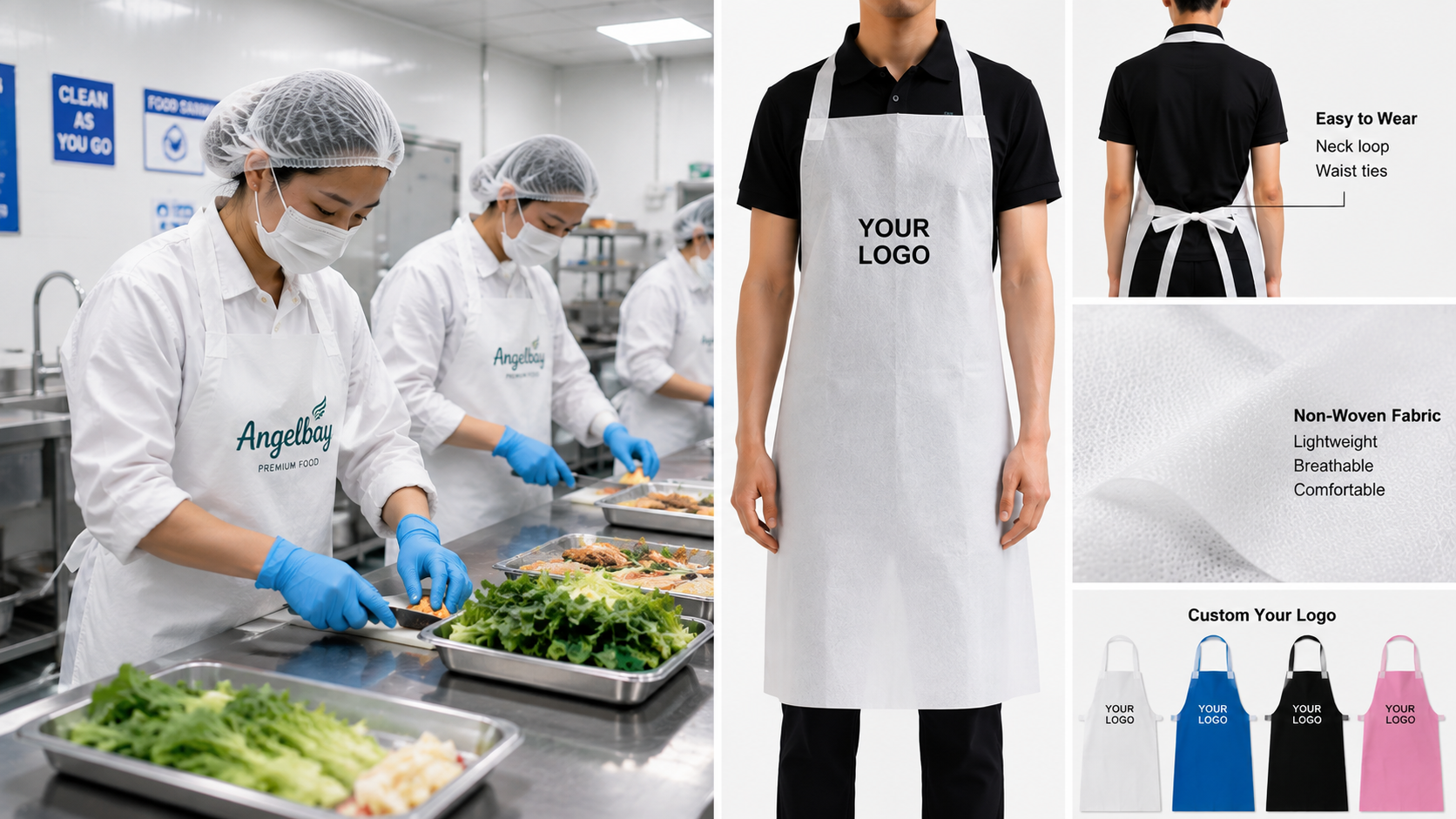
For buyers, the more useful comparison is therefore not simply disposable vs. reusable aprons. Consider how frequently garments need to be changed, whether reusable aprons can be cleaned quickly enough, and what the working environment requires.
Workshop Aprons
Workshop aprons may need to keep dust or debris off clothing while also putting frequently used tools within reach, and woodworking aprons are a common subtype built to keep hand tools organized.
Woodworkers, gardeners, makers, and craft staff might carry pencils, measuring tools, fasteners, scissors, or small hand tools. Canvas and other heavier fabrics are common partly because they give pockets and reinforced areas more structure. Heavy-duty aprons made of leather are also used in more demanding environments such as welding and metalwork.
Pocket size alone does not tell you whether that storage will work. Deep pockets can make small tools slow to retrieve, while loops can help keep certain tools separate and easy to grab. Pockets placed where the wearer bends can become uncomfortable. Reinforcement should also match what will actually be carried; adding heavy construction everywhere only adds weight.
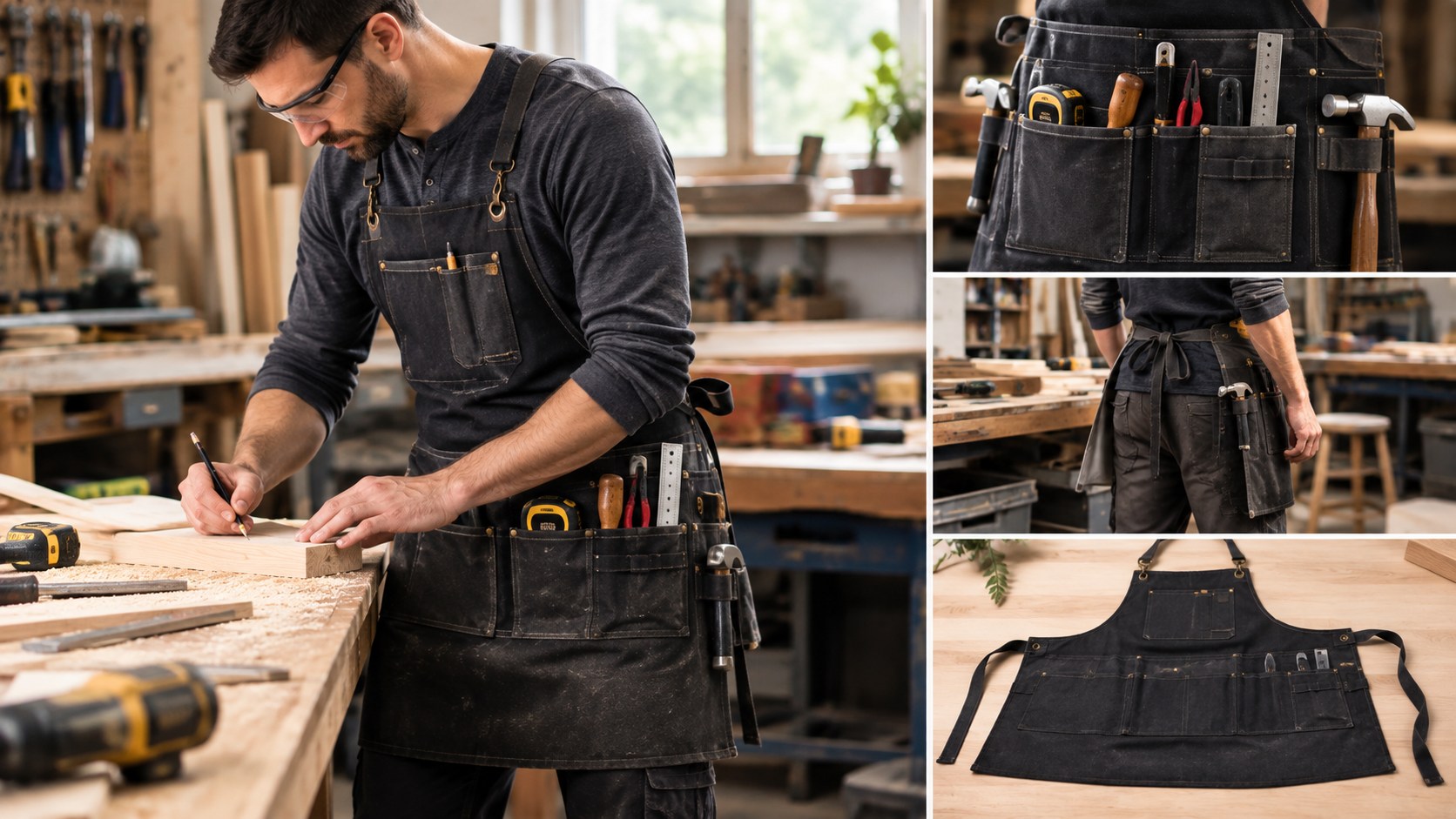
For a work apron with pockets, deciding what goes in each pocket and how often it needs to be reached is more useful than simply counting pockets in a product photo.
Bib vs. Cross-Back vs. Waist Aprons: What’s the Difference?
These three apron styles cover many common staff and hospitality uses, but they solve different problems.
| If the Wearer Mainly Needs… | Start With… |
|---|---|
| Chest and front-body coverage | Bib apron |
| Front coverage with shoulder-supported straps | Cross-back apron |
| Movement and quick access to small tools | Waist / half apron |
The right apron depends on the task, the coverage needed, and whether the wearer values shoulder support or faster movement.
Businesses do not need to use the same apron construction across every department. Kitchen workers, baristas, and servers can share the same branding while wearing different apron styles because the garment needs to support different movements and tasks.
What to Check Before Ordering Aprons for a Team
For team orders, small fit, pocket, or sizing issues are repeated across the whole quantity. Samples therefore need to be checked on the people who will actually wear the apron, not only against a flat measurement sheet.
For businesses sourcing several coordinated garments rather than aprons alone, TOMASCRAFTS also offers a wider range of custom apparel.
Apron Sizing and Adjustable Straps
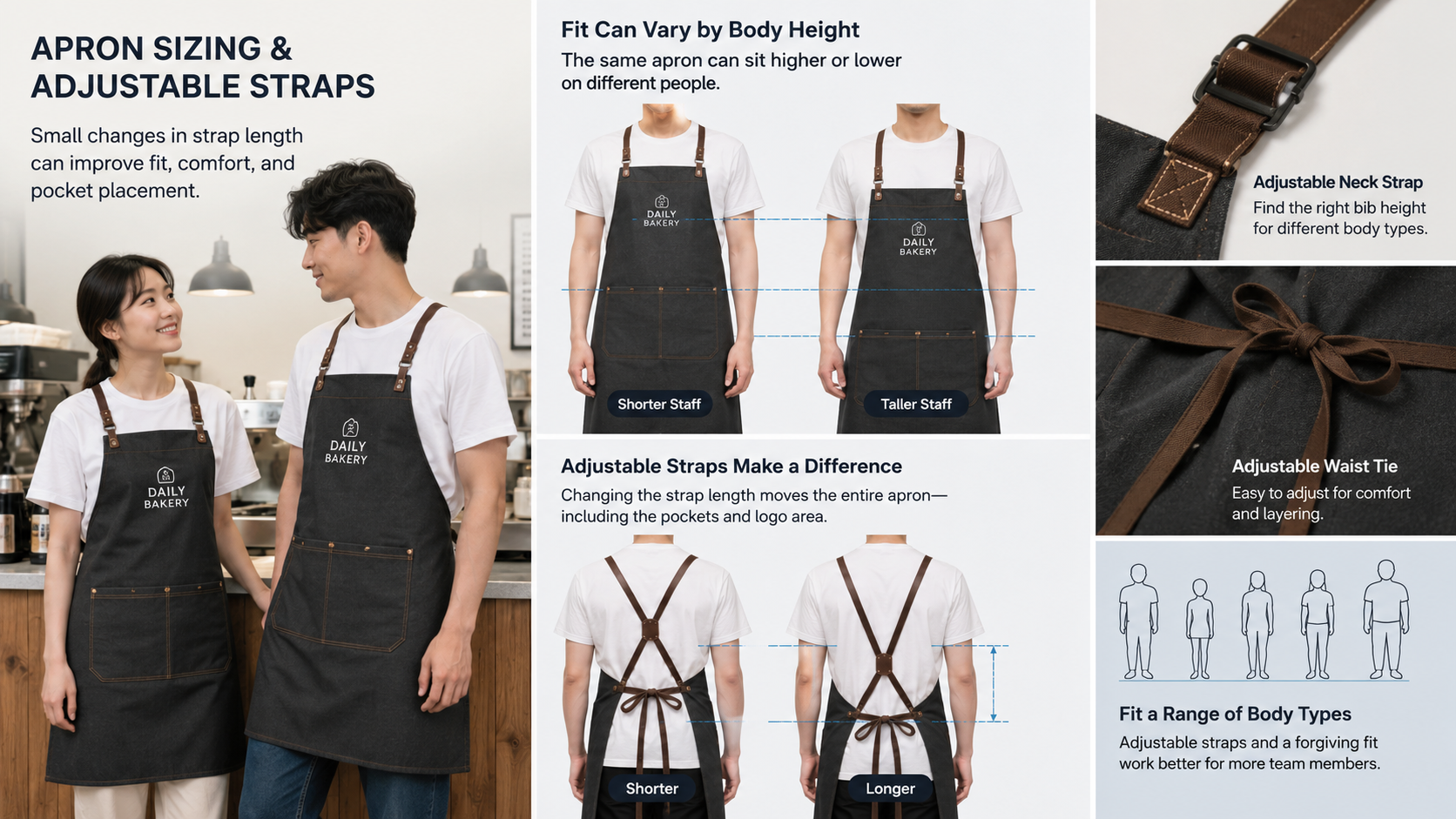
Two employees wearing the same apron can end up with very different pocket heights and bib positions.
Check the apron size, overall length, adjustable straps, waist-tie length, and where the apron sits on both shorter and taller staff. With cross-back and bib aprons, changing the strap length can move the whole garment up or down, including the pockets and logo area. Check side ties alongside neck adjustments so the apron sits correctly on different heights.
If the final wearer is not known in advance—as with some event giveaways or gifts—adjustable straps and a more forgiving fit range can make the apron easier to use across different recipients. These fit checks also help buyers choose the best apron or perfect apron for mixed staff sizes.
Apron Pocket Placement
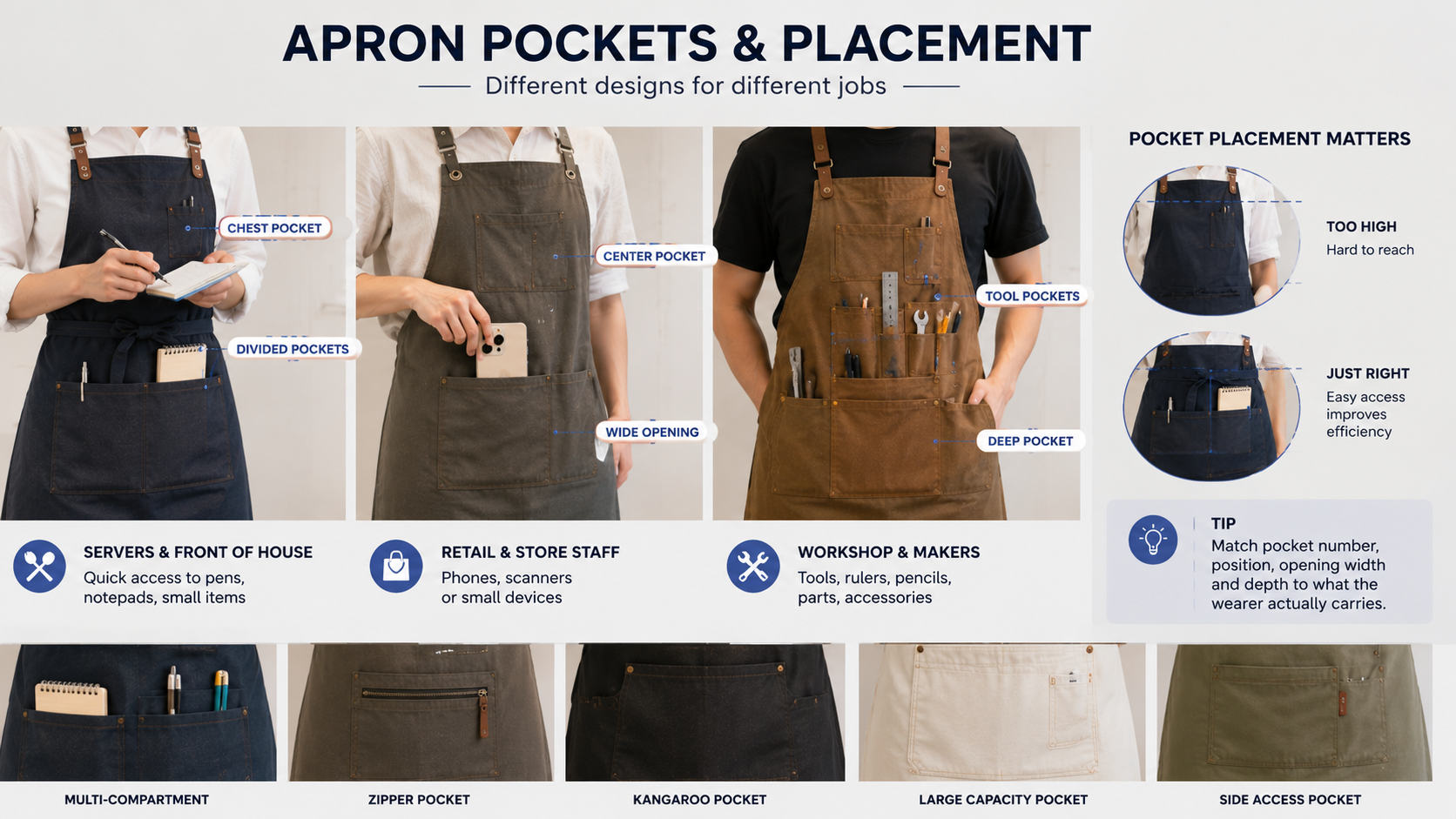
Ask what the wearer will actually carry before deciding how many apron pockets the design needs.
Servers may reach for pens repeatedly during a shift. Workshop employees may need one tool with a long handle and another that disappears inside a deep pocket. Kitchen staff may prefer fewer seams and pockets in areas that collect food.
Adding pockets because they look useful on a specification sheet can create bulk without improving the job. Pocket position, opening width, depth, and access all affect how the pocket performs once someone is actually wearing the apron.
Apron Materials for Daily Wear
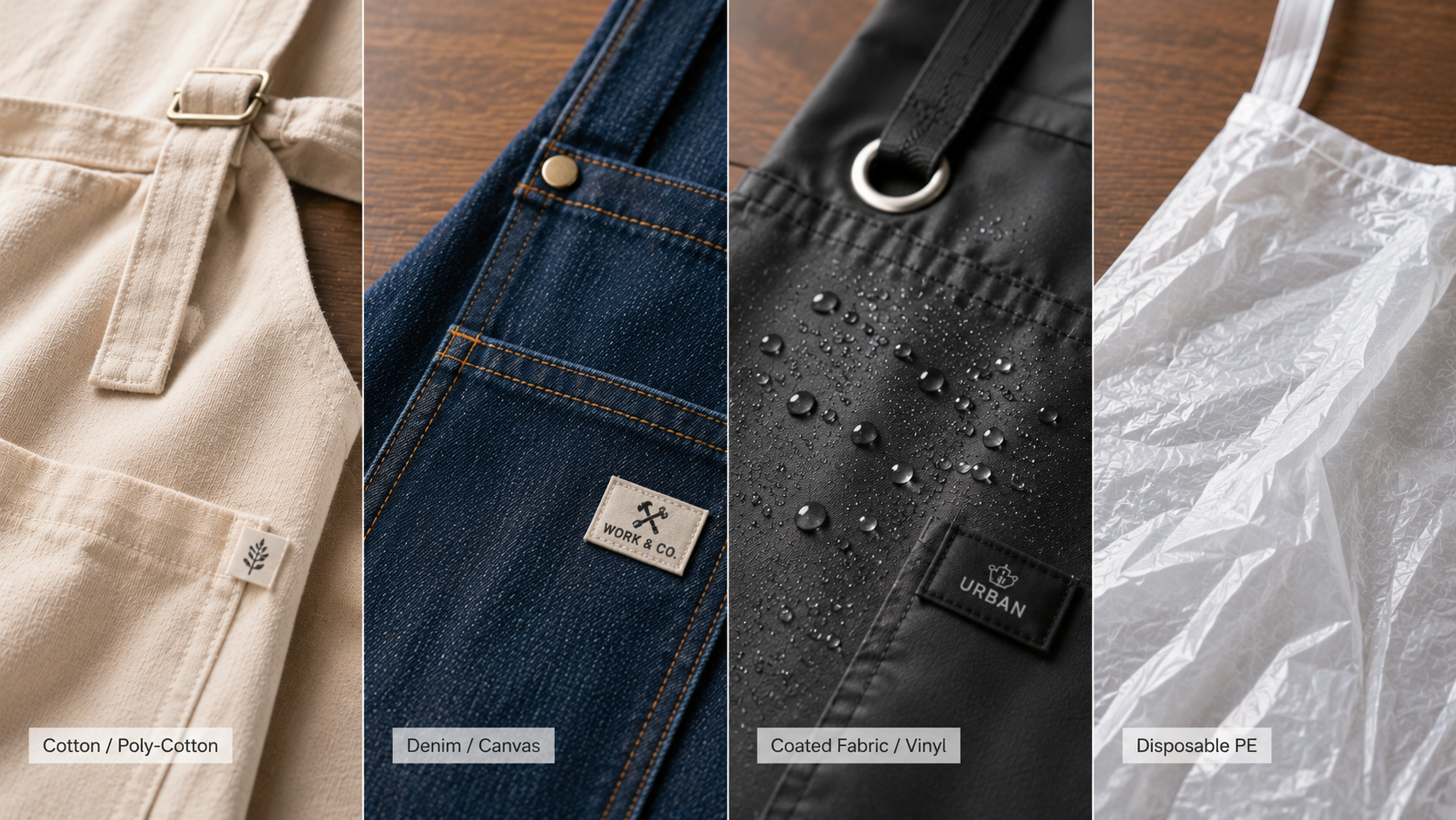
The apron material changes much more than how thick the garment feels in your hand.
| Material | What You May Notice in Use | What to Check |
|---|---|---|
| Cotton / Poly-Cotton | A common cloth option for daily wear | Wash frequency, shrinkage, drying time |
| Denim / Canvas | More structure around pockets and tools, with durable performance for frequent wear | Added weight and heat |
| Coated Fabric / Vinyl | Water remains on the surface rather than soaking through quickly | Breathability and flexibility |
| Disposable PE | Easy to replace between tasks | Comfort and suitability for the intended use |
Heavier fabrics can feel more substantial in a sample, but staff wearing them through a full shift may notice the extra heat and weight more than the additional structure. Polyester is also used when easier-care, water-resistant performance is needed.
For frequently washed uniforms, also consider wash frequency, drying time, shrinkage, stain visibility, and fabric feel after repeated care cycles. That matters because most aprons chosen for everyday use still need material choices that fit laundering, heat, and how visible stains will be.
Thicker apron fabric is not automatically better. The material needs to suit what the wearer will do and how the garment will be maintained.
What to Check on the Apron Sample
Digital mockups can confirm color and general artwork position, but they cannot show how an apron sample moves when someone bends over a counter, reaches for a shelf, or sits down.
Have actual staff wear the sample and check:
- overall length;
- neck or shoulder pressure;
- strap adjustment;
- waist-tie length;
- pocket height;
- access to tools or service items;
- movement while bending and reaching.
For larger orders, record the approved measurements, pocket positions, fabric, decoration size, and placement reference together with the approved sample. That gives production and quality-control teams specific details to check rather than relying on the mockup alone.
Custom Aprons: Logo Options and Placement
When ordering custom aprons with a logo, the decoration needs to work with the fabric, seams, pockets, and usable branding area rather than being treated as a separate design decision.
Embroidered aprons and Logo Detail
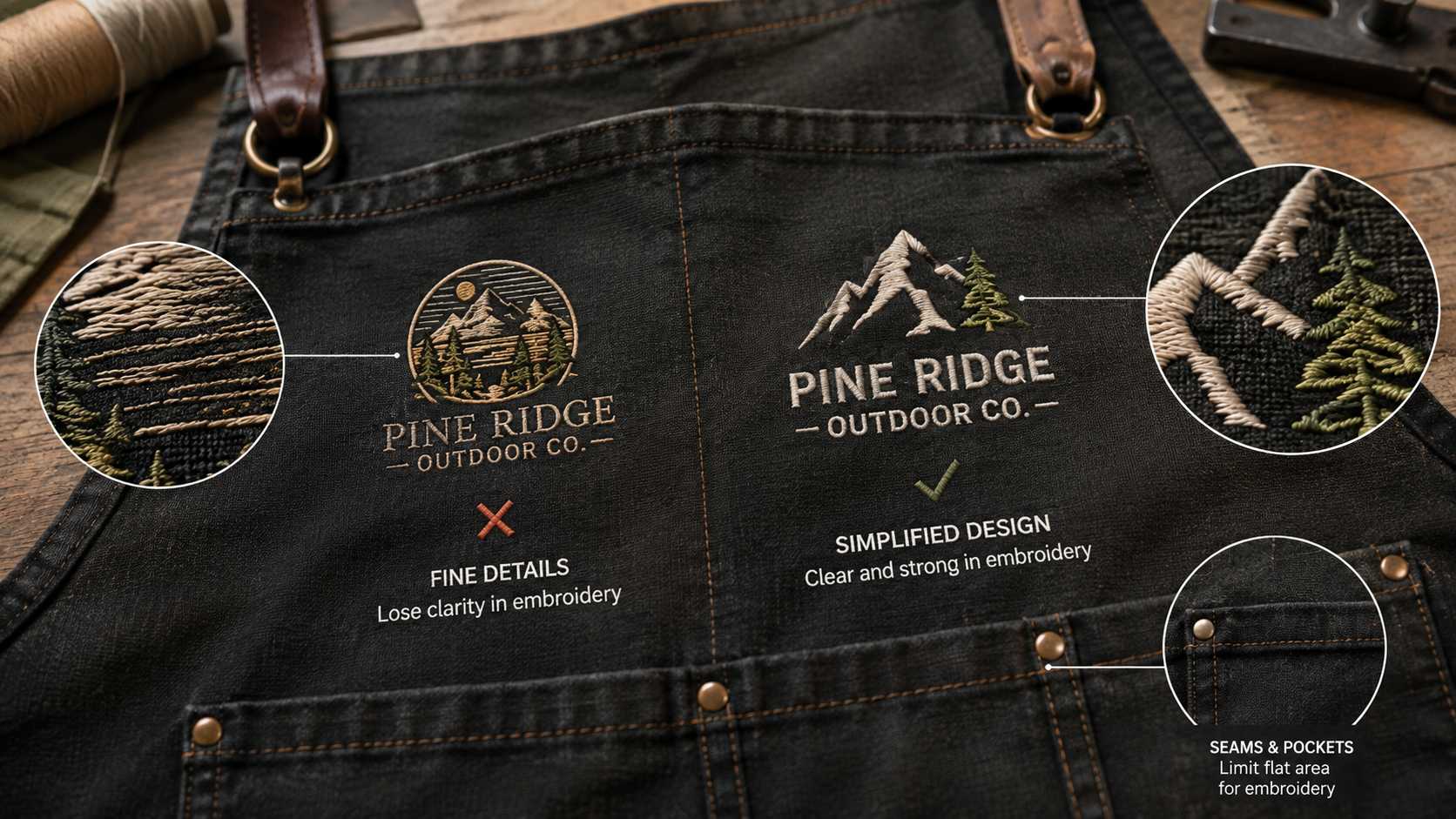
With apron embroidery, logos that look clear on screen can change once converted into stitches. Thin lettering, narrow gaps, and very small details may lose definition at a small embroidery size.
Apron construction also affects where embroidery can go. Thick seams, reinforced edges, and pockets can reduce the flat area available for stitching, especially on heavier canvas or workshop aprons.
Simple wordmarks, initials, and compact logos generally translate more cleanly into embroidery. If the artwork contains fine detail, testing the embroidered logo on a sample can show whether the design needs to be simplified or enlarged before production.
Printing Larger Artwork
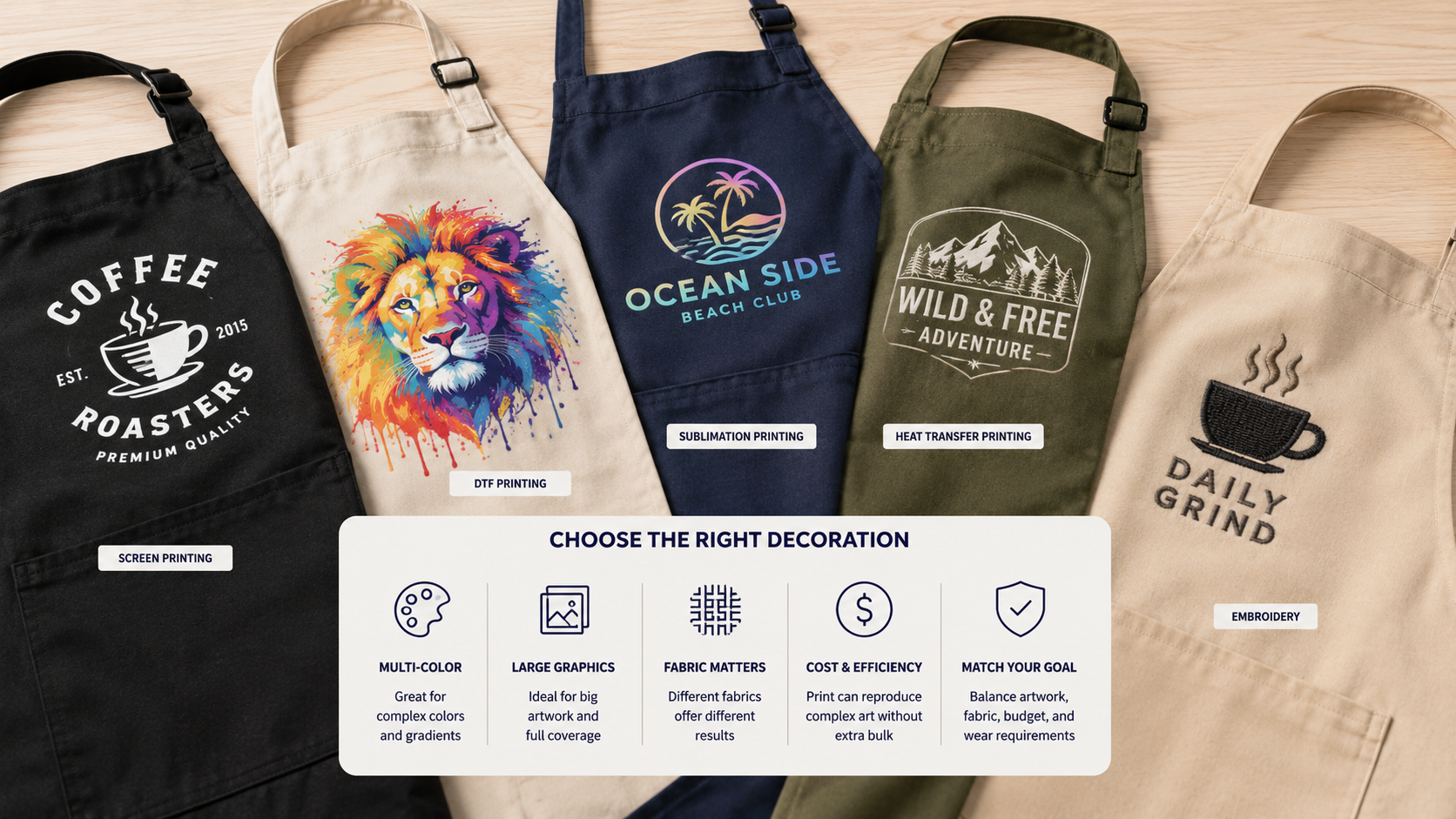
Apron printing gives more room when the artwork relies on several colors, gradients, fine detail, or a larger graphic area.
Large designs that require dense embroidery across much of the apron can add thread, weight, stiffness, and cost. Printing can reproduce that type of artwork without building up the surface in the same way.
The fabric still needs to be considered first. Smooth poly-cotton, heavy canvas, and coated waterproof materials do not offer the same print surface or production options.
If you need to compare screen printing, DTF, DTG, sublimation, heat transfer, and embroidery, see the TOMASCRAFTS Types of T-Shirt Printing Guide. The same artwork and fabric considerations can help when narrowing down the decoration method for custom aprons.
Logo Placement by Apron Style
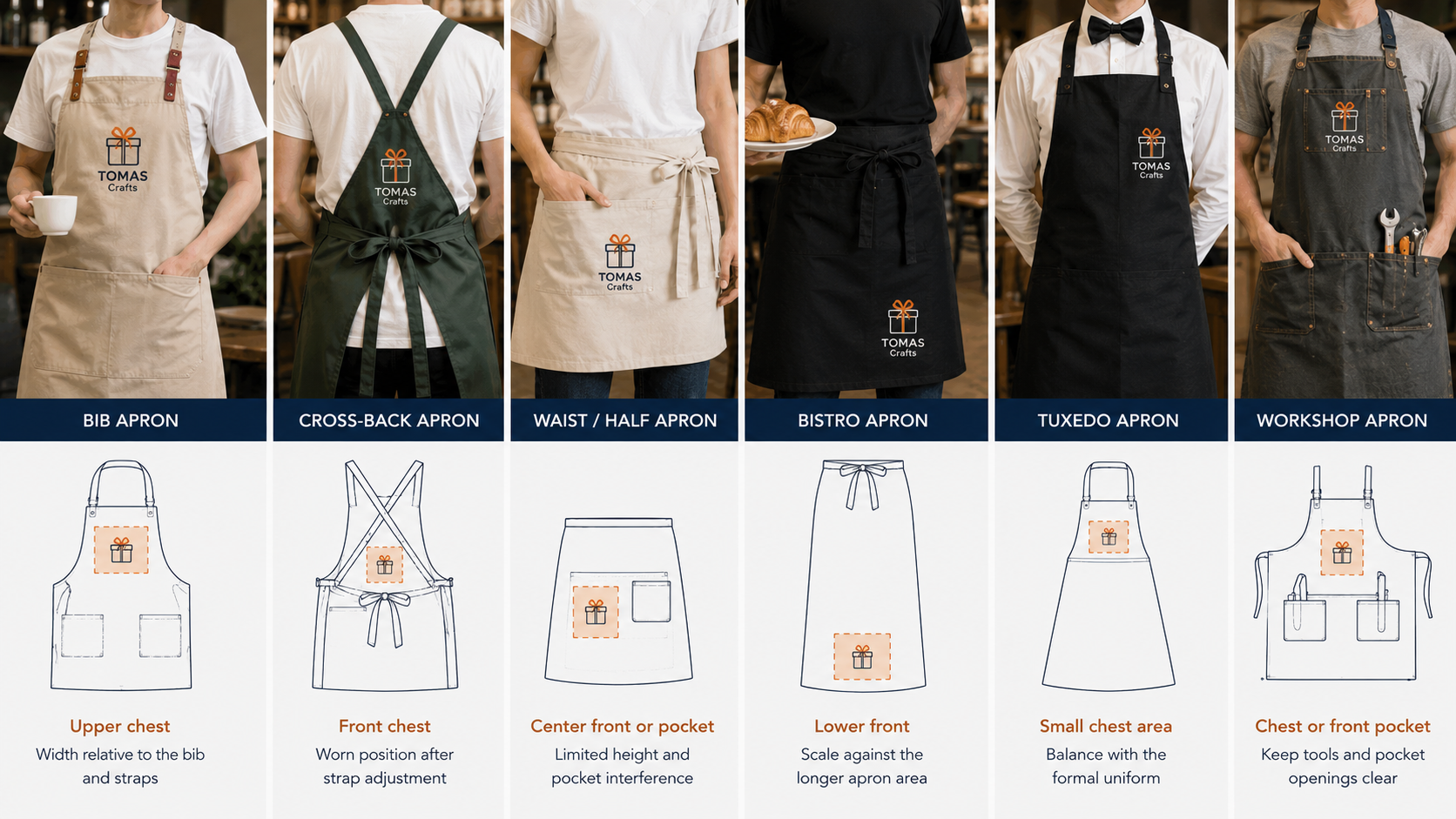
Apron logo placement changes with the garment construction. Logos that sit neatly on the chest of a bib apron may be too wide for a waist apron or interfere with a functional pocket on a workshop apron.
| Apron Style | Common Branding Area | What to Check |
|---|---|---|
| Bib | Upper chest | Width relative to the bib and straps |
| Cross-Back | Front chest | Worn position after strap adjustment |
| Waist / Half | Center front or pocket | Limited height and pocket interference |
| Bistro | Lower front | Scale against the longer apron area |
| Tuxedo | Small chest area | Balance with the formal uniform |
| Workshop | Chest or front pocket | Keep tools and pocket openings clear |
This becomes more noticeable when one brand is ordering several garments at once.
In one Australian uniform enquiry handled by TOMASCRAFTS, the requested range included polo shirts, T-shirts, hoodies, caps, and aprons. The logo size that looked balanced on the polo could not simply be copied onto the apron because the bib provided a different usable width and the pocket changed the available branding area.
The logo artwork remained consistent, but the logo size and placement specifications were adjusted for each garment family. Visual consistency does not require identical physical logo dimensions on every item.
For more examples of how garment construction changes usable branding space, see the TOMASCRAFTS T-Shirt Logo Placement Guide.
FAQs About Apron Types
What is the most common type of apron?
The bib apron is one of the most common apron types. It covers the chest and front of the body while leaving the arms free, which works well for cooking, baking, cafés, food service, and many everyday staff uses.
What is the difference between a bib apron and a cross-back apron?
Both provide front-body coverage. Bib aprons usually use a neck loop, while cross-back aprons distribute the straps across the shoulders and back. The difference becomes more noticeable during longer wear and can also affect where the bib, pockets, and logo sit on the body.
What are aprons used for besides cooking?
Aprons are used for much more than cooking. They can be part of staff uniforms, workshop and craft clothing, cleaning work, cooking classes or activities for kids, hospitality programs, branded events, and practical promotional gifts.
The apron style should follow what happens after it is handed over: how often it will be worn, what the wearer will do in it, which areas of the clothing need protection, and how well it will help protect clothes during these everyday uses.
Can aprons be customized with a company logo?
Yes. Custom aprons can use embroidery, screen printing, transfer printing, and other decoration methods depending on the fabric and artwork.
The right method depends on the logo size, artwork detail, apron material, branding area, and intended appearance. Logo placement should also be confirmed on the actual apron style rather than copied directly from another garment.
Start With How the Apron Will Be Used
Before narrowing down the style, picture where the apron goes after delivery. Will it be worn every day as part of a uniform, used during an event and kept afterwards, or included in a branded gift?
That use is a better starting point than choosing by appearance alone. Once it is clear, the differences between the main types of aprons—including coverage, fit, pockets, material, straps, and branding space—become much easier to compare.
Planning a Custom Apron Project?
If you already know how the aprons will be used, the next step is to confirm the apron style, fabric, fit, pocket layout, quantity, and logo requirements before sampling.
TOMASCRAFTS supports custom apparel projects for staff uniforms, hospitality teams, events, branded campaigns, gifts, and promotional programs. Share the intended use, quantity, artwork, and any fit or delivery requirements so the product and decoration details can be reviewed before production.