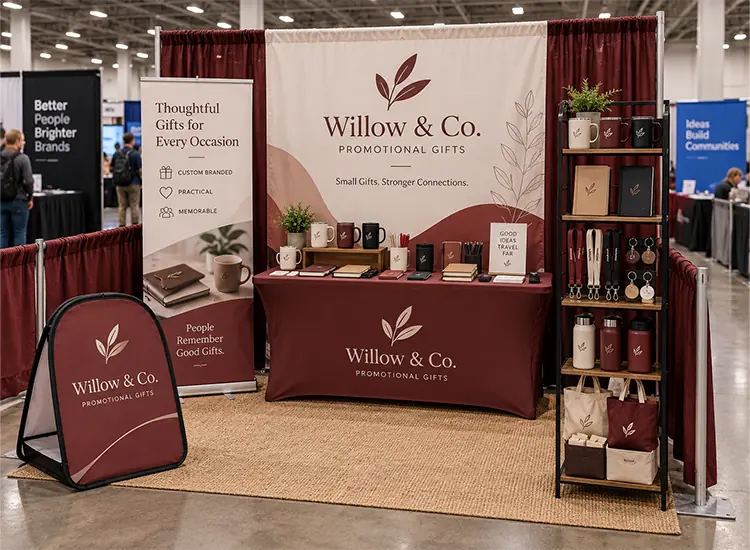
Trade show costs can rise quickly once displays, printing, shipping, giveaways, and booth accessories are added together. A limited budget does not mean the space has to look temporary or poorly planned.
The most useful trade show booth ideas for small budgets give every item a clear job. One product helps people notice the booth, another explains the offer, while an interactive element or giveaway gives visitors a reason to stop.
The six ideas below look at where different booth products make sense, from compact displays and simple activities to giveaways and reusable event materials, so you can compare the options before adding more to your booth plan.
1. Use Tabletop Trade Show Displays for a Low-Cost Setup
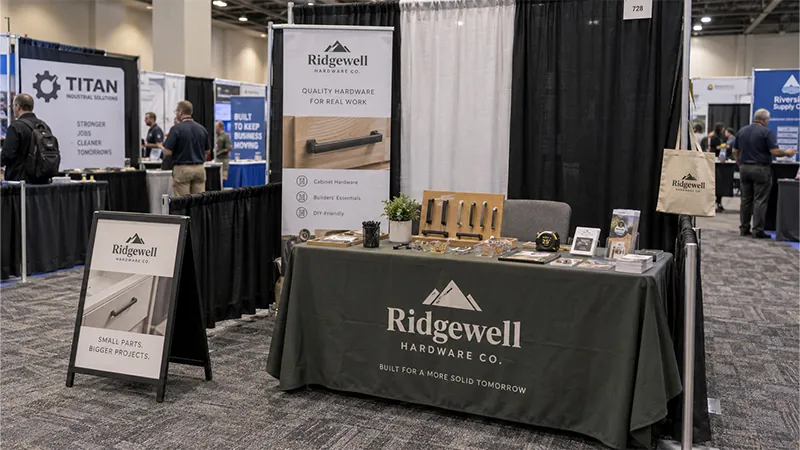
Not every exhibitor needs a full display wall. When most conversations happen around a table, tabletop displays can provide enough visual structure without using much floor space or requiring a complicated installation.
This works particularly well for first-time exhibitors, service companies, schools, associations, distributors, and brands with smaller product ranges. The table remains the working center of the booth, while compact display products handle the main branding and information.
Try a Mini Retractable Banner

Place a mini retractable banner beside a featured product, sample, signup point, or QR code. It adds vertical visibility without taking over the table or requiring a full-size backdrop.
Keep the artwork simple. One short headline, one clear image, and one useful action usually work better than shrinking a full-size poster into a small format.
The retractable structure also protects the graphic during transport. If you are deciding when a larger display is necessary, our Standard Banner Sizes guide explains common banner formats and where different sizes work best.
Use a Tri-Fold Display Board When You Need More Information
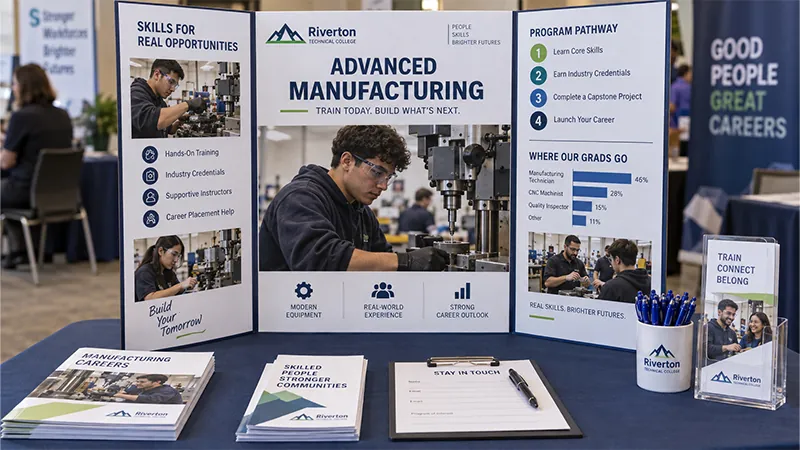
When the offer needs more explanation than one banner can provide, a tri-fold display board gives you more room for supporting information. Product ranges, project examples, before-and-after images, service steps, school information, and simple comparisons can all fit naturally into this format.
The folding structure keeps several pieces of information together instead of creating a collection of loose posters. It is also easier to move and store than many rigid display systems.
Keep one clear main subject in the center, with the side panels supporting it. That creates a more natural reading order than giving all three panels equal visual weight.
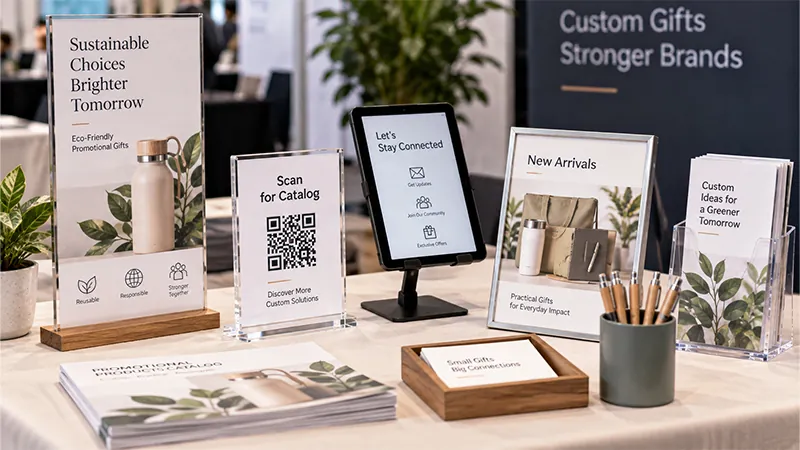
Add Tabletop Sign Holders for Information That Changes
Acrylic sign holders, tabletop frames, and small poster stands are useful for prices, QR codes, product specifications, registration instructions, and short campaign messages.
These details often change more frequently than the main booth branding. Keeping them on replaceable inserts means the holder can stay in the event kit while only the printed content needs updating.
Small booths do not need a separate display product for every message. One tabletop display, one changeable information point, and enough clear space to talk may already be enough.
2. Improve Booth Visibility With A-Frame Signs and Floor Graphics
Small trade show booths often become crowded because every message gets pushed onto the table or back wall. The entrance and floor offer additional communication space without competing with the main display.
This is especially useful when aisle traffic approaches from different directions. Instead of adding another wall graphic, place messages visitors need earlier in the path closer to the booth entrance.
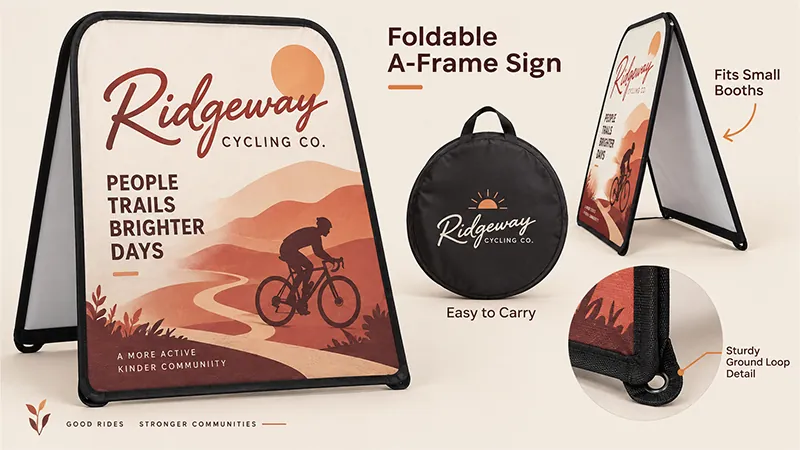
Place an A-Frame Sign Where Aisle Traffic Can See It
Use an A-frame sign to highlight a demonstration time, featured product, event offer, direction, or short call to action. This format works best when the message needs to be understood before someone reaches the table.
Frames with replaceable inserts make updates easier because the printed content can change without replacing the stand. For more signage options and their uses, see our Types of Signs guide.
Placement should always follow the individual show’s rules. The IAEE Guidelines for Display Rules and Regulations provide an industry reference for exhibit-space planning, while the event organizer’s own exhibitor manual should determine what is allowed at a specific show.
Use a Branded Floor Mat at the Booth Entrance
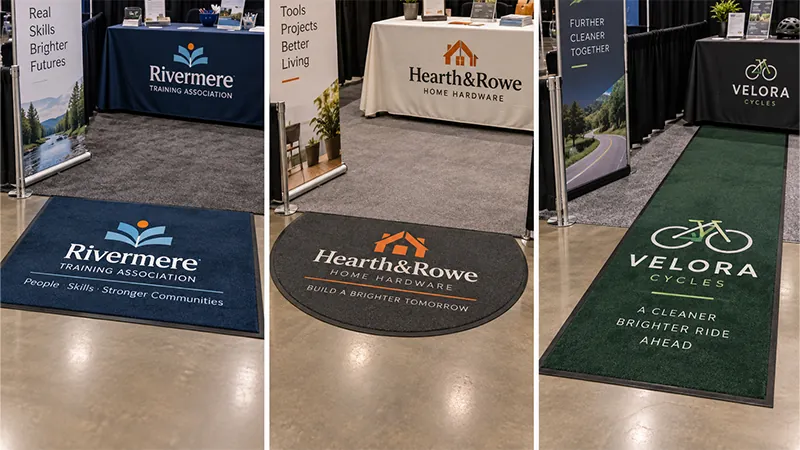
Custom floor mats add branding without taking away table or wall space. In a simple setup, they can help define the booth entrance while leaving the main display relatively uncluttered.
Keeping dates and one-time campaign wording off the design can extend its use beyond a single exhibition. The same mat may later work in a showroom, reception area, retail space, or another event.
That gives the mat a practical role beyond simply filling empty floor space.
Use Floor Decals for Temporary Messages or Directions
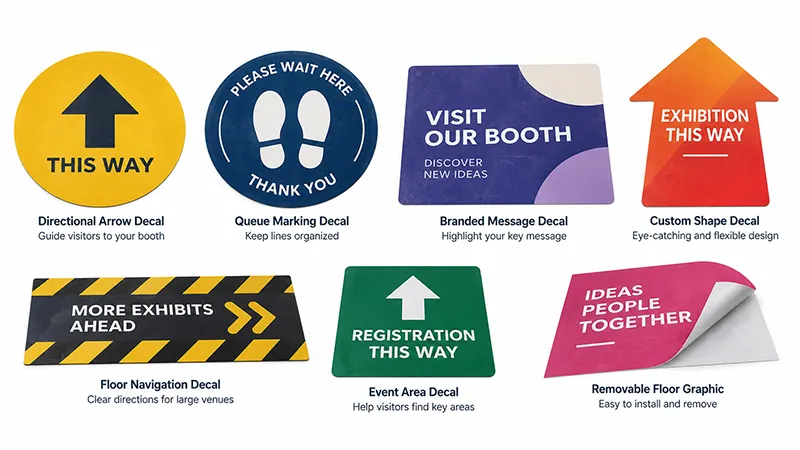
Where venue rules allow them, floor decals can handle temporary communication such as directional arrows, campaign messages, queue guidance, or short QR prompts.
They are most useful when they solve a real navigation or communication problem. If visitors already know where to go and what the booth offers, another floor graphic may only add visual noise.
For longer-term branding, a reusable mat usually makes more sense. Removable floor graphics are better suited to information that genuinely changes with the event.
3. Try Low-Cost Trade Show Booth Activities
Interaction does not require a large digital installation or expensive event technology. One simple activity can create enough of a pause for staff to begin a useful conversation.
Tie the activity to the booth goal. Prize wheels, photo products, or tabletop games have more value when they support a demonstration, signup, product question, or giveaway rather than functioning as entertainment on their own.
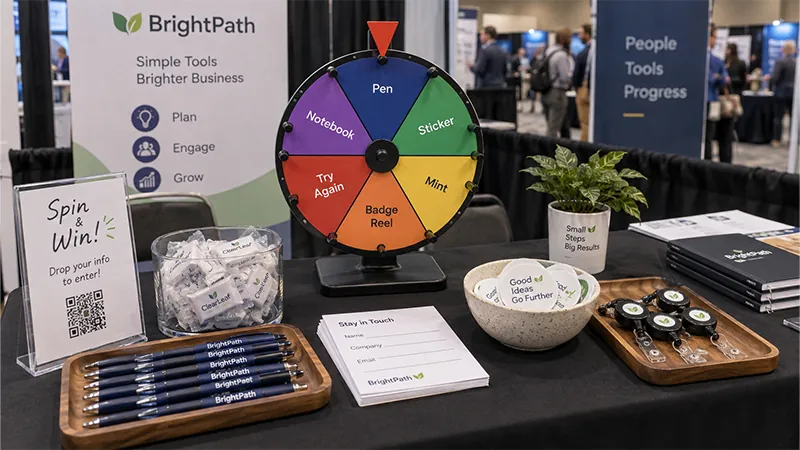
Use a Prize Wheel for Giveaways or Lead Capture
Use a prize wheel to make giveaway distribution part of the visitor experience. Someone might spin after completing a short lead form, joining a demo, answering a product question, or speaking with a representative.
The strongest versions keep the activity short. Visitors should understand why they are participating and what happens after the spin.
Traffic is not the same as engagement. If visitors collect a prize without learning anything about the company, the activity may be busy without producing much value.
Create a Photo Opportunity With a Selfie Frame or Props
Custom selfie frames or a small set of handheld photo props can create an interaction point without requiring a large photo wall.
This approach can work well for schools, sports organizations, consumer promotions, tourism campaigns, product launches, and community events. Keep the branding simple enough that the people in the photograph remain the main subject.
Compared with another decorative sign, a photo product gives visitors something they can actively use rather than simply look at.
Try a Tabletop Game When Space Is Limited
Tabletop games can bring interaction into booths that do not have enough floor space for a larger activity. Mini ring toss, voting games, quizzes, scratch-card activities, compact target games, or small prize wheels can all provide an easy conversation starter.
Choose the format according to the audience. Technical B2B exhibitions may suit a short product quiz or challenge better than a carnival-style game.
One well-chosen activity usually contributes more than several decorative products that visitors never touch.

4. Choose Small Trade Show Giveaways That Are Easy to Hand Out
For a small-budget booth, compact giveaways are easier to keep on the table, store behind the booth, and hand to visitors during a conversation. You also do not need many different products—one or two useful items are usually enough for general event traffic.
Good Giveaway Options for Most Trade Shows
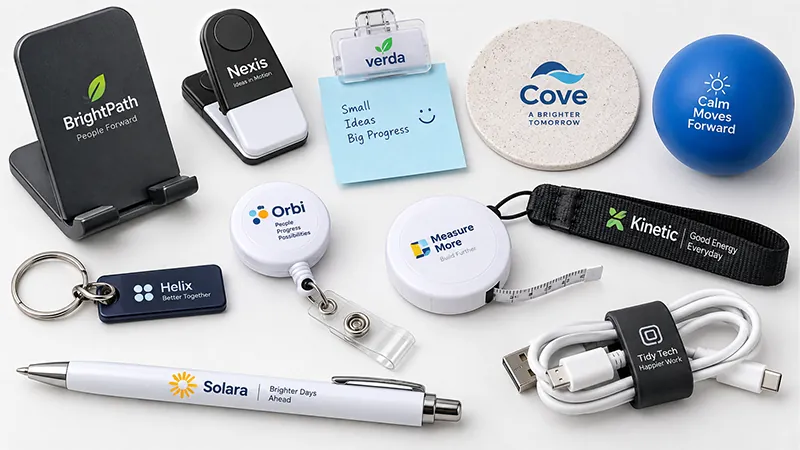
Phone stands, magnetic clips, memo clips, coasters, key rings, badge reels, wrist straps, mini tape measures, and small stress relievers all work well as trade show giveaways because they are compact and easy for visitors to take with them.
Phone stands, coasters, and magnetic clips give you more visible space for a logo or short message. Key rings, badge reels, and wrist straps are smaller and easier to hand out in larger quantities. Mini tape measures and stress relievers add a little more interaction without taking up much booth space.
Check the Logo Area Before You Order
Small products do not all offer the same branding space. A simple logo works well on key rings, badge reels, and wrist straps, while a company name, website, or QR code is usually easier to read on a phone stand, coaster, magnetic clip, or other product with a larger flat surface.
If several giveaway types are being prepared for the same event, they can also be coordinated with the booth colors, artwork, and other event materials instead of being treated as separate purchases. For more product ideas, see our Trade Show Giveaways guide.
5. Reuse Trade Show Displays by Replacing the Graphics
New campaigns do not always require a completely new booth. Keeping the structural pieces and changing only the visual layer carrying temporary information is often more economical.
Permanent brand elements can stay in place while product launches, campaign messages, event details, and short-term offers move onto smaller replaceable pieces.
Change the Table Runner Instead of the Whole Table Cover
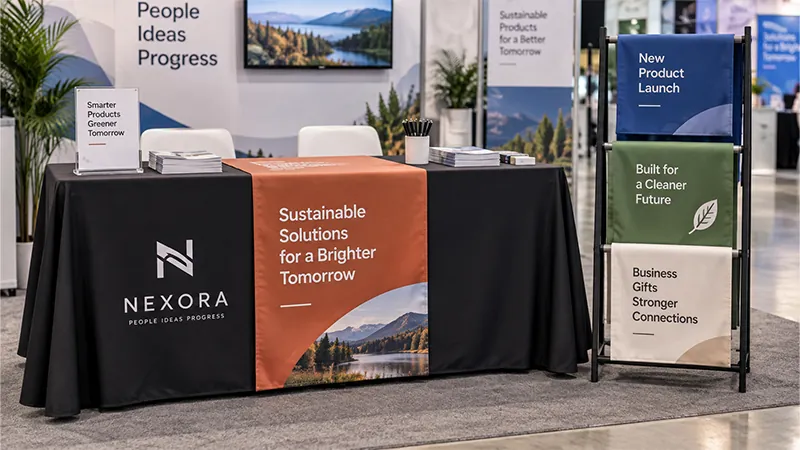
Keep long-term brand identity on the main table cover, and use a smaller runner or front panel for the current campaign or featured product.
When the message changes, only the smaller piece needs new artwork. The base remains familiar from event to event without forcing the exhibitor to order an entirely new table treatment.
This approach works especially well when corporate colors and logos stay consistent but different product categories are promoted throughout the year.
Reuse Sign Holders and Replace the Printed Insert
Acrylic holders, poster frames, tabletop stands, and A-frame hardware can remain in service while the content inside them changes.
Pricing, QR codes, campaign messages, event schedules, and featured products belong on the cheaper layer when they are likely to change frequently.
One sourcing mistake is putting short-term wording directly onto the most expensive display piece. Keep temporary information on the easiest part to replace, and the main visual has a much better chance of staying useful.
Keep Event-Specific Graphics Small
Dates, city names, temporary offers, and one-time campaign slogans should rarely dominate an expensive reusable display unless the product genuinely has no future use.
Smaller cards, inserts, table graphics, or replaceable printed panels make these updates easier to control. They also reduce the risk of an otherwise usable display becoming obsolete after one show.
The principle is straightforward: keep long-term branding on larger pieces and temporary information on lower-cost replaceable elements.
6. Build a Reusable Trade Show Booth Kit
Once the display products are selected, plan how the team will store, transport, identify, and rebuild the setup at the next event.
Treat the physical setup as one repeatable booth kit rather than a collection of separate products that happen to arrive at the same venue.
Keep the Core Kit Focused
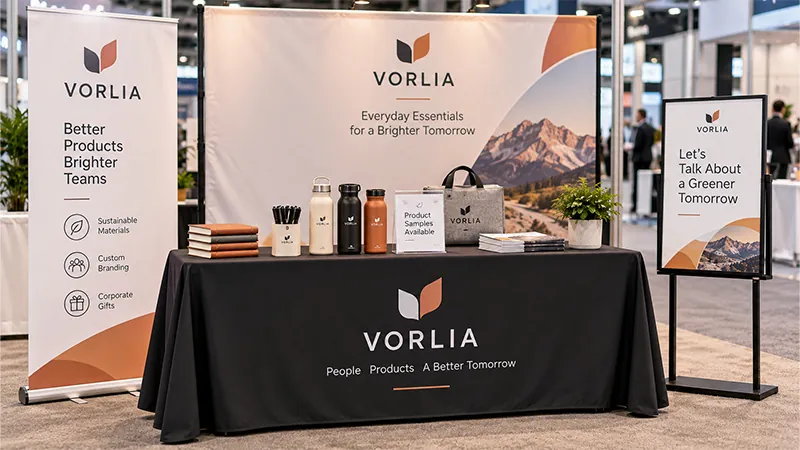
The kit may include a tabletop display, entrance sign, sign holders, table treatment, one interactive item, and the accessories the team uses consistently.
Avoid adding items simply because they might be useful someday. Smaller kits are easier to inventory, ship, set up, and hand over to another employee.
Needs also vary by business. Product brands may prioritize demonstration supports and sample storage, while service companies may need more signage and fewer physical display components.
Add the Accessories That Make Setup Easier
Brochure holders, tablet stands, collapsible storage boxes, carry bags, clips, fasteners, display cases, and small storage pouches are not the most visible part of the booth, but they can make repeated setup considerably easier.
Grouping these accessories with the equipment they support also reduces last-minute purchases. Storing a tablet stand with the display equipment makes it less likely to be forgotten than treating it as a separate office accessory.
Protective bags and cases deserve particular attention when displays will travel repeatedly. Damage between shows can erase the savings gained from buying reusable hardware in the first place.
Pack by Function, Not by Whatever Fits in the Box
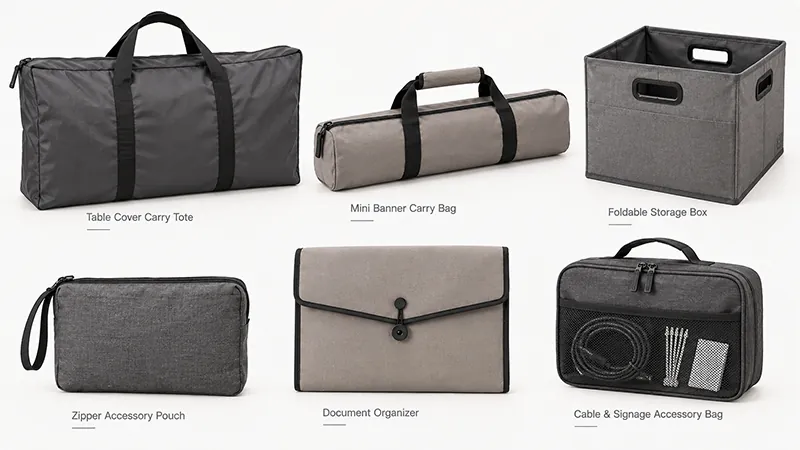
After the show, signage, display hardware, small accessories, staff materials, and remaining promotional products should not all return in random cartons.
Store related components together and label them clearly. The next team should be able to understand what belongs to the booth without relying on the person who packed it months earlier.
Freeman’s exhibitor planning guidance also emphasizes reviewing event-specific shipping, move-in, and service information in advance. Planning how the booth travels should happen before the final boxes are sealed, not after materials are already on the way.
Reuse only works when the team can rebuild the booth without starting the planning process again.
How to Choose a Small-Budget Trade Show Booth Setup
Start with the problem the booth needs to solve, not with the number of products you think it should contain.
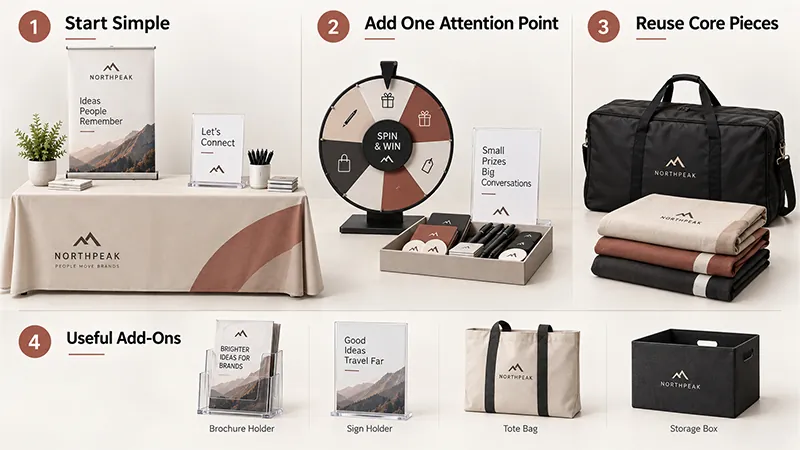
First-time exhibitors using one standard table may only need a tabletop display, one changeable information point, and a clear way to capture visitor interest. If people cannot see the booth from the aisle, an A-frame sign or entrance element may be more useful than adding more tabletop graphics.
Brands that already attract traffic but struggle to start conversations may get more value from a prize wheel, photo prop, or compact activity. Companies attending several events each year should place more of the budget into durable display structures, protective cases, and a booth kit that can be rebuilt consistently.
The best low-budget setup is not the one with the fewest products. It is the one where no two products are doing the same job.
What Can You Skip When Your Trade Show Booth Budget Is Tight?
Tighter budgets make duplication easier to spot. Before adding another product, check whether something already in the booth is solving the same problem.
- Several signs repeating the same message.
- Multiple brochure versions when one focused takeaway is enough.
- Event dates printed on expensive long-term graphics.
- Premium giveaways intended for every passerby.
- Heavy or fragile promotional products when transport is a concern.
- Decorative accessories with no clear role in visibility, communication, or interaction.
Empty space is not automatically a weakness. Booths that visitors understand quickly often look more deliberate than spaces where every available surface has been filled.
What Is Worth Spending More on in a Trade Show Booth?
Working with a small budget does not mean choosing the lowest-priced version of every product. Some items deserve more attention because replacement, breakage, or reprinting can quickly remove the original savings.
Reusable display hardware should be stable enough for repeated setup and transport. Main graphics need acceptable print quality and correct sizing, while stands and holders should remain secure throughout the event.
Protective cases and other components expected to travel repeatedly may also justify a larger share of the budget. Spend less on unnecessary quantity, not on the parts that need to keep working.
Small-Budget Trade Show Booth Checklist
Before placing orders, review the booth as one complete setup rather than approving each item separately.
- Confirm what furniture and basic equipment the event already provides.
- Check the booth dimensions, display boundaries, and organizer rules.
- Decide what visitors should understand or do at the booth.
- Choose one main display and remove competing messages.
- Keep temporary information separate from long-term branding.
- Estimate giveaway quantities from realistic visitor traffic and engagement.
- Review packed size, protection, storage, and transport requirements.
- Complete one full test setup before the booth is packed.
Running one full test setup can reveal problems that are difficult to see when each product is reviewed separately. It also gives the team time to remove unnecessary items before everything is shipped.
FAQs
What Is the Cheapest Way to Set Up a Professional Trade Show Booth?
For many small exhibitors, the most practical starting point is to use the basic furniture already provided by the event and add one compact branded display.
Combining a mini retractable banner or tri-fold display with one tabletop sign holder and a simple lead-capture point can cover the main functions without requiring a complete exhibition wall.
What Can I Use Instead of a Large Trade Show Backdrop?
Tabletop retractable displays, tri-fold boards, A-frame signs, compact fabric displays, and reusable sign holders are all alternatives when space and budget are limited.
Choose according to viewing distance. Tabletop displays suit close conversations, while taller signs are more useful when the message needs to be noticed from the aisle.
What Are Good Lightweight Giveaways for Trade Shows?
Phone stands, magnetic clips, carabiner key rings, badge reels, memo clips, mini tape measures, coasters, and small stress relievers are compact options worth considering.
The right choice depends on the audience, quantity, branding area, packed size, and event purpose. Small products still need enough relevance to justify handing them out.
What Display Equipment Do You Need for a Small Trade Show Booth?
For many small booths, one main visual element, one supporting information point, and enough clear space for the booth’s primary activity can be a practical starting point.
Add another display when it solves a different problem, such as aisle visibility or product explanation. More equipment does not automatically make a small booth look more professional.
Conclusion
Small trade show booths do not need the most products or the largest display. They need a few well-chosen pieces that help visitors notice the space, understand the offer, interact with the team, and take the next step.
The budget stretches further when temporary messages stay easy to replace, giveaways match the audience, and the physical setup can survive more than one event. Good planning is less about filling the booth and more about making every item earn its place.
Build a Trade Show Booth That Fits Your Budget
TOMAS Crafts can coordinate tabletop displays, signage, interactive event products, compact promotional items, booth accessories, staff apparel and accessories, and other customized materials within one trade show project.
If you already have a booth plan—or only a rough list of what you may need—send it to us. We can help you narrow down the options around your booth space, budget, branding, quantities, and event schedule, then turn those requirements into a practical sourcing plan. Talk to us about your trade show project.