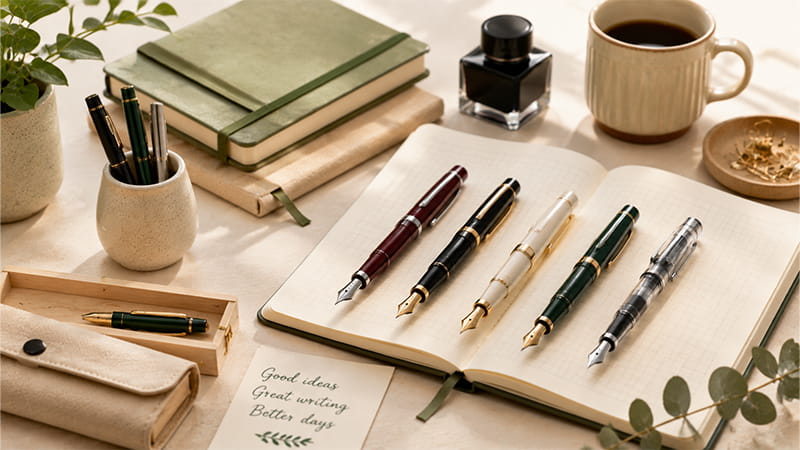
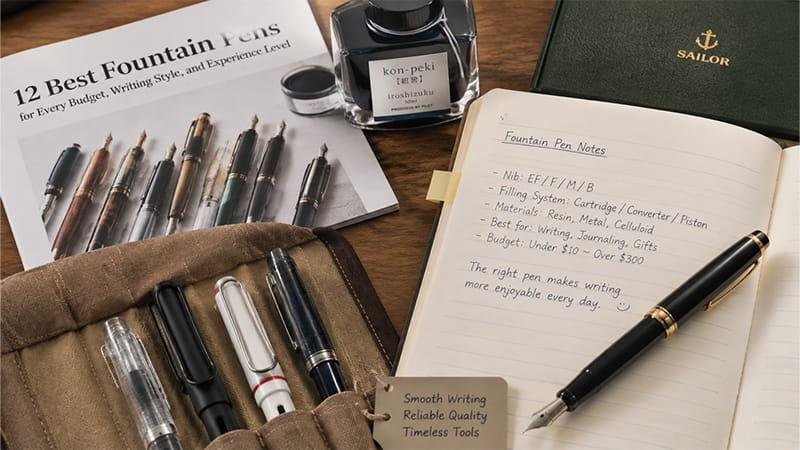
A good fountain pen does not have to cost hundreds. Based on current manufacturer specifications and verified market prices, this guide compares 12 of the best fountain pens from under 10toover10toover300. You will see how nibs, filling systems, comfort, and upkeep affect value, then find practical picks for beginners, daily writers, gift buyers, and business programs.
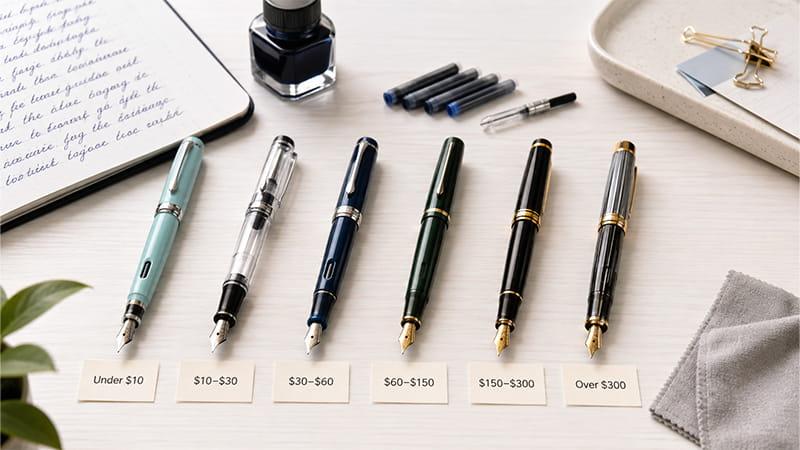
Best fountain pens at a glance
| Budget | Best overall | Best for | Nib options | Filling system | Main drawback |
|---|---|---|---|---|---|
| Under $10 | Platinum Preppy | First-time users and everyday notes | EF, F, M by version | Proprietary ink cartridges; converter optional | The converter can cost more than the fountain pen |
| 10−10−30 | TWSBI GO | Trying bottled ink on a small budget | EF, F, M, B, 1.1 stub | Spring-loaded piston | Cannot use ink cartridges |
| 30−30−60 | TWSBI ECO | Journaling and long writing | EF, F, M, B, 1.1 stub | Built-in piston | Cleaning takes more effort than swapping a cartridge |
| 60−60−150 | LAMY studio | Office use and a polished gift | EF, F, M, B on standard steel-nib versions | Cartridge or converter | Its metal grip will not suit every hand |
| 150−150−300 | Pilot Vanishing Point | Fast notes and professional use | 18k gold nib; sizes vary | Proprietary cartridge or converter | The clip sits near the grip |
| Over $300 | Pilot Custom 823 | Long writing and high ink capacity | 14k gold nib; sizes vary | Vacuum filler | Expensive and more involved to clean |
Price note: Prices and availability were checked on September 1, 2026 and may vary by model, nib, region, tax, and limited-edition status.
Quick answer: The Platinum Preppy is the easiest low-risk starting point. Choose the TWSBI ECO if you want a large ink supply for journaling, the Pilot Vanishing Point if fast one-handed access matters, or the Pilot Custom 823 if you already know that you enjoy vacuum fillers and premium pens.
Still deciding between fountain, gel, rollerball, and ballpoint formats? Compare their writing systems and branding uses in TOMAS Crafts’ guide to different types of pens.
How these fountain pens were selected
This is an editorial buying guide, not a laboratory ranking. Product construction, nib, filler design, and compatibility details come from current manufacturer specifications; approximate prices use a current market reference checked on the date above. TOMAS Crafts does not describe a fountain pen as “TOMAS tested” unless a documented writing test and original photographs exist.
Each pen was compared on cap seal and writing reliability, nib choices and ink flow, grip and weight, refill method, compatibility, maintenance, included accessories, and total ownership cost. A higher price was not treated as proof of better comfort or smoothness. The detailed selection factors appear in the buyer’s guide below.
What more money buys
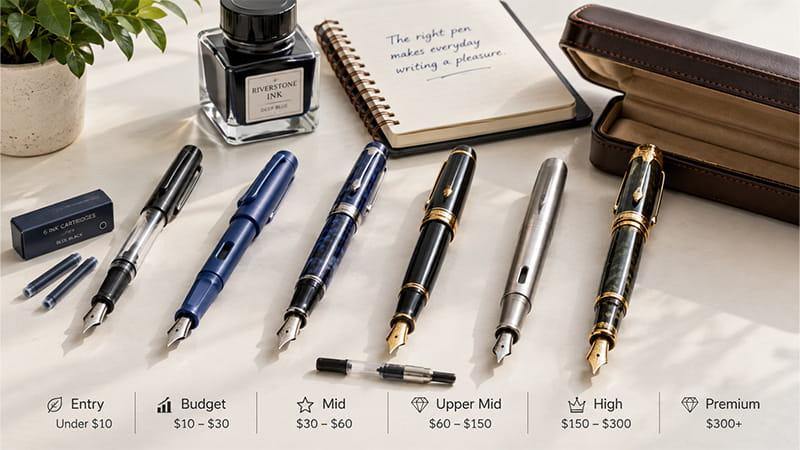
| Price range | Common body materials | Typical nib | Common filling system | What may improve | What may not improve |
|---|---|---|---|---|---|
| Under $10 | Injection-molded plastic | Steel | Pre-filled or cartridge | Low replacement cost and simple use | Finish, accessories, and repair options |
| 10−10−30 | Plastic or resin | Steel | Cartridge, converter, or simple piston | Grip choices, refill options, and nib selection | Prestige or premium packaging |
| 30−30−60 | Resin, ABS, or entry-level metal | Steel | Cartridge-converter or piston | Ink capacity, replaceable nibs, cap design, and finish | A writing feel every user will prefer |
| 60−60−150 | Aluminum, metal, or finished resin | Usually steel | Cartridge-converter, piston, or vacuum | Materials, balance, presentation, and serviceable parts | Guaranteed smoothness or better handwriting |
| 150−150−300 | Engineered resin or metal | Often gold | Cartridge-converter or piston | Nib responsiveness, mechanism refinement, and finishing | A proportionate gain in practical performance |
| Over $300 | Premium resin, metal, lacquer, or specialty materials | Gold or specialty nib | Piston, vacuum, or proprietary system | Craftsmanship, capacity, heritage, and collectability | Better value for ordinary daily notes |
An expensive fountain pen can be worth it when the material, mechanism, nib character, repair support, or design gives you something you will use. It is not a required upgrade. A well-adjusted steel nib can write as reliably as a gold nib, and the jump from 30to30to300 does not make a fountain pen ten times better at putting ink on paper.
Remember the ownership cost. A converter, proprietary ink cartridges, a bottle of fountain pen ink, suitable paper, a cleaning bulb, a replacement nib, and repairs can change the real budget. A 7Preppywithan7Preppywithan11 converter is no longer a $7 setup. A piston filler costs more at the start but does not require a separate converter.
Best budget fountain pens under $30
Platinum Preppy: best affordable refillable fountain pen
Best for: Beginners, students, occasional writers, and anyone testing an extra fine nib
Approximate US retail price: $7 for standard colors
Nib options: Extra fine, fine, and medium, depending on the version
Filling system: Platinum ink cartridges; compatible converter sold separately
The Platinum Preppy gives a first-time buyer a proper refillable fountain pen at a disposable-pen price. Its clear plastic body makes the ink level easy to see, and the available 02, 03, and 05 nibs cover small handwriting through a more generous medium line. The cap seal is especially useful for people who write only a few times each week.
Main drawback: Platinum uses proprietary ink cartridges, and a converter may cost more than the fountain pen.
Who should skip it: Buyers who want a metal body, gift presentation, or standard international cartridges.
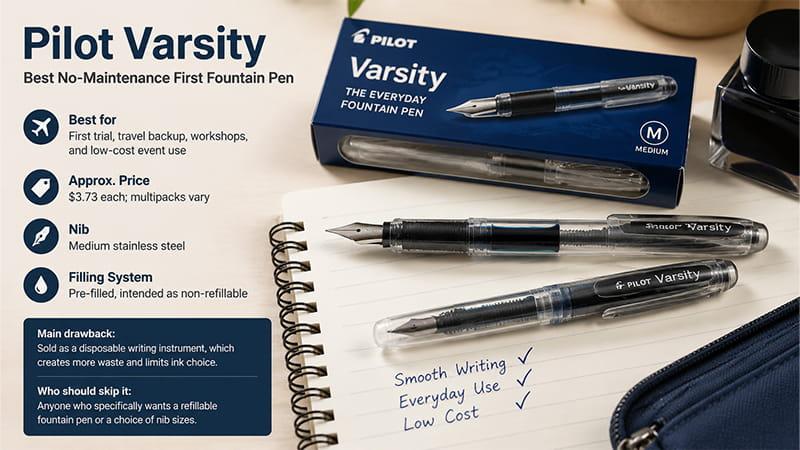
Pilot Varsity: best no-maintenance first fountain pen
Best for: A first trial, travel backup, workshops, and low-cost event use
Approximate US retail price: $3.73 each; multipacks vary
Nib: Medium stainless steel
Filling system: Pre-filled, intended as non-refillable
The Pilot Precise Varsity removes the usual beginner questions about cartridges and converters. Uncap it and write. Its visible ink supply is useful, and the low price makes loss or damage less painful than it would be with most fountain pens.
Main drawback: It is sold as a disposable writing instrument, which creates more waste and limits ink choice.
Who should skip it: Anyone who specifically wants a refillable fountain pen or a choice of nib sizes.
Pilot Kakuno: best beginner fountain pen for learning nib position
Best for: Students, younger writers, and adults learning fountain pen technique
Approximate US retail price: About $15 for standard versions Nib options: Extra fine, fine, or medium, depending on version and region
Filling system: Pilot ink cartridges; compatible converter sold separately
The Kakuno’s smile mark on the nib gives a simple visual cue: keep the face upright while writing. That small detail makes the fountain pen less intimidating for someone moving from pencils or gel pens. Pilot’s Kakuno use and care guide also explains cartridge installation, converter filling, and basic cleaning without assuming prior experience.
Main drawback: The playful appearance and molded grip are not ideal for every office or every hand position.
Who should skip it: Writers who rotate a fountain pen heavily or want a formal metal body.
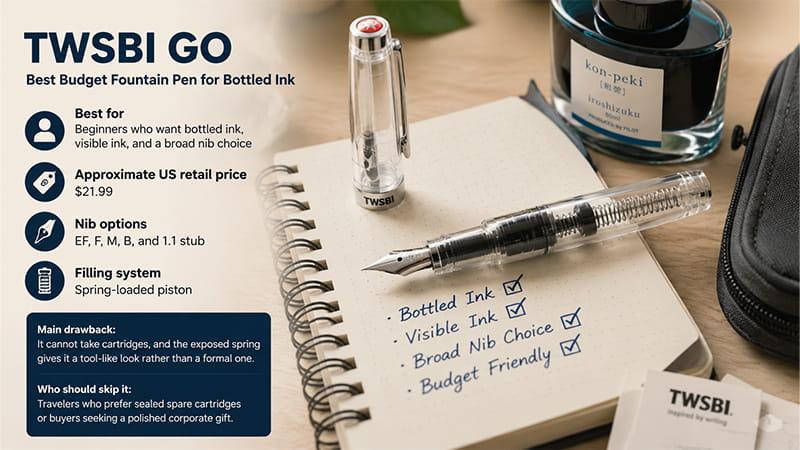
TWSBI GO: best budget fountain pen for bottled ink
Best for: Beginners who want bottled ink, visible ink, and a broad nib choice
Approximate US retail price: $21.99
Nib options: EF, F, M, B, and 1.1 stub
Filling system: Spring-loaded piston
The TWSBI GO fills with a spring-loaded push button. That makes it one of the least expensive ways to explore bottled inks without buying a converter. The clear or translucent fountain pen body also shows the remaining ink.
Main drawback: It cannot take cartridges, and the exposed spring gives it a tool-like look rather than a formal one.
Who should skip it: Travelers who prefer sealed spare cartridges or buyers seeking a polished corporate gift.
Best midrange fountain pens from 30to30to150
LAMY safari: best for replaceable nibs and a guided grip
Best for: Students, daily notes, nib experimentation, and color choice
Approximate US retail price: $37 from LAMY USA
Nib options: EF, F, M, B, and LH among current standard choices
Filling system: LAMY T10 ink cartridges; Z28 converter optional
The LAMY safari combines an ABS plastic body, ink window, replaceable steel nib, and molded grip. Changing nib sizes is easier than replacing the whole fountain pen, so a writer can move from fine writing to a broader line or a left-hand nib without building a new setup from scratch.
Main drawback: The triangular grip forces a particular finger position, and the converter is optional.
Who should skip it: Writers with an unconventional grip or those who dislike proprietary ink cartridges.
TWSBI ECO: best for journaling and large ink capacity
Best for: Journaling, long writing, ink shading, and monitoring ink level
Approximate US retail price: $36.99 for standard versions
Nib options: EF, F, M, B, and 1.1 stub
Filling system: Built-in piston
The TWSBI ECO carries more ink than a typical converter and has a transparent barrel that makes the ink color part of the design. Fine and extra fine nibs work well for everyday notes; medium, broad, and stub options give wetter inks more room to shade.
Main drawback: It requires bottled ink, and a full flush takes longer than replacing a cartridge.
Who should skip it: People who want the fastest possible refill while traveling or frequently switch ink colors.
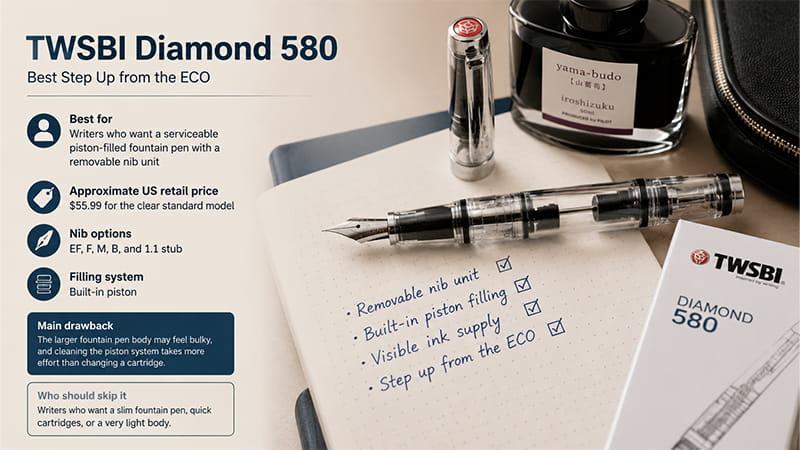
TWSBI Diamond 580: best step up from the ECO
Best for: Writers who want a serviceable piston-filled fountain pen with a removable nib unit
Approximate US retail price: $55.99 for the clear standard model
Nib options: EF, F, M, B, and 1.1 stub
Filling system: Built-in piston
The TWSBI Diamond 580 adds a more substantial faceted body, removable parts, and a removable nib unit. It still offers the visible ink supply and piston filling that attract buyers to the ECO, but it is easier to treat as a fountain pen that can evolve with a changing nib preference.
Main drawback: The larger fountain pen body may feel bulky, and cleaning the piston system takes more effort than changing a cartridge.
Who should skip it: Writers who want a slim fountain pen, quick cartridges, or a very light body.
Kaweco AL Sport: best compact metal fountain pen
Best for: Pocket carry, travel, and buyers who want a compact metal fountain pen
Approximate US retail price: 95−95−100 for common versions; regional prices vary Nib options: EF, F, M, B, and BB
Filling system: Standard international short cartridge; mini converter optional
The Kaweco AL Sport is only about 10.5 cm closed and reaches a more conventional writing length when the screw cap is posted. Its aluminum body is more durable than the plastic Classic Sport, and the exchangeable nib unit gives owners a practical route to another line width.
Main drawback: The clip and mini converter are optional, and the small converter limits ink capacity.
Who should skip it: Writers with large hands who dislike posting a cap or need a large ink reservoir.
LAMY studio: best understated office fountain pen
Best for: Office writing, client gifts, and buyers who want a cleaner metal design
Approximate US retail price: $99 for the standard black steel-nib version
Nib options: Common grades include EF, F, M, and B; finish-dependent options vary
Filling system: LAMY cartridge or converter
The LAMY studio moves away from the safari’s molded grip and bright, school-oriented design. Its metal body, propeller-shaped clip, and restrained finish look at home in a meeting without becoming decorative. Some premium finishes use different nib materials, so verify the exact version instead of assuming every studio fountain pen has the same nib.
Main drawback: Grip material and texture vary by finish, and polished sections may feel slippery to some writers.
Who should skip it: Anyone who wants a built-in high-capacity filler or a strongly textured grip.
Best premium fountain pens over $150
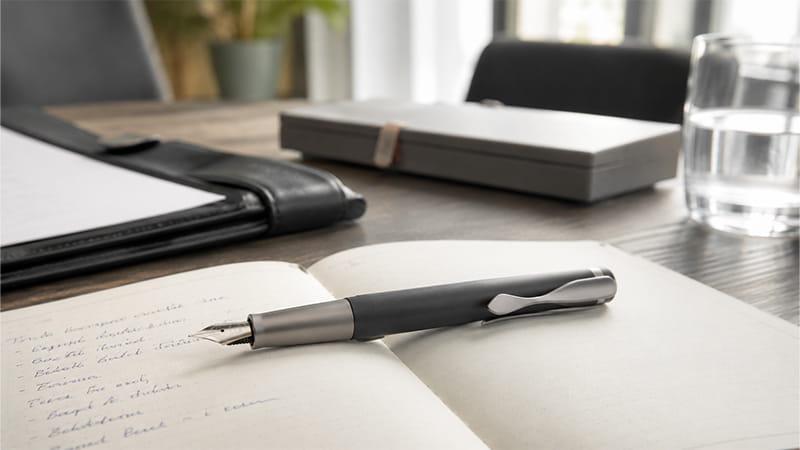
Pilot Vanishing Point: best retractable fountain pen for quick notes
Best for: Meetings, signatures, desk use, and frequent start-stop writing
Approximate US retail price: $192 at the checked retailer
Nib: Retractable 18k gold nib; available grades vary
Filling system: Pilot cartridge or converter
The Pilot Vanishing Point uses a push-button mechanism instead of a conventional cap. That matters when you need to take a note, pause, and continue several times in one meeting. The nib retracts behind an internal door that helps protect it from drying when closed.
Main drawback: The clip is positioned near the nib because it keeps the retracted nib upright in a pocket; some grips find that intrusive. Its converter capacity is also modest.
Who should skip it: Writers who hold close to the nib, rotate the fountain pen, or prefer screw-on caps.
LAMY 2000: best premium piston fountain pen under $300
Best for: Daily professional writing, long ownership, and understated design
Approximate US retail price: $279 from LAMY USA
Nib options: EF, F, M, B, BB, and oblique grades
Filling system: Built-in piston
The LAMY 2000 pairs a fiberglass body with brushed stainless steel details and a platinum-coated 14k gold nib. The hooded nib and small ink windows keep the fountain pen visually quiet. It does not look like a limited edition or a status object, which is part of its appeal.
Main drawback: The partially hooded nib has a narrower ideal writing angle than some open nibs, and the body is not designed for logo engraving.
Who should skip it: Buyers who want a visible ink level, decorative body, or easy nib swapping.
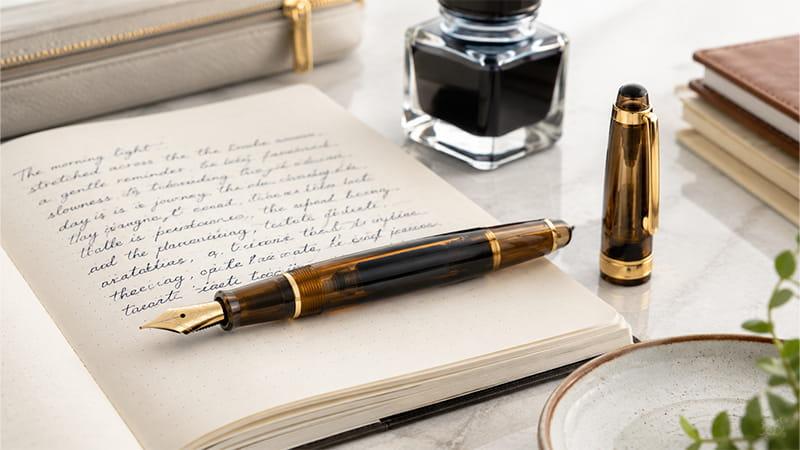
Pilot Custom 823: best for long writing and vacuum-fill capacity
Best for: Experienced writers, long sessions, travel between refills, and premium gifts
Approximate US retail price: $416 at the checked retailer
Nib: 14k gold; current US nib choices vary
Filling system: Built-in vacuum filler
The Pilot Custom 823 combines a large translucent body, visible ink supply, 14k gold nib, and vacuum filling system. The mechanism holds much more ink than a small converter, so it suits writers who finish pages rather than occasional signatures.
Main drawback: The price is high, cleaning is more involved, and frequent ink-color changes defeat the benefit of the large reservoir.
Who should skip it: Beginners, cartridge users, and anyone who changes bottled inks every few days.
Spending above $300 makes sense only after you know your preferred nib size, grip, weight, and filling system. Beyond this point, much of the extra cost goes toward materials, hand finishing, brand history, limited editions, and collectability. Those can be valid reasons to buy, but they are different from everyday writing performance.
Choose a fountain pen by how you write
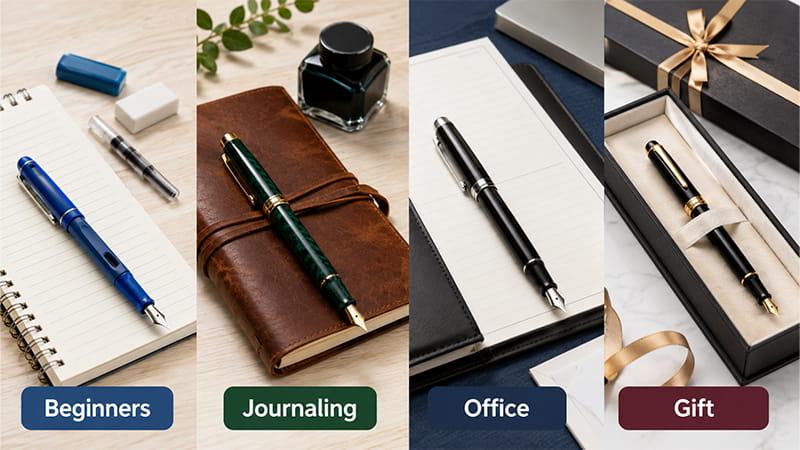
| Use case | Better starting points | What to prioritize |
|---|---|---|
| Beginners and students | Platinum Preppy or Pilot Kakuno; TWSBI GO for bottled ink | Fine nib, easy refills, low replacement cost, and performance on actual school paper |
| Journaling and long writing | TWSBI ECO or Diamond 580 | Comfortable grip, visible ink, useful capacity, and fountain pen friendly paper |
| Office work and signatures | Pilot Vanishing Point, LAMY studio, or LAMY 2000 | Quick opening, restrained design, and a fine or medium-fine line for copy paper and forms |
| Personal gifts | Match the model to the recipient’s routine | Cartridge convenience for new users; bottled ink for enthusiasts; secure cap and suitable presentation |
Research supports handwriting practice, not a particular pen model. A systematic review of 13 curriculum-based handwriting studies found small-to-medium improvements in legibility, while evidence for speed was mixed and evidence for fluency was insufficient. For students, comfort and affordability matter more than prestige.
Whatever the use case, test the pen, ink, and paper together. A broad nib may show more shading but dry slowly, while a fine nib may behave better on absorbent school or office paper.
Fountain pen buyer’s guide
For a visual explanation of the nib, feed, grip section, converter, and barrel, see TOMAS Crafts’ guide to the parts of a pen.
First-time buyers often focus on appearance and overlook compatibility. Common mistakes include choosing a fountain pen nib by label alone, assuming all ink cartridges fit, using unsuitable fountain pen ink, or buying metal pens without checking balance.
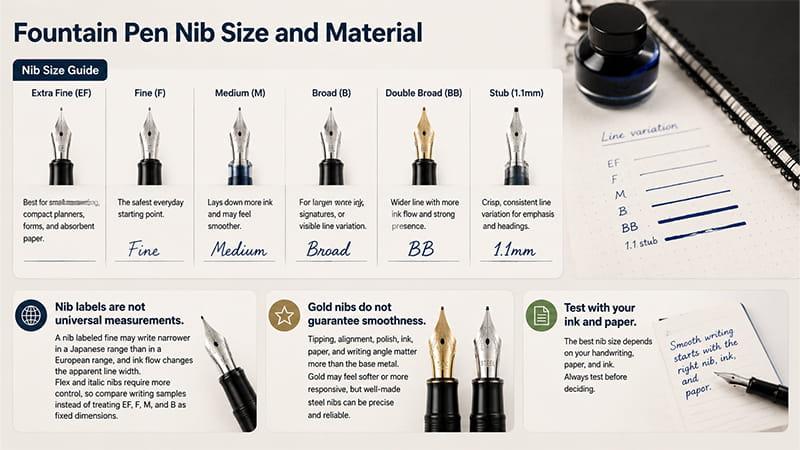
Fountain pen nib size and material
An extra fine fountain pen nib suits small handwriting, compact planners, forms, and absorbent paper. Fine is the safest everyday starting point. Medium usually lays down more ink and may feel smoother, while broad, double broad, italic, and 1.1 mm stub nibs favor larger writing, signatures, or visible line variation.
Nib labels are not universal measurements. A fountain pen nib labeled fine may write narrower in a Japanese range than in a European range, and ink flow changes the apparent line width. Flex and italic nibs also require more control, so compare writing samples instead of treating EF, F, M, and B as fixed dimensions.
Gold nibs do not guarantee smoothness. Tipping, alignment, polish, ink, paper, and writing angle matter more than the base metal. Gold may feel softer or more responsive, but well-made steel nibs can be precise and reliable.
Cartridges, converters, piston, and vacuum fillers
Ink cartridges are clean and portable, but compatibility varies. Pilot, Platinum, and LAMY use proprietary formats, while many Kaweco models accept standard international short cartridges. Body length can also limit what fits.
A converter draws bottled ink into a cartridge-fed pen and offers more color choice, though it usually holds less than a built-in piston. Piston and vacuum designs carry more ink for long writing, but they take longer to flush. If you change colors often, a small converter may be easier than a large reservoir.
Ink, paper, comfort, and drying time
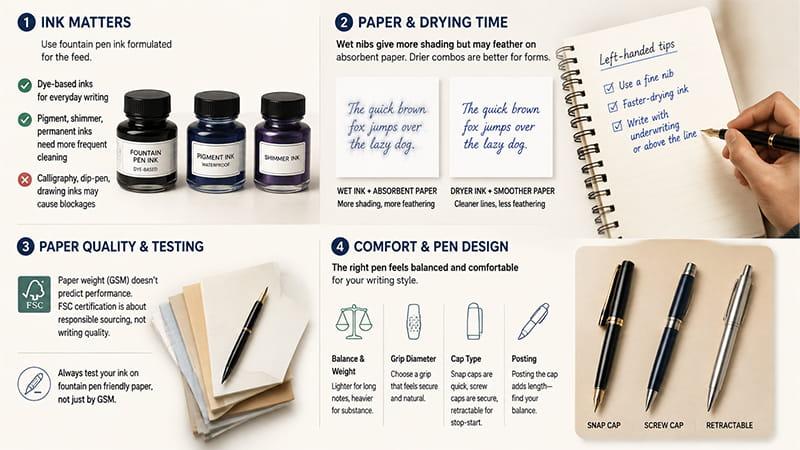
Use fountain pen ink formulated for the feed. Calligraphy, dip-pen, and drawing inks may contain binders or particles that cause blockages. Fountain pen enthusiasts who use pigment, shimmer, permanent, or high-sheen inks should clean more frequently.
A wet nib may produce darker color and shading but feather on absorbent paper. A drier combination can suit office forms. Left-handed writers often benefit from a fine nib, faster-drying ink, and a hand position that avoids fresh lines.
Paper weight alone does not predict performance, and FSC certification covers responsible sourcing rather than writing quality, as the Forest Stewardship Council’s paper guidance explains. Test the exact fountain pen ink on fountain pen friendly paper instead of relying on GSM alone.
Finally, check grip diameter, body weight, balance, and cap type. Lighter pens may suit long notes, while metal pens may feel more substantial but tiring after several pages. Snap caps are quick, screw caps are secure, and retractable models suit stop-start writing. Posting a cap can improve length while shifting too much weight behind the hand.
Fountain pen care and troubleshooting
Cleaning: Flush a fountain pen when flow weakens, before a major color change, or before extended storage. Cool or lukewarm water is usually enough unless the manufacturer says otherwise. Pigment, shimmer, and other specialty inks need closer attention; do not mix inks unless compatibility is confirmed.
Hard starts or scratching: Check that the cartridge or converter is seated, ink has reached the nib, and dried residue is not blocking the feed. Flush the pen and test a known ink on suitable paper. If it still scratches in one direction, the tines may be misaligned. Avoid abrasives and return a new damaged pen to the seller or a qualified specialist.
Storage and travel: Keep an inked fountain pen capped and nib-up when carried or left unused. During air travel, keep it upright and open it carefully after pressure stabilizes. A case protects polished or delicate finishes; always check model-specific instructions for piston and vacuum designs.
Custom fountain pens for corporate gifts
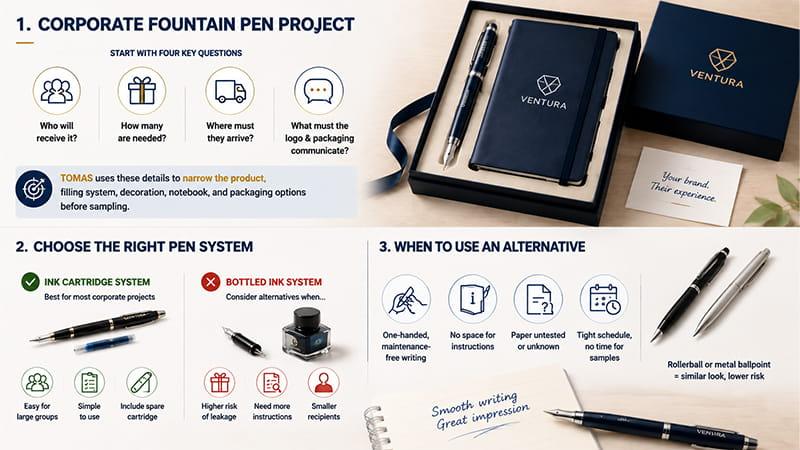
Retail recommendations answer, “Which fountain pen should I buy for myself?” A corporate project adds four questions: Who will receive it? How many are needed? Where must they arrive? What must the logo and packaging communicate? TOMAS can use those details to narrow the product, filling system, decoration, notebook, and packaging options before sampling.
Choose the pen system and know when to use an alternative
Pens that use ink cartridges are usually easier for onboarding kits, conferences, and broad recipient groups. Include an installed cartridge or spare pack and identify the compatible refill. Bottled-ink designs suit smaller executive gifts or enthusiasts, but they add packaging, leakage, and instruction requirements. Fine or medium-fine is a safer default for mixed office paper than a broad, italic, or flex nib.
A fountain pen is a poor choice when recipients need one-handed, maintenance-free writing, the giveaway volume leaves no room for instructions, the paper is untested, or the schedule cannot support a physical sample. A capped rollerball or refillable metal ballpoint may provide similar presentation with less setup risk. TOMAS can compare those alternatives before sampling.
Approve the logo and complete physical sample
The logo method depends on the body material, coating, shape, print area, artwork, and equipment. Pad printing, screen printing, UV printing, and laser engraving may work on suitable constructions, but no method fits every plastic, resin, lacquer, or metal pen.
In a documented TOMAS custom pen project, the customer approved a digital preview. The physical sample then showed that the curved barrel changed the logo’s visual balance even though the file was correct. TOMAS adjusted the position and confirmed a revised sample before production. The record supports this logo-approval process, not claims about nib or ink performance.
Before bulk production, TOMAS recommends five checks:
- Writing: Nib grade, initial flow, refill fit, and cap seal.
- Logo: Size, color, edges, legibility, clip alignment, and closed-cap orientation.
- Assembly: Coating, scratches, cap fit, clip, threads, button, and visible joins.
- Complete set: Ink on the actual paper, pen loop, insert, spare ink, and box closure.
- Reference: Approved model, artwork, logo position, nib, refill, packaging, and date.
This process prevents the pen, logo, paper, and packaging from being approved separately without checking how the complete gift set works together.
Plan the notebook, packaging, cost, and delivery
A fountain pen and notebook should be tested as one system. Check feathering and bleed-through, then confirm the notebook size, cover, pen loop, box insert, spare ink location, and shipping protection.
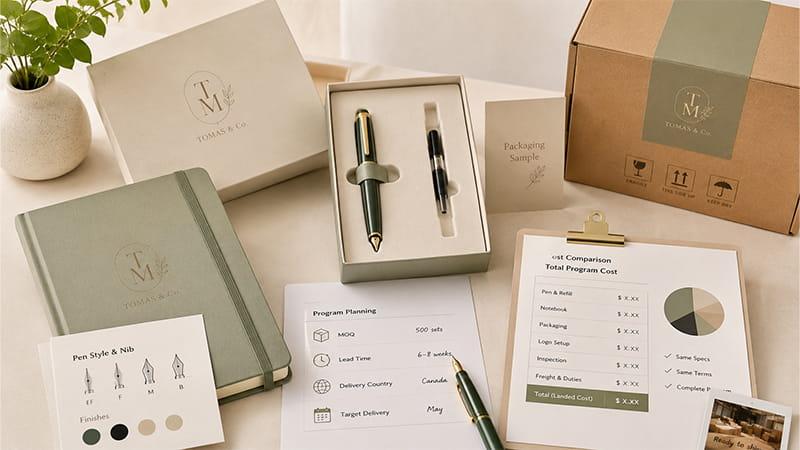
MOQ and lead time depend on the model, decoration, packaging, sample route, quantity, and destination. A useful inquiry includes the target budget, delivery country, required date, logo file, preferred pen style, nib, ink format, and packaging. TOMAS can coordinate these steps; buyers can also review the custom office supplies collection.
Compare complete program costs rather than pen prices alone. Include the pen, compatible refills, logo setup, sample, notebook or accessories, packaging, inspection, freight, and duties where applicable. Ask each supplier to quote the same specifications and delivery term so a low unit price does not hide missing components.
Conclusion: Choose the Right Fountain Pen for Your Writing Needs
Choose a fountain pen by the nib, grip, filling system, and cap you will actually use. Start with an affordable model while learning your preferences. Pay more only when a specific material, mechanism, ink capacity, or nib characteristic solves a real need.
Request a Custom Fountain Pen and Notebook Gift Set
Planning a branded fountain pen or notebook gift set? TOMAS can compare suitable pen styles, refill systems, logo methods, paper, packaging, and delivery options, then confirm the complete set through physical sample approval. Send the recipient type, quantity, target budget, destination, required delivery date, logo file, and packaging requirements to request a custom fountain pen and notebook set quotation.
FAQS
1. What is the best fountain pen for beginners?
The Platinum Preppy is the best low-risk starting point for most beginners because it is refillable, inexpensive, and available in useful nib widths. The Pilot Kakuno is better for someone who wants a guided grip and a visual cue for nib position. Choose the TWSBI GO instead if the beginner specifically wants to use bottled ink.
2. How much should a beginner spend on a reliable fountain pen?
About 7−7−40 is enough for a reliable everyday fountain pen. More money may buy a metal body, larger ink capacity, replaceable nib units, a refined mechanism, premium finishing, or a gold nib. It does not guarantee a smoother pen or a better fit for your hand.
3. Are gold nibs better than steel nibs?
No. Well-made steel nibs can be smooth, consistent, and durable. Gold nibs may feel softer or more responsive, but the result depends on nib design, tipping, alignment, ink flow, paper, and writing angle. Choose the specific nib’s behavior rather than the material alone.
4. Can fountain pens be customized with a company logo for bulk orders?
Yes. TOMAS can customize suitable fountain pens by pad printing, screen printing, UV printing, laser engraving, or another method matched to the barrel material and coating. MOQ and lead time vary by model, decoration, quantity, packaging, and destination. Confirm the print area, artwork, color, cap alignment, refill, and packaging through a physical sample before bulk production.