
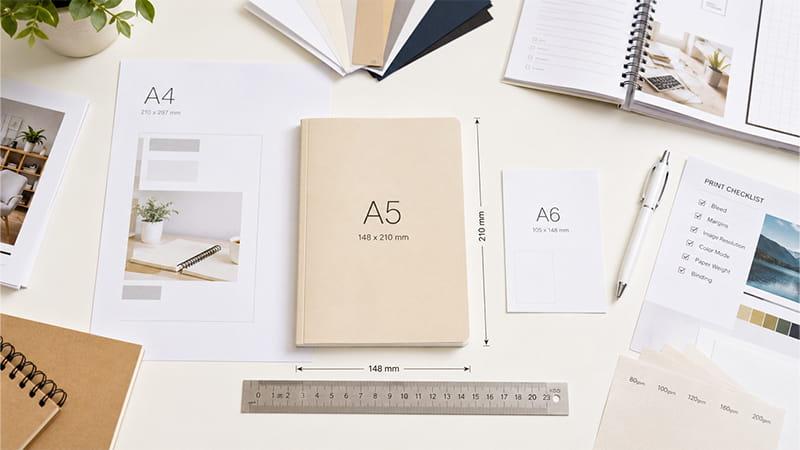
A5 dimensions are 148 x 210 mm, 14.8 x 21 cm, or 5.83 x 8.27 inches. Based on TOMAS Crafts’ custom notebook and printed insert experience, this guide compares A5 with A4, A6, US Letter, and Half Letter. It also explains which formats suit school, office, journaling, and portable use, plus how pixels, bleed, binding, and paper weight affect production.
What Are A5 Dimensions?
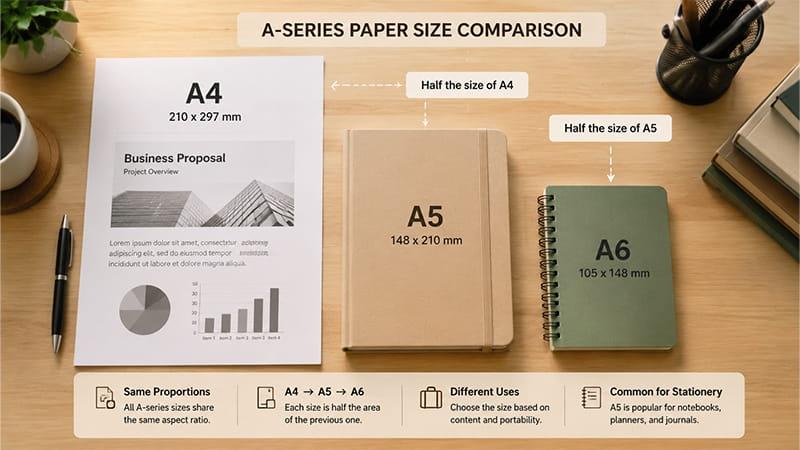
A5 is an ISO 216 paper format measuring 148 x 210 mm, or 5.83 x 8.27 inches. It is half the area of A4 and twice the area of A6. In landscape orientation, the dimensions become 210 x 148 mm.
A5 Paper Size in Millimeters, Centimeters, and Inches
| Unit | A5 dimensions |
|---|---|
| Millimeters | 148 x 210 mm |
| Centimeters | 14.8 x 21 cm |
| Inches | 5.83 x 8.27 in |
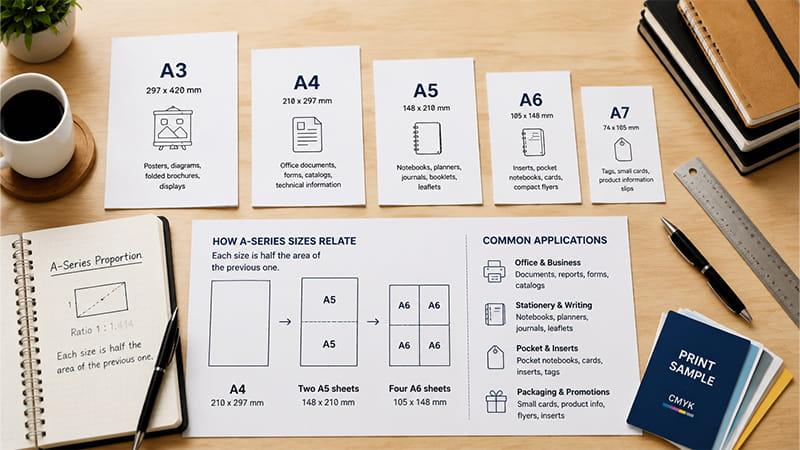
Cutting an A4 sheet parallel to its shorter side produces two A5 sheets; cutting A5 the same way produces two A6 sheets.
This relationship is useful when layouts need to scale across different paper formats. A design prepared for A4 can be reduced to A5 without changing its overall proportions, although font size, line weight, margins, and image detail still need to be checked for readability.
A5 Paper Size at Different DPI for Digital Design
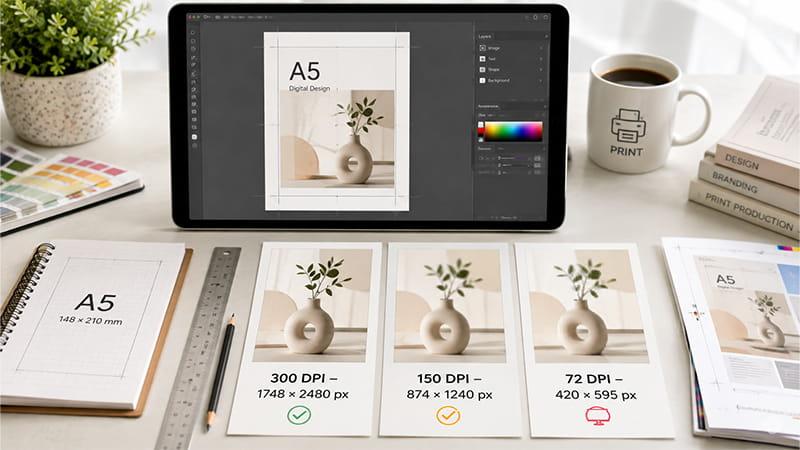
Digital artwork also needs a pixel size based on its resolution, normally expressed as dots per inch or DPI.
| Resolution | A5 pixel size, portrait |
|---|---|
| 300 DPI | 1748 x 2480 px |
| 150 DPI | 874 x 1240 px |
| 72 DPI | 420 x 595 px |
For high-quality commercial printing, 300 DPI is a common starting point for raster images at final size. A lower-resolution image may look acceptable on a screen but appear soft or pixelated in print. Vector logos are preferable because they can be resized without losing edge quality.
Pixel dimensions alone do not make a file print-ready. Designers also need to confirm the color mode, bleed, safe area, fonts, linked images, and the supplier’s file format requirements before release.
A5 vs A4 vs A6 Paper Size Comparison
A4, A5, and A6 share the same A-series proportions. Choose among them by the amount of content, carrying size, and how the finished product will be packed or distributed.
A5 vs A4 Paper Size
| Feature | A4 | A5 |
|---|---|---|
| Dimensions | 210 x 297 mm | 148 x 210 mm |
| Relative area | Twice the area of A5 | Half the area of A4 |
| Typical uses | Documents, forms, catalogs, training materials | Notebooks, planners, journals, booklets |
| Portability | Medium | High |
| Writing area | Larger | Balanced |
A4 suits office documents, forms, technical drawings, catalogs, and layouts where information density matters. A5 is easier to carry in a work bag, conference pack, or gift box while retaining room for meeting notes and planning, which makes it a common format for portable stationery.
For custom notebook buyers, size is only the first decision. Page count, paper weight, cover material, and binding can change the finished thickness and packing dimensions. TOMAS Crafts’ detailed A5 notebook size guide covers those product specifications separately.
A5 vs A6 Paper Size
| Feature | A5 | A6 |
|---|---|---|
| Dimensions | 148 x 210 mm | 105 x 148 mm |
| Writing space | Suitable for regular notes | Compact writing area |
| Typical uses | Notebooks, journals, planners, booklets | Pocket notebooks, inserts, cards, small leaflets |
| Portability | High | Very high |
| Branding area | More flexible | More limited |
The A6 paper size is 105 x 148 mm, exactly half the area of A5. A5 gives users more room for notes, schedules, diagrams, and longer entries, while A6 suits pocket products, thank-you cards, instructions, packaging inserts, and travel stationery. Its smaller surface requires tighter control of font size, logo scale, and content volume.
Understanding Standard Paper Sizes and ISO 216
The A-series is part of the international system described in ISO 216. The standard covers trimmed sizes for writing paper and certain printed materials used for administrative, commercial, and technical purposes.
How the ISO 216 Paper Size System Works
Each A-series sheet uses an aspect ratio of approximately 1:1.414, or 1 to the square root of 2. This proportion remains consistent as the paper is divided into smaller sizes.
The system starts with A0, which has an area of one square meter. Folding or cutting a sheet in half parallel to its shorter side creates the next size: A0 becomes A1, A1 becomes A2, A2 becomes A3, and the sequence continues through A4, A5, A6, and smaller formats.
Because the proportions stay consistent, artwork can be scaled between A-series paper formats without changing its basic shape. That does not remove the need for a visual check. Small text and detailed graphics that work on A4 may become difficult to read after reduction to A5 or A6.
Standard A-Series Paper Size Chart
| Size | Dimensions | Common applications |
|---|---|---|
| A3 | 297 x 420 mm | Posters, diagrams, folded brochures, displays |
| A4 | 210 x 297 mm | Office documents, forms, catalogs, technical information |
| A5 | 148 x 210 mm | Notebooks, planners, journals, booklets, leaflets |
| A6 | 105 x 148 mm | Inserts, pocket notebooks, cards, compact flyers |
| A7 | 74 x 105 mm | Tags, small cards, product information slips |
These are common applications, not rules. The right standard paper size depends on content, viewing distance, product structure, and production method.
ISO Paper Sizes vs US Letter Size
US Letter size paper measures 8.5 x 11 inches, or 215.9 x 279.4 mm. It is wider and shorter than A4, so the formats are not interchangeable in a fixed layout.
The difference matters when a file created for US Letter is printed on A4, or when A-series artwork is forced into a North American format. Automatic scaling can change margins, move page breaks, reduce type, or leave unwanted white space. Designers should build the file for the intended final trim size rather than relying on the print driver to resize it.
This is especially important for forms, catalogs, technical documents, promotional leaflets, and branded stationery distributed across different countries. Confirm the destination market and required paper format before approving the artwork.
How to Choose a Paper Size by Use
Choose the format around how and where people will write. Compare writing space, portability, paper, binding, packaging, and budget, not dimensions alone.
Paper Size Recommendations at a Glance
| Use | Recommended size | Practical starting specification | Main trade-off |
|---|---|---|---|
| School notes and study | A4, B5, or A5 | 80 GSM, spiral or Wire-O, durable cover | More writing space increases carrying size |
| Office meetings and work | A5 | 80-100 GSM, hardcover or PU, subtle logo | Premium materials increase weight and cost |
| Journaling and planning | A5 or A6 | 100 GSM, lined or dotted pages, comfortable-opening binding | More pages and heavier paper increase thickness |
| Notes on the go | A6 or lightweight A5 | Softcover, rounded corners, elastic closure | Compact formats provide less writing space |
Best Paper Sizes for School Notes and Study
A4 and B5 give students more room for diagrams, calculations, worksheets, and detailed class notes. A5 is a better fit when the notebook must move between classrooms, fit into a smaller backpack, or become part of a school welcome kit.
For general school use, TOMAS often starts with 80 GSM paper and spiral or Wire-O binding. The paper keeps weight and cost manageable, while the binding lets pages lie flat or fold back during lessons. A durable softcover can suit large programs; a stronger hardcover may be preferable for year-long use or higher-value school gifts.
Best Paper Sizes for Office Meetings and Work
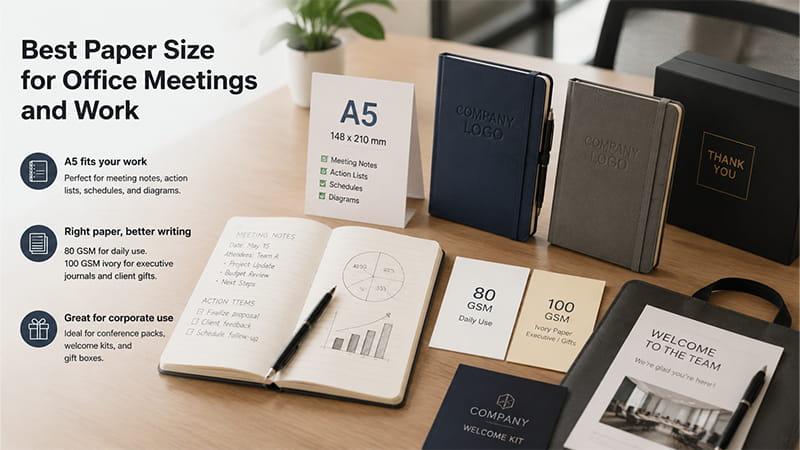
A5 suits most office notebook projects. It provides room for meeting notes, action lists, schedules, and diagrams without taking up as much desk or bag space as A4. It also fits into conference packs, employee welcome kits, and corporate gift boxes.
For regular office notebooks, 80 GSM paper is a practical starting point. For executive journals and client gifts, TOMAS often evaluates 100 GSM ivory paper with a hardcover or PU cover, subject to pen type, page count, budget, and the desired writing experience. A smaller debossed or foil logo often feels more suitable for daily business use than an oversized printed mark.
For more product detail, compare types of notebooks or see how A5 notebooks fit into custom office supply programs.
Best Paper Sizes for Journaling and Planning
A5 gives journal and planner users more writing space for longer entries, weekly layouts, habit trackers, and creative page designs. A6 suits short daily entries, travel journals, appointment notes, and planners built around brief prompts.
For a writing-focused journal, 100 GSM paper and a binding that opens comfortably can improve the experience. Lined pages suit general journaling, dotted pages support flexible layouts, and printed planner pages require careful checking of dates, margins, type size, and page sequence before production. More pages or heavier paper also increase spine width, product weight, and packing volume.
Best Paper Sizes for Notes on the Go
A6 is easier to carry in a small bag, travel pouch, uniform pocket, or compact event kit. It suits quick notes, checklists, contact details, and field observations. Choose A5 when users still need room for meetings or longer writing.
For frequent carrying, prioritize low weight, durable edges, and secure closure. A softcover reduces bulk, while rounded corners, an elastic band, or a protective sleeve can help the notebook withstand repeated handling. A thick hardcover A6 notebook may still feel bulky, so evaluate finished thickness rather than assuming every smaller format is pocket-friendly.
Production Details That Change the Final Product
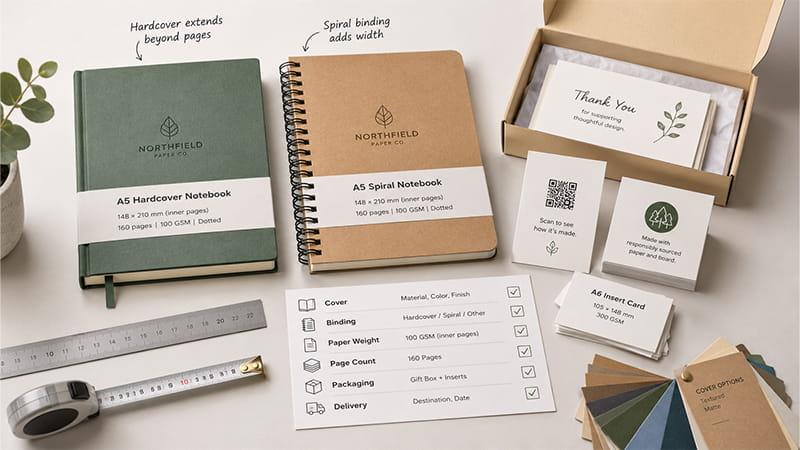
For custom stationery, confirm the cover, binding, paper weight, page count, printing, packaging, quantity, destination, and delivery date. Two A5 notebooks can have different outer dimensions: hardcover boards extend beyond the pages, while spiral binding adds width. Request both the finished product and packing dimensions; the inner paper size alone is not enough.
When an FSC claim is requested, treat certification as a verified supply-chain requirement, not a decorative phrase. The Forest Stewardship Council explains that certified paper and packaging involve appropriate certified materials and chain-of-custody controls. Buyers can review the FSC paper and packaging guidance and confirm the exact claim with the supplier before production.
A6 is also useful for thank-you cards, instructions, QR-code cards, and gift-box inserts. TOMAS often considers A6 with 300 GSM cardstock as a starting combination, but box dimensions, printing, lamination, folding, and transport conditions still govern the final specification. Test a physical sample inside the packaging before mass production.
A5 Printing Guide: Artwork Preparation and Production Tips
Correct dimensions are the foundation of a print file, but production accuracy also depends on how the artwork is built and reviewed.
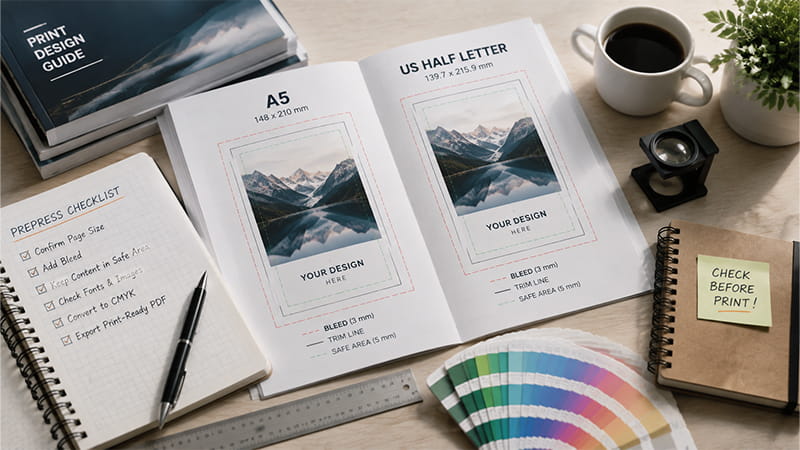
Avoiding the US Half-Letter vs A5 Artwork Problem
A5 and US Half Letter are similar enough to be confused, but they are not the same paper type.
| Format | Dimensions |
|---|---|
| A5 | 148 x 210 mm / 5.83 x 8.27 in |
| US Half Letter | 139.7 x 215.9 mm / 5.5 x 8.5 in |
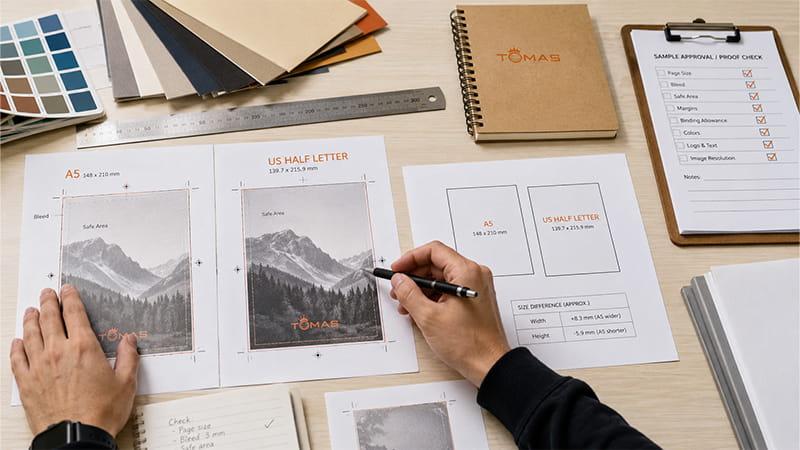
Half Letter is narrower and slightly taller than A5. Moving its artwork into an A5 template without adjustment can create distorted logos, uneven margins, cropped content, or white borders.
The following representative workflow reflects common TOMAS prepress checks rather than one specific customer order.
TOMAS confirms the finished page size, binding method, and production template before checking each page. Backgrounds are extended into the required bleed, critical content is moved inside the safe area, and extra clearance is added beside the binding. Images, fonts, colors, and logo files are reviewed before the buyer receives a revised proof.
A 3 mm bleed is common for A5 print files, but the supplier-approved template takes priority. Bleed, safe area, and binding allowances vary by construction and printing process. Confirming them before sampling reduces cropped content, exposed white edges, and misplaced branding.
All three constructions below use standard 148 x 210 mm A5 inner pages. Their finished outer dimensions still differ.
| Notebook construction | Why the finished outer size changes | What buyers should confirm |
|---|---|---|
| Softcover A5 | Cover thickness and trimming tolerance | Finished width, height, and thickness |
| Wire-O A5 | Wire and punched margin add width | Binding-side allowance and packed size |
| Hardcover A5 | Cover boards extend beyond the pages | Board overhang, spine width, and box fit |
CMYK, Bleed, and File Preparation
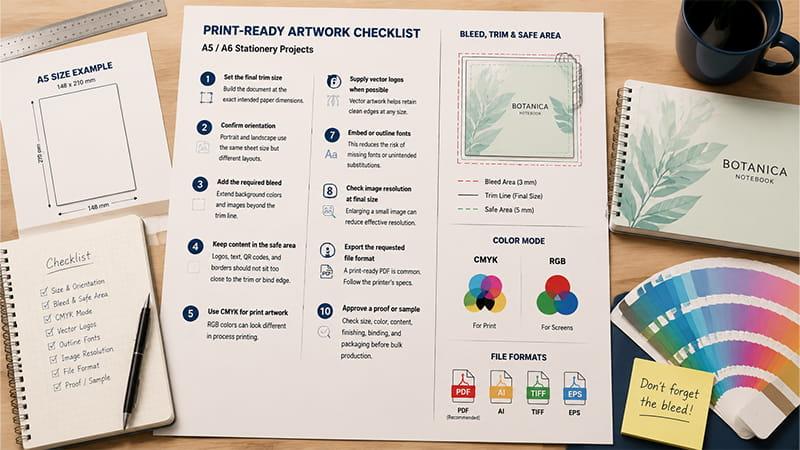
Use this checklist before releasing A5 or A6 artwork:
- Set the final trim size. Build the document at the exact intended paper dimensions.
- Confirm orientation. Portrait and landscape use the same sheet size but different artwork layouts.
- Add the required bleed. Extend background colors and images beyond the trim line.
- Keep critical content inside the safe area. Logos, text, QR codes, and borders should not sit too close to the trim or binding edge.
- Use CMYK for print artwork. RGB is designed for screens and can contain colors that do not reproduce the same way in process printing.
- Supply vector logos when possible. Vector artwork helps retain clean edges at different sizes.
- Embed or outline fonts. This reduces the risk of missing fonts or unintended substitutions.
- Check image resolution at final size. Enlarging a small image can reduce effective resolution.
- Export the requested file format. A print-ready PDF is common, but follow the printer’s specification.
- Approve a proof or sample. Check size, color, content, finishing, binding, and packaging before bulk production.
Adobe describes bleed as artwork extending beyond the crop area so ink can still reach the edge after trimming. Its printer marks and bleed guide also recommends confirming the required bleed with the print provider. For color preparation, use CMYK for print and RGB for digital screens, then review a proof for critical brand colors.
FAQs
1. What are the exact A5 dimensions?
A5 dimensions are 148 x 210 mm, 14.8 x 21 cm, or 5.83 x 8.27 inches. At 300 DPI, an A5 portrait image is approximately 1748 x 2480 pixels before adding bleed.
2. Is A5 the same as US Half Letter size?
No. A5 measures 5.83 x 8.27 inches, while US Half Letter measures 5.5 x 8.5 inches. Half Letter is narrower and taller. Using one format’s artwork for the other without adjustment can affect proportions, margins, trimming, and print placement.
3. What is the difference between A5 and A6 paper size?
A5 measures 148 x 210 mm and provides more writing space for notebooks, journals, planners, and booklets. A6 measures 105 x 148 mm and is better suited to pocket products, inserts, compact cards, and small promotional leaflets. A6 has half the area of A5.
4. What paper size is best for promotional notebooks?
A5 is usually the most versatile standard size for promotional notebooks because it balances writing space, portability, branding area, packaging, and daily usability. A6 may be better for pocket notebooks and compact giveaways, while A4 works better when users need more room for detailed notes or diagrams.
Conclusion
A5 dimensions are 148 x 210 mm. The format provides enough room for regular writing while remaining easy to carry. It suits office notebooks, school programs, journals, planners, conference materials, and corporate gifts; A6 is better for compact notes and packaging inserts.
For custom production, confirm the finished dimensions, artwork setup, construction, and packaging before sampling. Those details determine whether the notebook prints correctly, fits its packaging, and works for its intended use.
Need Help Planning an A5 Notebook or Printed Insert?
Preparing an A5 or A6 notebook, journal, planner, or packaging insert for bulk production? Send TOMAS Crafts your intended use, quantity, destination, required delivery date, artwork, and packaging requirements.
TOMAS can review the proposed format, identify possible bleed or binding issues, recommend suitable paper and construction options, and prepare a quotation and sampling plan before mass production.