An A5 journal, a five-subject spiral, and a sketchbook solve different writing problems. This guide compares eight of the best notebooks by size, binding, page layout, and drawbacks. Each pick is grounded in manufacturer specifications, with its use and limitation made clear. Then choose a notebook that fits your work without paying for features you will not use.
Quick Picks: The Best Notebooks at a Glance
| Notebook | Best for | Confirmed format | Main drawback |
|---|---|---|---|
| MD Notebook A5 | Everyday notes | A5; 176 pages; several layouts | Paper cover needs more care in a crowded bag |
| Kokuyo Campus Soft Ring | School notes at a small desk | Semi-B5 options; fold-back binding | Not the most formal-looking journal |
| Five Star Five-Subject Notebook | Several classes in one book | Five subjects; 200 college-ruled sheets | Large to carry every day |
| Mead One-Subject Spiral Six-Pack | Inexpensive class books | Six books; 70 sheets each | Subjects stay in separate books |
| Leuchtturm1917 Medium Hardcover | Organized journaling | Medium A5; 251 numbered pages | More bulk than a plain softcover |
| Stillman & Birn Alpha | Drawing and visual notes | Sketchbook formats; 150 gsm paper | More paper than text-only notes need |
| Field Notes Original Kraft | Pocket notes | 3.5 x 5.5 in; 48 pages per book | Limited room for long writing |
| Rhodia No. 16 Pad | Removable meeting notes | A5; 80 micro-perforated sheets | Loose pages need filing |
These picks use manufacturer-listed specifications, not TOMAS hands-on tests. “Best for” means a format suits a particular task; it is not a paper-performance rating. The third-party model names identify the products compared, not a TOMAS affiliation. Check the exact version and current price before buying.
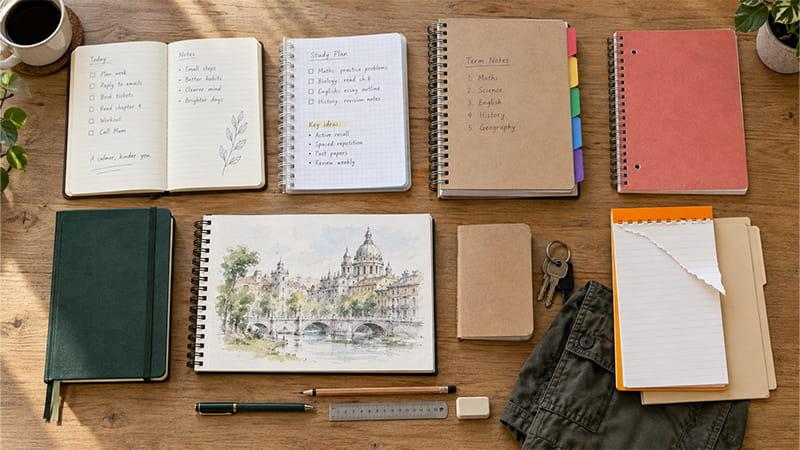
Best Notebooks by Use Case
Best for Everyday Note-Taking: MD Notebook A5
The MD Notebook A5 offers blank, lined, grid, and dot-grid options in a 176-page, thread-stitched book. Lined pages suit mostly text; dot grid gives small diagrams and tables room without ruling the whole page.
It is a useful everyday choice when you want one portable book for different kinds of notes. Its paper cover is the trade-off: carry it in a protected bag pocket or consider a separate cover. If you regularly write on a crowded desk and need pages to fold behind the book, choose the Kokuyo Soft Ring instead.
Best for School: Five Star and Kokuyo
The Five Star five-subject notebook keeps several classes in one notebook. Its 200 college-ruled sheets and pocket dividers help separate notes and handouts. The cost is carrying a large book even when only one class meets that day.
Kokuyo’s Campus Soft Ring is the alternative when desk space and fold-back writing matter more. The soft ring is designed to reduce hard-coil contact while keeping the convenience of ring binding. Check the particular semi-B5 version before buying: page layout and sheet count vary across models.
Best Inexpensive Notebooks: A Mead Pack Comparison
For several subjects, Mead’s one-subject spiral six-pack is the budget pick among the two Mead formats compared here. Each book has 70 double-sided college-ruled sheets, with perforations for removing assignment pages.
The Mead Black Marble three-pack is a composition notebook alternative. Each book has 100 double-sided college-ruled sheets in a sewn binding. Its pages suit notes you want to keep in order, not assignments you routinely remove.
At the time of comparison, September 15, 2026, Mead listed the six spiral books and the three composition books at 7.99perpackonitsUSsite.Beforetaxandshipping,thatisabout∗∗7.99perpackonitsUSsite.Beforetaxandshipping,thatisabout∗∗1.33 per spiral book versus $2.66 per composition book**. Their page counts and sizes differ, so the lower per-book price does not make the spiral format right for every class. Recheck both listings before relying on this comparison.
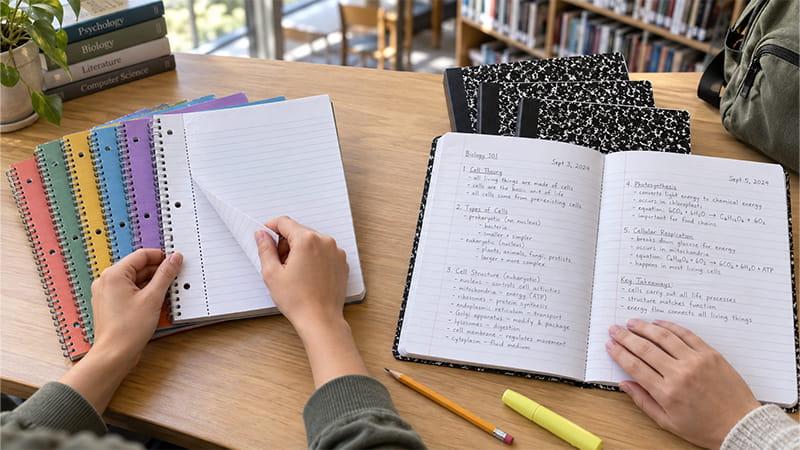
Best Hardcover Notebook for Organized Journaling: Leuchtturm1917 Medium Hardcover
Leuchtturm1917’s Medium hardcover offers 251 numbered pages, a table of contents, page markers, and a pocket. These features earn their place when you plan to revisit entries, track projects, or keep a journal for the longer term.
Its structured layout adds bulk. If you want a simpler journal without page numbers or an index, the MD Notebook may suit you better.
Best for Drawing: Stillman & Birn Alpha
The Stillman & Birn Alpha series uses 150 gsm, medium-grain paper specified for dry media, ink, and light washes. Choose a drawing-oriented book when sketches and visual work are the main purpose, rather than asking a ruled writing notebook to do both jobs.
A blank or dot-grid writing notebook may be enough for occasional pencil diagrams. Alpha’s textured drawing paper is unnecessary for text-only notes, and light-wash suitability is not a promise that every water-heavy technique will work equally well. Match the paper to the tools you actually use.
Best for Pocket Notes: Field Notes Original Kraft
Each Field Notes Original Kraft memo book has 48 pages in a 3.5 x 5.5-inch pocket format, with ruled, graph, or plain options. It suits brief observations, lists, and ideas recorded while moving.
Its value is availability, not capacity. It will not replace a school notebook or a long meeting record. Use it to capture a thought quickly, then transfer anything important into a larger notebook or filing system.
Best for Notes You Remove: Rhodia No. 16
Rhodia’s No. 16 is an A5 top-bound pad with 80 micro-perforated sheets and a cardboard back. Choose it for meeting action points, calculations, or pages that must go to someone else.
A pad is convenient while writing; a bound notebook is better for maintaining a continuous record. If detached pages become important, give them a folder or another system rather than letting the pad’s convenience become a filing problem.
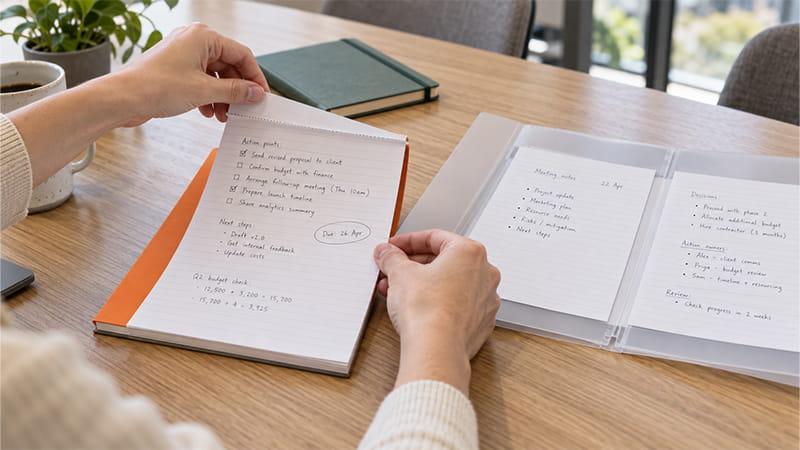
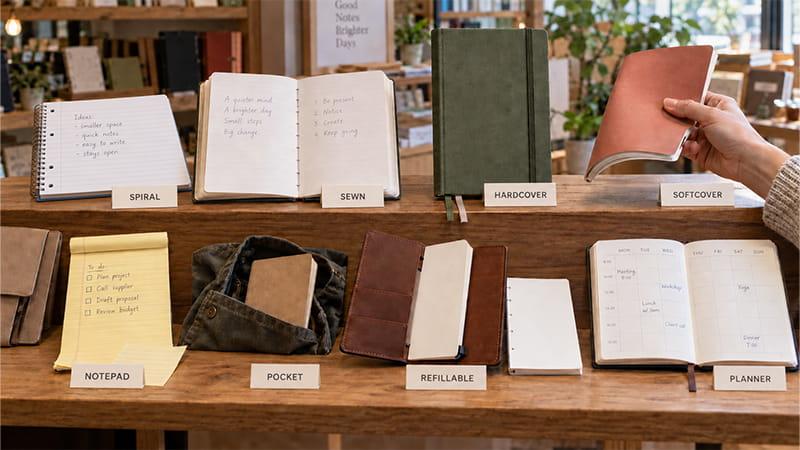
Common Notebook Styles: Which Format Fits Your Use?
These are common formats, not a sales ranking.
| Style | Most useful when | Main limitation |
|---|---|---|
| Spiral notebooks or wire-bound books | Writing on small desks; removing pages | Rings can add bulk |
| Sewn or composition | Keeping notes in sequence | Pages are less convenient to remove |
| Hardcover | Protecting a journal; presenting a gift | Additional weight and cover cost |
| Softcover | Carrying a full notebook frequently | Less protection in a crowded bag |
| Notepad or legal pad | Temporary notes and handouts | Detached pages need organizing |
| Pocket notebook | Capturing short notes while moving | Small writing area |
| Refillable notebook | Reusing the cover with new pages | Refills must remain available |
| Planner | Following a schedule | The wrong layout may go unused |
The practical distinction is simple: choose a notebook for an ongoing record and a notepad for removable notes. For more binding and custom-order options, see TOMAS’s guide to notebook types.
Notebook Sizes: A5, B5, A4, and Pocket Formats
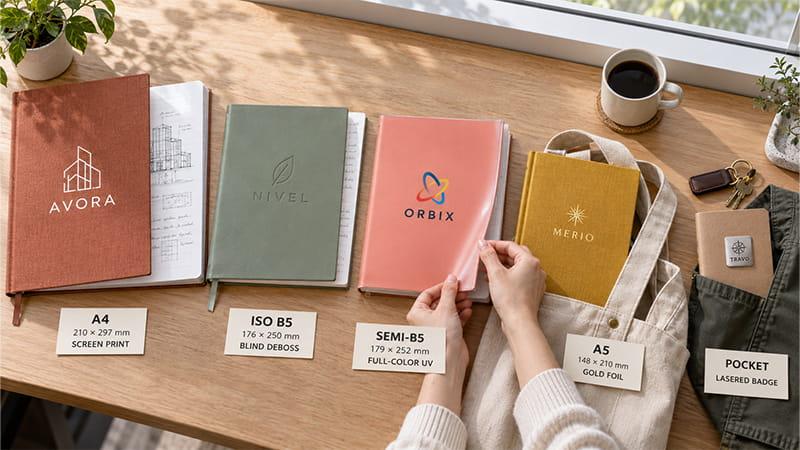
The ISO 216 standard covers trimmed writing-paper sizes in the A and B series. TOMAS’s A5 notebook guide compares how those sizes work in notebooks, including carrying and packaging trade-offs.
| Size | Common use | Main trade-off |
|---|---|---|
| A5, 148 x 210 mm | Daily notes, meetings, journals | Less room for wide diagrams |
| ISO B5, 176 x 250 mm | Study and longer desk writing | Larger to carry than A5 |
| Japanese semi-B5 | School notebooks | Confirm the maker’s exact dimensions |
| A4, 210 x 297 mm | Worksheets and large diagrams | Less portable |
| Pocket formats | Brief notes on the move | Limited writing space |
A5 or B5 for School Notes?
A5 favors carrying; B5 favors writing space. Short summaries and ordinary daily notes may fit A5. Equations, diagrams, and wide tables can justify B5.
Do not assume every product labeled B5 has the same inner-page size. For example, one Kokuyo semi-B5 Soft Ring model specifies 179 x 252 mm inner sheets, while ISO B5 is 176 x 250 mm. That difference may be small for writing, but it matters when a custom cover, refill, or gift box must fit. Check finished cover dimensions separately from page dimensions.
When A4 or a Pocket Book Makes More Sense
A4 gives more room when worksheets, pasted documents, or large drawings are part of the work. A pocket book solves the opposite problem: you can carry it when a larger notebook might be left behind.
Sometimes a pocket book for capture plus A5 or B5 for longer notes works better than forcing every task into one format.
How to Choose Between the Picks
Match Paper to Your Writing Tools
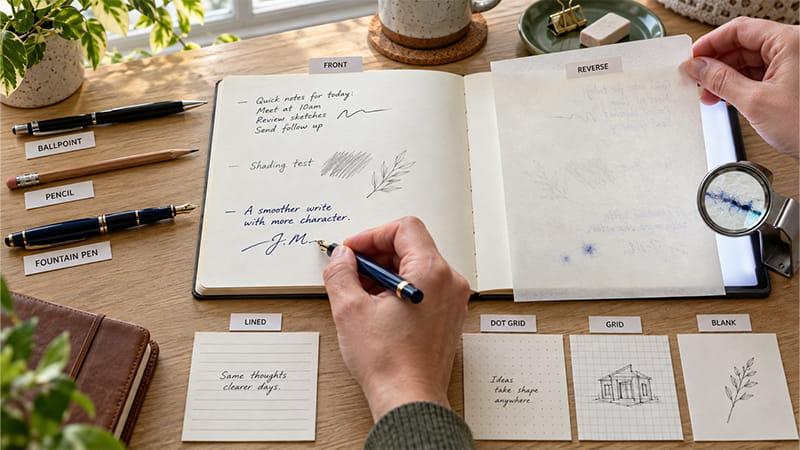
Paper quality is not one universal number. Look for bleed-through, show-through, and feathering: ink reaching the reverse side, writing visible through the page, and ink spreading along the fibers. Texture and drying time affect writing comfort too.
A ballpoint, pencil, and wet fountain pen may behave differently on the same sheet. GSM describes paper weight; it does not certify compatibility with fountain pen ink. If a particular pen matters to you, try that pen-and-paper combination before buying several books or approving a custom sample.
Choose a Page Layout and Binding
- Lined: text, class notes, and straightforward meetings.
- Dot grid: journaling, tables, and mixed notes.
- Grid: calculations and technical diagrams.
- Blank: drawing and free-form visual work.
Then check whether the book lies open, folds back, or has perforated pages. Numbered pages help you find earlier work; removable sheets help you hand work in. Pay for a feature because it solves your task, not because it fills a product specification list.
Compare Value Beyond Price
Check the usable sheets a listed price buys, whether both sides suit your pen, and whether the cover fits how you carry it.
For bulk buying, consider whether recipients need an ongoing record or temporary writing space. For gifts, a better cover adds value only if the pages will also be useful. Check tax and shipping in the current total before treating any listed price as a permanent buying rule.
Custom Notebooks for Schools, Teams, and Gifts
For a bulk project, recipient use should determine the notebook format before the logo. TOMAS can help buyers narrow the options and review relevant sample checks. Its custom office supplies range shows possible product directions.
How TOMAS Can Match Notebook Styles to Customer Projects
| Customer use | Notebook format to discuss | Logo direction | What to confirm on a sample |
|---|---|---|---|
| School or training program | Spiral or softcover notebook | Printed logo or full-cover artwork | Fold-back writing, cover stiffness, and clear space beside the coil |
| Meetings or short events | Notepad or lighter notebook | Simple, visible cover printing | Whether pages remove cleanly and the layout gives enough writing room |
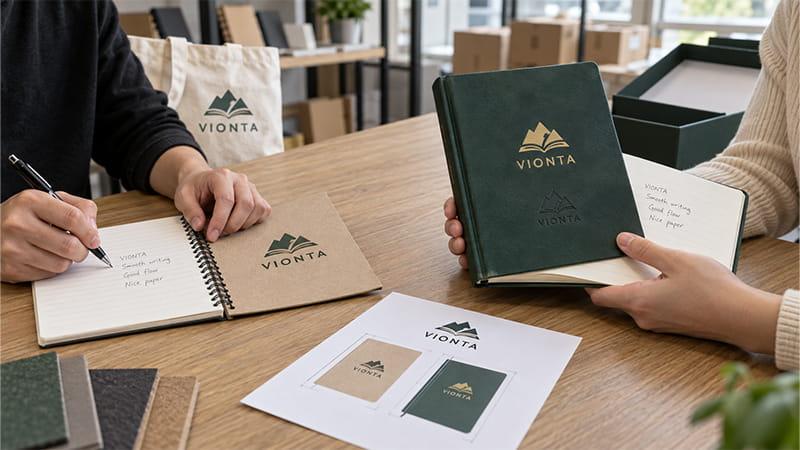
| Employee or client gift | Hardcover or PU-cover journal | Small debossed logo or foil stamping | Logo detail, cover texture, page feel, and finished size |
| Lifestyle or cultural gift | Kraft or fabric-cover notebook | One-color print, woven label, or patch as appropriate | Contrast, attachment, and whether material claims are documented |
The combinations above are selection examples, not documented TOMAS customer orders. A logo that fits an A5 cover may become crowded on a pocket notebook, so confirm artwork on the chosen size.
Compare a Coil-Bound Sample With a PU-Cover Sample
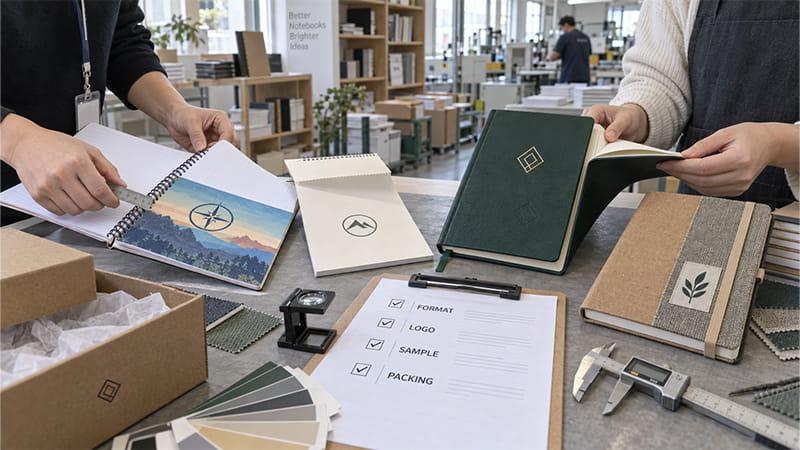
For a TOMAS custom order, put two candidate samples beside the same pen and artwork before choosing from catalog pictures. A spiral notebook and a PU-cover hardcover solve different problems. This is a buyer-facing sample checklist, not a hands-on test report.
| Physical comparison | Spiral or wire-bound notebook | PU-cover hardcover notebook |
|---|---|---|
| Open on a desk | Check whether it lies flat and folds back without the coil crowding your hand | Check how far it opens near the first and last pages |
| Hold and carry | Check coil projection, cover flex, and whether the finished size fits a bag | Check board stiffness, weight, and finished size with any elastic or pen loop |
| Compare the logo | Place printed artwork away from the binding edge; check readable size | Inspect the real debossed or foil mark for detail, depth, and contrast |
| Write on both sides | Use the intended ballpoint, gel pen, or fountain pen to check show-through and bleed | Repeat the same pen test; the cover does not establish paper performance |
| Pack for distribution | Check the quantity and fit in a school or event kit | Check gift-box fit, carton weight, and protection during delivery |
Photos can document the cover, binding, and logo placement. They cannot establish paper weight or ink performance. Keep the exact sample specification alongside front-cover, open-page, binding-edge, and logo close-up images.
Why the Logo Method Changes With the Cover
TOMAS’s A5 notebook guide explains how cover material affects logo methods. For kraft, check printing on the chosen stock and verify any recycled-material claim. Fabric may need a label or patch rather than the same artwork used on PU. TOMAS’s printing-method guide covers other decoration options.
What a Customer Should Approve Before Bulk Production
Before production, approve one complete sample specification: inner-page layout and count, finished dimensions, logo finish, and packaging. For a notebook-and-pen set, inspect both items together in the proposed box.
Conclusion
The best notebooks fit the work their pages need to hold. For school or training, check writing space, binding, and how easily you can carry the book. For journaling, choose a layout you will want to return to. For drawing, match the paper to your tools rather than relying on the cover or a “best” label.
Use the picks above to narrow your options, then check the actual notebook with your usual pen where paper performance matters.
Request a Custom Notebook Shortlist From TOMAS
Ordering notebooks for a school, team, event, or client gift? TOMAS can turn your project brief into a format and branding shortlist, then identify the sample checks relevant to your order.
To start, share just three details: who will use the notebooks and for what, approximate quantity, and required date. Budget, destination, and logo artwork can follow. TOMAS can use your brief to discuss suitable formats, branding options, sample checks, and a quote once the specification is clear.
Send Your Notebook Brief to TOMAS
FAQs
1. Should students use one notebook for several subjects or separate notebooks?
A five-subject notebook keeps class notes in one place and reduces the number of books to carry. Separate notebooks are easier to replace or archive one subject at a time. Choose based on how many classes you have and whether you need to carry every subject each day.
2. What should I check before buying an inexpensive notebook?
Compare the cost per notebook, not just the pack price. Check page count, binding strength, and whether the cover will hold up in a school bag. If you use gel or fountain pens, try your usual pen on the paper before buying in bulk.
3. Can a journaling notebook also handle drawing and fountain pen ink?
Blank or dot-grid pages can work for journaling, diagrams, and occasional pencil sketches. Fountain pen ink may feather or show through depending on the paper and ink, so test a page first. For watercolor or frequent marker work, choose paper made for those media rather than a standard writing notebook.
4. Can TOMAS customize the cover logo and inside pages for a bulk order?
TOMAS can discuss cover logo options and custom inner pages based on the notebook material and intended use. Before ordering, confirm the size, page layout, cover material, logo method, quantity, and delivery destination. Request an artwork proof or sample when available so the final specifications can be checked before production.