
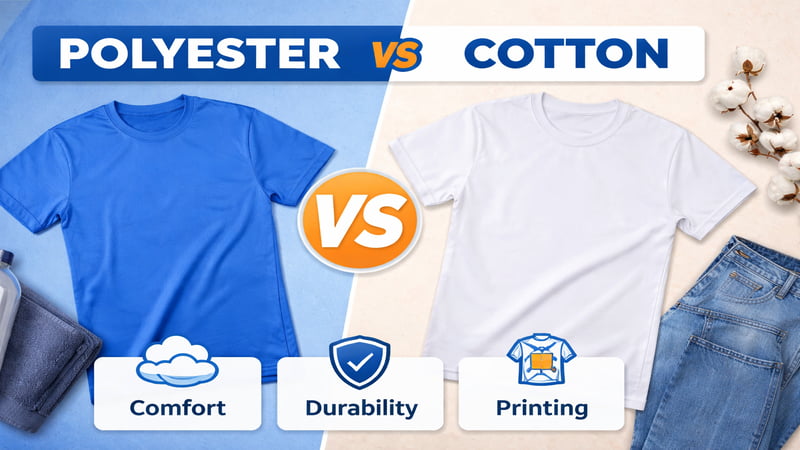
Stuck between cotton and polyester shirts? This classic debate still shapes choices in everyday wear, sports gear, and even promotional clothing. Both fabrics dominate the clothing market, but the right pick really depends on how you plan to use it.
In this article, we will discuss the distinctions between polyester fabric and cotton fabric shirts, weighing their pros and cons, exploring where each fabric excels and where it falls short. Read on to find out which option best suits your needs.
What Is Cotton fabric?
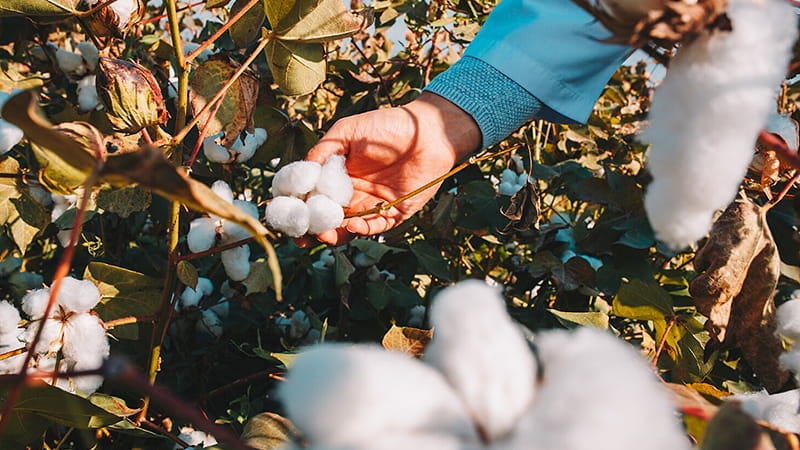
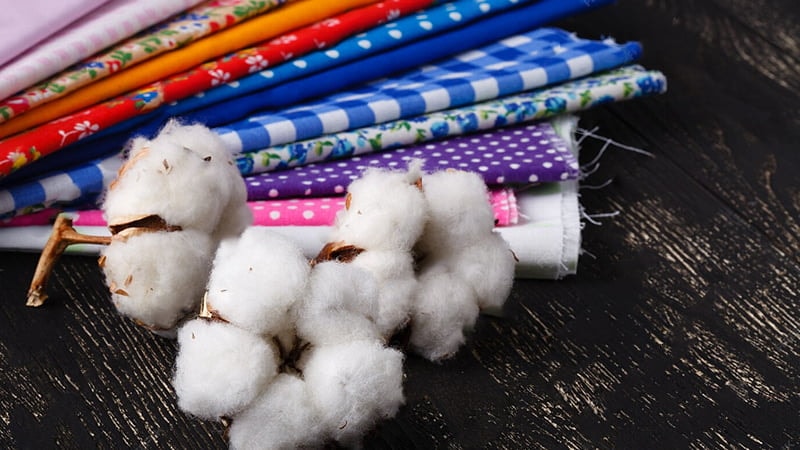
Cotton is a natural fiber produced in a fluffy ball of the cotton plant. It was used in textile manufacture thousands of years ago, and it is widely loved due to its softness, breathability, and versatility. According to the Textile Exchange, cotton makes up about 24% of global fiber production.
Since 2011, TOMAS has specialized in custom shirts and promotional apparel. Backed by years of experience, we’ve seen firsthand how the right fabric choice impacts comfort, durability, and brand image.
Source: freepik
The major features of Cotton Shirts:
- Plush and non-slippery on the skin.
- Very porous and water-absorbing.
- Nonsensitized (suits sensitive skin)
- Ironed easily without any wrinkles.
- Stenches when sprayed with hot water.
- Weaker when compared to synthetic fibers.
The shirts made of cotton are particularly popular in casual and summer wear, and when comfort is of the highest consideration.
What Is Polyester fabric?
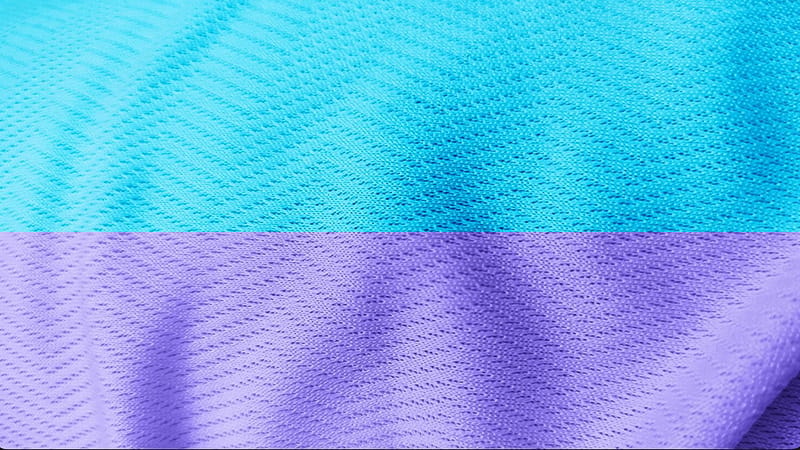
Polyester is an artificial fiber that is made using petroleum-based polymers. It was widely marketed in the mid-20th century and has since become a household mark of sportswear, uniforms, and advertising clothing with its moisture-wicking and durability.
The notable features of Polyester fabric :
Pros
- Powerful, tough, and do not stretch.
- Anti-wrinkle and has a good shape.
- Fast-drying and moisture-wicking.
Cons
- Breathability is not as good as cotton.
- It could be less soft, or it could be plastic, of low quality.
- Difficult to diminish and fade away.
Source: freepik
Polyester fabric shirts may be used in active life, sports uniforms, and mass-level promotion, in case the mass-garment must be durable and can be readily utilized.
Polyester Clothing vs. Cotton Clothing
| Feature | Cotton Shirts | Polyester Shirts |
| Comfort | Soft, breathable, skin-friendly | Smooth, lightweight, less breathable |
| Durability | Weaker, prone to shrinkage & wrinkles | Strong, shrink-resistant, wrinkle-free |
| Moisture | Absorbs sweat, dries slowly | Quick-drying, absorbs sweat efficiently |
| Skin Sensitivity | Hypoallergenic, gentle | Can irritate if low quality |
| Maintenance | Needs careful washing & ironing | Easy to wash, low-maintenance |
| Sustainability | Natural, renewable, biodegradable | Petroleum-based, non-biodegradable |
| Printing | Best for screen printing | Best for sublimation printing |
| Cost | Higher priced | Cheaper, bulk-friendly |

Source: freepik
On the comfort aspect, cotton fibers are soft and breathable and fall softly on the skin. This is why the garment has been a favorite for daily use. Polyester fabric shirts, on the other hand, are smooth and lightweight but not breathable in most cases.
Cotton is unstable to wear, tear, and shrinkage compared to polyester, which is very strong and does not shrink or expand. Cotton is a product that absorb moisture and evaporates it to keep the product dry; however, it is slow to dry. Polyester, however, evaporates very fast. Hence, it dries very fast and can quickly absorb sweat.
Cotton wrinkles easily and will need ironing regularly, compared to polyester fibers, which are wrinkle-resistant and maintain their shape, enhancing durability. Cotton has a soft feel and is an allergy-free and hypoallergenic material that can help avoid skin irritations.
However, polyester fabric has been identified to irritate the skin when of low quality. Polyester fabric is easy to clean and maintain in a machine, unlike cotton, which needs more attention during washing and ironing.
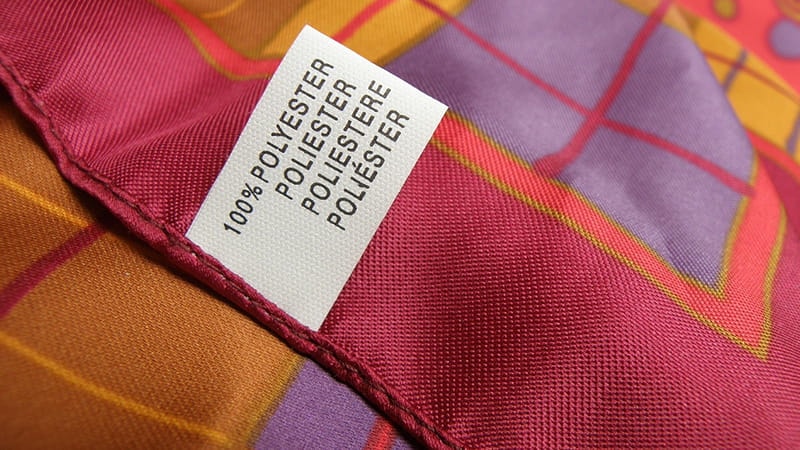
Cotton is a natural and renewable resource; polyester is non-biodegradable and petroleum-based. Fabric made from cotton fibers can be used successfully in screen printing to give good quality printing and bright colors.
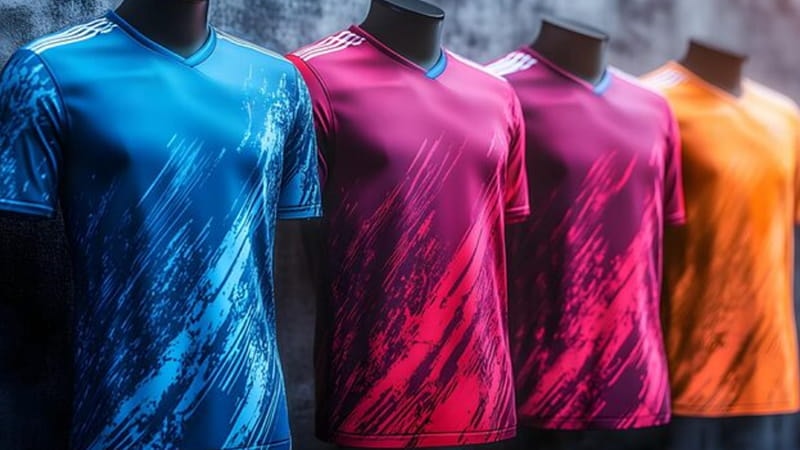
In contrast, polyester is best used with sublimation printing, where designs are permanently attached to the fibers. Finally, cotton is generally higher priced based on quality, whereas polyester fabric is cheaper, particularly in big promotional orders.
Pros and Cons of Cotton Clothes
Source: freepik
Pros
- Natural, eco-friendly fibers
- Light, soft feel, and can be worn in all weather.
- The most suitable case is sensitive skin and everyday use.
- Cotton of high quality lasts longer.
Cons
- Easy wrinkler, needs additional attention.
- Wades in the absence of pre-shrinking.
- Less durable than polyester
- Sweats and the garment are harder to wash.
Pros and Cons of Polyester Clothes
Source: freepik
Pros
- Very tough and shows wrinkle-resistance.
- Fast drying and moisture drying (good in sports).
- Stays in shape and color even after numerous washes.
- Economical when it comes to high-volume promotional orders.
Cons
- Breathing lower than natural fibers.
- It may be hard (less soft than cotton).
- Non-biodegradable (based on petroleum).
- It can leave trap odors with time unless washed.
Blended Fabrics

Source: freepik
In the fashion industry, many contemporary T-shirts and polo shirts are produced from cotton-polyester mixes (usually 50/50 or 65/35). They are a mix of cotton and polyester, with softness and durability.
Benefits of Blended Shirts
- Comfort and durability in a balance.
- Less wrinkles than pure cotton.
- Shorter drying period as compared to 100% cotton.
- Economical and multifunctional.
- Fabricated excellently on screen printing and sublimation.
Blends will be a frequent favorite among corporate uniforms, sports teams, and T-shirts to promote, since they are comfortable, yet practical and durable.
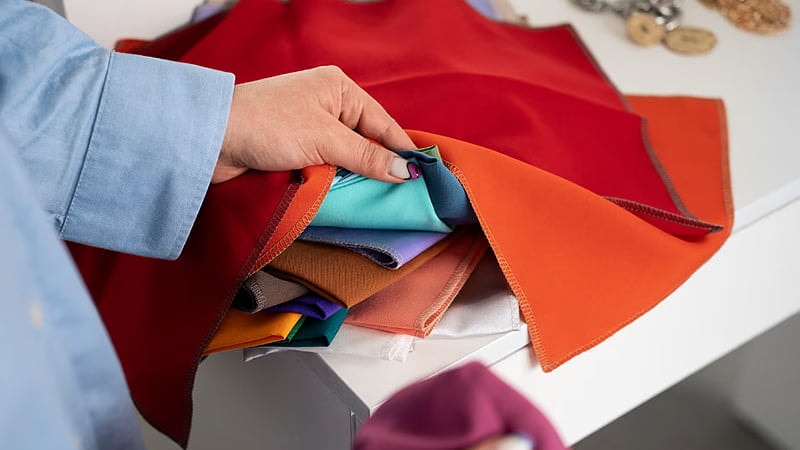
Which of the two materials is more suited to you?
Source: freepik
That depends on your use case. Let’s break it down:
Best Fabric For Everyday Casual Wear
Winner: Cotton fabric
The comfort and breathability may be put on the first line, and cotton shirts cannot be defeated. Perfect on a summer day, when relaxing or having a light trip.
Best Fabric For Sports & Activewear
Winner: Polyester clothing
Dry, lightweight, and sturdy- polyester has been developed to deal with sweat and motion.
Best Fabric For Promotional Shirts & Events
Winner: Blended Fabrics (Cotton- Polyester).
Blends provide the best balance of affordability, comfort, and durability when one needs to order in large quantities of items to be given during events, giveaways, or corporate uniforms.
Best Fabric For Printing & Branding
Screen Printing: Cotton offers more vivid prints, which are sharper.
Sublimation Printing: This is the most desirable since the polyester will be used, as the dye fixes on the fibers, making patterns durable.
Sustainability: Polyester vs. Cotton

Source: freepik
As the focus on environmentally conscious options has become the center of most business ventures in the textile industry, sustainability must be addressed.
Cotton: Cotton fabric is environmentally friendly, biodegradable, and renewable, provided they are grown organically. However, conventional cotton clothing production entails huge consumption of water and pesticides.
Polyester: This is not biodegradable but consists of petroleum and is relatively stable and tough. Hence, it does not need as many replenishments. One material that can be transformed into rPET is polyester.
Note: According to Textile Exchange, recycled polyester (rPET) uses 59% less energy compared to virgin polyester.
Eco-friendly and sustainable promotional gifts are another service we offer at TOMAS, such as apparel choices made of organic cotton or recycled polyester, and we assist brands in achieving CSR and ESG objectives.
Practical Buying Tips
Source: freepik
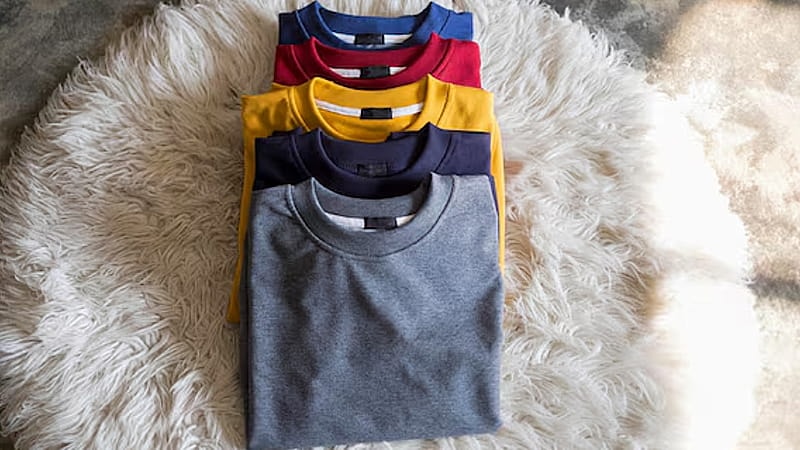
Suppose you are planning a bulk order of shirts, as staff uniforms, for a trade show, or trying to market your new product introduction. You need to make choices that are comfortable, affordable, and branded. The following are some additional tips to follow:
Define Your Use Case Clearly
The usage of the shirts and the location where they will be used should be considered before making a decision on the fabric to be used. Consider your targeted audience also: will they appreciate such a tight level of comfort or a shirt that can be washed multiple times? Valuing fabric to the situation is a way of maximizing value.
Test the Fabric Weight
A thin cotton shirt is good in hot environments or a casual atmosphere, although it might not last long. Both features are more durable and comfortable, but heavier cotton or poly-cotton blends are more durable.
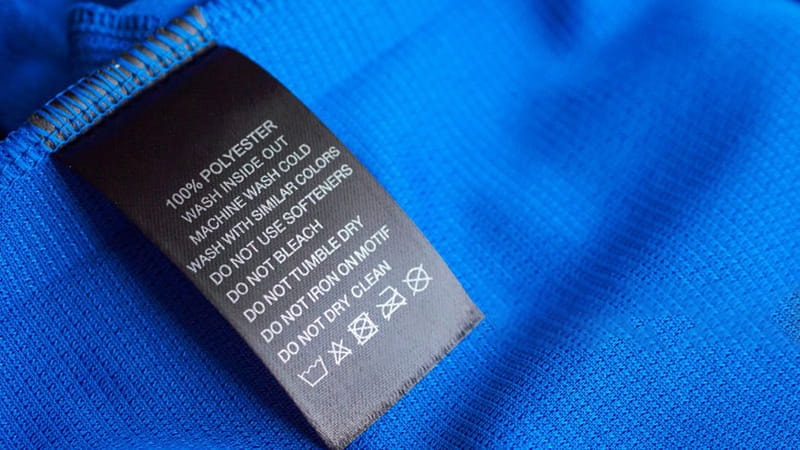
Polyester fabrics, in turn, are of varying grades that may resemble the softness of cotton and be tough simultaneously. Asking about different weights would be a good idea to make the right balance between comfort and durability.
Choose the Proper Process of printing
Source: freepik
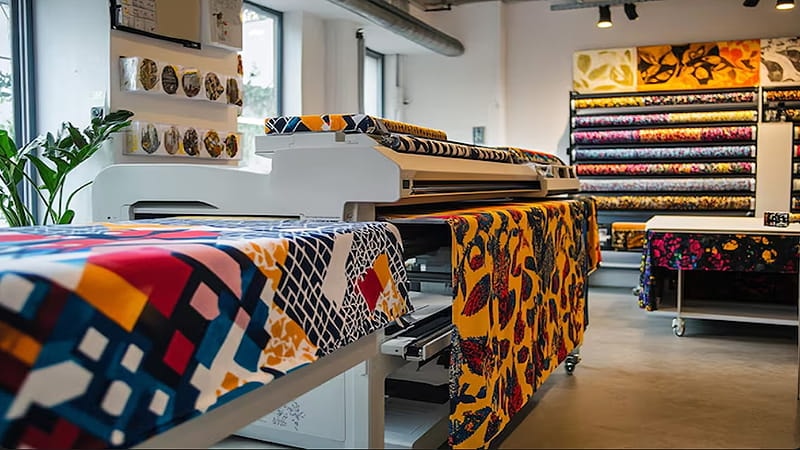
Fabric choice must be affected by your branding approach. Cotton is a screen printer that gives bold and vibrant, permanent designs. Conversely, polyester is used in sublimation printing where the patterns are impregnated in the cloth to provide a durable, long-lasting, and shineless finish.
Polyester can work better if you want to print elaborate graphics or bright, all-over designs. Cotton is a safe option when it comes to classic and simple logos.
Consider Long-Term Servicing
Though cotton shirts are easier to wear and softer, they are easy to wrinkle, can readily shrink in the washing machine, and must be ironed. ‘
On the other hand, polyester shirts do not wrinkle, dry quickly, and are not hard to wash; hence, they are convenient for large teams where convenience is an important consideration. Considering the expenses of laundry, maintenance, and replacement, it could save your company a lot of resources in the long run.
Request Samples First Before Ordering

Source: freepik
However good the shirt may seem in the pictures or the descriptions, the only test of this is how it feels. It is always advisable at TOMAS to seek a sample before making any bulk orders. This enables you to view the fabrics as opposed to one another, test the quality of the prints, and see how the shirts stand up to washing.
FAQS
1. Which is better to wear, cotton or polyester?
Polyester is not as shrink-resistant, stretchable, or wrinkly. It therefore has a high shelf life. Cotton is also easier to wear and feel; thus, it can be washed easily and often.
2. What should be the most suitable shirts on which to print logos?
Cotton: The fabric is ideal for screen printing and bright ink.
Polyester: Polyester is the best in sublimation printing, where the design is imprinted permanently on the clothes. In either of the approaches, it is possible to use blends, which are common in promotions.
3. Are polyester shirts comfortable during hot weather?
Polyester wicks dry fast, with a vaporating rate, making it suitable for active wear. But it is not as breathable as cotton, so it seems colder if it is too hot.
4. Is either of the fabrics more environmentally friendly?
Cotton is natural and can be biodegraded, and traditional farming consumes a small amount of water. Polyester is neither biodegradable nor made of synthetic materials; the other is recycled polyester (rPET), which is greener.
5. What kind of material should promotional shirts be made of?
The promotional campaigns for blended fabrics (cotton-polyester mixes) are the best. They are good to use, not costly, durable, and have good printing options.
Conclusion
There is no universal solution to the question of polyester and cotton shirts; it all depends on your requirement from the fabric and the use case. Choosing the right supplier to match your goals is important. At TOMAS, we provide fabric samples, customization, and eco-friendly options so you can confidently move forward with your next campaign. Ready to explore fabric options? Request a free consultation or catalog today!
Elevate Your Brand with TOMAS: Source Custom Shirts Now

Source: https://tomascrafts.com/
TOMAS is more than a vendor, we are your brand partner. As a one-stop solution, we handle everything from sourcing to customisation, offering fast quotations, flexible branding options, a wide product range, and eco-friendly fabric choices to suit every budget and campaign size.
Planning an event or bulk order? Explore our full capabilities on the official TOMAS website or submit your requirements through our online inquiry system to get started today.