
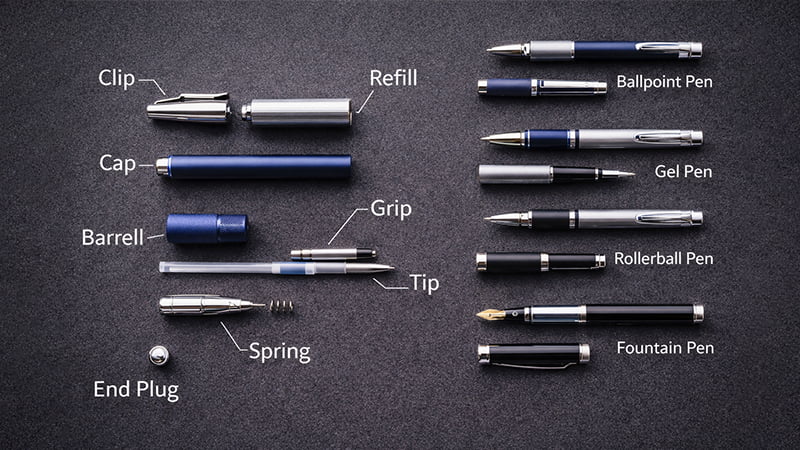
Understanding the parts of a pen helps you choose smoother writing and the right refill system. This guide breaks down the core components (tip/nib, refill or cartridge, barrel, grip, and clip), explains how mechanisms differ across common pen types, and includes quick tables for comparison and troubleshooting. Use it as a fast reference when sourcing, fixing, or customizing pens.
Labeled Parts of a Pen
When you look at basic parts of a pen, most modern designs share the same structure. The shape may change, but the core pen anatomy stays familiar. You usually get a pen barrel, a grip, a clip, a front tip, an internal ink reservoir, and a back-end closure or mechanism.
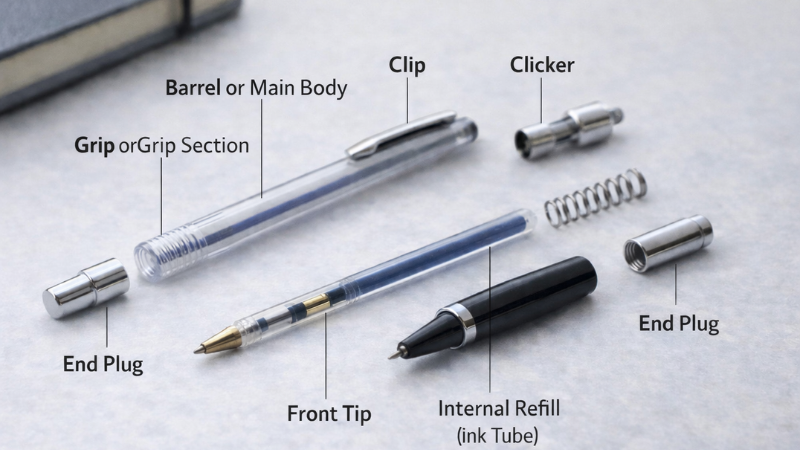
Common parts of a pen every pen shares:
- Barrel or main body
- Grip or grip section
- Clip
- Cap on capped models
- Clicker on a click pen or click action pen
- Front tip or point
- Internal refill, cartridge, or reservoir
- End cap or end plug
Quick Glossary of Parts of a Pen
Common parts of a pen name and synonyms:
- Tip/point/nose cone
- Refill/ink tube/ink cartridge
- Grip/section
- End cap/end plug/finial
- Pen body/body / main body
Table: Labeled Parts of a Pen
| Part Name | Where | Function | Material | Notes |
| Barrel | Main body | Holds parts of a pen | Plastic, metal, wood | Body |
| Grip / Grip Section | Finger area | Improves comfort and control | Rubber, textured plastic, metal | Section |
| Clip | Cap or barrel side | Attaches pen to pocket or notebook | Steel, plastic, metal | Pocket clip |
| Cap | Front cover | Protects tip | Plastic, metal | Lid |
| Clicker / Button | Top | Extends or retracts the point | Plastic, metal | Plunger |
| Tip / Point | Front end | Directs ink to paper | Plastic or metal | Nose cone |
| Refill / Ink Tube | Inside barrel | Stores ink | Plastic or metal tube | Refill |
| Cartridge | Inside a fountain pen | Holds ink | Plastic | Different from refill |
| Spring | Inside retractable pen | Supports click action | Steel | Retractable only |
| End Plug / End Cap | Back end | Seals barrel | Plastic, metal | Finial |
These parts of a pen matter because they shape comfort, durability, refill compatibility, and the final impression your brand makes with custom pens.
Tip of a Pen: Parts of a Pen, Tip Vs Point Vs Nib
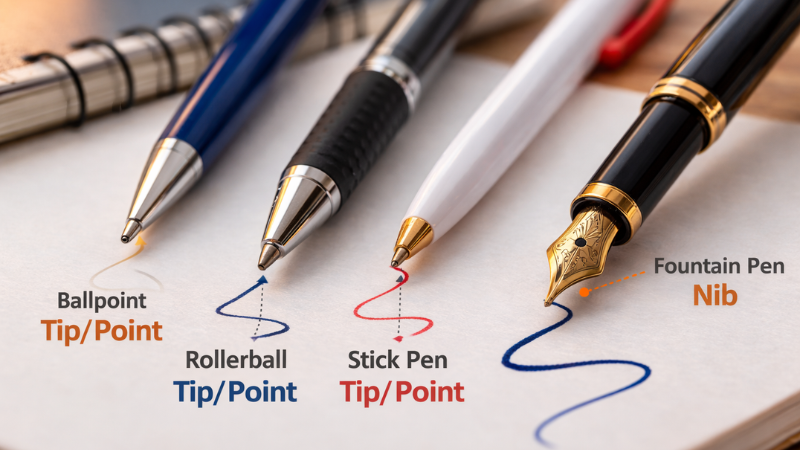
Each type of pen has a different front writing tip of a pen. Know the difference between a tip, a point, and a nib to better understand different parts of a pen. People also compare these writing parts with a mechanical pencil, but that uses graphite lead instead of ink.
Tip/Point for Ballpoint, Stick, and Rollerball Pens
The front writing end of a ballpoint, stick pen, or rollerball is typically referred to as the tip or point. This section is located in the front metal tip or nose cone. It houses the writing point and guides ink onto the page.
Nib for Fountain Pens
In a fountain pen, there is a nib, rather than a rolling ball. The nib is the metal writing object that can be observed on the front of the pen. It tends to possess two tines, a midpoint cut, and a breather hole. Some fountain pen nibs also include tipping material at the writing end to improve smoothness and wear resistance.
Why the Tip Affects Writing Performance
The front pen part influences the feel of the pen on paper. These factors affect smoothness, line consistency, and ink flow. When the tip is loose or clogged, the writing may become uneven or rough.
Helpful Resource: The Best Luxury Corporate Gifts & High-End Promotional Items (2026 Buyer’s Guide)
Ballpoint Pen Anatomy
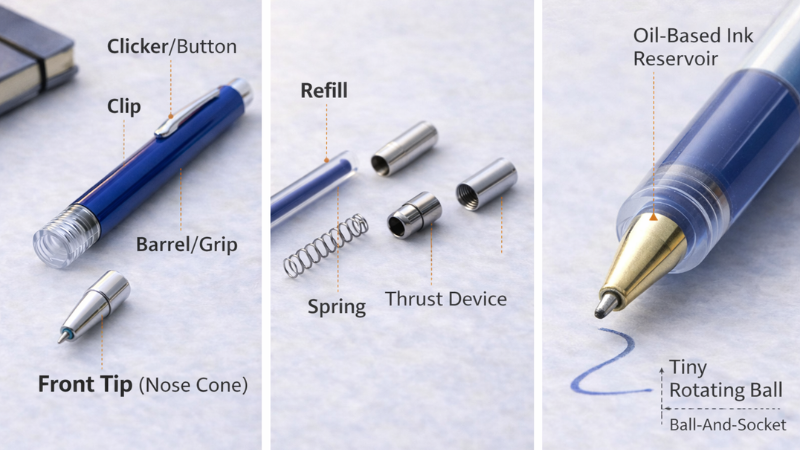
The ballpoint pen is the most popular writing pen, which is used every day. Its parts of a pen are straightforward, convenient, and simple to understand.
External Parts
The external parts of a pen usually include the barrel, grip, clip, and front tip or nose cone. Some models also have a cap, while a retractable version has a clicker or button. That is why a ballpoint pen can appear in both capped and click pen styles.
Internal Parts
The internal parts of a pen usually include the refill, spring, and end plug. In retractable models, a cam or thrust device moves the refill in and out. The parts of a ballpoint stay simple, which makes the design reliable and affordable.
Ballpoint Refill Basics
A ballpoint refill holds oil-based ink inside an ink reservoir. The ballpoint tip uses a rotating small ball in a ball-and-socket joint. This helps transfer ink onto the writing surface with better control.
Quick Click Mechanism
- You press the top button.
- The button pushes the refill downward.
- The spring compresses.
- The internal thrust device locks the refill in place.
- You press again, and the mechanism releases it.
That is why a good retractable pen should feel stable, not rattly.
Rollerball Pen Anatomy
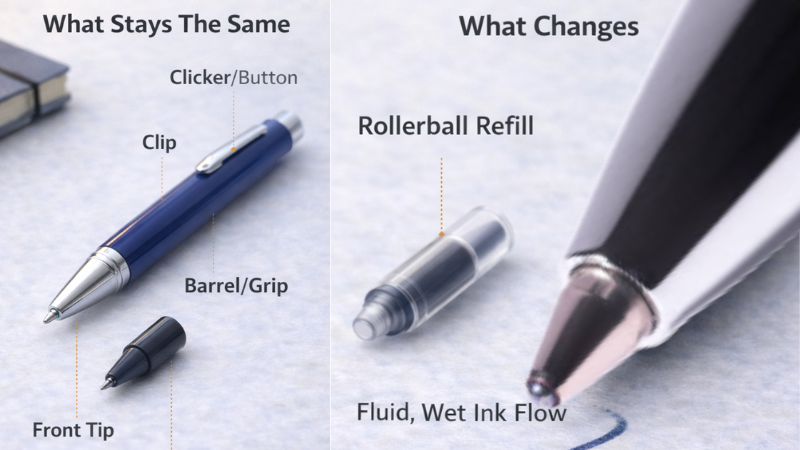
A rollerball shares many external parts of a pen with a ballpoint pen. However, the main difference appears in the refill and writing feel.
What Stays the Same
A rollerball still has common parts of a pen, like the barrel, grip, clip, and front tip. Some models use a cap, while others use a clicker or retractable format. So, the outer pen anatomy often looks very similar.
What Changes
What changes are the refill style and the feel on the paper? A rollerball often gives a smoother writing feel than a standard ballpoint pen. It also feels wetter because the ink flow is usually more fluid. Some rollerball models also have a larger ink capacity for longer use.
Stick Pen Anatomy
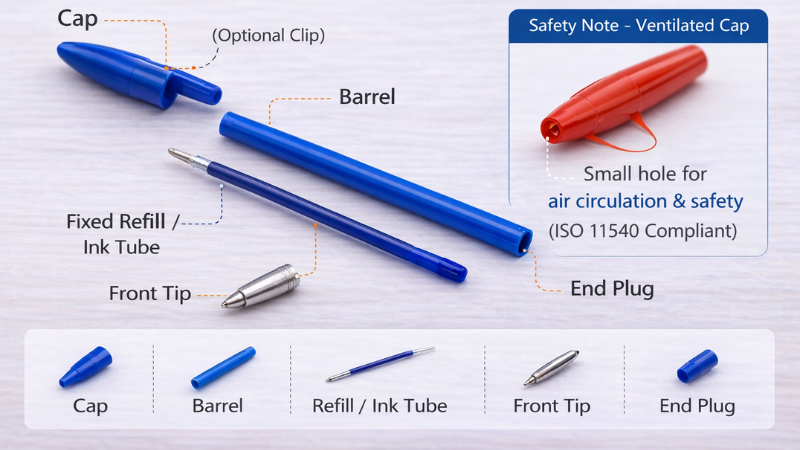
A stick pen is one of the simplest types of pens. It has fewer moving pen parts and a lighter pen body. It also uses a cap instead of a button, which makes it easy to produce for promotional pens and giveaways.
Typical Stick Parts of a Pen
Typical parts of a pen on a stick model include:
- Cap
- Barrel
- Fixed refill or ink tube
- Front tip
- End plug
- Optional clip
A stick pen works well when you need volume, speed, and price control. That is why many event teams choose this format for trade shows, schools, campaigns, and mass distribution.
Safety Note on Ventilated Caps
Many pen caps include a small hole. BIC explains that vented caps comply with ISO 11540 and help reduce risk in case of accidental inhalation. The vent can also allow more air circulation around the point when capped.
Fountain Pen Anatomy
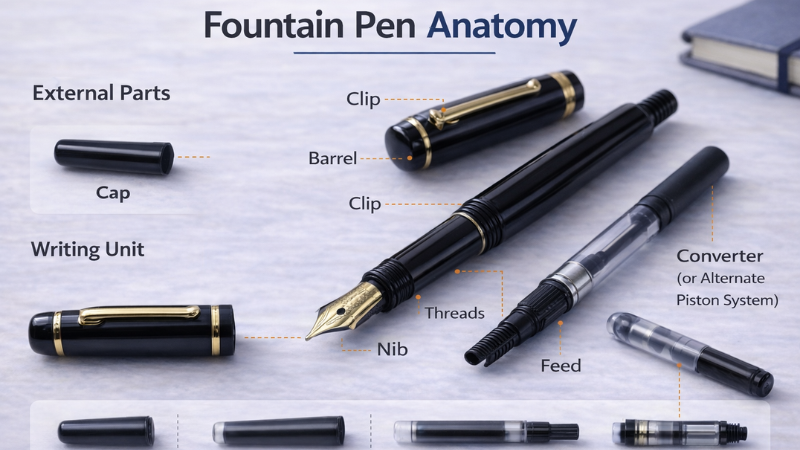
A fountain pen has more specialized parts of a pen than a standard ballpoint.
External Parts
Outside, you usually see a cap, clip, barrel, and grip section. You also see threads that join the section to the barrel. These parts of a pen support the structure and protect the writing end.
Writing Unit
The feed and the nib are parts of the writing unit. It typically has two tines on the nib, a center nib slit, and frequently a breather hole. The nib is attached to the feed, which is placed directly under the nib and is connected to the reservoir to regulate the flow of ink.
Filling Systems
The filling systems are different depending on the fountain pen design. In some models, the ink is contained in a cartridge, whereas in others, the ink is obtained by pulling it through a bottle with the help of a converter. Pens of higher quality can have a piston integrated into the body.
Pen Anatomy Comparison
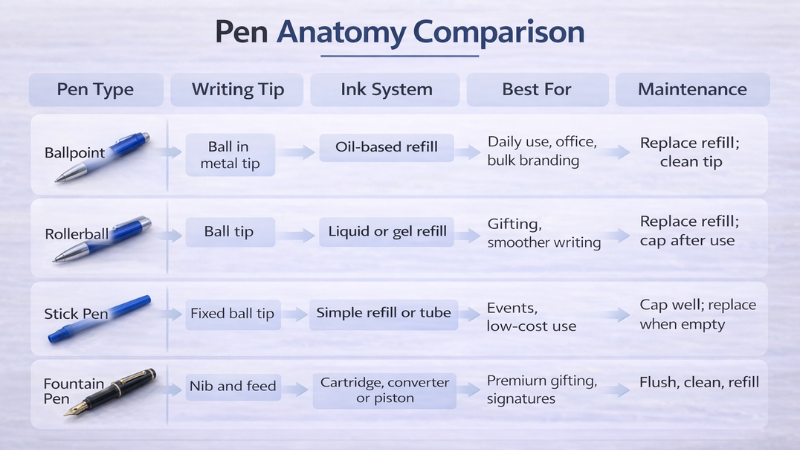
| Pen Type | Writing Tip | Ink System | Best For | Maintenance |
| Ballpoint | Ball in metal tip | Oil-based refill | Daily use, office, bulk branding | Replace refill; clean tip |
| Rollerball | Ball tip | Liquid or gel refill | Gifting, smoother writing | Replace refill; cap after use |
| Stick Pen | Fixed ball tip | Simple refill or tube | Events, low-cost use | Cap well; replace when empty |
| Fountain Pen | Nib and feed | Cartridge, converter, or piston | Premium gifting, signatures | Flush, clean, refill |
Most ballpoint pens and rollerball designs look similar from the outside. However, their parts of a pen perform differently because the refill and flow differ. A different model of fountain pen works by replacing the rolling tip with a nib-and-feed system.
How to Spot a Quality Pen
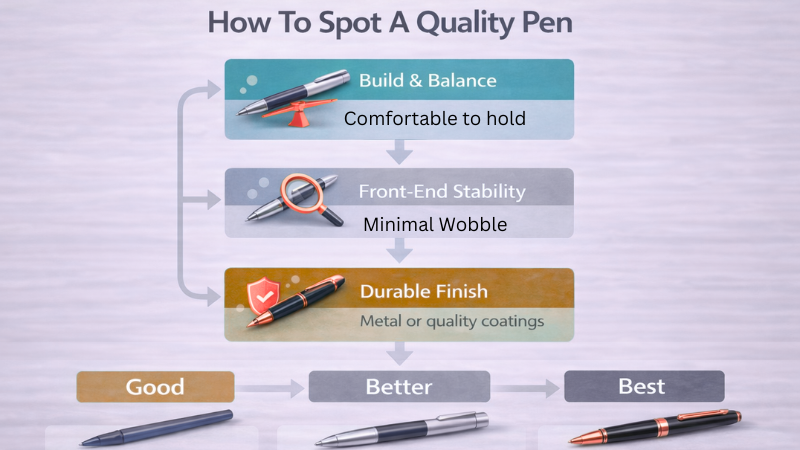
Start with build and balance. A good pen must be comfortable to hold in your hand, but must not be too heavy or too thin. An improvement in weight distribution is useful in the case of longer writing periods.
This matters because a pen-grip kinetics study showed that grip force and tip pressure can affect writing performance. So comfort and balance matter more than they seem.
Then, test front-end stability. Grasp the point towards the front and test wobble. Minimal movement tends to imply narrower tolerances and improved predictable operation.
Then check the finish. Painted surfaces may become discoloured much faster. Coated or anodized metal components tend to be more durable, particularly on branded products that are engraved or marked in any way. This is important in case your brand desires a cleaner, long-term appearance of custom pens.
Good, Better, Best
- Good: Basic pen/stick pen with a simple plastic barrel. Ideal when large-scale giveaways are required.
- Better: A retractable ballpoint having a stable ballpoint tip, a lighter clicking feel, and a better finish.
- Best: Stronger balance, better trim, and finer branding in a metal-body model to be used by the executive.
Helpful Resource: Eco Friendly Promotional Products for Sustainable Branding: 2026 Buyer’s Guide
Common Pen Problems and the Parts That Cause Them
| Problem | Likely Part | Fix |
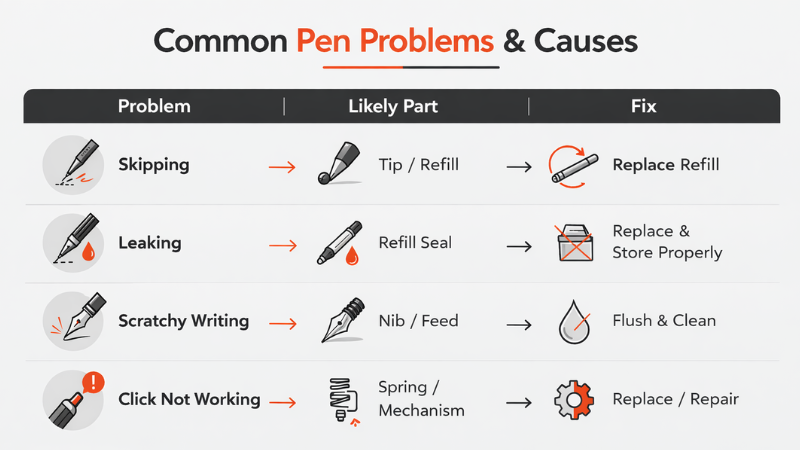
| Skipping | Tip, ball, refill | Scribble on paper; replace the refill |
| Leaking | Refill or cartridge seal | Replace refill; store properly |
| Scratchy Fountain Writing | Nib or feed | Flush and clean; service if needed |
| Click Not Working | Spring or thrust device | Replace the pen or the mechanism |
Quick tips:
- Cap pens after use.
- Keep retractable pens closed in bags.
- Store fountain pens carefully, especially when refillable.
- Do not leave any pen in extreme heat.
TL;DR
- Knowing parts of a pen will enable you to select better pens to use every day or a brand.
- The primary pen components are: barrel, grip, clip, tip, refill or ink cartridge, and cap or click mechanism.
- A ballpoint pen consists of a rolling ball and an oil-based refill that is used to write.
- A rollerball is smoother, whereas a stick pen maintains the simplicity and affordability of the design.
- A fountain pen has a nib, feed, as well as an ink converter, cartridge, or piston mechanism.
Conclusion
Once you know the labeled parts of a pen, it becomes easier to choose the right pen. You can also replace the right refill and fix common issues faster. All pens share core pen parts, but the writing mechanism changes by type, which affects smoothness, maintenance, cost, and user experience.
Some models also include a metal part of the pen that improves durability or adds value for decorative purposes. So, before you order pens for school, office, events, or gifting, look beyond color and style. Focus on the parts of a pen that actually shape performance.
FAQs
Q1: What Are the Main Parts of a Pen Called?
A majority of pens consist of simple components. They are typically the barrel, grip, clip, cap or clicker, tip, ink refill, or reservoir, and the end cap. In the case of a fountain pen, the major components are slightly varied. It has a nib, a feed, and a cartridge or converter.
Q2: What Is the Tip of a Pen Called?
In the case of rollerball, stick, and ballpoint pens, the writing end of the pen is called the tip or point of the pen. While in the case of fountain pens, that writing end is called the nib.
Q3: What’s the Difference Between a Ballpoint and a Rollerball Pen?
A ballpoint pen is oil-based, thicker, and more controlled. A rollerball uses thinner ink, so it feels smoother when writing, and the ink flows more easily.
Q4: What’s the Difference Between a Pen Refill and an Ink Cartridge?
The pen refill is the internal ink tube present in ballpoint, stick, and roller pens. You have to replace the whole refill once used completely. An ink cartridge is a small, removable ink container in a fountain pen. Once used, it is replaced with another cartridge or a converter.
Why Choose Tomas Crafts
TOMAS Crafts has been assisting global brands to source promotional products since 2011. TOMAS is a reputed producer and supplier of personalized promotional items. Tomas assists companies in ordering quality pens at competitive quotes and provides support.