Notebooks have not disappeared just because more work happens on screens. You still see them in meetings, training rooms, conferences, employee welcome packs, and on desks beside laptops.
They are easy to hand out and easy to use. No setup, no charging, and no learning curve. For a company, that also means your branding can stay in front of someone through ordinary work rather than only appearing during a campaign or event.
But notebooks that look similar in a catalog can feel very different once people start using them. That is where the type of notebook you choose begins to matter.
Main Types of Notebooks
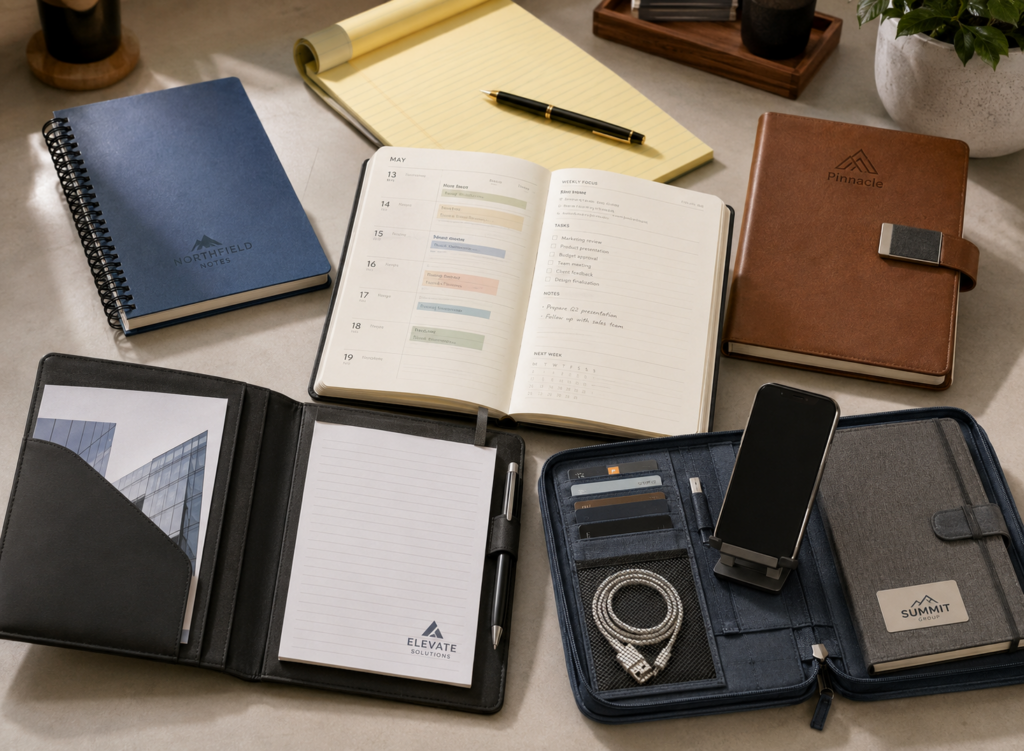
Spiral Notebook
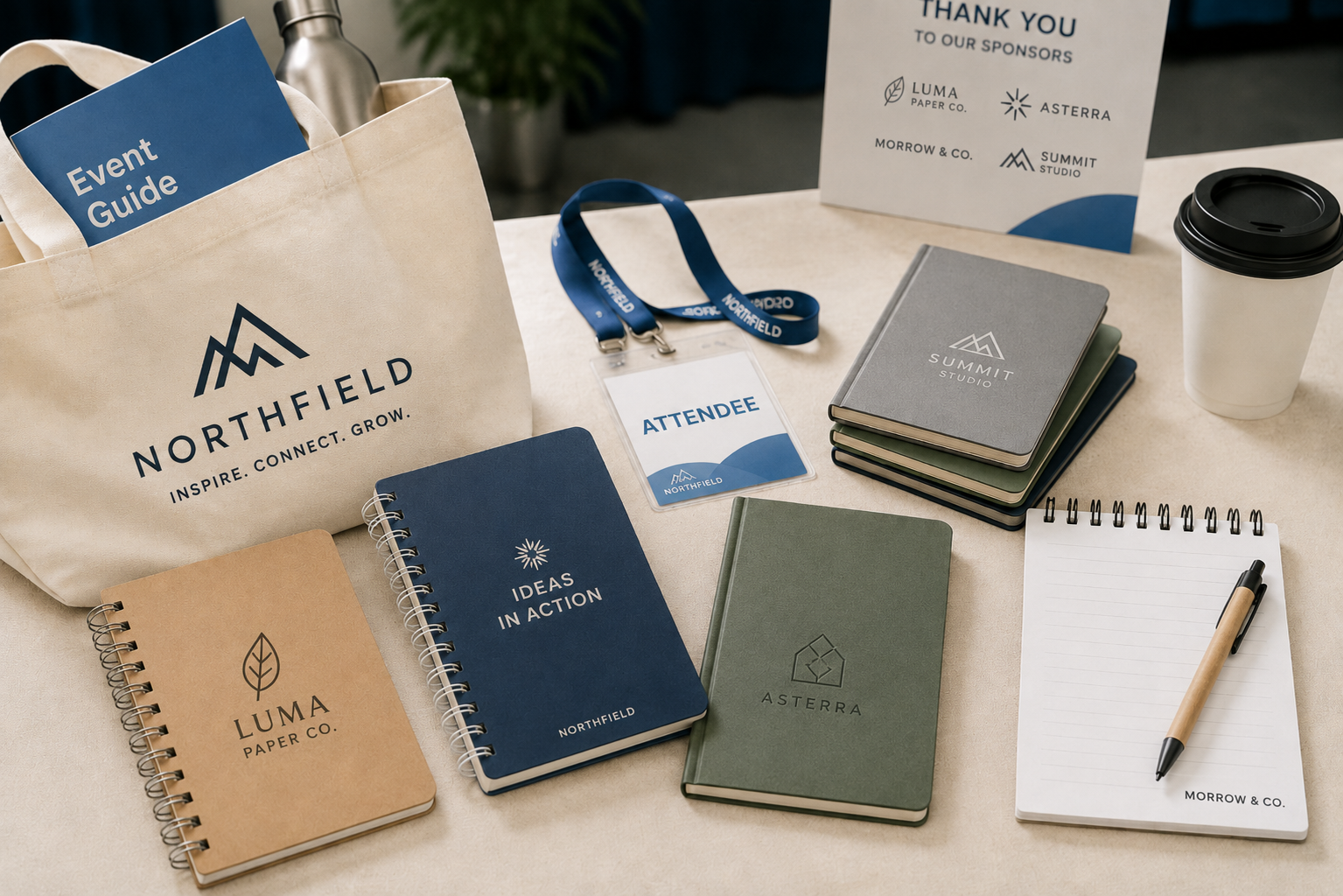
Spiral notebooks work particularly well when your recipients need to write quickly or do not always have much desk space.
The pages can fold completely behind the cover, so the notebook takes up less room during training sessions, workshops, conferences, classes, or meetings where people may be sharing a table.
Their relatively light construction also helps when you need to pack and distribute a larger quantity. The exposed coil does make the notebook feel more casual, so it usually suits training and event use better than a formal client gift.
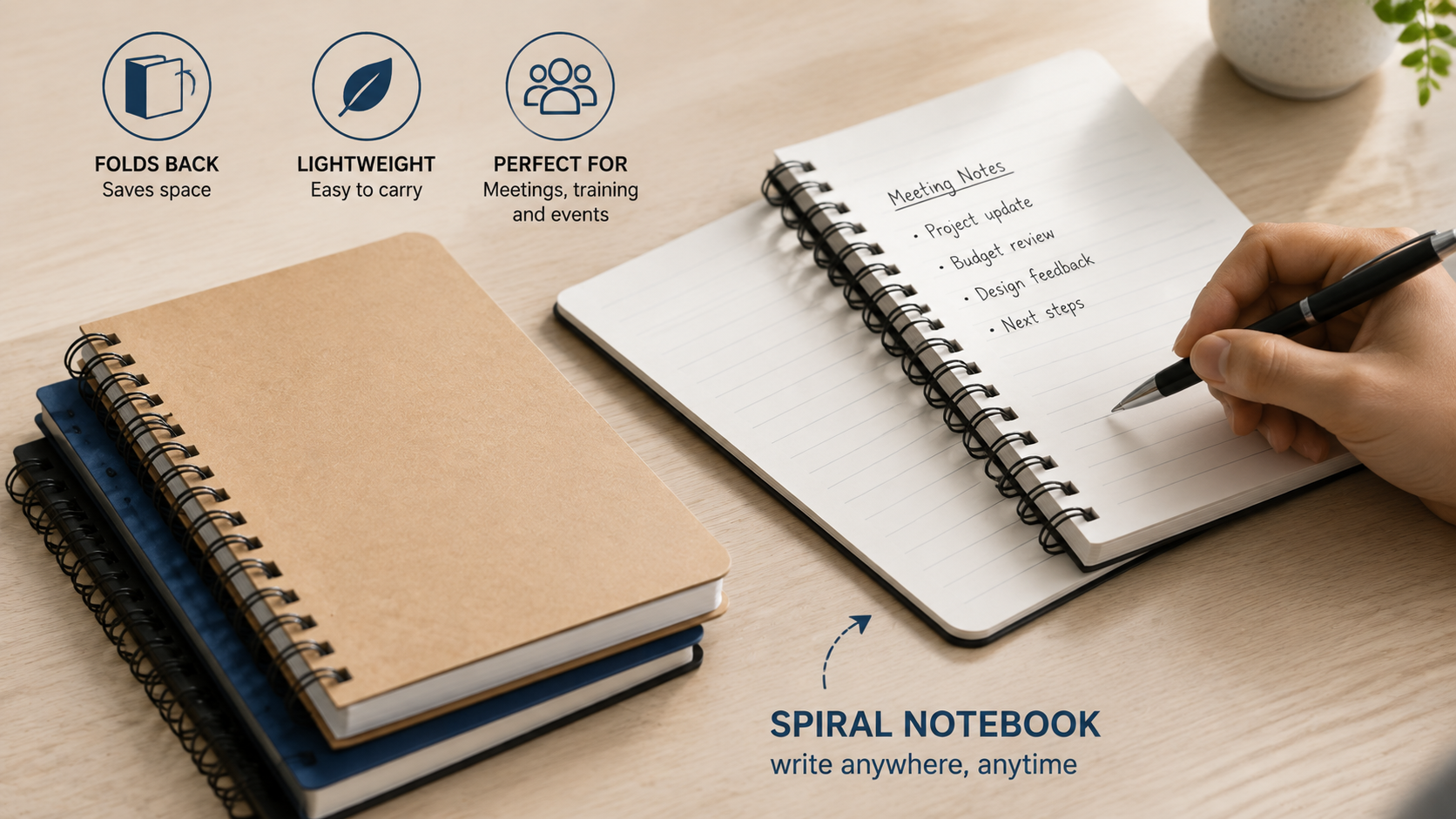
For custom orders, coil size and cover stiffness are worth checking. An oversized coil adds bulk in cartons, while a very light cover can bend more easily during transport.
Hardcover Notebook
Hardcover notebooks make more sense when presentation is part of the reason you are giving the notebook.
The rigid cover protects the pages and gives you a stronger surface for embossing, debossing, foil stamping, textured finishes, or restrained logo placement. That works naturally for client gifts, employee welcome kits, executive stationery, and other projects where the notebook should feel more substantial.
The extra structure also adds weight and carton volume. For a small group of clients, that may be easy to absorb. When you move into several hundred pieces, the difference starts showing up in packing and freight as well as the product cost.
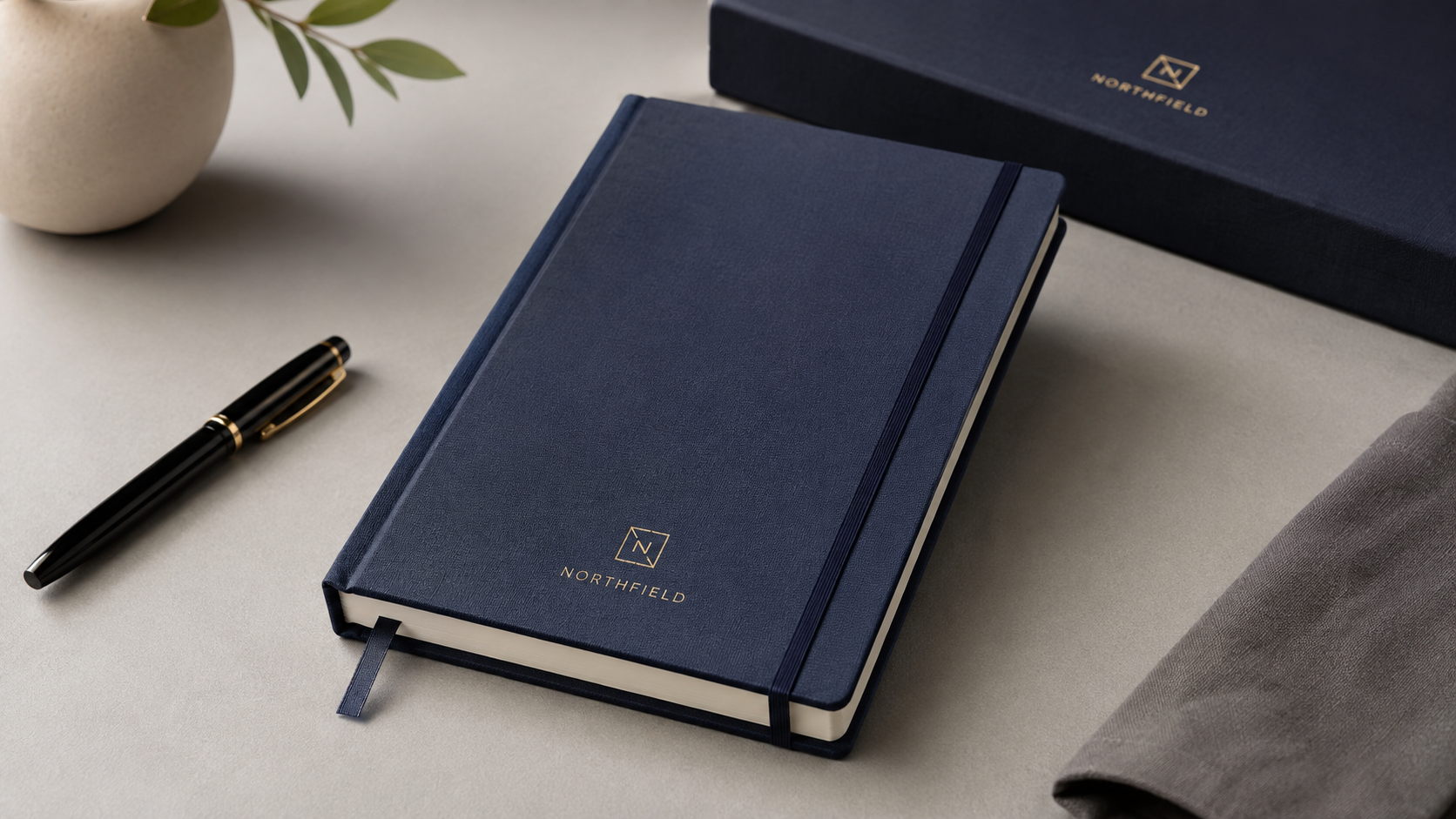
A premium cover adds value when the presentation matters; it adds unnecessary weight when it does not.
Softcover Notebook
Softcover notebooks are a useful middle ground when you want something more complete than a notepad without the weight of a rigid hardcover.
They slip easily into work bags and are practical for conferences, internal training, office programs, and projects where recipients are expected to continue using the notebook afterward.
Softcover does not automatically mean cheap. A good cover stock, clean printing, solid binding, and better paper can still create a polished product.
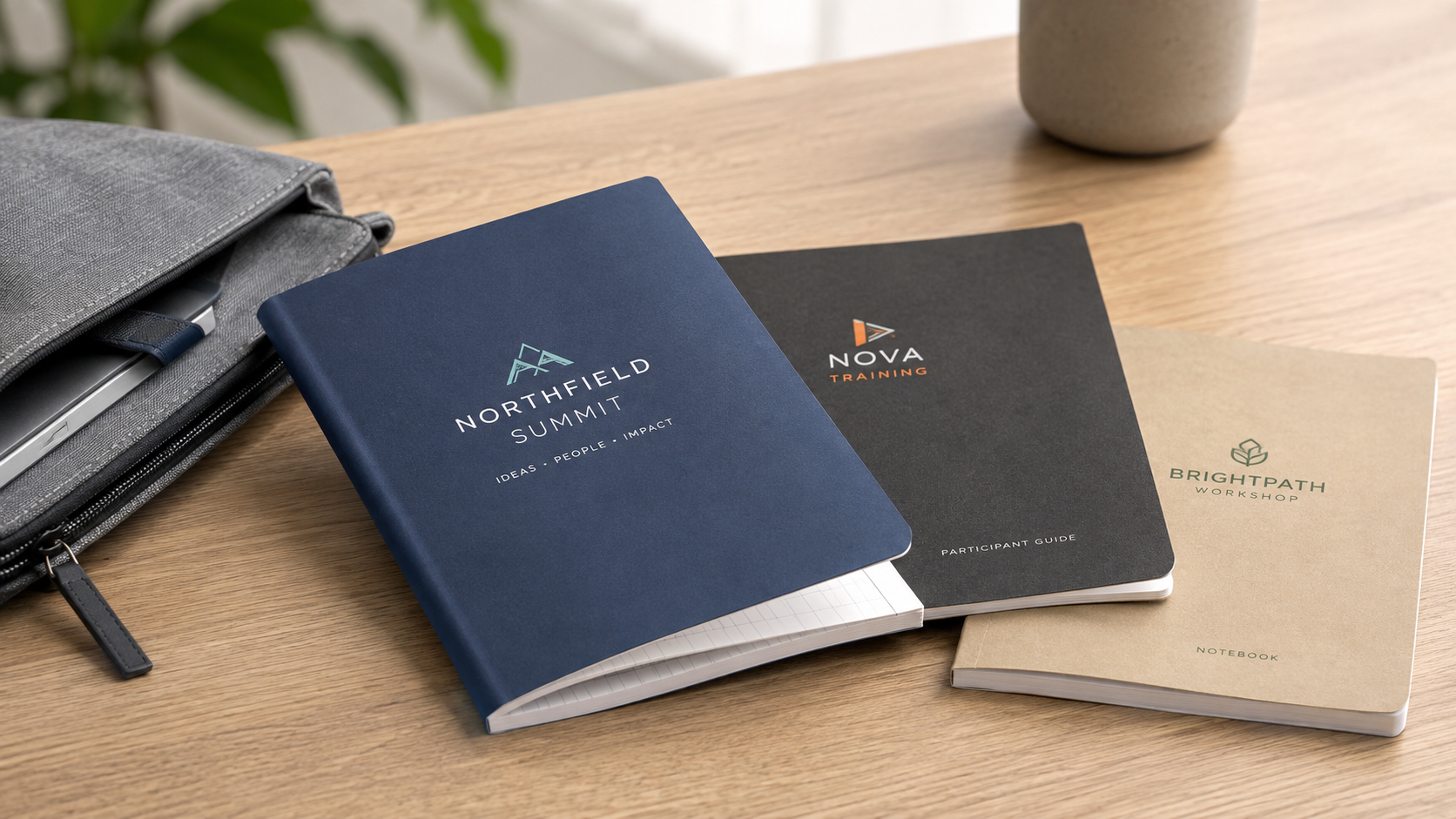
For larger quantities, the lighter construction can also leave more of your budget available for paper quality, printing, or useful supporting items rather than putting most of it into the cover.
Composition Notebook
Composition notebooks work well when the notes from one program need to stay together in a clear sequence.
That can be useful for education, onboarding, certification courses, employee training, or multi-session workshops where participants return to the same notebook over time.
For these projects, the inside pages can do more than provide writing space. You can include training schedules, reference pages, checklists, instructions, or program-specific content alongside the normal note pages.
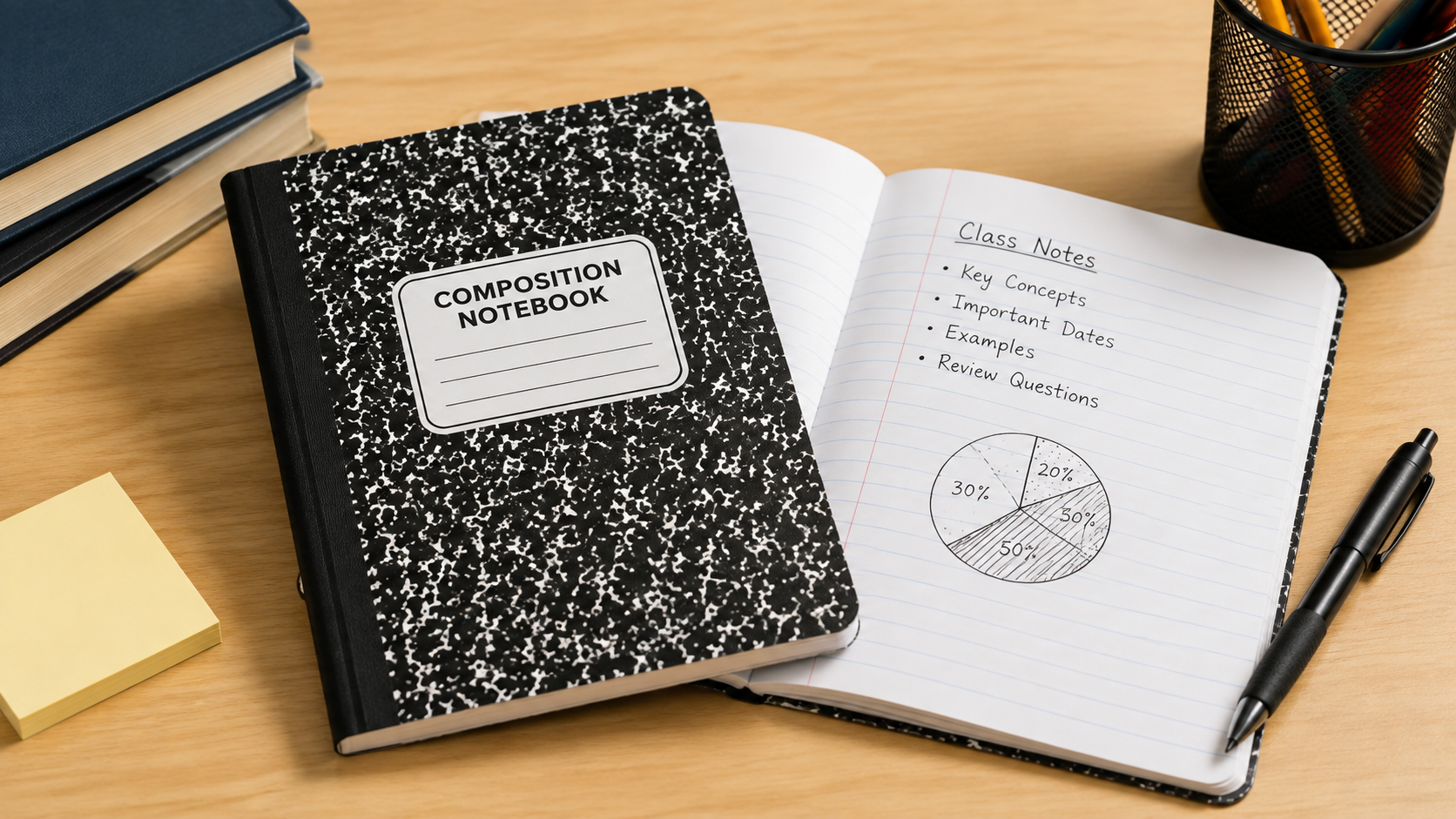
The fixed binding is less convenient when your recipients need the notebook to fold back or open completely flat. In that case, spiral or another lay-flat construction may be easier to work with.
Legal Pad or Notepad
You do not always need to give people a full notebook.
For a one-day workshop, sales meeting, registration desk, brainstorming session, or training exercise, a notepad may provide all the writing space the project needs.
Pages can be removed for action points, calculations, forms, or temporary notes that will later be transferred elsewhere.
Choose a notebook when you want people to keep a record. Choose a notepad when the writing is mainly temporary.
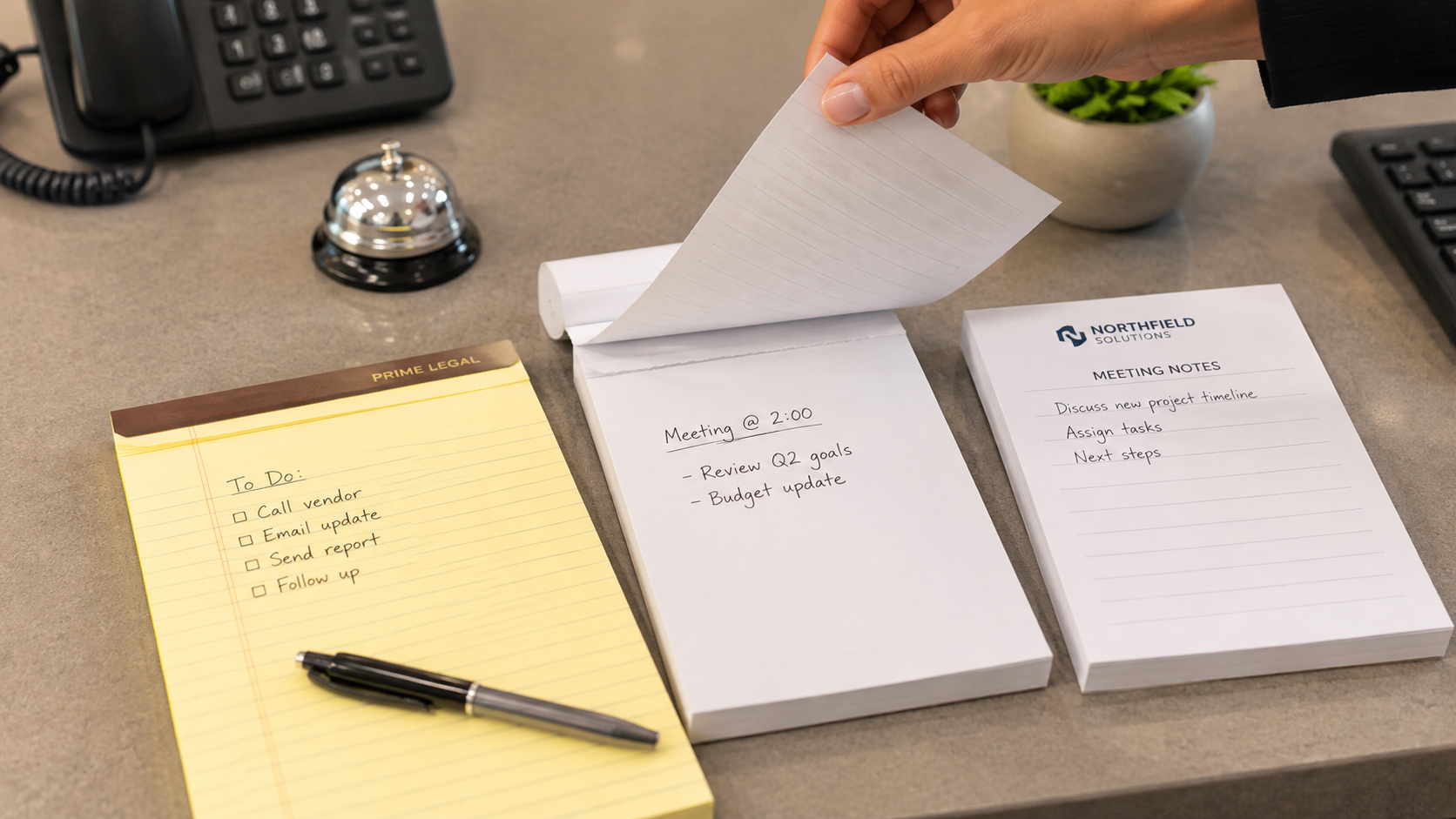
That distinction can keep you from paying for a more substantial product that the project does not really require.
Pocket Notebook
Pocket notebooks are useful when your recipients are more likely to take notes while moving than while sitting behind a desk.
Sales teams, technicians, field staff, event crews, site visitors, and travel groups can carry one without adding the bulk of a full-size notebook.
The smaller format comes with an obvious compromise: less room for long notes and less cover space for artwork.
If your project involves detailed meeting notes, A5 will usually be easier to write in. When quick access and portability matter more, the smaller format becomes much more practical.
Branding also needs more discipline. Artwork that looks balanced on an A5 cover can quickly feel crowded when it is simply scaled down to pocket size.
Common A-series paper dimensions such as A5 are standardized under ISO 216.
Planner Notebook
With planners, the most important decision is often hidden inside the cover. Daily or weekly pages, appointment times, task lists, goals, priorities, and notes sections determine how your recipients will use the product throughout the year.
If you are preparing planners for employees, sales teams, managers, or an annual company program, review the page layout before approving the cover artwork. Planner designed around the wrong routine is easy to abandon.
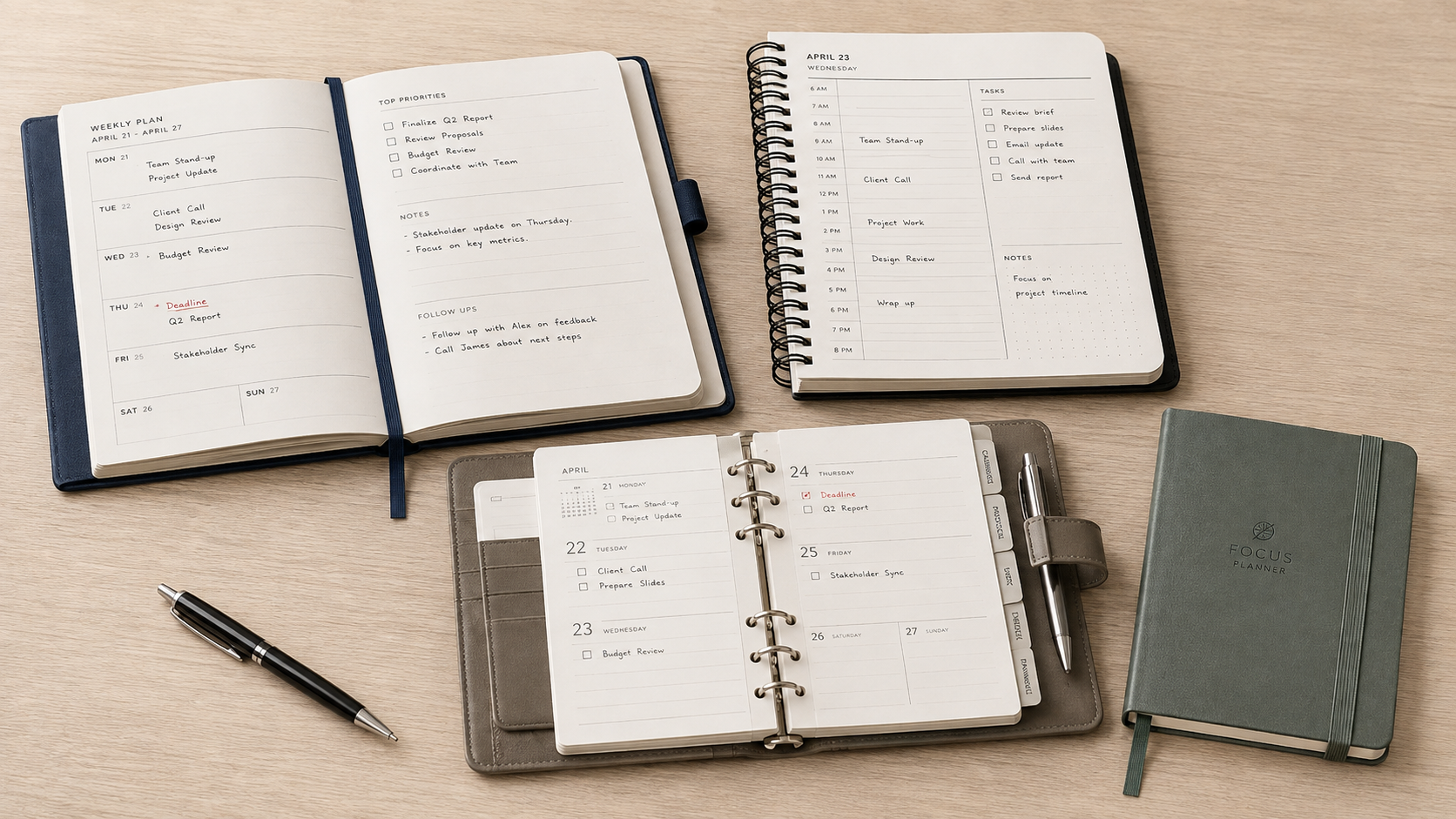
A weekly spread with too little writing room, for example, can become frustrating even when the cover looks excellent. For international programs, language, holidays, date formats, and whether the week begins on Monday or Sunday may also need to be checked before printing.
Journal Notebook
A journal works better when you want the notebook to feel personal rather than purely work-focused.
It can fit employee wellbeing programs, retreats, creative teams, brand communities, or appreciation gifts where people may use the pages for reflection, ideas, sketches, or longer writing.
This is also one category where heavy branding can easily work against the product.

A large corporate logo can make a personal journal feel more like promotional merchandise. Smaller mark, an inside-cover message, or a customized opening page can keep your organization present while leaving the notebook room to feel like the recipient’s own.
Grid Notebook
Grid notebooks are useful when your recipients regularly combine writing with diagrams, measurements, tables, sketches, or rough layouts.
Engineers, designers, architects, technicians, and product teams often get more value from grid pages than from ordinary ruled paper because the page already provides alignment without forcing everything into lines of text.
If your audience mainly takes meeting notes, however, the grid may add visual complexity without solving a real problem.
The grid itself deserves attention too. Lines that print too dark compete with handwriting; lines that are too faint may disappear once the paper and ink are finalized.
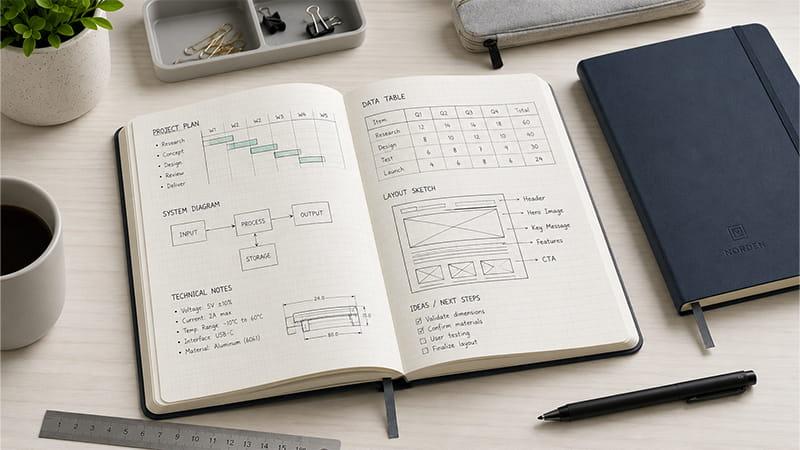
Choose grid pages because your audience works visually, not simply because they look more specialized.
Refillable Notebook
Refillable notebooks make more sense when you expect the cover to stay in use after the first set of pages is finished.
That can suit membership programs, executive gifts, planners, long-term employee programs, or projects where new inserts will be issued later.
Before placing the order, look beyond the first refill. Size, hole position, ring mechanism, insert format, and future availability all matter. A reusable cover loses much of its value if your recipient cannot find the correct refill six months later.
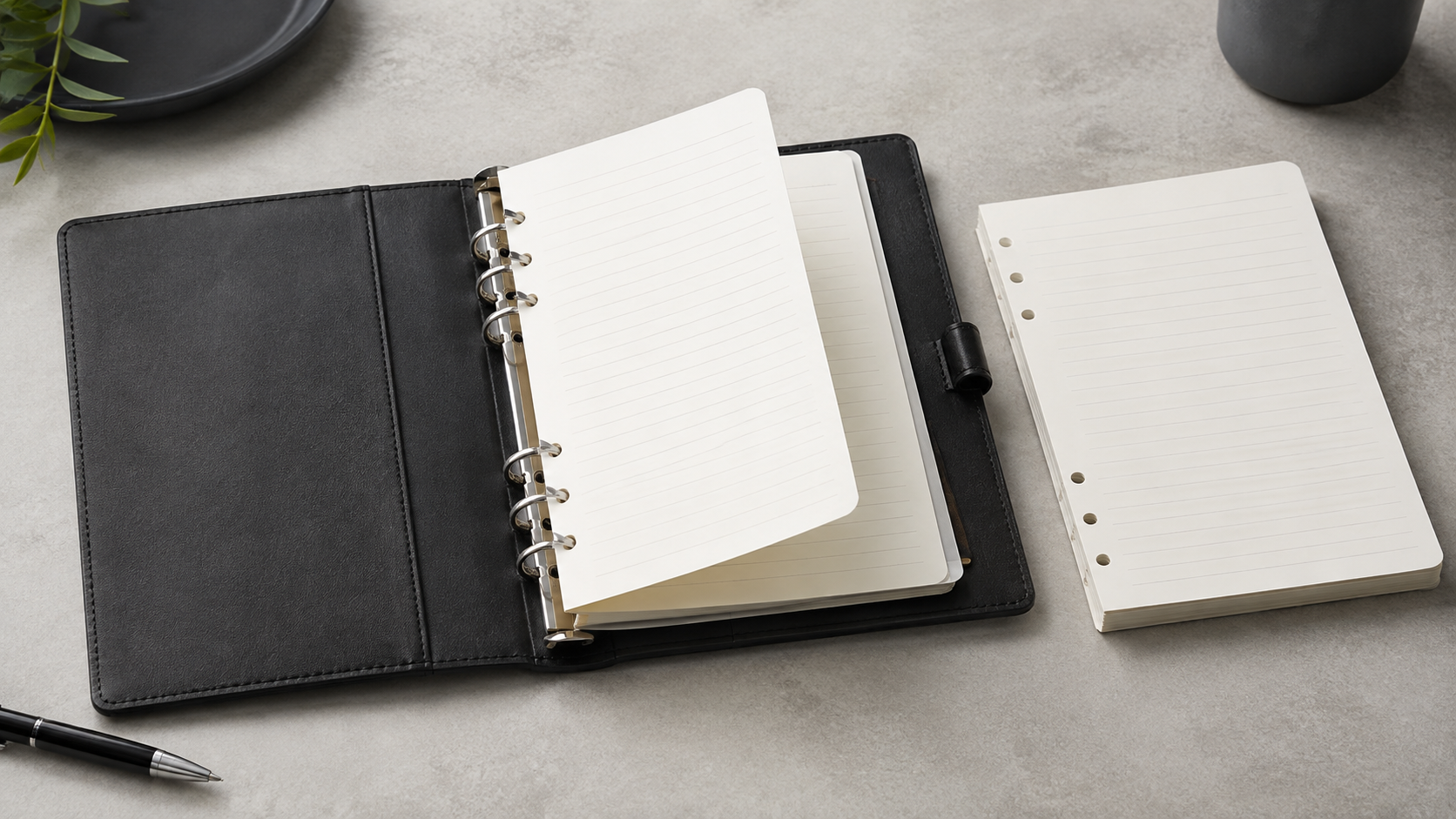
For repeat programs, it is better to decide early whether future inserts will use a standard format or need to be produced again as part of the same program.
Portfolio Notebook
Portfolio notebooks are useful when your recipients normally bring more than notes into a meeting.
Printed documents, business cards, handouts, a pen, and writing space can all sit inside one cover, which can be useful for sales teams, client meetings, presentations, conferences, and business travel.
The internal layout matters more than the number of features listed in the product description.
A document pocket that is too small, an awkward pen loop, or card slots no one uses do not add much real value.
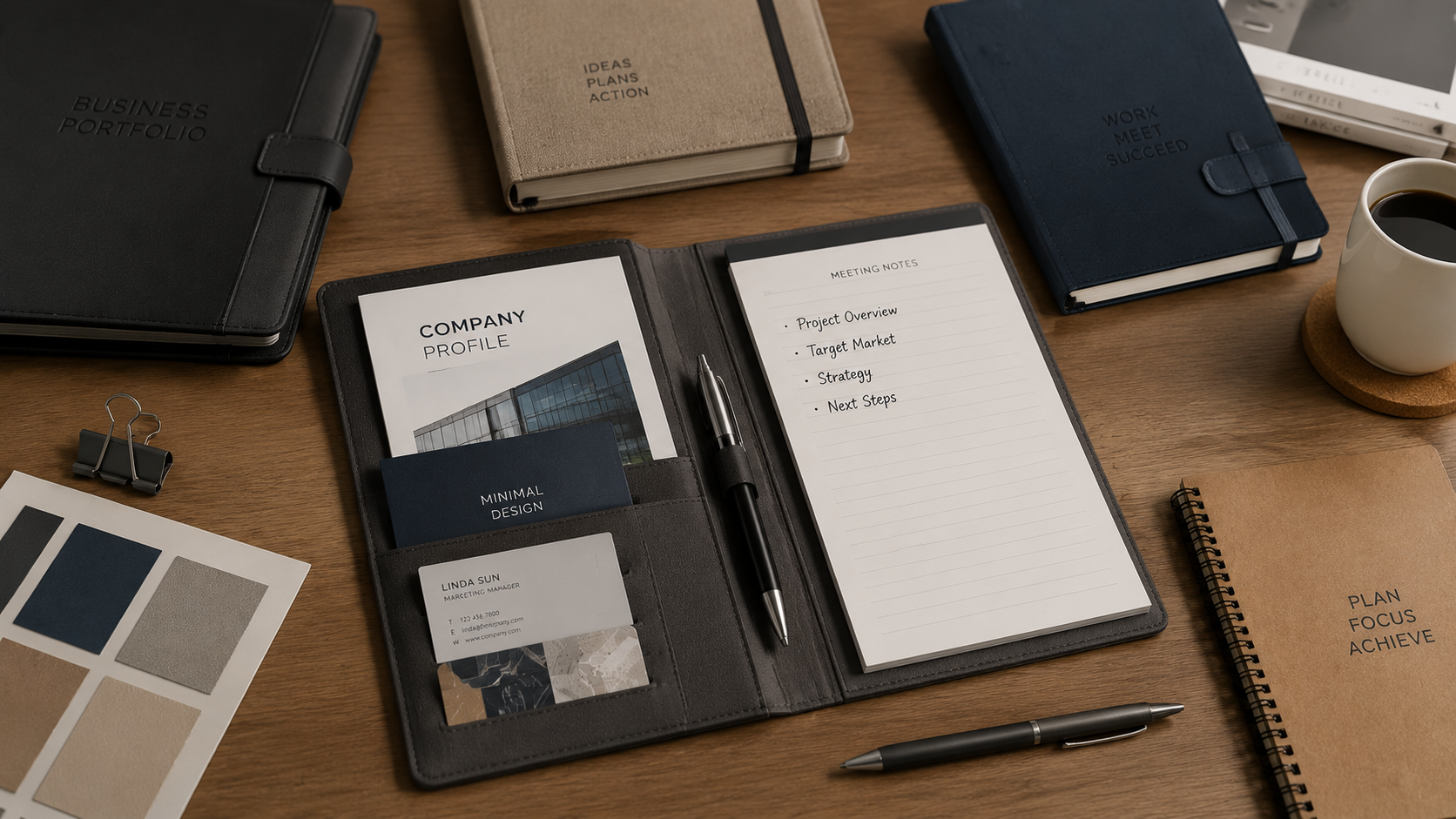
Think about what your team or clients actually carry into meetings, then choose the layout around that.
Multifunctional Business Notebook
Multifunctional business notebooks take the portfolio idea a step further by combining writing space with business accessories or electronic functions.
Depending on the model, the cover may include card storage, a pen holder, phone support, cables, USB storage, wireless charging, a built-in power function, or other accessories that would otherwise be carried separately. This format can give a client or executive gift more substance without requiring several unrelated products in the box.
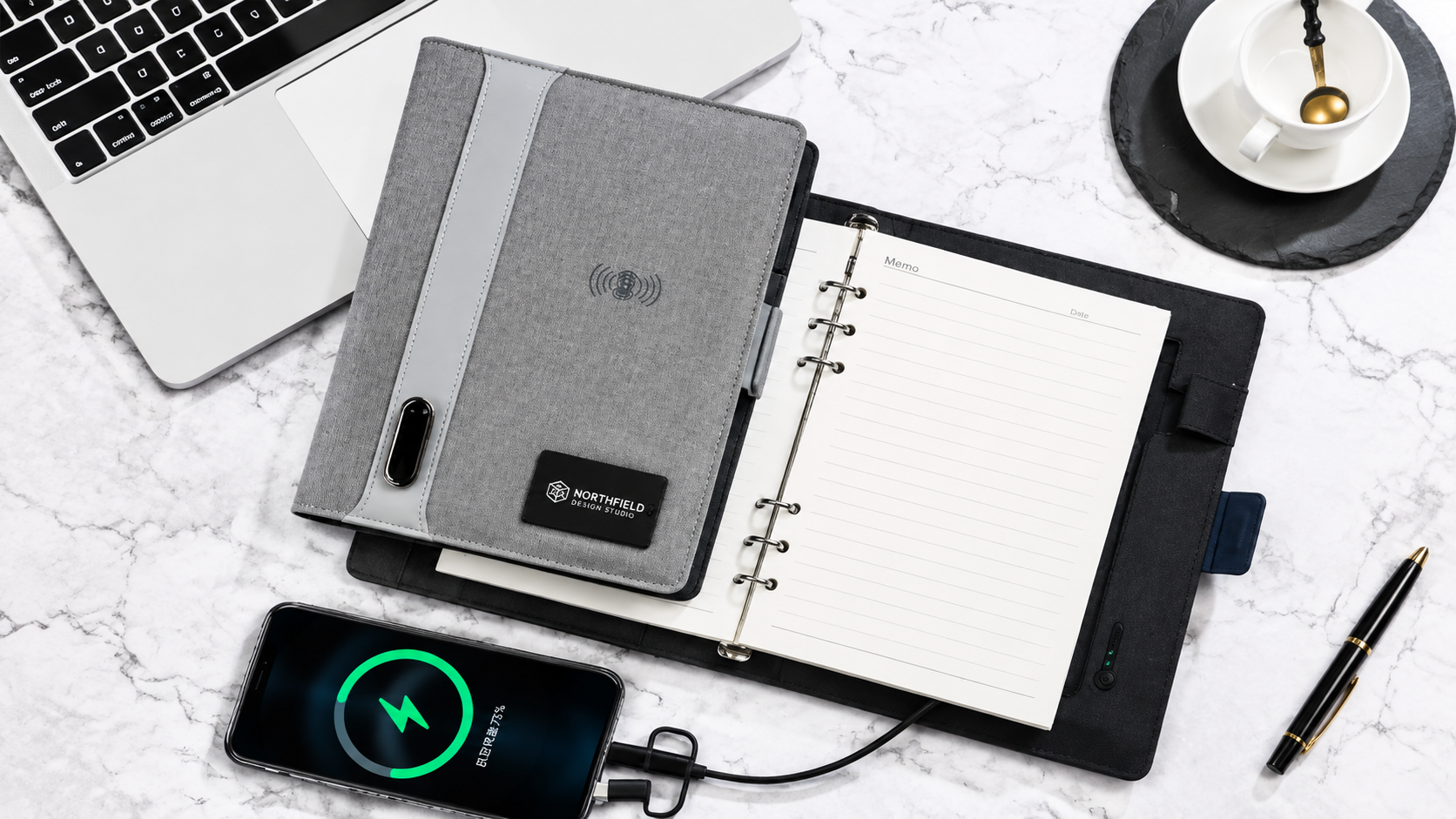
The number of functions should not be the main selling point, though. Once electronics are involved, you also need to look at device compatibility, charging performance, component quality, overall weight, and how easy the notebook is to use without instructions.
For customization, the larger cover surface usually gives you room for restrained branding, initials, embossing, or a small metal badge without turning the notebook into ordinary promotional merchandise.
Which Notebook Fits Your Project?
Once you understand the basic differences, start with the situation rather than the product name.
| Project or Use | Notebook Types to Consider | What Usually Matters |
|---|---|---|
| Training and education | Spiral, composition, softcover | Comfortable writing and easy distribution |
| Everyday office use | Spiral, notepad, planner | Convenience and regular use |
| Employee welcome gifts | Hardcover, planner | Presentation and continued use |
| Client or executive gifts | Hardcover, portfolio, multifunctional business notebook | Materials, usefulness, and presentation |
| Conferences and events | Softcover, spiral, notepad | Weight, quantity, and easy distribution |
| Creative or wellbeing programs | Journal, grid | Flexible page use |
| Technical teams | Grid | Diagrams and structured information |
| Field and travel teams | Portability |
The same upgrade can add real value in one project and unnecessary cost in another.
For training or event distribution, a lighter spiral notebook may be easier to carry, hand out, and write in during the session. In a smaller client or executive project, the cover material, paper feel, presentation, or added business functions may matter more than saving weight.
That is why the most useful question is:
What will your recipients actually be doing when they open the notebook?
For larger event programs, our trade show giveaways guide looks at the same selection problem across other promotional products.
Page Layout Can Change the Whole Experience
The cover creates the first impression. The pages determine whether people continue using the notebook.
| Page Layout | Common Uses |
|---|---|
| Ruled | Meetings, office notes, classroom writing |
| Blank | Sketches, brainstorming, creative work |
| Grid | Technical notes, diagrams, measurements |
| Dot grid | Planning, bullet journaling, flexible layouts |
| Planner | Schedules, tasks, and goals |
Ruled Pages
Ruled pages are familiar and require very little adjustment from the person using them.
That makes them a dependable choice when the same notebook needs to work for a broad group of employees, attendees, or clients.
Blank Pages
Blank pages remove nearly all structure.
They give creative users more freedom to sketch, map ideas, combine text with visuals, or use the page without working around printed lines.
Grid and Dot Grid Pages
Grid and dot grid pages provide guidance without controlling the whole page.
A full grid gives stronger alignment for technical work and measurements. Dot grid pages are visually lighter and can support notes, planning, layouts, and diagrams on the same page.
Planner Layouts
Planner pages deserve more attention because the printed layout directly affects how the notebook is used.
Daily, weekly, monthly, dated, and undated formats can feel completely different.
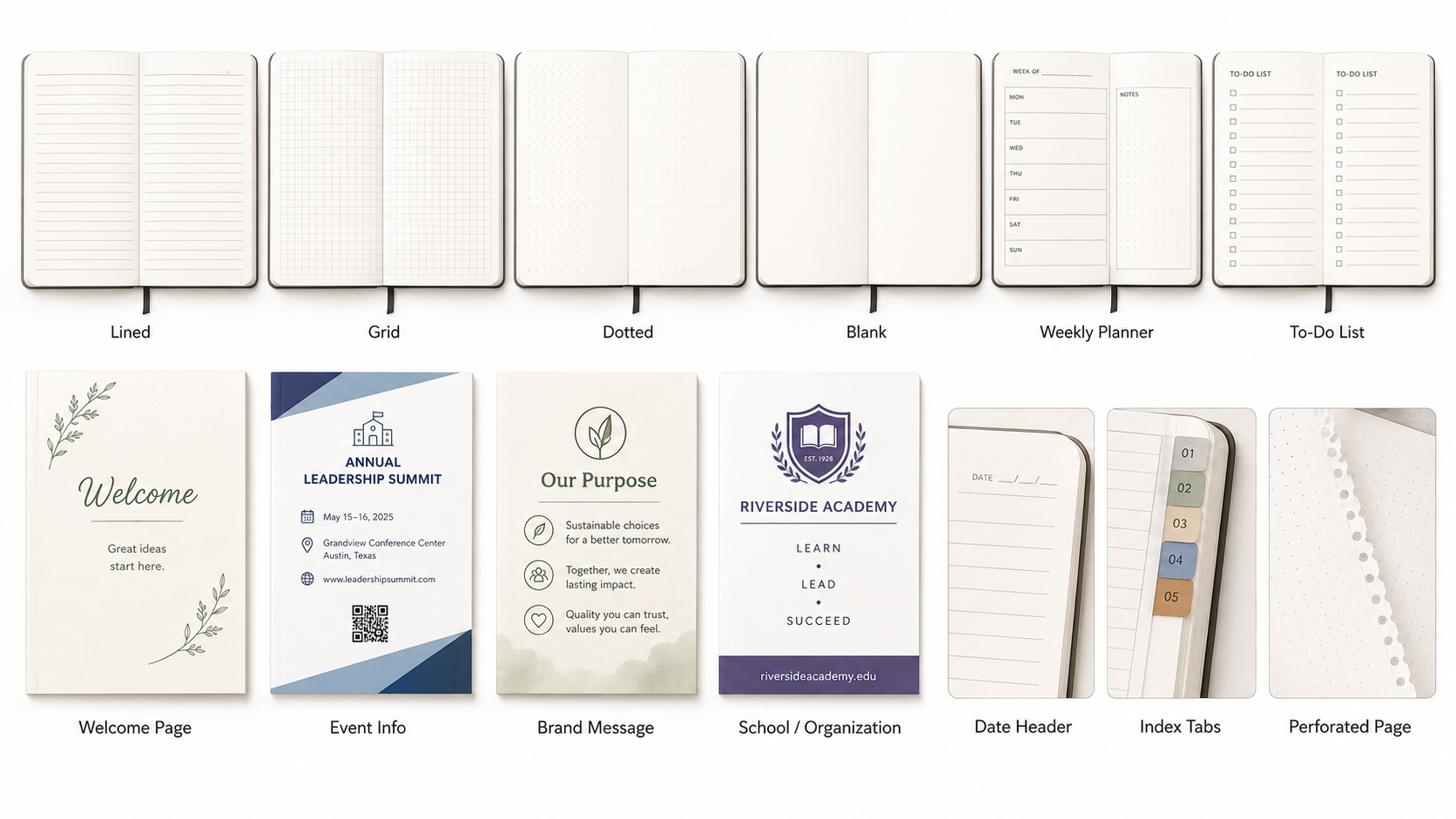
Before ordering a large quantity of planners, review the inside pages—not just the cover.
What Really Changes When a Notebook Is Customized?
Choosing the notebook type is only the first part of a custom project.
Two products can look similar in a catalog and feel very different once the cover material, paper, artwork, and packaging have been finalized.
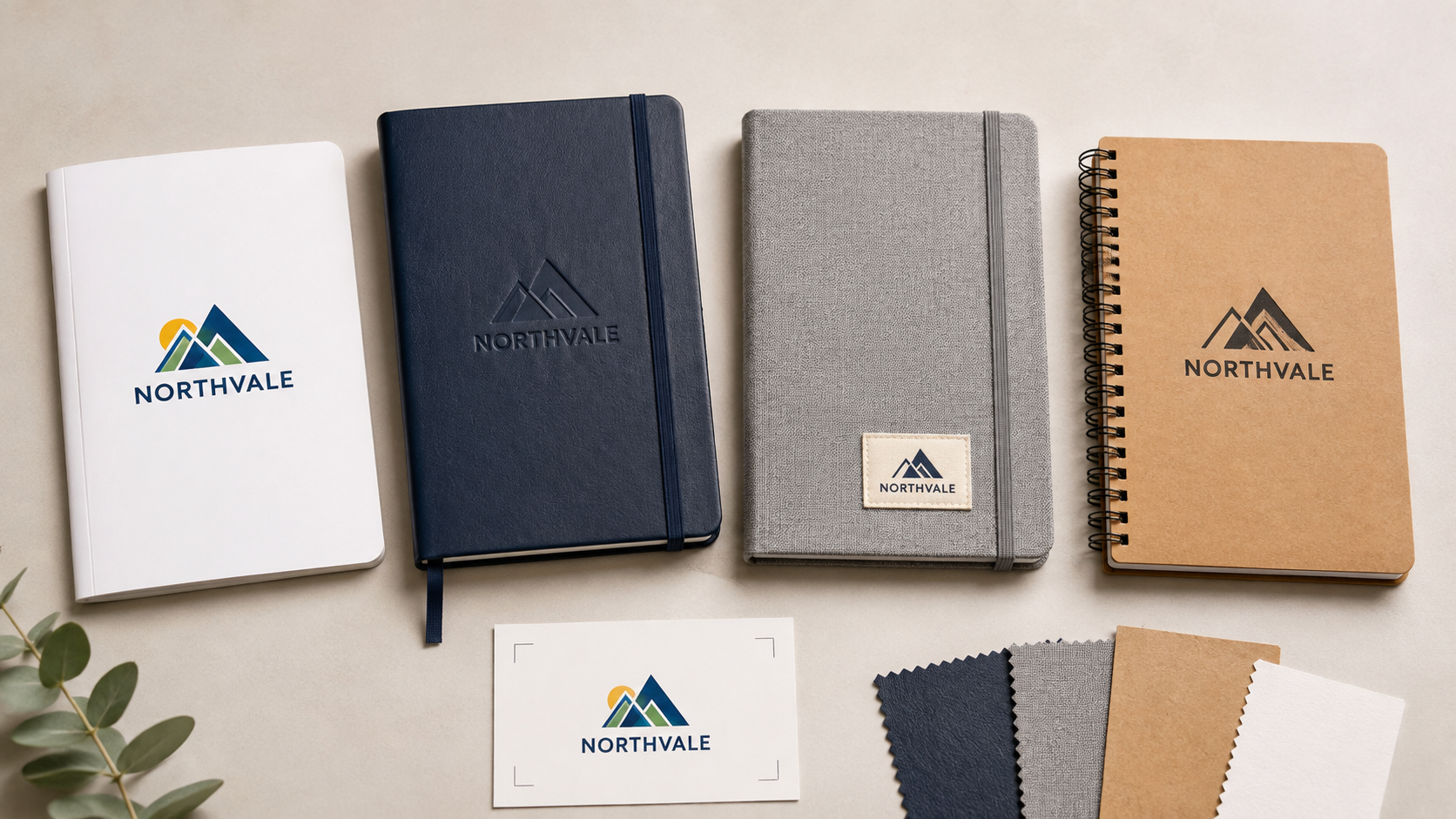
Cover Material Changes the Branding Result
A logo does not reproduce the same way on every surface.
Smooth paper allows more freedom for printed graphics. Textured PU works differently with embossing or debossing. Fabric and specialty materials bring their own limitations around detail and coverage.
One thing we pay close attention to in custom notebook projects is artwork scale.
A logo that looks clean on a PDF may lose fine detail on a textured cover or feel oversized when it is placed on a smaller notebook.
The artwork, decoration method, and cover surface should be reviewed together rather than treating the logo file as something that never changes.
Buyers comparing notebooks with pens, folders, and other stationery can also explore TOMAS Crafts’ custom office supplies.
Binding Changes the Writing Experience
Binding is difficult to judge from a front-facing product image.
Once the notebook is opened, it affects how flat the pages sit, how easily they turn, and how comfortable it is to write close to the center.
The construction that sounds more premium on a specification sheet is not always the one that feels better in use.
Paper Quality Is Felt Repeatedly
The cover gets noticed first. The paper gets used again and again.
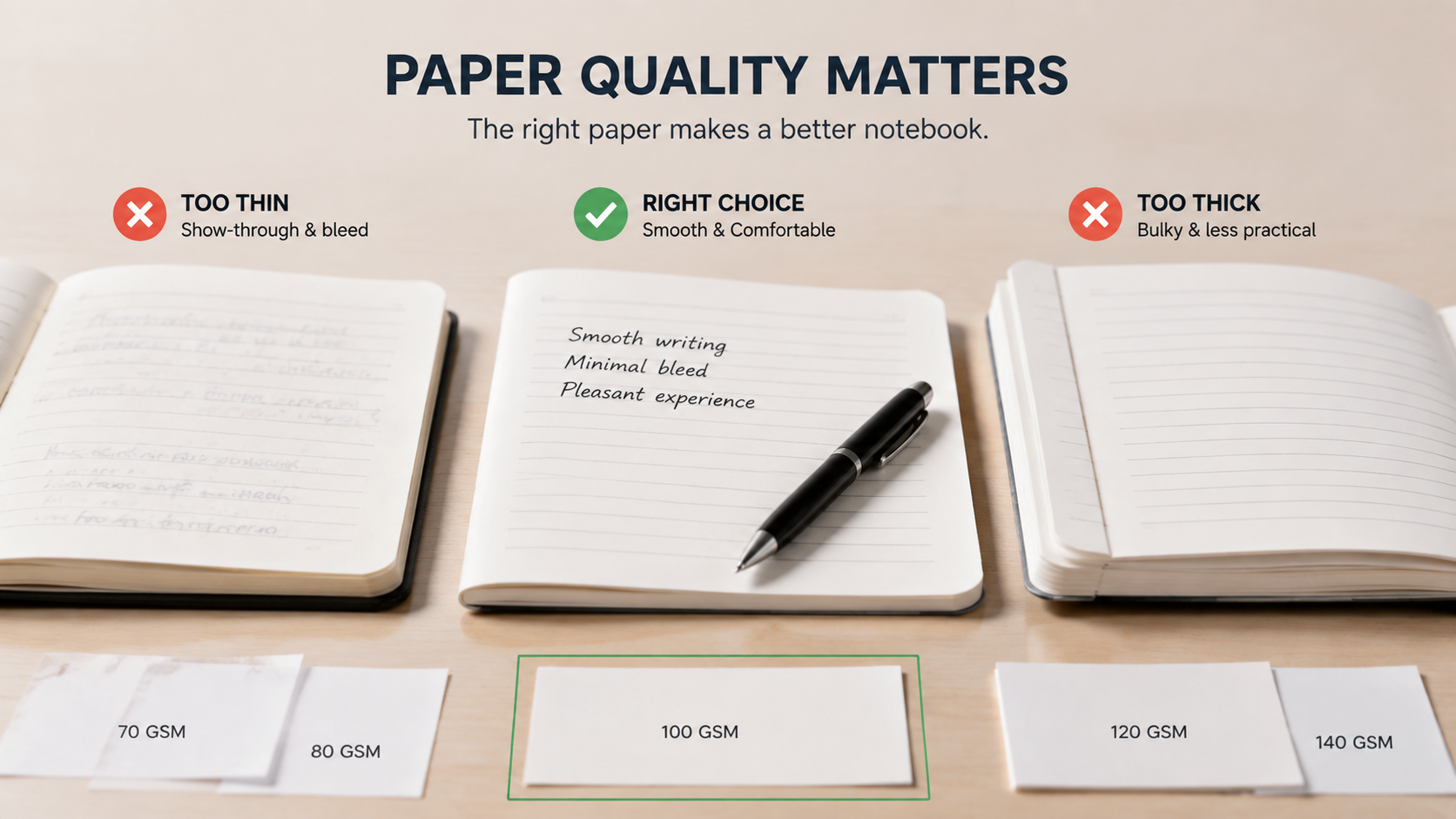
Thickness, smoothness, opacity, ink performance, and page count all shape the writing experience.
Higher GSM is not automatically the better choice. Heavier paper can also increase notebook thickness, product weight, and shipping weight.
The paper specification should match the way the notebook will be used, not simply chase the highest number available.
Logo Application Should Follow the Material
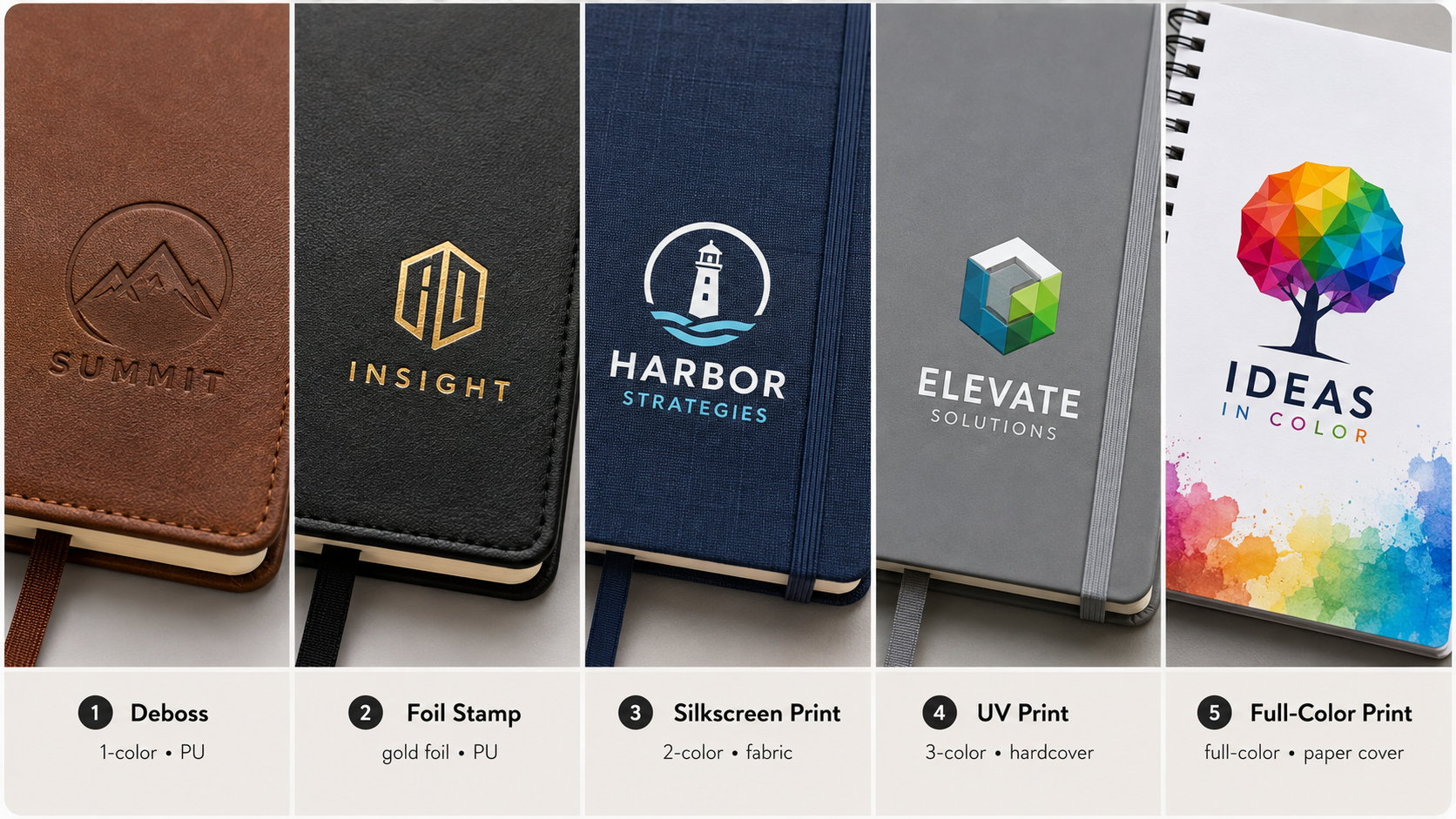
Screen printing, UV printing, embossing, debossing, and foil stamping create very different results.
Full-color artwork may suit a paper-covered event notebook. A small blind deboss may feel more natural on a textured executive notebook.
Trying to force the same decoration method onto every notebook style usually produces weaker results than adapting the branding to the product.
When notebooks are combined with other items, TOMAS Crafts’ corporate gift solutions can help coordinate materials, decoration, and packaging across the full set.
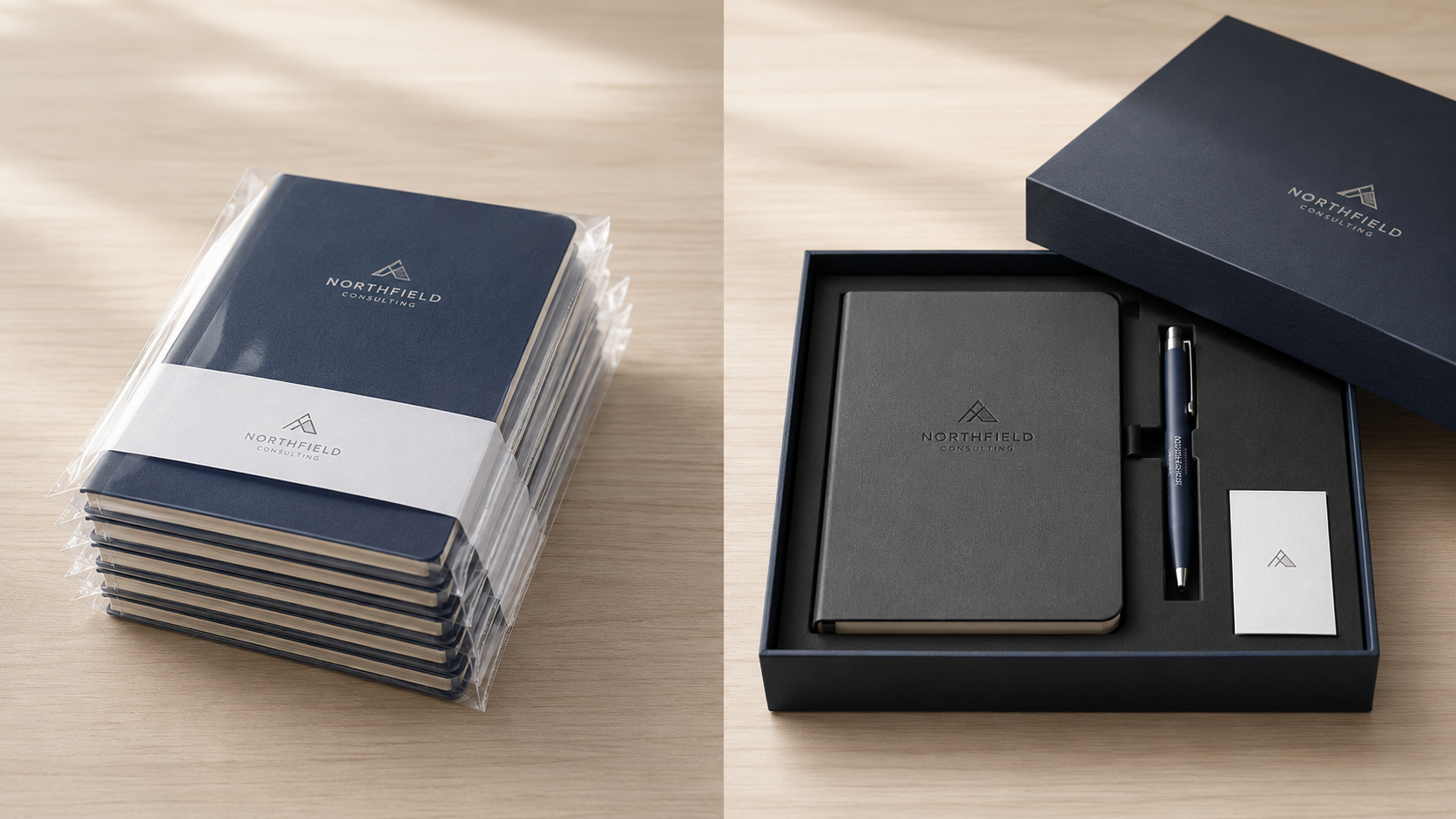
Packaging Should Match How the Notebook Is Given
Packaging can improve the presentation, but it can also become unnecessary cost.
A notebook handed out during training may only need clean protective packaging. A client gift may benefit from a sleeve, presentation box, matching pen, or message card.
Neither is automatically better.
Packaging should support the occasion instead of trying to make every notebook look like a luxury gift.
Before You Finalize a Custom Notebook
Before production, look at the notebook as one finished product rather than a list of separate specifications.
Check:
- Who will receive it?
- Where will they use it?
- How much writing space do they need?
- Which page layout suits that use?
- Does the cover material suit the artwork?
- Is the notebook meant to feel practical, promotional, or gift-ready?
- How will it be packed and distributed?
Artwork deserves one final check before approval.
The same logo can look balanced on an A5 hardcover and crowded on a pocket notebook. Fine lines that print clearly on smooth paper may lose definition when embossed into a textured surface.
Instead of forcing the same artwork treatment onto every notebook, adjusting the size, detail, or decoration method to the actual product usually creates a cleaner result.
These are small decisions, but they often determine whether the branding feels integrated into the notebook or simply added on top of it.
FAQs About Notebook Types
What are the main types of notebooks?
Common notebook types include spiral, hardcover, softcover, composition, notepad, pocket, planner, journal, grid, refillable, portfolio, and multifunctional business notebooks.
The main differences come from binding, cover construction, size, page layout, portability, and intended use.
Which notebook type works well for business gifts?
Hardcover and portfolio notebooks are common choices when presentation matters. Multifunctional business notebooks can work well when you want to combine writing with useful business accessories or charging functions.
The right choice depends on the recipient, how the notebook will be used, and how formal you want the gift to feel.
What is the difference between a notebook and a notepad?
A notebook keeps pages together as an ongoing record. A notepad is designed more for temporary notes that may later be removed, transferred, or discarded.
What should I check before ordering custom notebooks?
Start with the recipient and intended use, then review the size, binding, page layout, paper, cover material, decoration method, quantity, packaging, and delivery requirements.
Those choices should work together rather than being treated as separate specifications.
Conclusion
The best notebook type is not always the most expensive or the most stylish one. It is the aone that feels right for the way people will use it.
Before choosing, think about the purpose, the writing experience, and the setting where the notebook will appear. A good notebook should be easy to use, appropriate to give, and worth keeping.
Need Custom Notebooks for Your Business or Event?
Choosing notebooks for a school program, company event, employee gift, client gift, trade show, or promotional campaign usually involves more than picking a style from a catalog. The right option depends on your users, budget, logo method, packaging plan, and delivery timeline.
TOMAS Crafts can help match notebook types with your project needs, from practical school notebooks to premium notebook and pen sets. To discuss your quantity, logo, packaging, and deadline, contact Us.